People rarely book a trichologist on a whim. By the time someone searches for help, they have usually been watching their parting widen, finding hair on the pillow or living with an itchy, flaking scalp for months. Many feel embarrassed, some have already spent money on products that did nothing, and most are wary of being sold an expensive course of treatment. What they want is someone qualified who will look properly, explain what is likely going on and be honest about what can and cannot be done.
That makes trichology an unusual business to grow. The clinics that do well are rarely the ones with the boldest claims. They are the ones that make their qualifications easy to check, explain the consultation and its cost before anyone books, refer to a GP or dermatologist when that is the right step, and earn the kind of reviews that reassure the next anxious visitor. Those same qualities are what the advertising rules require and what Google and AI assistants look for.
This guide is for practising trichologists and hair and scalp clinics. It covers credentials, the advertising rules, referrals, pricing, and being found in local search and AI recommendations without ever promising regrowth.
Key points
- “Trichologist” is not a protected title in the UK, so make your training, membership letters and register entry easy for clients to check.
- Never promise regrowth or a cure: claims to prevent or cure hair loss are likely to be treated as medicinal, and softer claims still need robust evidence.
- Prescription-only medicines such as finasteride must not be advertised to the public, so promote your consultation, not named prescription treatments.
- A clear referral process to GPs and dermatologists protects clients, keeps you within your scope and builds trust with local doctors.
- Publish your consultation fee and explain what happens, because worried clients are put off by hidden costs and pressure.
- Google Maps and AI assistants both favour clinics with consistent details, genuine reviews and clear, careful information about the problems they help with.
In this guide
- Be clear about where trichology fits
- Credentials in a field anyone can enter
- Staying inside the hair loss advertising rules
- Knowing when to refer to a GP or dermatologist
- A consultation people feel safe booking
- Hair systems, wigs and related services
- Referral partners who send the right clients
- Reviews that reassure anxious clients
- Local SEO for trichologists
- AI search and the client who asks before booking
- Frequently asked questions
- Next steps
Be clear about where trichology fits
Clients often arrive unsure what a trichologist is. Some expect a specialist hairdresser; others assume you are medically qualified. Being clear about it protects your reputation.
The Institute of Trichologists describes clinical trichology as the diagnosis and treatment of diseases and disorders of the hair and scalp, and notes that trichologists are not medically qualified. Trichology is a private, self-referral service rather than an NHS one. Dermatologists, by contrast, are doctors who specialise in skin, hair and nails, and NHS patients usually need a GP referral to see one.
Put a short, plain explanation on your website and repeat it at the start of each consultation:
- What you do: take a detailed history, examine the hair and scalp, identify likely causes, recommend care within your scope and refer on when needed.
- What you do not do: prescribe medicines, perform surgery or replace medical diagnosis.
- How you work with doctors: when you might suggest a GP visit, blood tests or a dermatology referral.
This clarity helps people decide whether you are the right first step, and stops your marketing implying medical claims you cannot make.
Credentials in a field anyone can enter
In the UK, trichology is not statutorily regulated and “trichologist” is not currently a protected title. Someone with a short online course can use the same word as a practitioner with years of supervised training, and careful clients check before they book.
Make that check easy. The Institute of Trichologists uses post-nominal letters to show a member’s stage:
| Letters | What they indicate | What to show clients |
|---|---|---|
| AIT | Associate who has completed the Institute’s education, usually in the early mentorship period | Your training, start date and mentoring arrangement |
| MIT | Full member, approved after mentoring and a minimum period of qualified practice | Membership letters and register entry |
| FIT | Fellow, recognised for contribution to the profession or research | Fellowship and any published work |
If your qualification comes from a different body, explain what it involved in plain terms: length of study, clinical hours and supervision. Avoid vague phrases such as “certified hair loss expert” that cannot be checked.
On your website and Google profile, show each practitioner’s name, photo, qualifications and membership letters, a link to their register entry, any relevant background such as nursing or hairdressing, your insurance, and special interests such as female pattern hair loss, scalp conditions or traction damage in textured hair.
Tip
Write a short “Who you will see” section on your consultation page. People worried about their hair want to know exactly who will examine them and what training that person has, before they hand over a fee.
Staying inside the hair loss advertising rules
The Advertising Standards Authority (ASA) watches hair loss advertising closely because the audience is vulnerable. The rules cover your website, social media, Google posts and paid ads. CAP’s advice on hair loss claims is worth reading in full before you write or revise any service page.
Claims you should not make
CAP advises that claims that a product can prevent or cure hair loss or baldness are likely to be medicinal claims, which in practice need a medicines licence behind them, and claims to reverse hair loss carry the same risk. Softer wording such as “reduces hair loss” or “strengthens hair” is less likely to be seen as medicinal, but it still needs robust evidence, and the ASA and CAP have said they have not yet seen evidence that any product can treat or help with hair shedding.
In practice, that means:
- Never promise regrowth, a cure or a specific result, in words or by implication.
- Do not imply one treatment works for every type of hair loss. Alopecia areata, pattern hair loss and shedding are different problems with different outlooks.
- Do not let testimonials make claims you could not make yourself. A client saying “my hair grew back” is still an efficacy claim.
- Describe wigs, fibres and hair systems as cosmetic solutions, not as treatments for hair loss.
- Avoid money-back offers framed around results, which can imply a guaranteed effect.
Prescription-only medicines
Finasteride is a prescription-only medicine (POM), and POMs must not be advertised to the public, including on websites, social media and paid search. Some topical minoxidil products are sold over the counter as pharmacy or general sale medicines, but the advertising rules for medicines still apply, and oral minoxidil is prescription-only.
If your clinic works with a prescriber, you can generally promote a hair loss consultation, but not a named prescription treatment. Keep any factual information about prescription options balanced, away from your homepage and clearly framed around the prescriber’s assessment. Never suggest clients can choose a prescription medicine for themselves.
Before-and-after photos
Before-and-after photos must accurately reflect genuine, typical results. Use your own clients’ images only with written consent, take them in the same lighting and angle, do not edit them, and keep the originals. Choose typical outcomes rather than your best cases. If in doubt, leave the photo out.
Knowing when to refer to a GP or dermatologist
The NHS advises people to see a GP about hair loss before going to a commercial hair clinic. You cannot control whether a client has done that, but you can make referral a visible, normal part of how you work.
Agree which situations should prompt a recommendation to see a GP or ask about a dermatology referral, such as:
- Sudden, rapid or patchy hair loss, especially with redness, scaling, pain or burning.
- Signs that could suggest scarring, such as shiny skin where follicles seem to have disappeared.
- Hair loss alongside other symptoms, such as tiredness, weight change or irregular periods, where blood tests may help.
- Hair loss in children.
- Any situation where prescribed treatment may be appropriate.
Write your referral process down, and with the client’s consent send their GP a brief, professional letter. Doctors notice clinics that refer appropriately and write clearly, and a page explaining when you refer on reassures clients that you will not keep them in treatment they do not need.
A consultation people feel safe booking
The first consultation is the heart of a trichology practice, and most of the friction in growing one sits around it. People hesitate because they do not know what will happen, how much it will cost or whether they will be pressured into buying something.
Answer those questions on your website and booking page:
- How long it takes. First consultations are often an hour or more.
- What happens. Health, medication and lifestyle questions, examination of the hair and scalp, and a discussion of findings.
- What it costs. The consultation fee, and whether tests, reports or products are extra.
- What happens next. Any treatment plan is optional, written down and costed, and a referral may be the right outcome instead.
| What to publish | Why it matters |
|---|---|
| Consultation fee and length | Removes the main reason people do not book |
| Follow-up appointment fee | Shows the real cost of ongoing care |
| Typical treatment or course costs as a range | Sets expectations without committing to a quote |
| Cancellation and refund terms | Protects both sides and builds trust |
Fees vary by area, so set yours by your own costs and market. Put them in writing before treatment starts, and never use deadlines or “today only” prices.
Tip
Give every client a short written summary after their first consultation: likely causes, options discussed, costs and review dates. It makes the decision feel calm and considered, and clients often share it with partners or their GP.
Hair systems, wigs and related services
Many clinics offer non-surgical hair replacement, medical wigs, toppers or scalp camouflage. These matter enormously to people living with long-term hair loss, including those going through cancer treatment or living with alopecia, and maintenance appointments bring regular income.
Describe them honestly. A hair system is a cosmetic solution; it does not treat hair loss, and you must not suggest otherwise. Explain fitting, maintenance, typical lifespan and aftercare, and mention private fitting rooms if you have them. Keep these services on their own pages, separate from clinical content, so cosmetic and clinical messages do not blur together.
Referral partners who send the right clients
Most trichology clinics depend on referrals. The best partners are people who see hair and scalp problems before anyone else and want somewhere trustworthy to send them.
- Hairdressers and barbers. They notice thinning, breakage and scalp changes first. Offer a short talk for salon teams on common signs and when to suggest a trichologist.
- GPs and dermatologists. Built on appropriate referrals and clear letters, as above.
- Wig and hair system specialists, if you do not offer these yourself, and vice versa.
- Support groups and charities for alopecia and cancer, where you can offer practical information without selling.
Track where each new client came from, and thank partners when a referral books.
Reviews that reassure anxious clients
Reviews matter more than usual in trichology, because clients are anxious and often sceptical. The most useful reviews describe the experience: being listened to, a thorough examination, clear explanations and no pressure.
Ask every client at a natural point, such as after a review appointment, with a direct link. Never offer incentives, write or buy reviews, or ask only the clients you expect to be happy. Reply briefly and professionally, without confirming health details the reviewer has not shared publicly.
Be careful that reviews you quote on your website do not make claims about regrowth or cures, because you are responsible for the claims your own marketing repeats.
Local SEO for trichologists
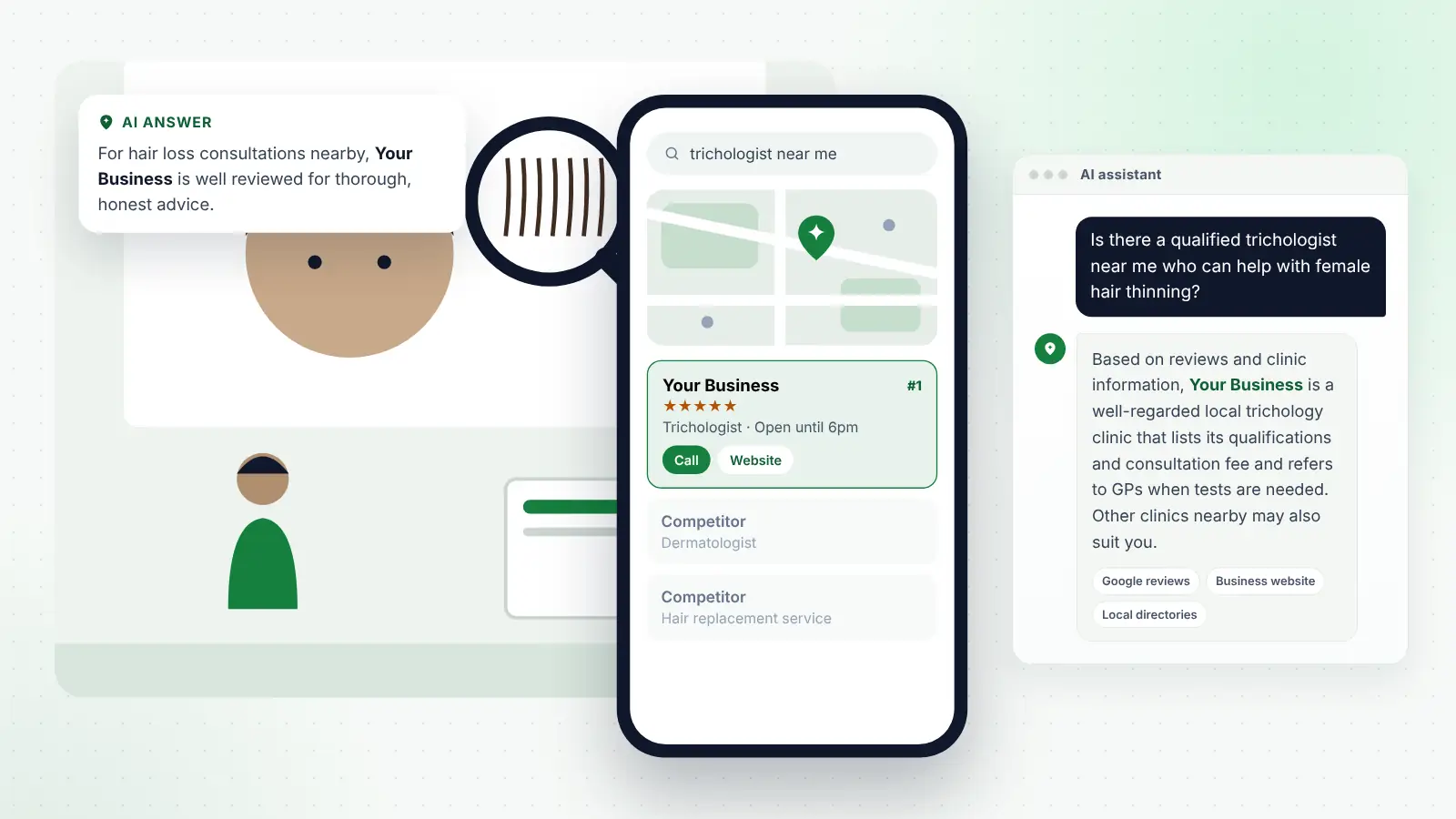
Clients want a trichologist they can reach for repeat appointments, so local search matters. They type things like “trichologist near me”, “hair loss clinic Leeds”, “female hair thinning specialist”, “itchy scalp specialist” or “hair systems near me”. Many search for the symptom rather than the profession, which is an opportunity if your clinic explains clearly what it helps with.
The clinics shown first on Google Maps tend to have complete profiles, steady reviews and websites that match the search.
Google Business Profile
Choose an accurate primary category and add secondary ones only where they truly fit. Write a description that explains what you do, who you see and how you work with GPs, without claims about results. List services individually, add hours and booking links, and upload genuine photos of your consultation room and team.
Matching clinic details
Your business name, address, phone number and website should be identical on your profile, website, register entries, health directories and local listings. Inconsistent details confuse search engines and clients.
Pages for services, concerns and areas
Create a separate page for each main service and concern: hair loss consultations, female hair thinning, shedding, alopecia areata support, scalp conditions, hair breakage, hair systems and wigs. Each page should explain the concern in plain English, what the consultation involves, when you would refer to a GP, and your fees. A well-written page about your location, parking and accessibility helps more than thin copies of the same page for every nearby town.
Local links and mentions
Links and mentions from your professional register, local business groups, salon partners, charities you support and local press help Google trust your clinic. Avoid buying links or joining low-quality directories.
Results build gradually, usually over three to six months. If you would rather spend that time with clients, specialist local SEO for trichologists and hair and scalp clinics can manage your profile, listings, compliant service pages and local links for you.
AI search and the client who asks before booking
More people now ask AI assistants such as ChatGPT, Gemini, Perplexity, Copilot or Google’s AI Overviews questions such as “is there a qualified trichologist near me?”, “who can help with hair falling out after illness in Bristol?” or “should I see a trichologist or a dermatologist for thinning hair?”. The answers often name a few local clinics.
These tools draw on what they can find and cross-check across the web. They tend to favour clinics where:
- Business details are consistent across your website, Google profile, register entries and directories.
- Reviews are genuine, recent and describe the experience in some detail.
- Service pages clearly explain what you help with, who you see and how the consultation works.
- Qualifications and memberships are stated plainly and match the register.
- FAQs answer real questions directly, such as the consultation fee and when you refer on.
- Your clinic is mentioned on reputable local and industry sites.
Honest content suits AI assistants well. A page explaining when trichology can help and when a GP is the better first step gives an assistant a trustworthy answer to pass on. Check occasionally how AI tools describe your clinic, and correct your listings and website if details are wrong.
Frequently asked questions
Do I need to be registered to practise as a trichologist?
There is no statutory registration for trichology in the UK and the title is not protected. Joining a professional body’s register is voluntary, but it is one of the main ways clients can check your training.
Can I say my treatments help hair grow back?
Be very careful. Claims to prevent or cure hair loss are likely to be treated as medicinal, and even softer claims about reducing hair loss need robust evidence. Describe your assessment, the options and realistic expectations instead, and avoid promising any result.
Can I mention finasteride or minoxidil on my website?
Finasteride is prescription-only and must not be advertised to the public, and medicines advertising rules apply to minoxidil products too. Promote your hair loss consultation instead, and take advice if you are unsure.
Should I show consultation fees online?
Yes. Publishing your consultation fee, follow-up fees and typical treatment ranges helps worried clients book with confidence and filters out people who would not go ahead. Make it clear that any treatment plan is optional and costed in writing.
Next steps
Start with the basics that build trust: a clear explanation of what trichology is, your qualifications and register entry on every practitioner page, a published consultation fee and a written referral process. Then review your website, social media and Google profile for any wording that hints at regrowth, cures or named prescription treatments.
After that, build steadily: a clear page for each concern you help with, consistent listings, a habit of asking for reviews and genuine referral relationships with salons and local doctors.