Pressure washing and exterior cleaning is one of the most visible trades you can start. A green, weed-filled driveway or a streaky, algae-stained rendered wall can look transformed in a day, and the customer, their neighbours and anyone walking past can see the result. That makes it a business where good work markets itself, and where before-and-after photos do much of your selling.
It is also easy to start badly. Too much pressure on block paving, sandstone, render or a roof can strip joints and etch surfaces, soft washing chemicals can scorch plants, and run-off in the wrong drain can pollute local streams. The businesses that last learn their surfaces, choose the right method for each job and explain it honestly.
This guide covers the services to offer, soft washing versus pressure washing, insurance, chemicals and COSHH, waste water, equipment, pricing, add-ons, maintenance plans, seasonality, and how to get found by local customers on Google and in AI search.
Key points
- Match the method to the surface: high pressure suits hard, sound paving and concrete, while render, roofs and delicate stone usually need low-pressure soft washing.
- Assess every chemical you use under COSHH, and only use moss and algae treatments that are approved and labelled for that purpose.
- Dirty wash water and chemical run-off must not go into surface water drains, so plan for containment, collection or permitted disposal on every job.
- Public liability insurance is essential for this work, and employers’ liability insurance is usually a legal requirement once you take on staff.
- Sealing, gutter cleaning and annual maintenance plans turn one-off cleans into repeat income and help smooth out the winter lull.
- Real before-and-after photos, detailed reviews and a complete Google Business Profile are what most homeowners check before they ask for a quote.
In this guide
- Decide which services to offer
- Soft washing versus pressure washing
- Registering, insuring and setting up the cleaning business
- Chemicals and COSHH
- Waste water and run-off
- Pressure washers, vans and what it costs to start
- Pricing, add-ons and maintenance plans
- Plan for seasonality
- Before-and-after photos
- Local SEO: how homeowners find you
- Being named when homeowners ask AI who cleans driveways
- Frequently asked questions
- Next steps
Decide which services to offer
Most exterior cleaners start with driveways and patios, then add soft washing, sealing and specialist work as their skills grow. Each service needs different kit, chemicals and insurance, so decide early which direction you want to take.
| Service | Typical customers | Strengths | Watch out for |
|---|---|---|---|
| Driveway and patio cleaning | Homeowners, landlords, sellers | High demand, dramatic results | Joint loss, price shoppers |
| Render and wall soft washing | Homeowners with rendered or painted walls | Higher value per job | Plant damage, overspray, work at height |
| Roof soft washing | Homeowners, property managers | Specialist, less competition | Fragile tiles, ladder and roof safety |
| Decking and timber | Homeowners, pubs, holiday lets | Easy add-on to patio jobs | Raised grain and splintering from too much pressure |
| Cladding and commercial | Offices, retail parks, schools | Larger jobs, contracts | Method statements, access equipment |
| Sealing and joint resanding | Customers who have just had a clean | Adds value, slows regrowth | Needs dry weather, curing time |
For windows, fascias and soffits, either offer them as add-ons or build referral relationships with local window cleaners and roofline specialists.
Soft washing versus pressure washing
Pressure washing uses high-pressure water, usually with a rotary surface cleaner on flat areas, to physically remove dirt, moss and weeds. It works well on concrete, sound block paving and hard natural stone. Used carelessly, it can blast out jointing sand, etch softer stone, leave stripes on paving and force water into places it should not go.
Soft washing uses low-pressure water with a cleaning solution, typically containing a biocide or sodium hypochlorite, that kills algae, lichen and mould. The solution is applied, left to work and then rinsed or allowed to break down. It is usually the better choice for render, painted masonry, roofs, cladding and softer stone, where high pressure would cause damage.
| Pressure washing | Soft washing | |
|---|---|---|
| How it works | Mechanical force from high-pressure water | Chemical treatment at low pressure |
| Best for | Concrete, block paving, hard stone | Render, roofs, cladding, soft stone |
| Main risks | Surface damage, joint loss, splashback | Plant scorch, overspray, chemical exposure |
| Results | Immediate visual clean | Some staining fades over days or weeks |
Many jobs combine both: a pre-treatment to kill growth, a pressure clean, then a post-treatment to slow regrowth. Tell customers that some marks fade gradually after a soft wash.
Tip
Test a small, out-of-sight area first on any surface you are unsure about, and photograph it. It takes minutes and can prevent a damage claim.
Registering, insuring and setting up the cleaning business
Register as self-employed with HMRC or set up a limited company, open a separate business bank account, keep records from the start and insure your van for business use.
Insurance
- Public liability insurance covers injury to other people and damage to their property. It is not a legal requirement, but homeowners, letting agents and commercial clients increasingly ask for proof, and you should not work without it.
- Employers’ liability insurance is a legal requirement in most cases as soon as you employ someone, including part-time staff.
- Tools and equipment cover protects expensive machines, tanks and surface cleaners stored in your van.
- Check your policy covers chemical application, roof cleaning and work at height, as some exclude them.
Written terms and cancellation rights
Put quotes and terms in writing, including what is included, weather delays and regrowth. If you agree a job with a consumer in their home, by phone or online, they usually have a 14-day right to cancel, so give them the cancellation information and get their written request if they want you to start within that period.
Chemicals and COSHH
The Control of Substances Hazardous to Health Regulations (COSHH) apply to anyone using chemicals at work, and exterior cleaning relies heavily on them. Sodium hypochlorite, surfactants, biocides, rust removers and acid-based cleaners can cause burns, eye damage, dermatitis and breathing problems. The Health and Safety Executive’s guidance on COSHH for cleaning explains how to control these risks through good working methods, safe storage and protective equipment.
In practice, COSHH means:
- Keeping the safety data sheet for every product you use.
- Writing a COSHH assessment for each product, covering the risks and how you control them.
- Wearing suitable gloves, eye protection and, where needed, respiratory protection.
- Storing and transporting chemicals securely, in labelled containers, away from heat.
- Mixing only what you need, at the dilutions recommended by the manufacturer.
- Training anyone who works with you before they handle chemicals.
Many moss, algae and lichen killers for outdoor surfaces are pesticides that need HSE approval or authorisation, under the Control of Pesticides Regulations or the GB biocidal products rules, before they can be advertised, sold, supplied, stored or used in Great Britain. Buy from reputable trade suppliers, use products only for the purposes on their label and follow the label instructions exactly. Avoid mixing products yourself unless you are certain it is safe and permitted.
Protect the customer’s property too. Wet plants, lawns and shrubs before and after soft washing, cover delicate planting and ponds, close windows and move cars out of range of overspray.
Waste water and run-off
This is the area new exterior cleaners most often overlook. Water from cleaning a driveway or wall carries dirt, moss, algae, detergents and sometimes biocides or hypochlorite. Most roadside gullies, and many drains on driveways, patios and car parks, are surface water drains. They usually run straight to local streams and rivers without treatment.
The government’s pollution prevention guidance for businesses, published by Defra and the Environment Agency for England, says only clean water should go into surface water drains and soakaways. Contaminated water can go into a foul sewer only with permission from your water company; otherwise it should be collected for reuse, treated on site or removed by a registered waste carrier. Wales, Scotland and Northern Ireland have their own guidance, and the principles are broadly similar.
What that means on site:
- Find out where the drains on the property lead before you start. If you are not sure whether a drain is foul or surface water, treat it as surface water.
- Block or cover nearby gullies and use drain covers or booms to contain run-off.
- Use a wet vacuum or recovery system to collect dirty water, especially where chemicals are involved.
- Sweep up and bag moss, weeds and debris rather than washing them into drains.
- Be particularly careful near ponds, streams, ditches and wells.
A pollution incident can lead to enforcement action and clean-up costs. Explaining your run-off controls in your quotes is also a strong trust signal.
Pressure washers, vans and what it costs to start
Costs vary widely by supplier and whether you buy new or used, so treat these as rough guides only.
| Item | Rough cost | Notes |
|---|---|---|
| Petrol pressure washer | Typically £800–£3,000 | Commercial-grade, not a domestic electric unit |
| Rotary surface cleaner | £200–£800 | Gives an even finish on flat areas |
| Water tank and hose reels | £300–£1,500 | Lets you work without the customer’s water |
| Soft wash system | £500–£3,000 | Pump, tank and low-pressure hose |
| Wet vacuum or recovery kit | £300–£1,500 | Collects run-off |
| Used van | £6,000–£15,000 | Check payload with full water tanks |
| PPE, drain covers, signage | £200–£500 | Gloves, goggles, wet-weather gear |
| Insurance and marketing | Varies | Get several insurance quotes |
Check your van’s payload: water is heavy, and an overloaded van is unsafe.
Pricing, add-ons and maintenance plans
Most exterior cleaners price by area or by job, with extras for heavy growth, difficult access or treatments. Ask for photos or visit before quoting larger jobs.
Add-ons that increase the value of each job
- Resanding joints on block paving after cleaning, often with kiln-dried sand.
- Sealing block paving, patios or decking to slow regrowth and staining. Make clear it needs dry weather and time to cure, and that results depend on the product and surface.
- Weed and post-clean biocide treatments to slow moss and algae coming back.
- Gutter cleaning, which pairs naturally with roof and render work.
Recurring maintenance plans
Most exterior cleaning jobs are one-off. A maintenance plan changes that: offer an annual treatment, a light refresh clean or a sealing top-up at a fixed price. Customers on a plan are easy to schedule and give you booked work before the season starts.
Tip
Send each customer a short message about a year after their first clean, with their own before-and-after photos and a simple rebooking link. It is the cheapest marketing you will ever do.
Plan for seasonality
Demand usually peaks from spring to late summer, when people start using their gardens, prepare homes for sale and notice the winter’s growth. Frost, heavy rain and short days slow things down from late autumn, and sealing and resanding need dry conditions.
Ways to smooth the year:
- Use autumn to sell maintenance plans and pre-book spring work.
- Offer gutter clearing and roof treatments before and after leaf fall.
- Pursue commercial clients such as offices, shops and property managers, whose work is less dependent on the season.
- Keep a cash buffer from the busy months so winter does not force heavy discounting.
Before-and-after photos
In this trade, photos are your strongest sales tool. Take them from the same angle, in similar light, before and after every job. A half-cleaned shot showing a clear line between dirty and clean surfaces is especially persuasive.
Organise photos by surface and town so you can use them on service pages, your Google profile and social media. Ask customers’ permission, avoid showing house numbers or car registrations, and never use photos of work you did not do.
Local SEO: how homeowners find you
Most homeowners do not have an exterior cleaner they already know. They search when they notice a problem, compare the businesses at the top of Google Maps, look at photos and reviews and contact two or three. Typical searches include “driveway cleaning near me”, “patio cleaning [town]”, “render cleaning near me”, “roof moss removal” and “block paving sealing”.
Google Business Profile
Choose the most accurate primary category, add every service you offer, set your service area to the towns you genuinely cover and upload before-and-after photos regularly. Answer messages quickly.
Reviews
Ask every happy customer for a review, ideally when they are admiring the result. Reviews that mention the surface, the town and details such as care, tidiness and plant protection help other customers and search engines understand what you do. Answer each review, and if someone complains about a streak or a missed joint, respond calmly and offer to put it right.
Consistent details
Keep your business name, phone number, service area and website identical across your website, Google, Bing, Apple Maps, Facebook and directories. If one directory still shows an old mobile number, customers ring the wrong phone and Google trusts your details less.
A website with a page for each surface and town
Create a page for each main service, explaining your method, what is included, aftercare and guide prices where possible. Add pages for the main towns you cover, with real local photos rather than copied text. Include your insurance, run-off controls and an FAQ section. If you would rather have specialists handle this while you get on with jobs, local SEO for pressure washing and exterior cleaning companies covers the profile, listings, content and links for you.
Local links and mentions
Mentions from community groups, local directories, sponsorships and local magazines show you are a real, established local business.
Being named when homeowners ask AI who cleans driveways
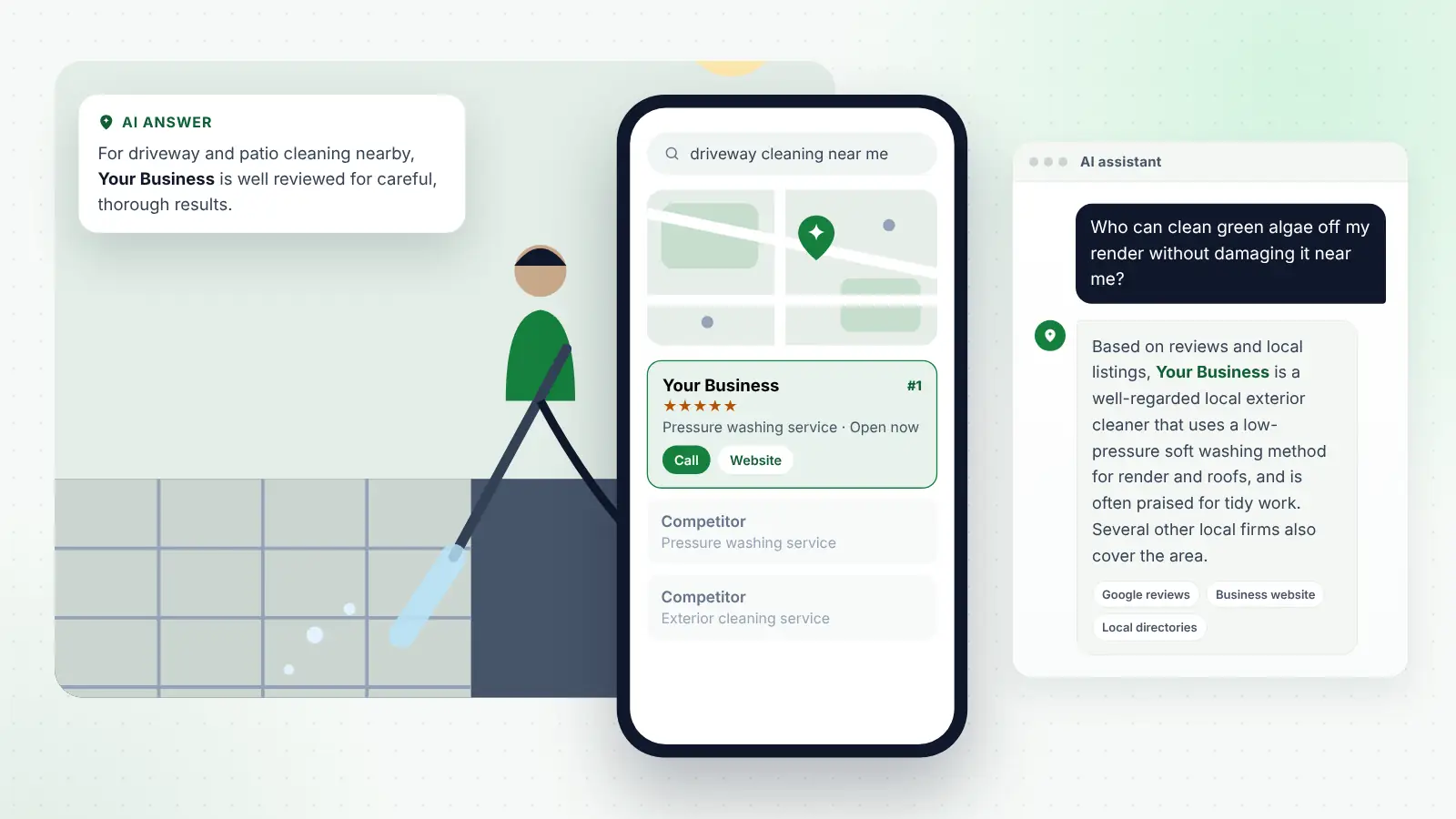
More homeowners now ask AI assistants such as ChatGPT, Gemini, Perplexity, Copilot and Google AI Overviews for advice and recommendations instead of scrolling through results. Exterior cleaning questions are often detailed: “is soft washing better than pressure washing for render?”, “will pressure washing damage my block paving?”, “who cleans roofs safely near me?” or “how often should a patio be sealed?”.
These tools draw on information they can find and trust. They tend to rely on:
- The same name, number and service area on your website, Google profile and every directory.
- Reviews that describe the work, the surface and the area.
- Clear service pages that explain your methods, chemicals, run-off controls and aftercare.
- FAQ content that answers common questions honestly.
- Mentions on reputable local and home improvement websites.
An honest page explaining when you use soft washing rather than pressure washing, and what results to expect, gives AI tools something reliable to quote. Like local SEO, AI visibility usually builds over three to six months.
Tip
Ask a few AI assistants the questions your customers ask, and note which local businesses they mention and why. It shows you which information about your business is missing.
Frequently asked questions
Do I need a licence to start a pressure washing business?
There is no specific licence for pressure washing or exterior cleaning in the UK. You need to register with HMRC, follow health and safety and COSHH rules, dispose of waste water correctly and hold employers’ liability insurance if you take on staff. If you remove waste from customers’ properties, check whether you need to register as a waste carrier.
Is soft washing safe for roofs?
Soft washing is generally gentler on roofs than high pressure, which can damage tiles and force water underneath them. It still involves work at height and chemicals, so it needs proper training, safe access equipment and plant protection. Avoid walking on fragile roofs and refuse jobs you cannot do safely.
How long does a clean driveway stay clean?
It depends on shade, trees, drainage and the surface. A post-clean biocide treatment and sealing can slow regrowth, but no treatment stops it entirely. Be honest with customers and offer a maintenance plan rather than promising results that last for years.
Should I offer sealing straight away?
Only once you understand the products, surface preparation and drying conditions. Poorly applied sealer can look patchy, become slippery or trap moisture, so get training or supplier guidance before you add it to your services.
Next steps
An exterior cleaning business can be started with modest kit, but it is built on knowledge of surfaces, methods and chemicals. Get trained, sort out insurance, COSHH assessments and a run-off plan, then focus on careful work, good photos and detailed reviews. Add sealing, gutter cleaning and maintenance plans to turn one-off jobs into repeat customers, and keep your Google profile and website up to date so local homeowners find you first.