Most small businesses do not have a marketing budget so much as a marketing guilt: a sense that they should be doing more, a drawer of leaflets left over from last year, and a Facebook page last updated in spring. The good news is that local marketing rarely needs much money. It needs a handful of sensible activities done consistently, aimed at the people who actually live and work near you.
This guide sets out 26 low-cost ideas that work for UK local businesses, whether you run a plumbing firm, a physiotherapy clinic, a hair salon, an accountancy practice or a café. For each one you will find a rough cost, the effort involved and the kind of business it suits best. Costs are given as broad bands rather than exact figures, because printing, sponsorship and signage prices vary a great deal by area and supplier.
There is a second thread running through the guide. Almost every idea here does more than bring in a customer directly. Done well, it produces reviews, local mentions, photos and links that help you show up on Google Maps and get recommended when someone asks an AI assistant for a business like yours. Those connections are covered in their own sections towards the end.
Key points
- The best low-cost local marketing builds relationships with people and businesses near you, rather than buying attention.
- Pick three or four ideas that suit your business and do them consistently for a few months before judging them.
- Email marketing is cheap and effective, but you must follow PECR and UK GDPR rules on consent and opt-outs.
- Community activity, partnerships and local press produce mentions and links that support your Google Maps visibility.
- Reviews, photos and clear details created through these activities also give AI assistants more to go on when recommending you.
In this guide
- The ideas at a glance
- Working with other local businesses
- Showing up in your community
- Online communities without being “that business”
- Print and signage that people keep
- Local press, radio and community publications
- Email and messages, within the rules
- Content that does double duty
- How these ideas help you show up on Google Maps
- How these ideas feed AI recommendations
- A simple 90-day plan and how to measure it
- Frequently asked questions
- Next steps
The ideas at a glance
Use the table to shortlist. As a rough guide, “Free” means only your time, “Low” usually means tens of pounds, and “Moderate” usually means a few hundred pounds, but this varies by area, supplier and how far you take each idea.
| Idea | Rough cost | Effort | Best for |
|---|---|---|---|
| 1. Referral partnerships with complementary businesses | Free | Medium | Trades, clinics, professional services |
| 2. Joint offers with neighbouring businesses | Free to low | Low | Shops, cafés, salons |
| 3. Local business networking groups | Low to moderate | Medium | Professional services, B2B trades |
| 4. Grassroots sports or club sponsorship | Low to moderate | Low | Most local businesses |
| 5. Stalls at fetes, fairs and markets | Low | Medium | Food, retail, gardening, pet services |
| 6. Free workshops or talks | Free to low | Medium | Clinics, professional services, garden and craft businesses |
| 7. Open evenings or behind-the-scenes events | Low | Medium | Salons, studios, cafés, nurseries |
| 8. Supporting a local charity or cause | Free to low | Low | Any business with genuine links to a cause |
| 9. A Nextdoor business page | Free | Low | Home services, trades, pet care |
| 10. Taking part in local Facebook groups | Free | Medium | Almost everyone |
| 11. Targeted leaflets done well | Low to moderate | Medium | Trades, takeaways, home services |
| 12. Referral cards | Low | Low | Salons, clinics, trades |
| 13. Useful leave-behinds | Low | Low | Trades, garages, pest control |
| 14. Vehicle signage | Moderate | Low | Any business with a van or car on the road |
| 15. Shopfront, window and pavement signs | Low to moderate | Low | High street businesses |
| 16. Site boards on jobs (with permission) | Low | Low | Builders, roofers, landscapers |
| 17. Local press stories | Free | Medium | Businesses with a genuine story |
| 18. Expert comment for local media | Free | Low | Clinics, solicitors, accountants, vets |
| 19. Parish magazines and community newsletters | Low | Low | Village and small-town businesses |
| 20. An email newsletter | Free to low | Medium | Repeat-purchase businesses |
| 21. Service and rebooking reminders | Free to low | Low | Garages, salons, dentists, boiler engineers |
| 22. A review-request routine | Free | Low | Everyone |
| 23. Google Business Profile posts | Free | Low | Everyone with a profile |
| 24. Before-and-after content | Free | Low | Trades, cleaners, groomers, salons |
| 25. Answering common questions on your website | Free | Medium | Clinics, professional services, trades |
| 26. Seasonal campaigns | Free to low | Medium | Nearly everyone |
You do not need all 26. Most businesses do best by choosing three or four that suit how their customers find them, then running them properly for at least three months.
Working with other local businesses
1. Referral partnerships with complementary businesses
Think about who your customers use just before or just after they use you. A kitchen fitter’s customers need a plasterer, an electrician and a decorator. A physiotherapist’s patients may also see a personal trainer or a sports massage therapist. An accountant’s clients need a solicitor and a mortgage broker. A wedding florist works alongside venues, photographers and cake makers.
Pick two or three businesses whose work you would genuinely recommend, meet for a coffee and agree to pass work to each other when it is a good fit. Keep it honest: only recommend people whose standards you trust, because their work reflects on you. Regulated professions should check their own rules on referral arrangements and any referral fees before agreeing to anything formal.
2. Joint offers with neighbouring businesses
Businesses on the same street can promote each other cheaply. A café might offer a discount to customers of the bookshop next door; a barber and a menswear shop might share a window display; a dog groomer and a pet supply shop might hand out each other’s cards. The cost is small and both sides reach customers who are already nearby.
3. Local business networking groups
Chambers of commerce, breakfast networking groups and local business clubs can be useful for professional services and trades that do commercial work. They vary hugely in cost, format and quality, so attend as a visitor first and ask members where their referrals actually come from. Membership listings on a chamber’s website are also a genuine local mention.
Showing up in your community
4. Grassroots sports or club sponsorship
Sponsoring a junior football team’s kit, a cricket club’s scoreboard or a running club’s annual race is often affordable and well received. Parents and members see your name every week. Ask what the sponsorship includes: a listing on the club’s website, mentions on its social media and a photo you can use are worth more than a logo on a banner nobody reads.
5. Stalls at fetes, fairs and markets
Summer fetes, Christmas markets and farmers’ markets put you in front of local people in a relaxed setting. They suit businesses with something to show or taste: bakers, florists, garden designers, pet groomers, craft businesses. Bring a simple way to capture interest, such as a sign-up sheet for your newsletter with clear wording about what people are signing up for.
6. Free workshops or talks
Teaching people something useful builds trust quickly. A garden centre or landscaper can run a pruning session; an accountant can give a self-assessment talk for new sole traders; a physio can talk to a running club about common niggles; a bike shop can run a puncture repair evening. Libraries, community centres and village halls often have rooms at modest cost. Keep it educational rather than a sales pitch, and avoid health claims you can’t support.
7. Open evenings or behind-the-scenes events
An open evening at a new salon, a tasting night at a café or a family open day at a nursery lets people see inside before committing. Invite existing customers and ask them to bring a friend.
8. Supporting a local charity or cause
Choose a cause with a genuine connection to your business or staff, and support it in a way people can see: a collection point, a fundraising day, volunteering, or a percentage of a seasonal product. Charities often thank supporters publicly, which is a meaningful local mention. Don’t overstate your contribution in your own marketing.
Tip
Say yes to the photo. Whenever you sponsor, volunteer or run an event, take a few good photos and ask the organiser whether they can mention you on their website or social media. That one request turns a nice gesture into lasting visibility.
Online communities without being “that business”
9. A Nextdoor business page
Nextdoor is a neighbourhood network where residents ask for and give recommendations. You can set up a free business page, and when neighbours recommend you, those recommendations are shown to others nearby. Ask local customers who use Nextdoor to recommend you there, and reply politely to questions. Avoid replying to every “can anyone recommend” post with a sales message.
10. Taking part in local Facebook groups
Town and village Facebook groups are where many people ask “does anyone know a good electrician?” Each group sets its own rules, and many restrict business posts to a particular day or ban them altogether. Read the rules, respect them and contribute as a neighbour first: answer questions helpfully, share genuinely useful information, and let recommendations come from customers. A business that posts adverts every day in breach of the rules soon gets removed, and people remember.
Good etiquette in practice:
- Post business content only where and when the group allows it.
- When someone asks for a recommendation, let past customers tag you rather than tagging yourself repeatedly.
- If you do reply, be brief and helpful, and declare that it is your business.
- Never criticise competitors in public.
- Don’t use a personal profile to pretend to be a happy customer. Under UK consumer law, fake reviews and concealed promotion are banned.
Print and signage that people keep
11. Targeted leaflets done well
Leaflets still work when they are targeted and well made. A takeaway leafleting the streets within its delivery area, a gutter cleaner covering estates with the right type of house, or a window cleaner introducing a round all make sense. What fails is a cluttered design sent everywhere.
A good leaflet has one clear offer, a short list of what you do, your area, a phone number and website in large type, and a reason to keep it, such as a price guide or a seasonal checklist. Respect “no junk mail” signs. If you plan to hand leaflets out in the street rather than deliver through letterboxes, check with your local council first, as some areas need permission to distribute free printed material.
12. Referral cards
A simple card that a happy customer can hand to a friend works well for salons, clinics and trades. Keep any reward modest and make it about the referral, not about leaving a review. Google’s policies do not allow incentives for reviews, so never link a discount to a review.
13. Useful leave-behinds
A sticker on the boiler with your number and the next service date, a fridge magnet from a pest controller, or a service record card from a garage gets kept because it is useful. It puts your name in front of the customer at exactly the moment they next need you.
14. Vehicle signage
A van that is on local roads every day is advertising space. Keep the design simple: business name, what you do in a few words, phone number and website, readable from a distance. A clean, well-parked van says more about your standards than any slogan. Signage can range from simple vinyl lettering to a full wrap, with costs that vary widely.
15. Shopfront, window and pavement signs
If you have premises, make sure people can tell what you do and when you are open from across the street. A clear window display, an opening hours sign and, where permitted, a pavement board with a changing message all help. Check with your council before placing a board on the pavement, as rules vary.
16. Site boards on jobs
Builders, roofers, landscapers and decorators can put a small board outside a job with the customer’s permission. Neighbours watching the work become warm leads. Keep the site tidy, because the board ties your name to whatever people see.
Local press, radio and community publications
17. Local press stories
Local newspapers, news websites and community magazines need stories. Genuine news includes opening a new premises, taking on an apprentice, a milestone anniversary, a fundraising achievement, an award or helping in a local emergency. Send a short, factual email with a good photo and a contact number. Keep it news rather than advertising.
18. Expert comment for local media
When a local story touches your field, offer a short, sensible comment. A vet can comment on hot-weather dog walking, an accountant on a tax deadline, a solicitor on a change to tenancy law, a heating engineer on preparing boilers for winter. Local BBC radio and community stations sometimes look for this kind of voice. Being quoted builds authority and often earns a mention online.
19. Parish magazines and community newsletters
In villages and small towns, the parish magazine or residents’ newsletter is read cover to cover. Advertising is often inexpensive, and editors may welcome a short helpful article, such as a gardener’s seasonal tips.
Email and messages, within the rules
20. An email newsletter
Email is one of the cheapest ways to bring customers back, especially for repeat-purchase businesses such as cafés, salons, garden centres and pet shops. A short monthly email with something useful, a seasonal reminder and any news is enough.
You must follow the Privacy and Electronic Communications Regulations (PECR) and UK GDPR. In plain terms:
- Individuals need to have opted in to marketing emails, unless the “soft opt-in” applies.
- The soft opt-in lets you email existing customers whose details you collected during a sale, or negotiations for one, about your own similar products or services, provided you gave them a clear chance to opt out when you collected their details and in every email.
- Sole traders and some partnerships count as individuals under PECR, so treat them as consumers. Emails to staff at limited companies have different rules, but you must still identify yourself and offer an opt-out.
- Every email must say who it is from and include an easy way to unsubscribe, which you must act on promptly.
- Keep records of how and when people signed up, and explain how you use their data in a privacy notice.
- Don’t buy email lists. They are rarely compliant and rarely work.
Most businesses that process personal data also need to pay the data protection fee to the Information Commissioner’s Office unless they are exempt. The Data (Use and Access) Act 2025 updated these rules, and most of its changes affecting marketing and data protection have applied since early 2026, so check the ICO’s current guidance on electronic mail marketing before you start.
21. Service and rebooking reminders
Reminders that a customer would expect, such as “your MOT is due next month” or “it’s eight weeks since your last cut”, are some of the most effective messages you can send. Be clear whether a message is a service message or marketing, and follow the same consent rules for anything promotional.
Tip
Add a “How did you hear about us?” question to your booking form or phone script. It costs nothing and, after a few months, tells you which of these ideas is actually bringing in customers.
Content that does double duty
22. A review-request routine
Asking every customer for a review, at the right moment and with a direct link, is free and builds steadily. Make it part of how you finish a job or appointment. Never offer rewards for reviews or ask only those you expect to be positive.
23. Google Business Profile posts
Posts on your Google Business Profile let you share updates, offers and events where local searchers see them. A post every week or two about a recent job, a seasonal service or an event keeps your profile active and gives customers a reason to choose you.
24. Before-and-after content
Before-and-after photos show results in a way words can’t: a cleaned patio, a groomed spaniel, a restored kitchen, a reorganised garden. Get the customer’s permission, avoid showing house numbers or anything that identifies where they live, and keep the photos honest without misleading edits. Clinics offering cosmetic or medical treatments have stricter advertising rules on before-and-after images, so check the advertising codes that apply to you first.
25. Answering common questions on your website
Every question customers ask on the phone is a page or FAQ waiting to be written. “Do you cover Harpenden?”, “How long does a boiler service take?”, “Can I bring my child to my appointment?” A short, direct answer on your website helps customers, reduces repeat calls and gives search engines and AI tools something clear to quote.
26. Seasonal campaigns
Plan a simple calendar around your busy and quiet periods. A gardener promotes autumn tidy-ups in September; a heating engineer promotes boiler servicing before the first cold snap; a florist plans around Valentine’s Day and Mother’s Day; a café runs a summer menu; an accountant reminds sole traders about the January self-assessment deadline. Prepare each campaign a few weeks early and use it across your Business Profile, email, social media and leaflets.
How these ideas help you show up on Google Maps
Google ranks local businesses on relevance, distance and prominence. You can’t change distance, but much of this guide feeds prominence and relevance.
- Reviews from referral cards, open evenings and a steady request routine are one of the clearest prominence signals.
- Local mentions and links from clubs you sponsor, charities you support, chamber directories and local news sites show Google you are an established part of the community.
- Photos and posts from events, jobs and before-and-after work keep your Business Profile active and help customers choose you once they find you.
- Branded searches increase when people see your van, leaflet or name on a junior football shirt and then search for you by name.
- Website content answering local questions makes your site more relevant to the searches people actually do.
The foundations still need to be right: an accurate Google Business Profile with the correct category, hours and service area, consistent details on other listings, and a website with clear service and area pages. If you would like that groundwork handled while you get on with the community side, our local SEO support for small businesses covers it, but none of the ideas here depend on hiring anyone.
How these ideas feed AI recommendations
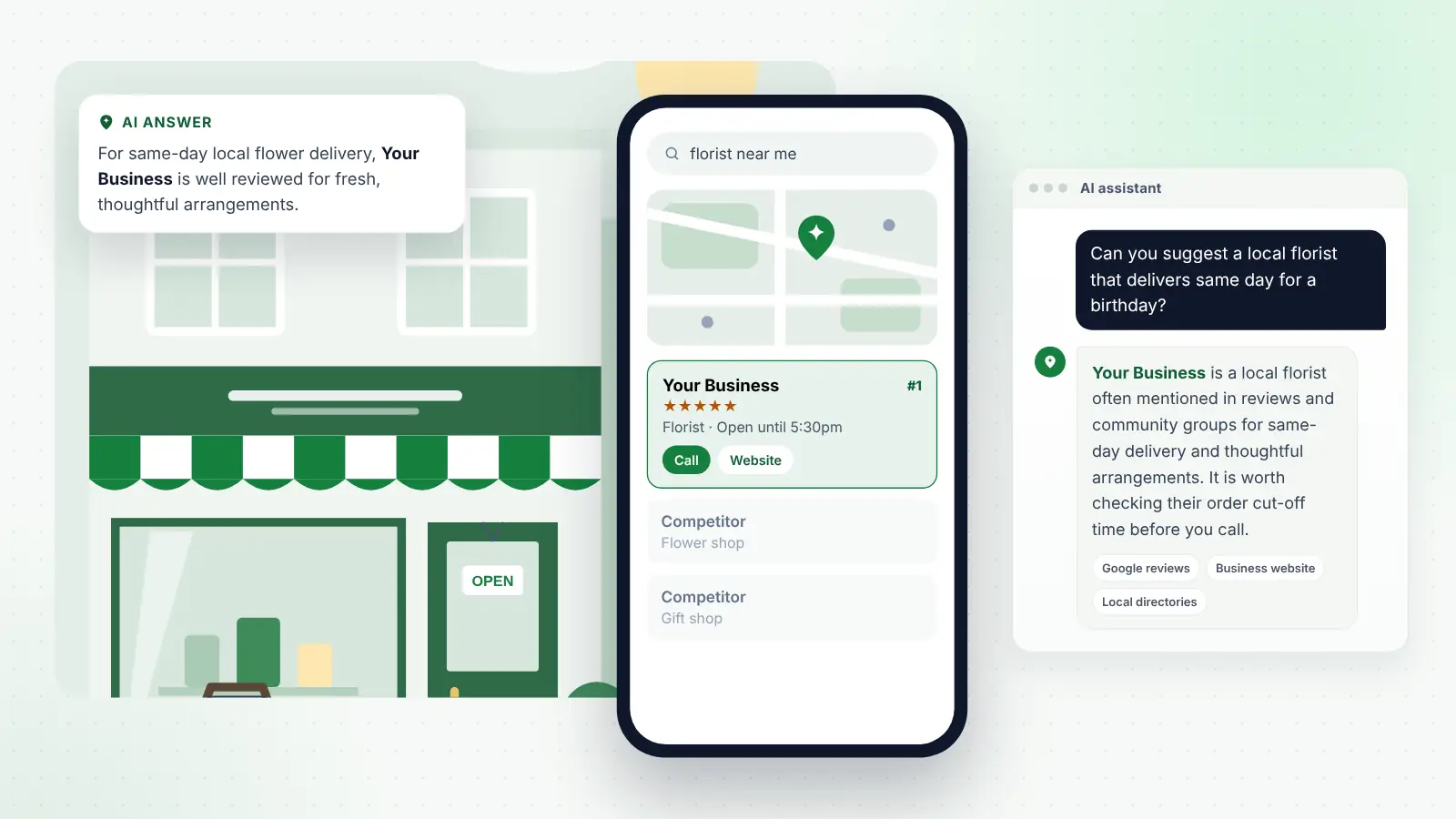
More people now ask ChatGPT, Gemini, Copilot or Perplexity to “recommend a florist in Guildford that does same-day delivery” or “find a good family-friendly café near me”. These tools tend to recommend businesses that several trustworthy sources agree on.
Low-cost marketing helps here in specific ways:
- Reviews that mention details. When customers say “they delivered a birthday bouquet the same afternoon”, an assistant has something concrete to repeat.
- Independent mentions. A write-up in the local paper, a thank-you on a charity’s website or a listing on the sports club’s sponsors page all confirm that you exist and are well regarded.
- Community recommendations. Public recommendations on platforms and community sites can reinforce your reputation, though assistants don’t read every private group.
- Clear, consistent facts. Leaflets, signs and listings should all use the same name, phone number and description of what you do. Conflicting details make assistants less confident.
- Answerable content. FAQs and service pages written in plain language give assistants exact wording to rely on, such as your opening hours, delivery cut-off or areas covered.
None of this guarantees a recommendation, because the tools change how they choose businesses, but any effect tends to build gradually as these signals accumulate over several months.
A simple 90-day plan and how to measure it
Pick a small set of ideas and give them a fair trial. A sensible starting mix for most businesses:
- Weeks 1 to 2: Check your Google Business Profile, Apple and Bing listings and website details are accurate. Set up a review-request routine and add “How did you hear about us?” to your enquiry process.
- Weeks 3 to 6: Approach two complementary businesses about referrals, and choose one community activity, such as a sponsorship, a workshop or a stall.
- Weeks 7 to 10: Start a monthly email to customers who have agreed to receive it, and post on your Business Profile every week or two.
- Weeks 11 to 13: Plan your next seasonal campaign and send one local press story if you have genuine news.
To measure progress, track a few simple numbers each month: enquiries and where they came from, new reviews, calls and website clicks from your Business Profile insights, and email sign-ups. Drop the ideas that produce nothing after a fair trial and do more of what works.
Frequently asked questions
What is the cheapest local marketing that actually works?
A consistent review-request routine, an accurate and active Google Business Profile, and genuine participation in local online groups cost nothing but time. Referral partnerships with complementary businesses are also free and can be very effective.
Are leaflets still worth it?
They can be, if they are targeted at the right streets, well designed and repeated a few times. A single untargeted drop rarely works. Track responses with a specific offer or a question on your enquiry form so you know.
Can I email customers who have bought from me before?
Usually yes, under the soft opt-in, if you collected their details during a sale, you are marketing your own similar products or services, and you gave them a clear chance to opt out at the time and in every email. If those conditions were not met, you need their consent first.
Is it acceptable to give customers a discount for referring a friend?
A referral reward is generally fine if it is clearly about introducing someone new. What you must not do is reward customers for leaving reviews, which breaks Google’s policies and risks breaching UK consumer law on fake and incentivised reviews.
How long before I see results?
Some ideas, such as a well-timed leaflet or a seasonal email, can bring enquiries within weeks. Effects on Google Maps visibility and AI recommendations from reviews and mentions usually build over three to six months.
Next steps
You don’t need a big budget to become the business people in your area think of first. Choose three or four ideas from this list that fit your customers, put dates in your calendar, and keep at them for a few months. Ask every new customer how they heard about you so you know what is working.
Alongside that, keep the basics in order: accurate listings, a steady flow of genuine reviews and a website that answers real questions. Together, the community work and the online foundations make your business easier to find on Google Maps and easier for AI assistants to recommend with confidence.