Many local businesses spend time and money getting the phone to ring, then lose a large share of those enquiries without ever noticing. A call goes to voicemail while you are up a ladder. A website form sits unread until the weekend. A WhatsApp message gets a quick “will get back to you” and then nothing. A quote goes out a week late, and by the time it arrives the customer has booked someone else.
None of this is about being a pushy salesperson. Customers looking for a plumber, a physio, a hairdresser, an accountant or a caterer mostly want the same things: a quick, clear reply, a sense that you understand what they need, an honest idea of the cost and an easy way to book. The business that provides those things first, and makes them easy, wins a surprising amount of work that a slower competitor would have had.
This guide covers how to handle enquiries from the first ring or message to a confirmed booking: responding quickly, dealing with missed calls, using WhatsApp and web forms well, asking the right qualifying questions, quoting, following up, handling people who are “just shopping around”, taking deposits and tracking what is working. It includes example wording from several industries that you can adapt.
Key points
- Speed matters: the first business to reply properly often wins the job, so aim to respond within minutes or a few hours, not days.
- Treat missed calls as lost customers until proven otherwise, and set up a voicemail and text-back routine that keeps them warm.
- A handful of good qualifying questions saves wasted visits and lets you quote accurately and quickly.
- A short, polite follow-up schedule recovers work that would otherwise drift away.
- Deposits and clear booking terms reduce no-shows, but cancellation rights for consumers still apply in many cases.
- Track enquiries, quotes and wins by source so you know where your best customers come from.
In this guide
- Why speed to reply matters so much
- Answering the phone and dealing with missed calls
- WhatsApp, messages and web forms
- Qualifying questions: find out what the customer really needs
- Quoting quickly and clearly
- A follow-up schedule that does not feel pushy
- Handling “I’m just shopping around”
- Deposits, booking and confirmation
- Track your conversion rate
- Enquiries and Google Maps
- AI assistants and the enquiries they send
- Frequently asked questions
- Next steps
Why speed to reply matters so much
When someone needs a service, they rarely contact only one business. A homeowner with a leaking pipe may ring three plumbers in five minutes. Someone looking for a sports massage may fill in forms on two clinic websites and send an Instagram message to a third. A couple planning a party may email four caterers on a Sunday evening. Whoever replies first with something useful has a strong advantage, simply because the customer’s problem starts to feel solved.
This is often called “speed to lead”. You do not need complicated software to improve it. You need to know where enquiries arrive, who is responsible for answering them, and what a good first reply looks like.
Set yourself realistic targets for each channel. For example:
- Phone calls: answered live during working hours where possible, with missed calls returned within an hour.
- WhatsApp and text messages: a first reply within an hour during working hours.
- Website forms and emails: a reply the same working day, ideally within a couple of hours.
- Out-of-hours enquiries: an automatic acknowledgement straight away, then a real reply first thing the next working day.
A useful first reply does more than say “thanks, will be in touch”. It confirms you have understood the request, asks any essential question, and says what will happen next and when.
Answering the phone and dealing with missed calls
For many trades and appointment businesses, the phone is still where the most valuable enquiries arrive, especially urgent ones. It is also where the most work is lost, because owners are usually busy doing the job when it rings.
Make missed calls recoverable
You will miss calls. What matters is what happens next.
- Record a clear voicemail greeting. Say your business name, that you are on a job or with a client, and when you will call back. Invite the caller to leave their name, number, postcode or area and a brief description of what they need.
- Check missed calls at set times, such as between jobs, at lunch and at the end of the day, rather than leaving them until the evening.
- Call back unknown numbers. Many callers do not leave a voicemail. A short call back, “Hello, it’s Sam from Ridgeway Electrical, I’ve just missed a call from this number”, recovers a lot of work.
- Use a missed-call text if your phone system offers it. Many business phone apps can send an automatic text such as “Sorry we missed your call. We’re on a job and will ring you back within the hour, or reply here with what you need.”
- Consider an answering service or a part-time administrator once your volume justifies it. Brief them properly so they can take the details you actually need.
Answer in a way that moves things forward
When you do answer, have a simple structure in your head: greet, listen, ask the key questions, explain the next step and the likely cost, and confirm details. If you record calls for training or quality, tell callers.
Tip
Write down the five things you always need to know from a caller and keep them by the phone or in a notes app. Everyone who answers should collect the same details in the same order, so nothing is missed when the call is returned.
WhatsApp, messages and web forms
WhatsApp and text messages
Many customers now prefer to message rather than call, particularly for non-urgent work, and they like being able to send photos. A free WhatsApp Business account lets you set a business profile with your hours and address, create a greeting message for first contact, an away message for outside your hours, and quick replies for common answers. Use them, but keep them human. A stock reply followed by a real message from a person within the hour works well. A stock reply followed by silence does not.
Photos are particularly useful. A roofer can often judge whether a site visit is needed from two or three clear pictures. A dog groomer can see the coat condition. A decorator can get a sense of room size and condition. Ask for photos politely and explain why they help.
Keep business messages on a business number where you can, so enquiries do not get lost among personal chats and so someone else can pick them up if you are ill or on holiday.
Website forms that bring useful enquiries
A good contact form is short but asks for enough to give a useful reply. For most businesses that means:
- Name, phone number and email.
- Postcode or town, so you know whether you cover the area.
- What they need, ideally with a short dropdown of your main services plus a free-text box.
- Timing, such as “as soon as possible”, “within a month” or “just planning”.
- An optional photo upload where it helps.
Send an automatic confirmation that tells the customer what happens next and when. Then check that form submissions actually reach you: test the form every month, because broken forms and enquiries going to an old email address are more common than most owners realise.
Treat enquiry data with care. Keep it secure, use it to reply to the request, and do not add people to a marketing list unless the rules on electronic marketing allow it. Following up a quote someone asked for is part of handling their enquiry; a monthly newsletter is not.
Qualifying questions: find out what the customer really needs
Qualifying is simply finding out, politely and quickly, whether you are the right business for the job and what it will involve. Good questions save wasted visits and let you quote accurately. They also reassure customers, because a business that asks sensible questions sounds like it knows what it is doing.
| Business type | Useful qualifying questions |
|---|---|
| Plumber or heating engineer | What is happening, and since when? Is water leaking now? What type and age of boiler? Is it a home you own or a rental? |
| Physiotherapy or sports clinic | What is the problem and how long have you had it? Have you seen a GP or anyone else about it? Are you claiming through health insurance? |
| Hair or beauty salon | What service are you looking for? Have you had colour or this treatment before? Do you have any allergies or sensitivities? Any date you need it by? |
| Accountant or bookkeeper | Are you a sole trader, partnership or limited company? Roughly what turnover? Which software do you use? Any deadlines coming up? |
| Caterer or event venue | What is the date, venue and number of guests? What style of food or service? Any dietary requirements? Roughly what budget per head? |
| Landscaper or builder | What do you have in mind, and roughly how big is the area? Do you have plans or drawings? When would you like the work done? Have you set a budget? |
Asking about budget feels awkward to many owners, but it is useful when handled gently. “To make sure I suggest the right options, do you have a rough budget in mind?” is a reasonable question. If the answer is far below what the work costs, saying so kindly saves everyone time.
Quoting quickly and clearly
Once you know what the customer needs, the speed and clarity of your quote often decide the outcome. Customers frequently choose the first professional, understandable quote they receive, especially when the prices are broadly similar.
Ways to quote faster:
- Use templates for your common jobs, with standard descriptions, inclusions and exclusions you can adjust.
- Give a guide price on the first call or message where you can, so the customer knows whether you are in the right range before you book a visit.
- Send the written quote the same day as the visit, or the next working day at the latest.
- Use job management or invoicing software that sends quotes by email or text with an accept button, if it suits your business.
A clear quote says what is included and excluded, the total price including VAT for consumers, how long the price is valid, any deposit and payment stages, when you can start and how you will handle anything unexpected. For appointment businesses such as clinics and salons, the equivalent is a clear treatment description, price, duration and cancellation policy at the point of booking.
If the job has options, show two or three, such as a standard and a premium boiler, or a single consultation and a course of treatment. Customers like choice, and it shifts the question from “should I book” to “which one”.
A follow-up schedule that does not feel pushy
Many quotes are not rejected; they are simply forgotten. People get busy, wait for payday or want to talk to a partner. A short, polite follow-up recovers some of that work at almost no cost.
| When | What to send | Example wording |
|---|---|---|
| Same day | The quote, with a short covering message | “Thanks for showing me the job today. Your quote is attached. Any questions, just reply here.” |
| 2 to 3 days later | A check that it arrived and an offer to help | “Just checking the quote came through and made sense. Happy to talk through any of it.” |
| About a week later | A useful reminder, with your availability | “I’ve got some availability the week of the 14th if that suits. Let me know if you’d like me to hold a date.” |
| Shortly before the quote expires | A final, friendly note | “Your quote is valid until Friday. After that I’ll need to recheck prices. No problem if you’ve gone another way.” |
Then stop. Three or four contacts is plenty. Record the outcome in a simple spreadsheet or your job software: won, lost on price, lost on timing, no reply. Over time those notes show you patterns, such as particular job types or areas where you rarely win.
For appointment businesses, the follow-up is lighter. A clinic might send one message the next day to someone who asked about prices but did not book. A salon might follow up an enquiry about a wedding trial once.
Handling “I’m just shopping around”
Customers who say they are getting a few quotes are being sensible, not difficult. The aim is not to talk them out of it, but to make sure you are the one they remember for the right reasons.
What helps:
- Agree with them. “That makes sense, it’s a big job. Here’s what to look for when you compare.”
- Explain what you include. Guarantees, certificates, insurance, tidying up, aftercare or a follow-up appointment are often the differences customers miss.
- Make comparison easy. A clear, itemised quote is easier to compare fairly than a single figure on a text message.
- Give them a reason to come back to you. Offer to answer questions once they have the other quotes.
Some examples by industry:
- Builder: “When you compare quotes, check whether they include skip hire, making good the plaster and building control fees. Ours does, and it’s all listed on page two.”
- Physiotherapist: “It’s worth asking how long the first appointment is. Ours is 45 minutes and includes a written exercise plan, so you’re not paying for a second visit just to get started.”
- Accountant: “When you compare fees, check what’s included. Our monthly fee covers your year-end accounts, tax return and unlimited email questions, so there are no extra bills in January.”
- Caterer: “Do compare. When you do, check whether staff, crockery and clearing up are included in the price per head, because that’s where quotes vary most.”
If the customer chooses someone cheaper, thank them and let them go graciously. People remember a business that was helpful even when it lost, and some come back.
Tip
When you lose a job, ask one short question: “Would you mind telling me what made the difference?” The answers are often about speed or clarity rather than price, and both are things you can fix.
Deposits, booking and confirmation
A clear booking process turns a “yes” into a firm commitment. For appointment businesses it also reduces no-shows.
Good practice includes:
- Confirm every booking in writing by text or email, with the date, time, address, what is included, the price and your cancellation terms.
- Send a reminder a day or two before an appointment or start date.
- Use deposits where they make sense, such as for larger trade jobs where you order materials, wedding and event bookings, long appointments at a salon or clinic, and new clients with no booking history.
- Keep deposits proportionate. A deposit should reflect the costs and losses you would genuinely face if the customer cancelled. Terms that keep large sums regardless of circumstances can be challenged as unfair under consumer law.
- Take payment securely, through a card terminal, payment link or bank transfer details sent from a trusted address. Warn customers that you will never change your bank details by message, which helps protect them from invoice fraud.
Remember cancellation rights. When a consumer agrees a contract away from your premises, such as in their home, or at a distance, such as by phone, email, WhatsApp or online, they usually have 14 days to cancel under the Consumer Contracts Regulations 2013. You must tell them about this right; if you do not, the cancellation period can be extended by up to 12 months. If they want work to start within that period, they need to ask expressly, and if they then cancel they may have to pay for work already done. There are exceptions, including some urgent repairs the customer has asked for and certain catering and leisure services booked for a specific date, so check how the rules apply to your type of work.
Track your conversion rate
You cannot improve what you do not measure. A simple spreadsheet with one row per enquiry is enough to start. Record the date, how they found you, the service, whether you quoted, and whether they booked.
Here is an illustrative month for a small kitchen and bathroom fitter. The figures are made up to show how the sums work.
| Source | Enquiries | Quotes sent | Jobs won | Enquiry to job |
|---|---|---|---|---|
| Google Business Profile | 18 | 10 | 4 | 22% |
| Website form | 9 | 6 | 3 | 33% |
| Referrals from past customers | 5 | 5 | 4 | 80% |
| Lead generation site | 14 | 6 | 1 | 7% |
| Total | 46 | 27 | 12 | 26% |
Even rough figures like these answer important questions. Which sources bring the best customers? How many enquiries never get a quote, and why? Is your quote-to-win rate dropping, which might suggest a pricing or speed problem? A clinic can do the same with enquiries and first appointments booked; a salon with enquiries and new client bookings; an accountant with discovery calls and signed engagement letters.
Review the numbers monthly. Small changes, such as replying faster or adding a guide price to your first message, usually show up in the figures within a few months.
Enquiries and Google Maps
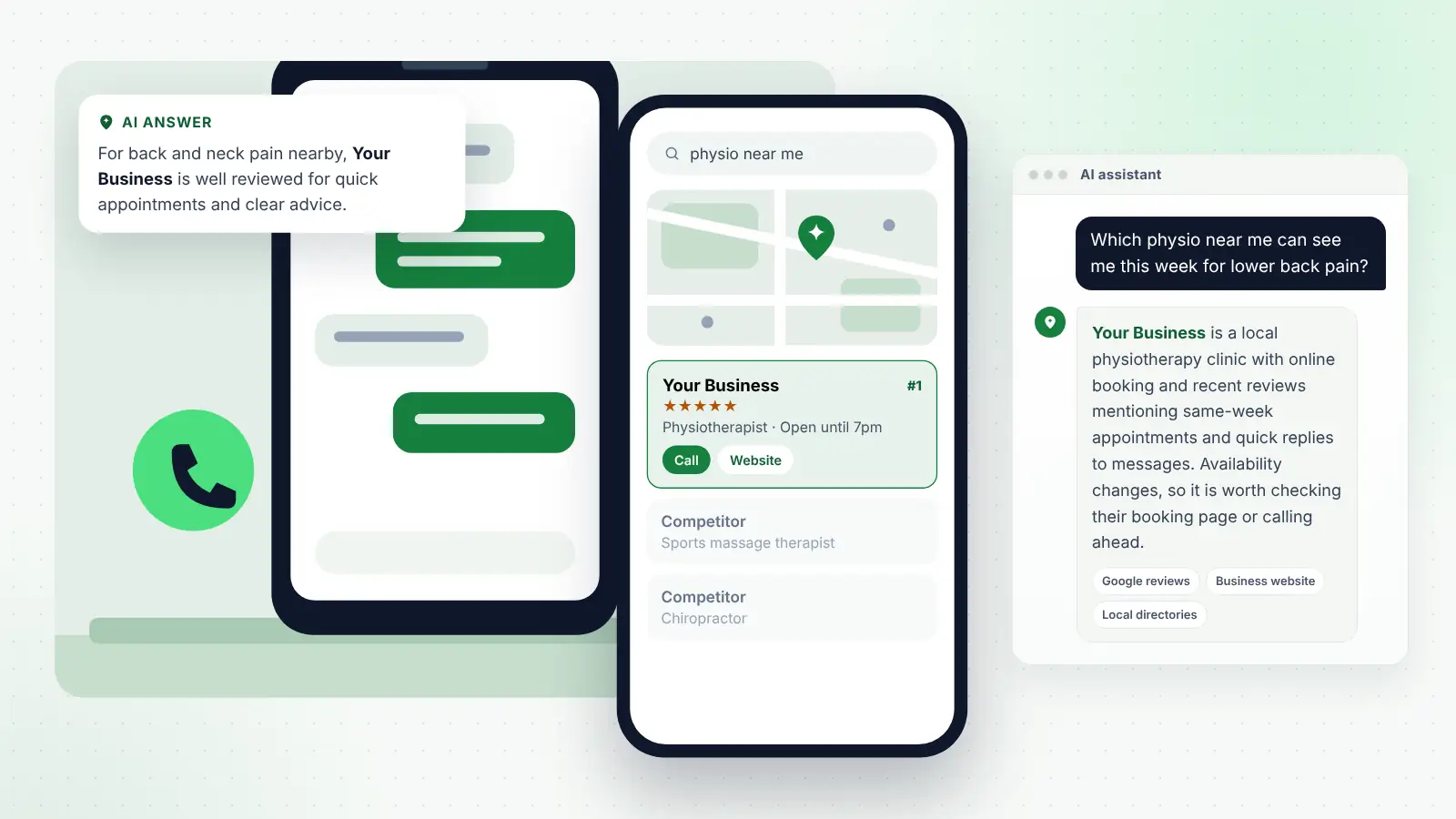
For most local businesses, a large share of enquiries starts with a search on Google or Google Maps, such as “emergency electrician near me”, “physio in Harrogate”, “eyelash extensions near me” or “accountant for landlords Bristol”. Google shows a map with a few local businesses, and customers compare them in seconds.
What they see on your Google Business Profile strongly affects whether they contact you, and how. Make sure your phone number is one that is actually answered, your opening hours are accurate, and any booking or messaging links work. Add your main services with clear descriptions, upload genuine photos of your work or premises, and keep your details identical to your website and directory listings. Reviews that mention quick responses, clear quotes and turning up on time are especially persuasive to someone deciding who to contact first, so ask every customer for an honest review.
Your website should then make the next step easy: a clickable phone number, a short form, a WhatsApp link where you use it, and service and area pages that answer common questions. If you would prefer specialists to look after that, local SEO and AI search services for small businesses can manage your profile, pages and listings so more of the right people find you. Local SEO results usually build over three to six months, so it works best alongside the enquiry-handling habits in this guide, not as a replacement for them.
AI assistants and the enquiries they send
People increasingly ask AI tools such as ChatGPT, Gemini, Perplexity, Copilot and Google’s AI Overviews for help choosing a local business: “which plumber near me can come out today”, “is there a physio in Leeds that does evening appointments”, “best caterer for a 50th birthday party in Kent”. These tools look for consistent, trustworthy information about businesses across the web.
Responsiveness can become part of that picture. If your reviews regularly mention that you replied quickly, your website clearly states your hours and how to book, and your listings show the same information everywhere, an assistant has good material to describe you accurately. A business whose details are vague or contradictory gives the tools little to work with.
Practical steps:
- State clearly on your website how customers can contact you and how quickly you usually reply.
- Publish an FAQ covering what customers ask before booking, such as whether you offer free quotes, your call-out terms or how to book a first appointment.
- Keep hours, services and contact details consistent across your website, Google profile and directories.
- Make sure the enquiries these tools send you are handled as quickly as any other, because a customer who arrives via an AI recommendation still expects a prompt reply.
No one can guarantee how an AI assistant will answer a given question, and the tools change often, but being clear, consistent and well reviewed improves your chances.
Frequently asked questions
How quickly should I reply to an enquiry?
As quickly as you reasonably can. For urgent work such as leaks, lock-outs or breakdowns, minutes matter. For planned work, replying within a few hours during the working day puts you ahead of many competitors. Use an automatic acknowledgement outside working hours so customers know they have been heard.
Should I give prices over the phone?
Where you can, give a guide price or a starting price, and explain what affects it. Customers appreciate knowing whether you are in the right range, and it avoids wasted visits. For complex jobs, explain that you will confirm a fixed price after a visit or a look at photos.
Is it worth paying for an answering service?
It can be once you are regularly missing calls that turn into lost work. Calculate the value of the jobs you probably miss each month and compare it with the cost. Brief the service properly so they collect the details you need and give accurate information about your call-out terms.
How many times should I follow up a quote?
Two or three times over a couple of weeks is usually enough: once to check it arrived, once with your availability, and once before it expires. After that, record the outcome and stop.
Can I keep a deposit if a customer cancels?
It depends on your terms, when they cancel and whether consumer cancellation rights apply. A deposit should be proportionate to your genuine costs. If the customer cancels within a statutory cancellation period, you may have to refund it. Set your terms out clearly in writing at the time of booking, and take advice if you are unsure.
Next steps
Pick one channel to improve this week. That might be recording a better voicemail greeting, setting up WhatsApp Business away messages, testing your website form or creating a follow-up reminder for every quote. Start a simple spreadsheet to track enquiries and wins, and look at it at the end of each month. Most local businesses do not need more enquiries as urgently as they think; they need to win more of the ones they already get, and that is mostly a matter of speed, clarity and consistent habits.