Most owners of small service businesses set their first prices by looking at what everyone else charges and pitching slightly below. It feels safe, and for a while it can even work. The trouble shows up later: a full diary, a tired owner, and a bank balance that never seems to reflect how hard everyone is working. The usual cause is not a lack of customers but prices that were never built on the real cost of running the business.
Pricing is not just a number on a quote. It decides which customers you attract, how much time you have for doing the job properly, whether you can afford to replace the van when it fails, and whether you can ever take a proper holiday. It also shapes how you come across online, because customers increasingly compare businesses on how clearly they explain what things cost before they ever pick up the phone.
This guide walks through how to work out what an hour of your time genuinely costs, how to choose between hourly rates, day rates, fixed prices and packages, how to handle call-out charges and price increases, and what UK consumer law expects when you show prices on your website. The examples cover trades, clinics, salons, professional services and hospitality, because the principles are the same whether you fit kitchens or run a physiotherapy practice.
Key points
- Your real hourly cost includes overheads, holidays, unbilled admin and travel, and is usually far higher than a simple “wage divided by 40 hours” sum.
- Pick a pricing model to suit the work: hourly or day rates for uncertain jobs, fixed prices and packages where you can define the outcome.
- If you are, or will soon be, VAT registered, build VAT into your consumer prices from the start; the registration threshold is £90,000 of taxable turnover in a rolling 12 months as of October 2026.
- Since April 2025, prices shown to consumers must include unavoidable fees, so compulsory charges cannot be added at the end.
- Small, regular price rises explained calmly lose far fewer customers than owners fear.
- Clear, consistent prices on your website and Google profile help customers choose you and give AI assistants accurate information to repeat.
In this guide
- Start with what a year of running the business costs
- Count the hours you can genuinely charge for
- A worked example: from “£25 an hour” to the real number
- VAT: plan for it before you have to register
- Choose the right pricing model for each kind of work
- Call-out charges, minimum charges and travel
- Showing prices online: what UK consumer law expects
- Raising prices without losing good customers
- Discounting without undermining your prices
- Clear pricing and being found on Google Maps
- Pricing pages and AI assistants
- Frequently asked questions
- Final thoughts
Start with what a year of running the business costs
Before you think about what to charge per hour or per job, work out what the business needs to bring in over a whole year just to stand still. Most underpricing comes from leaving things out of this sum.
Go through your bank statements for the last 12 months, or estimate if you are newer, and list every cost that is not directly recharged to a customer. A typical list includes:
- Vehicle costs: finance or lease payments, or an allowance for replacing the van every few years, plus fuel, servicing, tyres, road tax, parking and congestion or clean air zone charges.
- Insurance: public liability, professional indemnity, employer’s liability if you have staff, tools cover, van insurance and any treatment or malpractice cover your industry needs.
- Premises: rent, business rates, utilities and cleaning for a shop, salon, clinic or unit. For mobile and home-based businesses, a share of home costs and storage.
- Tools, equipment and consumables: replacement tools, clinic couches, salon chairs, kitchen equipment, and the small items you never charge for, such as dust sheets, gloves and couch roll.
- Memberships and compliance: trade body or professional body fees, scheme registrations, training and continuing professional development.
- Admin and software: accountancy, booking or job management software, phone contracts, card terminal fees and bank charges.
- Marketing: website hosting, directory listings, printed material, signage and any advertising.
Then add the income you want to take out of the business for yourself, plus an allowance for tax and a pension. A business that only covers its costs and your wage has nothing left for a bad month, a broken van or growth, so you will also add a profit margin later.
Tip
Keep this list in a simple spreadsheet and update it every six months. Costs creep up quietly, especially insurance, fuel and software subscriptions, and reviewing them twice a year tells you when your prices need to move.
Count the hours you can genuinely charge for
The second half of the sum is time. Here the gap between what owners assume and what actually happens is usually widest.
Start with 52 weeks. Take off holidays: employees in the UK are entitled to 5.6 weeks of paid leave a year, and there is no good reason to give yourself less. Take off a week or so for illness, training and the days when weather, cancellations or a supplier problem leave you idle. That leaves roughly 45 working weeks.
Then think about how much of each working day a customer actually pays for. A self-employed electrician might work a ten-hour day but spend an hour driving between jobs, an hour collecting materials, and another hour or two on quotes, invoices, phone calls and messages. A physiotherapist with a 40-hour week may have only 28 or so hours of booked appointments once notes, cancellations and gaps are accounted for. A hairdresser loses time to no-shows and to the quiet early-week slots that rarely fill.
Be honest. Track a few typical weeks: note every hour you work and mark which ones were paid for. Many people find that a much smaller share of their working time is billable than they assumed. Your rate has to recover the cost of the unpaid hours as well as the paid ones.
A worked example: from “£25 an hour” to the real number
Here is an illustrative example for a self-employed tradesperson with a van and no staff. The figures are made up for the purpose of the sum and will be different for your business, area and industry, so replace them with your own.
| Item | Annual amount | Notes |
|---|---|---|
| Van finance or replacement allowance | £4,800 | Spread the cost of the next van over its working life |
| Fuel | £3,600 | Depends heavily on how far you travel |
| Van insurance, tax and servicing | £1,800 | Include tyres and MOT |
| Business insurance | £600 | Public liability and tools cover |
| Tools and equipment replacement | £1,200 | Things wear out, get stolen or need upgrading |
| Phone, software and accountant | £1,500 | Job management app, bookkeeping, year-end accounts |
| Marketing and website | £1,500 | Hosting, listings, printed material |
| Uncharged consumables and workwear | £600 | Sealant, fixings, dust sheets, boots |
| Total overheads | £15,600 | |
| Owner’s target income before tax | £38,000 | What you want to earn for yourself |
| Total to recover | £53,600 | Before any profit margin |
| Working weeks | 45 | 52 weeks minus holidays, illness and lost days |
| Hours worked per week | 40 | |
| Billable share | 70% | Travel, quoting and admin take the rest |
| Billable hours per year | 1,260 | 45 × 40 × 0.7 |
| Break-even hourly rate | £42.54 | £53,600 ÷ 1,260 |
| With a 15% profit margin | £48.92 | Money for bad months, growth and reinvestment |
Now compare that with the sum many people do in their heads: £53,600 divided by 52 weeks of 40 hours gives about £25.77 an hour. Charging that would mean working every week of the year, never being ill, and being paid for every minute including the drive to the merchant. In practice it would leave this business several thousand pounds short every year.
The same method works for any service business. A salon owner can divide total costs by the number of chair hours realistically booked. An accountant can divide by billable client hours rather than office hours. A small café or caterer works the same logic through gross margin on food and labour rather than an hourly rate, but the principle of recovering every overhead is identical.
VAT: plan for it before you have to register
As of October 2026, you must register for VAT if your VAT-taxable turnover goes over £90,000 in any rolling 12-month period, or if you expect it to go over that figure in the next 30 days alone. It is a rolling figure, not a tax-year one, so check it monthly once you are getting close. Materials and products you sell count towards turnover, not just your labour.
For businesses that mostly serve consumers, crossing the threshold is a big moment, because households cannot reclaim VAT. Overnight, you either add 20 percent to your prices or absorb it from your margin. Neither is comfortable if it comes as a surprise.
A few practical points:
- Show consumer prices including VAT. Customers who are not businesses should see the full price they will pay, not a figure with VAT added later.
- Business customers usually think in prices excluding VAT, because they can reclaim it. A bookkeeper or commercial cleaner can quote “plus VAT” to business clients, as long as it is clear.
- Raise prices gradually as you approach the threshold. Two or three modest increases in the year before registration are easier for customers than one large jump.
- Ask your accountant about the schemes available, such as the Flat Rate Scheme, and whether voluntary registration makes sense if most of your customers are VAT registered themselves.
Do not try to stay under the threshold by turning away work or splitting a business artificially. HMRC looks at the reality of who is running the business, and the penalties for late registration can be painful.
Choose the right pricing model for each kind of work
There is no single right way to price. Most established businesses use a mix, matched to how predictable each type of job is.
| Model | Works well for | Watch out for |
|---|---|---|
| Hourly rate | Repairs, fault finding, consultancy, jobs where the scope is unclear | Customers watching the clock; you earn less by working faster |
| Day or half-day rate | Decorating, landscaping, joinery, multi-day trade work, photography | Days that overrun; agree what a “day” includes |
| Fixed price per job | Defined jobs such as a boiler service, a set of sockets, a tax return, a cut and colour | Hidden problems; spell out what is included and excluded |
| Packages and tiers | Treatment courses, maintenance plans, bookkeeping bundles, event catering menus | Too many options confuse; keep to two or three |
| Memberships or retainers | Regular cleaning, garden maintenance, monthly clinic plans, accountancy | Clear terms and easy cancellation matter |
Hourly and day rates
Hourly rates are honest when you genuinely cannot predict the work, such as tracing an electrical fault or untangling a set of messy accounts. Day rates suit trades where work fills a day and travel and set-up make short visits inefficient. Be clear what a day means, for example eight hours on site including a lunch break, and how you charge for materials.
Fixed prices
Customers prefer fixed prices because they remove uncertainty, and you benefit too: if you are efficient, you keep the time you save. The risk is the unknown. A kitchen fitter who finds rotten floor joists, or a dentist who discovers more decay than expected, needs a clear written explanation of what happens next. Exclusions, provisional sums for things you cannot yet see, and a promise to agree any extra cost before doing the work make fixed prices safe.
Packages and tiers
Offering two or three versions of a service, such as a basic, standard and premium garden tidy, or a single physio session versus a block of six, lets customers choose their own level. Many will pick the middle option. Keep the differences meaningful and the names plain.
Tip
If you quote fixed prices, keep a note of the actual hours each job took. After a few months you will know which jobs you consistently underprice, and you can adjust before they cost you more.
Call-out charges, minimum charges and travel
Short visits are where many service businesses quietly lose money. Driving 25 minutes to replace a tap washer, or opening a clinic early for a single 30-minute appointment, costs far more than the time on the job.
Common approaches include:
- A call-out or attendance charge that covers travel and the first period on site, such as the first hour, with further time charged in set increments.
- A minimum charge for any visit, so small jobs still cover their real cost.
- Out-of-hours rates for evenings, weekends and bank holidays, priced to reflect the disruption.
- Travel zones, with a supplement beyond your core area, which suits mobile hairdressers, dog groomers and locksmiths.
- Booking or cancellation fees for appointment businesses, set out clearly at the time of booking.
Whatever you choose, say it before you set off. State the call-out charge on the phone, confirm it by text or email, and put it on your website. A customer who learns about a charge at the door feels misled, even when the charge itself is reasonable. And if every job carries a compulsory charge, it is part of the price and needs to be shown upfront, which leads on to the law.
Showing prices online: what UK consumer law expects
The Digital Markets, Competition and Consumers Act 2024 replaced the old consumer protection regulations, and its unfair commercial practices rules have applied since 6 April 2025. The Competition and Markets Authority can now enforce them directly and fine businesses, and there is no exemption for small firms.
The part most relevant to pricing is drip pricing. When you show consumers a price for a service in a way that lets them decide to buy, the price should include any mandatory fees and charges they cannot avoid. In practice:
- Include compulsory fees in the headline price. If your online booking adds a booking fee or admin fee that every customer must pay, it belongs in the price you display, not at the final step.
- Where a charge cannot be worked out in advance, explain how it is calculated. For example, travel charged per mile beyond a set area, or materials at cost plus a stated percentage.
- Optional extras can be priced separately, such as a deep conditioning add-on, an extended warranty or a weekend slot, as long as they really are optional.
- “From” prices are fine if they are genuine. A meaningful number of customers should be able to buy at the starting price, and you should explain what pushes the price up, such as size, length of hair, number of rooms or condition.
- Show consumer prices including VAT if you are registered.
- Do not add surcharges for paying by card. Consumers in the UK cannot be charged extra for paying by debit or credit card.
Separately, if a customer agrees to a service without a price being agreed, the Consumer Rights Act 2015 generally means they pay a reasonable price, which is an uncomfortable basis for both sides if a dispute arises. Written prices or written quotes protect you.
Rules can change and guidance is updated, so check the CMA’s current guidance on unfair commercial practices, or ask your trade body, if you are unsure how they apply to your business.
Should you show prices at all?
Many owners worry that publishing prices invites competitors to undercut them or puts off customers who see a number and leave. In reality, most customers want at least a rough idea before they get in touch, and a business that hides every price often loses enquiries to one that is more open. Several approaches work:
- Full prices for standard services, such as an MOT, a gel manicure, a sports massage or a fixed-fee will.
- “From” prices with clear factors for variable work, such as decorating or garden clearance.
- Typical ranges for bigger projects, such as kitchen installations or extensions, phrased honestly as a guide.
Even a guide price filters out people whose budget is far from yours, which saves you hours of quoting.
Raising prices without losing good customers
Most small businesses raise prices too rarely and then too sharply. An annual review, ideally at a set time such as the start of the year or after your insurance renews, keeps changes small and predictable.
When you do increase prices:
- Give notice. For regular customers, a few weeks to a month is courteous. For contract and retainer customers, follow whatever your agreement says.
- Honour existing quotes and bookings at the price agreed.
- Explain briefly, without apologising at length. Rising costs for materials, fuel, insurance or wages are reasons customers understand.
- Update every place your prices appear on the same day: website, Google Business Profile services, booking system, price lists and social media.
- Expect a small number of people to leave, and recognise that they are often the most price-driven customers.
A short message to regular customers might read:
“From 1 February, our standard service price will change from £85 to £92. This is our first change in 18 months and reflects higher costs for parts and insurance. Any bookings already made will stay at the current price. Thank you for your continued custom.”
A salon might adapt the same message for colour services, an accountant for annual fees, and a window cleaner for each property on the round. Keep it factual and short.
Discounting without undermining your prices
Discounts are tempting when the diary looks thin, but they are easy to start and hard to stop. A customer who gets 20 percent off once often expects it again, and a reputation as the cheap option attracts more people who will haggle.
If you discount, do it with a purpose:
- Fill specific gaps, such as a lower price for midweek morning appointments at a salon or clinic, rather than reducing everything.
- Reward commitment, for example a lower per-session price for a block of treatments, an annual service plan or a regular cleaning contract.
- Offer more, rather than less. An added extra, such as a free filter change with a service, protects your headline price better than a cut.
- Set an end date and stick to it.
- Keep “was” and “now” prices genuine. A reference price should be one you actually charged for a meaningful period, or the comparison may be misleading.
Never discount to buy reviews. Offering a discount in return for a review, or only for positive ones, breaches Google’s policies and can fall foul of the DMCC Act’s rules on fake and incentivised reviews.
Clear pricing and being found on Google Maps
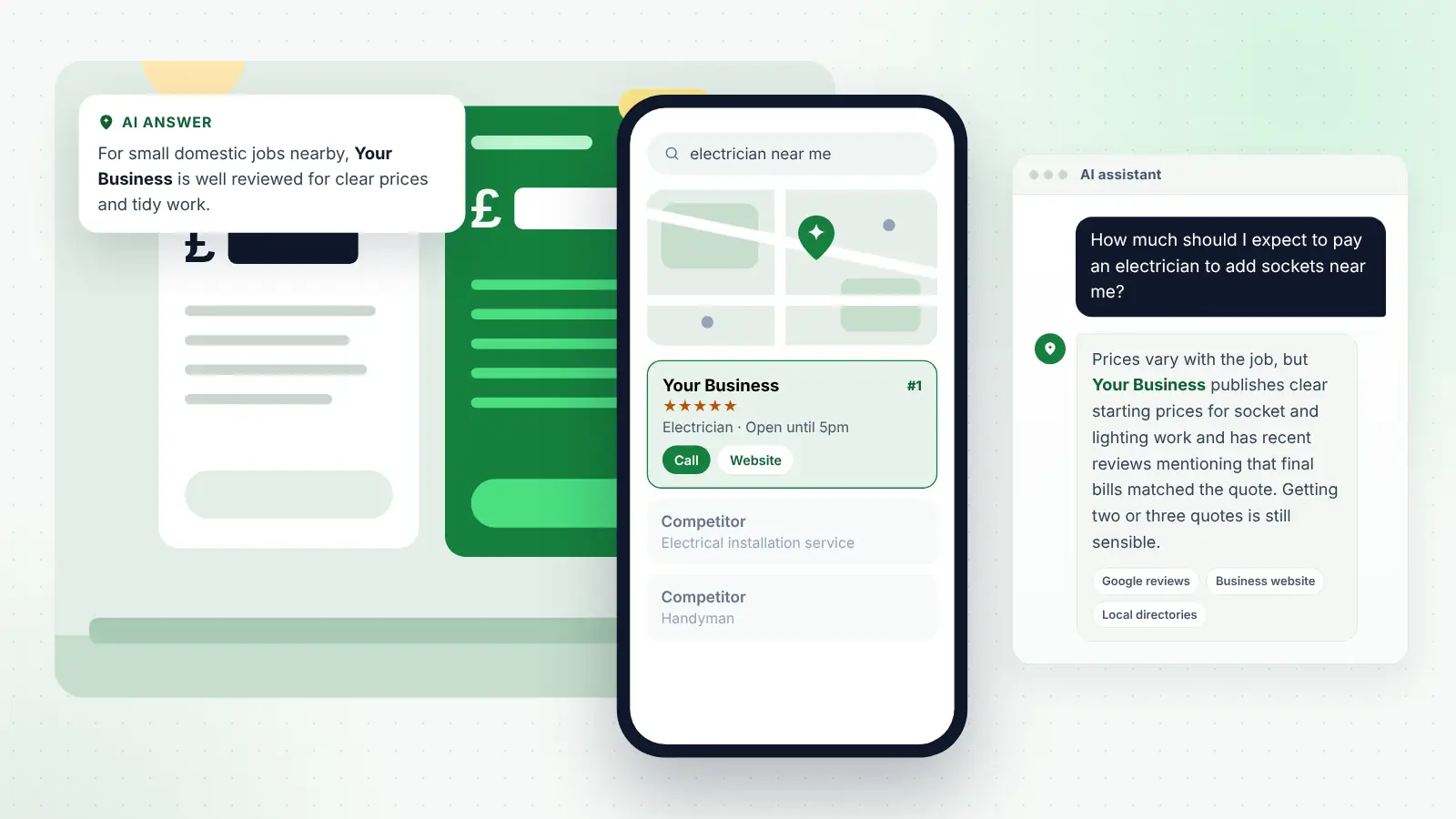
When someone searches for an electrician, a beautician or a physio nearby, Google usually shows a map with a short list of local businesses before any ordinary results. People compare those listings quickly, and price information is part of how they choose.
Your Google Business Profile lets you list services, and in many categories you can add descriptions and prices for each one. Use the same service names and prices as your website, so a customer sees one consistent story. Reviews matter here too: reviews that mention fair, clear pricing or a final bill that matched the quote are among the most reassuring things a new customer can read. You cannot write those reviews for customers, but you can earn them by being transparent and then asking every customer for honest feedback.
On your website, a dedicated prices page, or a short pricing section on each service page, answers the question most visitors arrive with. Pair it with service pages for each main job and area pages for the towns you cover, and keep your name, address and phone number identical across your site and directories. If you would rather have specialists handle that work, local SEO and AI search services for small businesses can take care of your profile, service pages and listings while you concentrate on running the business. Results from local SEO usually build over three to six months rather than overnight.
Pricing pages and AI assistants
More customers now ask ChatGPT, Gemini, Perplexity, Copilot or Google’s AI Overviews questions such as “how much does a sports massage cost in Leeds”, “what should I pay for a boiler service near me” or “which accountant in Bristol has fixed fees for sole traders”. The answers they give are assembled from whatever pricing details they can find online and judge reliable.
That favours businesses that publish clear, consistent information. If your website says a standard service starts at a certain price, explains what affects it, and your Google profile and directory listings say the same, an assistant has something solid to work with. If your prices are hidden, contradictory or years out of date, it may describe your business vaguely, use an outdated figure, or recommend a competitor whose information is clearer.
Practical steps:
- Write a short, plain-English FAQ on your pricing page answering the questions customers ask most, such as whether you charge for quotes, what the call-out charge covers and how you price larger jobs.
- Mention the towns and areas you serve alongside your prices, so location questions can be matched to you.
- Keep prices current everywhere after every review. Old figures cached on directories cause confusion.
- Encourage reviews that describe the job, which give AI tools real detail about your value and service.
None of this guarantees a mention, because AI assistants change how they choose and present businesses, but clear, consistent information gives you a far better chance than silence.
Frequently asked questions
Is it worth charging customers for a quote?
For straightforward jobs, most customers expect a free quote, and charging can put them off. For complex work that needs a detailed survey, design or diagnosis, such as a full kitchen design or a detailed tax planning meeting, a fee is reasonable, especially if you deduct it from the final bill when the customer goes ahead. Say so clearly before you visit.
How often should I review my prices?
At least once a year, and whenever a major cost changes, such as an insurance renewal, a new van or taking on staff. Small annual increases are easier for customers to accept than a large rise every few years.
Is it better to charge hourly or a fixed price?
Fixed prices are usually better for customers and for efficient businesses, as long as the job can be clearly defined. Hourly or day rates make sense where the work is uncertain. Many businesses quote fixed prices for standard work and hourly rates for investigation or repairs.
Can I show prices on my website without VAT?
If your customers are consumers and you are VAT registered, show prices including VAT, because that is what they will pay. If you only sell to businesses, prices excluding VAT are normal, provided you make that clear.
What if a competitor is much cheaper?
Check whether they are comparing like for like: insurance, guarantees, qualifications, materials and the time they spend. Then explain your value plainly in your quotes and on your website. You do not need to win every price-led customer, only enough of the right ones.
Do I have to include a call-out charge in my advertised price?
If every customer must pay it, it is effectively part of the price, so show it clearly upfront rather than revealing it later. Charges that only apply in some situations, such as out-of-hours visits or travel beyond your area, should be explained clearly where you show your prices.
Final thoughts
Good pricing starts with an honest sum: everything the business costs, the income you need, and the hours you can genuinely charge for. From there, choose models that fit each kind of work, show your prices clearly and lawfully, and review them every year. Customers rarely leave a business they trust over a modest, well-explained increase, and the businesses that last are almost always the ones that charged enough to look after their customers, their staff and themselves.