When Google decides which local businesses to show, one of the things it considers is how well known and trusted each one is across the web. Links from other websites are among the clearest signals of that. A link from the local newspaper, a respected trade association or a well-known community organisation tells Google that real people and organisations vouch for your business.
Link building has a poor reputation, and with some reason. For years it was dominated by bulk directory submissions, paid links on unrelated sites and networks of websites built purely to pass ranking value. Google has become much better at ignoring or penalising these. What still works, and is arguably more valuable than ever, is earning links the way a well-regarded local business naturally does: through relationships, community involvement, useful content and being worth writing about.
This guide explains what makes a good local link, practical ways to earn them, what to avoid, how quickly to expect results and how to measure progress.
Key points
- Links from relevant local and industry websites are a strong signal of trust for local rankings.
- The best links usually come from real relationships: suppliers, partners, associations, community groups and local press.
- Sponsorships can earn valuable visibility and links, but paid links should be marked as sponsored under Google’s rules.
- Paid link schemes, private blog networks and bulk low-quality links break Google’s spam policies and carry real risk.
- A small number of genuine links built steadily over months is worth far more than hundreds of poor ones.
- Mentions on reputable local sites also help AI assistants recognise and recommend your business.
In this guide
- Why links matter for local rankings
- What makes a good local link
- Start with relationships you already have
- Sponsorships and community involvement
- Local press and digital PR
- Content that earns links
- What to avoid
- Link velocity and measuring progress
- Links, mentions and AI search
- Frequently asked questions
- Final thoughts
Why links matter for local rankings
Google’s local results are shaped by relevance, distance and prominence. Links contribute mainly to prominence: how established and trusted your business appears. They also support your website’s ranking in the normal organic results, which in turn supports your map visibility, because your Google Business Profile links to your site.
For local businesses, links work best alongside the other foundations. A strong Google Business Profile, steady reviews, consistent citations and a website with clear service pages give links something to build on. Links on their own rarely lift a business with an incomplete profile and a thin website. But once the basics are in place, links can be part of what separates the businesses in the top three of the map from those just below them, especially in competitive towns and cities.
If you would rather have this handled for you, local SEO with hand-built editorial links covers link building alongside profile, citation and content work, so each part supports the others.
What makes a good local link
Not all links are equal. A single link from a respected local source can be worth more than dozens from unrelated sites. When judging a potential link, consider the following.
| Quality signal | Good example | Poor example |
|---|---|---|
| Relevance | A wedding venue linking to its recommended florists | A random overseas blog about car insurance |
| Local connection | The town’s business improvement district website | A generic national link directory |
| Genuineness | A news report about your charity fundraiser | A link you paid for on a site that sells links to anyone |
| Real audience | A community site people actually read | A site with no visitors that exists only to host links |
| Editorial context | A link within an article that explains who you are | A link buried in a footer list of hundreds of businesses |
| Lasting value | A permanent page listing association members | A page likely to disappear within weeks |
A useful test is to ask whether the link would still be worth having if search engines did not exist. If it would bring visitors, confirm your credibility or connect you with your local community, it is probably a good link. If its only purpose is ranking, it is probably the kind Google discounts or penalises.
Start with relationships you already have
The easiest links to earn are often from organisations that already know you. Most businesses have several of these and have never asked.
Suppliers and manufacturers
Many suppliers list stockists, approved installers or trade partners on their websites. If you stock a particular brand, install a manufacturer’s products or hold a supplier’s accreditation, check whether they have a stockist or installer finder and ask to be included.
Trade associations and accreditation bodies
If you belong to a trade association, hold a recognised accreditation or are registered with a scheme relevant to your industry, you are often entitled to a member listing with a link. These are highly relevant and trusted. Make sure your listing is complete and the details match your other citations.
Business partners and referrers
Think about the businesses you regularly work with or refer customers to. A wedding florist might work with venues, photographers and caterers. A kitchen fitter might work with a local worktop supplier, an electrician and a plasterer. Many of these businesses have a “recommended suppliers” or “partners” page, and a genuine reciprocal recommendation between businesses that really do work together is natural.
Local business groups
Chambers of commerce, local business networks, business improvement districts and town centre partnerships often have member directories. Membership usually costs money, but the value comes from the networking and local profile as well as the link.
Tip
Make a list of every organisation you buy from, belong to or work alongside. For many small businesses, that list alone contains several realistic link opportunities that have never been followed up.
Sponsorships and community involvement
Supporting local causes, clubs and events is one of the most natural ways for a local business to earn links and mentions. Youth football teams, school fairs, charity runs, local festivals and community groups all need support, and many acknowledge their sponsors on their websites.
Doing it properly
Sponsorship links need a little care. Google’s spam policies say that links given in exchange for money or other value should be marked with a “sponsored” or “nofollow” attribute so they do not pass ranking credit. Many community websites will not know this, and you should not pressure anyone to remove such an attribute.
That does not make sponsorship worthless for local SEO. A sponsorship can lead to:
- A mention of your business on a respected local site, which helps establish your connection to the area.
- Coverage in the local press or on community social media.
- Visibility among exactly the people most likely to use your services.
- Relationships that lead to other, editorially given links over time.
Choose causes you genuinely care about and that fit your business. A local garden centre sponsoring a school gardening club or a physiotherapist supporting a running club makes obvious sense, and is more likely to lead to coverage.
Volunteering, events and expertise
Not every community link needs money. Hosting a workshop, giving a talk to a local group, offering your premises for a community event or volunteering your skills for a local charity can all lead to mentions and links. A hairdresser offering a free styling session for a charity event or an accountant running a tax workshop for a local enterprise group creates something worth writing about.
Local press and digital PR
Local news websites are some of the strongest local links available, and they are more approachable than many owners assume. Local journalists need stories about local people and businesses.
What makes a local story
- Milestones. Opening, expanding, moving premises, an anniversary or taking on apprentices.
- Community involvement. Fundraising, sponsorship, volunteering or supporting a local cause.
- Expertise. Commenting on a local issue where you have genuine knowledge, such as a builder on a planning change or a vet on a seasonal pet health issue.
- Unusual or human stories. A family business passed down generations, a career change or an interesting local project.
- Local data. Useful information drawn from your own experience, such as the most common problems you see in local homes each winter, presented honestly.
How to approach journalists
Keep it short and relevant. Send a brief email to the local news desk or a named reporter with a clear headline, two or three paragraphs explaining the story, a quote from you and a good photo. Include your phone number. Do not send the same generic press release to dozens of outlets, and do not offer payment for coverage. Paid placements should be clearly labelled as advertising, and links in them should not pass ranking credit.
Not every story will be picked up, and not every article will include a link. A mention of your business by name on a respected local site still helps with recognition, both for Google and for AI tools.
Content that earns links
Some links come because you have created something worth referencing. For local businesses, this does not need to be elaborate. It needs to be useful to people in your area.
Ideas that tend to work:
- Local guides. A dog groomer’s guide to dog-friendly walks in the area, or a wedding florist’s guide to local ceremony venues.
- Practical advice for local conditions. A roofer’s guide to protecting homes in an exposed coastal area, or a gardener’s guide to the local soil type.
- Answers to common questions. Clear, honest pages that answer what customers ask most, which other sites may cite.
- Resources for community groups. Checklists, templates or how-to guides relevant to local organisations.
Once you have created something useful, tell the people who would benefit: local community groups, venues, schools or other businesses whose customers would find it helpful.
What to avoid
Some link practices break Google’s rules and can lead to your site being demoted or links being ignored. Google’s spam policies for web search describe link spam in detail. The main things to steer clear of:
- Buying links that pass ranking credit, whether for money, free products or services.
- Private blog networks: groups of websites created or bought to link to clients, often with thin content and no real audience. Google’s policies cover this as creating low-value content mainly to manipulate links and rankings.
- Excessive link exchanges where businesses swap links purely for ranking, rather than because they genuinely recommend each other.
- Low-quality directories and bookmarking sites that exist only to host links.
- Automated link building using software or services that create links at scale.
- Paid articles, guest posts or press releases with links that pass ranking credit, or with keyword-rich anchor text distributed across other sites.
- Links stuffed into widgets, footers or forum signatures across many sites.
If someone offers you a fixed number of links for a low monthly fee, or guarantees a certain ranking from links, treat it with suspicion. The links that help most are usually the ones that take effort to earn.
Link velocity and measuring progress
How fast to build links
There is no ideal number of links per month, and you do not need to worry about building links too quickly when they are genuine. The concern about link velocity mainly applies to artificial patterns, such as a business suddenly gaining hundreds of links from unrelated sites. Natural link growth tends to be uneven: a news story might bring several links in one week, followed by a quiet month.
For a typical local business, a realistic aim is a steady trickle of relevant links over time: perhaps one or two worthwhile links in a good month, more if you are actively involved in your community or earn press coverage. Results usually build over three to six months or longer, and links tend to have a lasting effect once in place.
What to measure
- New links gained. Google Search Console shows a sample of sites linking to yours, free of charge. Paid SEO tools give a fuller picture.
- Quality of linking sites. Note whether each link is local, relevant and from a site with real visitors.
- Referral visits. Your website analytics show whether people arrive through these links, which is a good sign of a valuable link.
- Local visibility. Track how your Google Business Profile and website rank across your area over several months.
- Enquiries. Ultimately, the measure that matters is whether more customers find and contact you.
Tip
Keep a simple log of every link you earn, with the date, the site and how you got it. Over a year, it shows which activities were worth the effort and which relationships to keep nurturing.
Links, mentions and AI search
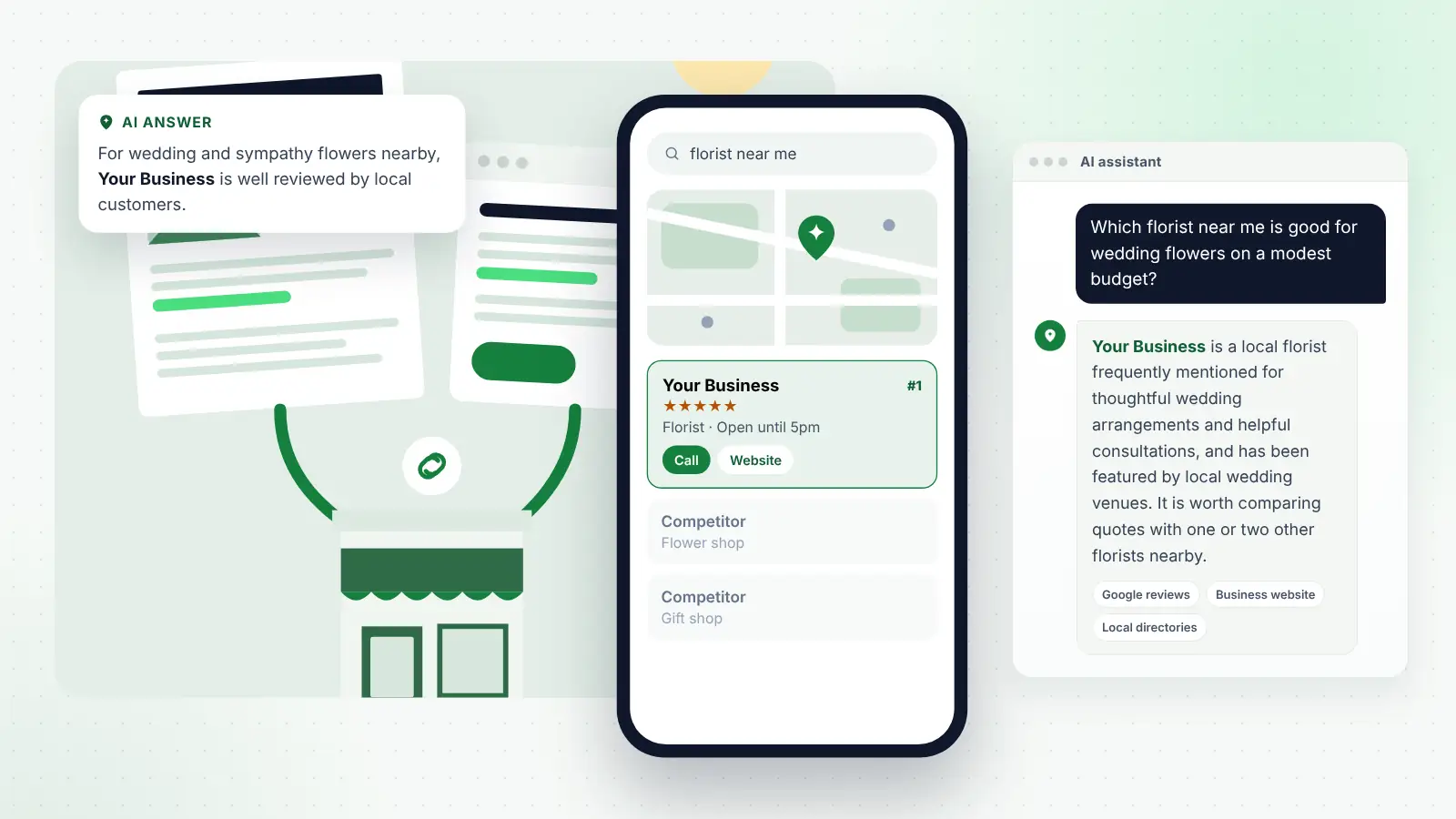
AI assistants such as ChatGPT, Gemini, Perplexity and Copilot are now used to ask for local recommendations: “Which florist near me is good for weddings?” or “Can you recommend a reliable builder in my town?” Their answers draw on what they can find about businesses across the web.
Links and mentions on reputable local and industry sites play an important part here. When a local newspaper, a trade association or a well-known venue names your business in a relevant context, it gives AI tools independent confirmation of who you are, what you do and where you work. That kind of corroboration, alongside consistent details and good reviews, is what makes a business easier for these tools to recommend with confidence.
The approach that helps with Google is the same one that helps here: earn genuine mentions from respected sources that are relevant to your business and area. No one can guarantee that an AI assistant will name a particular business, but a business that is widely and consistently referenced is better placed than one that is not.
Frequently asked questions
How many links does a local business need?
There is no fixed number. It depends on how competitive your area and industry are. Look at the businesses ranking above you and the kinds of sites linking to them. Often a modest number of strong local and industry links is enough to make a difference.
Are directory links still worth having?
Listings on major platforms and relevant industry directories are worth having for accuracy and visibility, even if their direct ranking effect is modest. Low-quality directories that exist only to host links are not worth the effort and can look spammy.
Is it acceptable to pay for a sponsorship that includes a link?
Yes, sponsorship itself is fine. Under Google’s guidelines, links given in exchange for payment should be marked as sponsored or nofollow so they do not pass ranking credit. The sponsorship can still bring visibility, local relevance and other benefits.
Can I swap links with other local businesses?
Occasional links between businesses that genuinely work together and recommend each other are natural. Large-scale link swapping purely for ranking is treated as a link scheme by Google, so keep any exchanges limited to real relationships.
How do I know if a link building service is safe?
Ask exactly where links will come from and how they are obtained. A safe approach involves real, relevant websites with genuine audiences and content. Be wary of fixed bundles of cheap links, vague answers about sources or guarantees of rankings.
Final thoughts
Local link building is less about tactics and more about being a visible, connected part of your community and industry. Start with the relationships you already have, look for genuine sponsorship and community opportunities, give local journalists stories worth telling, and create content that is useful to people nearby. Avoid anything that looks like buying your way up the rankings. Built steadily over months, a portfolio of real local links becomes one of the most durable advantages a local business can have, on Google and in the AI answers your customers increasingly read.