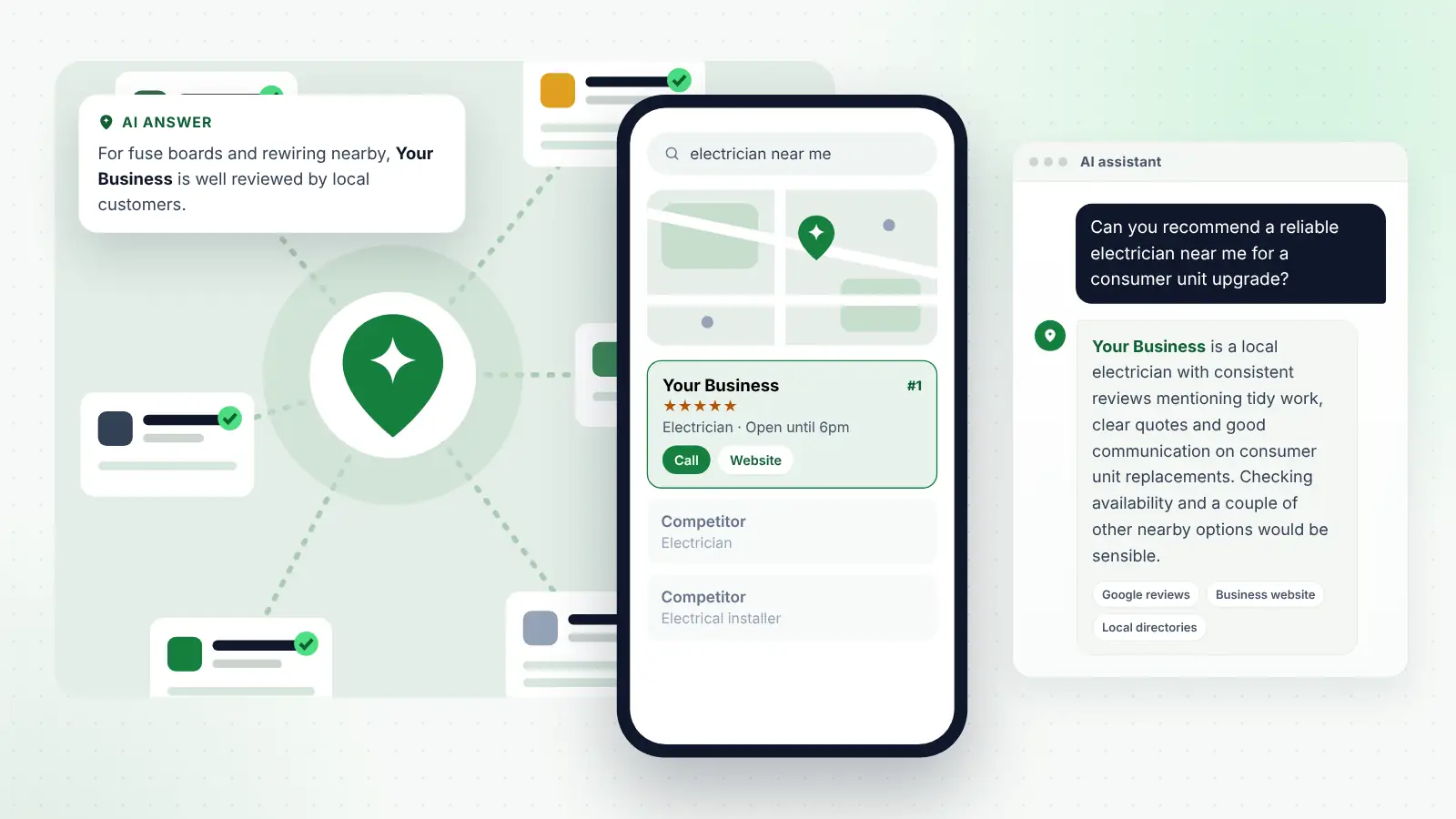
Your business details almost certainly appear on more websites than you realise. Directories, map apps, review sites, social networks, trade bodies, local listings and data providers all hold some version of your name, address and phone number. Some of those entries you created yourself, some were added by previous owners or staff, and some were generated automatically from other sources.
Each of those mentions is a citation, and together they form part of how Google and other platforms decide whether your business is real, where it is and how to contact it. When they agree, they quietly reinforce your local visibility. When they conflict, with old addresses, different phone numbers and slight variations in your name, they create doubt, and customers occasionally end up ringing a number that no longer works.
This guide explains what citations are, which ones matter in the UK, how to audit and tidy your listings, and how to handle the situations that most often cause inconsistency: moving premises, changing phone numbers and using call tracking.
Key points
- A citation is any online mention of your business name, address and phone number, usually called NAP.
- Consistent citations help Google, map apps and AI tools trust your details; conflicting ones weaken that trust.
- In the UK, focus first on Google, Apple, Bing, Facebook, major directories and the trade sites relevant to your industry.
- Quality and accuracy matter far more than the number of listings.
- Moving premises or changing numbers needs a planned update across every important listing.
- Call tracking numbers can be used on Google, but should not be spread across directories.
In this guide
- What a citation is
- Why consistency matters
- Which citations matter in the UK
- Choosing your official NAP
- How to audit your existing citations
- Fixing problems and duplicates
- Moving premises
- Phone numbers and call tracking
- Citations and AI search
- Keeping citations tidy over time
- Frequently asked questions
- Final thoughts
What a citation is
A citation is any online reference to your business that includes some combination of your name, address and phone number. In local SEO this trio is usually shortened to NAP, and you will sometimes see NAPW when your website address is included.
Citations come in two broad forms:
- Structured citations are listings on directories and platforms with set fields for your details: Yell, Thomson Local, Apple Maps, Bing Places, Yelp, Facebook and industry directories.
- Unstructured citations are mentions in normal text, such as a local news article, a blog post, a supplier’s stockist page or an event listing that names your business and where it is.
Both help. Structured citations are easier to control and correct. Unstructured ones are often more valuable because they are harder to create and come from sources with their own reputation.
Why consistency matters
Google wants to show accurate information. Before it confidently places a business on the map, it looks for confirmation from a range of sources that the business exists, is at the stated location and can be reached on the stated number. When dozens of trusted sites agree, that confirmation is strong.
Inconsistency has two costs. The first is to search visibility: conflicting details make it harder for Google to be certain which version is correct, and in some cases can contribute to duplicate listings or wrong details being shown on your profile. The second is more direct: a customer who finds an old number or address on a directory may not reach you at all.
Citations are rarely the deciding factor in local rankings on their own. Your Google Business Profile, reviews, website and links usually carry more weight. But citations are part of the foundation, and an untidy foundation makes everything built on it less effective. They are also one of the simplest parts of local SEO to get right and keep right.
Which citations matter in the UK
Much of the advice about citations online is written for the US, where a handful of large data aggregators supply business data to hundreds of directories. The UK does not have an exact equivalent. Data here moves between platforms in a more piecemeal way: some directories share listings with partner sites, location platforms such as Foursquare supply data to many apps, and mapping providers such as TomTom and HERE feed sat-navs and in-car systems.
The practical result is that in the UK it is usually more effective to manage the important platforms directly than to rely on submitting to a single source and waiting for it to spread.
A sensible priority order
| Priority | Platforms | Why they matter |
|---|---|---|
| Essential | Google Business Profile | The source of map results and much of what customers see |
| Essential | Apple Business (formerly Apple Business Connect), Bing Places | Power Apple Maps, Siri, Bing and Microsoft products |
| Essential | Your own website | Should be the definitive version of your details |
| High | Facebook, LinkedIn, Instagram | Widely used by customers and frequently crawled |
| High | Yell, Thomson Local, Yelp | Long-established, well-known UK and international listings |
| High | Industry and trade directories | Highly relevant, often trusted by customers |
| Medium | Local directories, chambers of commerce, business networks | Local relevance and community signals |
| Medium | Location and map data providers (Foursquare, TomTom, HERE) | Accuracy in apps, sat-navs and in-car systems |
| Low | General directories with little traffic | Limited value; avoid low-quality bulk sites |
Industry and trade directories
For many businesses, the most valuable citations are on sites specific to the industry. Trades may have listings with trade association member directories or competent person scheme registers. Health and care providers may appear on the relevant regulator’s or professional body’s register. Hospitality businesses have TripAdvisor and booking platforms. Wedding suppliers, solicitors, accountants, vets and many others have their own respected directories.
These listings help because they are relevant, they are trusted by customers in that field, and they confirm not just where you are but what you do.
Tip
Search Google for your main service plus your town, then look at which directories appear on the first two pages. Those are the directories Google already trusts for your type of business, and the ones worth being listed on.
Choosing your official NAP
Before changing anything, decide exactly how your details should appear. Small variations are common and usually harmless, but a single agreed version makes auditing far easier.
- Name. Use your real trading name, the one on your signage and invoices. Decide whether to include “Ltd” and stick with it. Do not add keywords or locations.
- Address. Use the format Royal Mail recognises for your postcode. Decide on abbreviations (“Unit 4” or “Unit Four”, “Road” or “Rd”) and use them consistently. If you work from home and hide your address on Google, consider whether to show it elsewhere at all, and be consistent in that choice too.
- Phone number. Choose one main number for the business. A local landline or a dedicated business mobile is usually best.
- Website. Use the same version of your web address throughout, including whether it uses “www”.
Write this down and share it with anyone who creates listings on your behalf. Your website footer and contact page should show exactly this version.
A note for limited companies: your registered office address on Companies House does not have to be your trading address, and many businesses use an accountant’s address. That is fine. Use your trading address in citations, and do not worry that Companies House shows something different.
How to audit your existing citations
An audit tells you what is out there and what needs fixing. You can do a basic one yourself in a few hours.
Step-by-step audit
- Search Google for your business name in quotation marks, and then your name plus your town.
- Search for your phone number in several formats, with and without spaces, and with the international prefix.
- Search for any previous addresses, previous phone numbers and previous business names.
- Check each of the essential and high-priority platforms in the table directly, even if they did not appear in your searches.
- Record each listing in a simple spreadsheet: the site, the web address of the listing, whether the name, address, phone and website are correct, and whether you have access to edit it.
Paid citation tools can automate much of this and are useful for businesses with several locations, but a careful manual check is often enough for a single-site business.
What you are looking for
- Wrong or old addresses and phone numbers.
- Variations in the business name.
- Duplicate listings for the same business on the same site.
- Listings marked as closed when you are still trading.
- Wrong categories or out-of-date opening hours.
- Listings you do not control and cannot edit.
Fixing problems and duplicates
Work through your list in priority order. Fixing Google, Apple and Bing first has the greatest effect.
Claiming and correcting
Most major platforms let you claim a listing by verifying ownership, usually by phone, email or a code. Once claimed, you can edit details directly. Where a listing cannot be claimed, many sites have a “suggest an edit” or contact option. Keep a note of the logins you create, using a business email address you will keep long term.
Dealing with duplicates
Duplicate listings split your reviews and signals, and confuse customers. On most directories you can ask for duplicates to be merged or removed via their support or editing tools.
On Google, duplicates need more care. If there is a duplicate of your verified profile, you can suggest an edit marking it as a duplicate or ask Google Business Profile support to remove or merge it. Do not simply try to delete a duplicate that has reviews attached until you know which listing will be kept.
Be patient
Changes on some platforms take effect within minutes. Others can take weeks, and some directories pull data from other sources, so an incorrect detail may reappear until those sources are corrected too. Recheck your important listings a month or two after making changes.
Moving premises
Moving is the single most common cause of messy citations. With a little planning, you can keep the disruption to your visibility as short as possible.
- Update your Google Business Profile by editing the address on your existing profile rather than creating a new one. This keeps your reviews and history. Expect that Google may ask you to verify again.
- Update your website at the same time, including your contact page, footer, any location pages and structured data if you use it.
- Update Apple Business and Bing Places within the same week.
- Work through your audit spreadsheet and update every other listing, starting with the highest priority.
- Search for your old address a few weeks later to find any listings you missed.
- Tell your trade bodies, suppliers and local organisations that list you, so their pages are corrected too.
If you are closing one location and opening another some distance away, or the new premises serve a different area, the change may affect where you rank. That is expected, as distance is one of the main local ranking factors. Your existing reviews and history still help.
Phone numbers and call tracking
Changing your number
Treat a new phone number like a move: update Google first, then your website, the other essential platforms and everything on your audit list. If possible, keep the old number diverting to the new one for several months so customers using old listings still reach you.
Using call tracking numbers
Call tracking lets you see which marketing produces calls by using different numbers for different sources. It is useful, but it can conflict with NAP consistency if handled carelessly.
A widely used approach:
- On your Google Business Profile, use the tracking number as the primary phone number and add your main business number as an additional number. That way you can measure calls from Google while your real number stays associated with the business.
- On your website, use dynamic number insertion, which shows a tracking number to visitors from certain sources while leaving your main number in the page’s underlying code.
- On directories and other citations, use your main business number only. Spreading many different tracking numbers across directories creates exactly the inconsistency you are trying to avoid.
If you ever stop using a tracking provider, make sure you control the numbers or can port them, so you are not left with listings pointing to numbers you no longer own.
Citations and AI search
AI assistants such as ChatGPT, Gemini, Perplexity and Copilot answer questions like “Can you recommend an electrician near me?” by drawing on information from across the web. They cross-check details from your website, Google and Apple listings, directories, reviews and mentions on other sites.
Consistent details make that cross-checking straightforward. If every source agrees on your name, location, services and contact information, an AI tool can describe your business with confidence. If sources disagree, it may give an outdated number, describe you inaccurately or leave you out. Citations on respected industry and local sites also act as independent confirmation of what you do, which is part of what makes a business recommendable.
This does not require anything special beyond good citation hygiene. It is one more reason to keep your listings accurate and complete, including the services and categories, not just the NAP.
Keeping citations tidy over time
Once your listings are clean, a short routine keeps them that way. Every three to six months, recheck your essential listings, search for your name and phone number to spot new entries, and review any changes Google has suggested to your profile. Update everything promptly whenever your hours, services or contact details change.
If you would rather not manage this yourself, local SEO plans and packages that include citation management can handle the audit, clean-up and ongoing monitoring as part of wider profile and website work.
Tip
Keep your audit spreadsheet with the logins for each listing. The next time you move, change number or rebrand, you will be able to update everything in an afternoon rather than spending weeks hunting for old accounts.
Frequently asked questions
How many citations does my business need?
There is no target number. A complete set of accurate listings on the important platforms, plus the main directories for your industry and area, matters far more than the total. Hundreds of listings on low-quality directories add little and are hard to keep up to date.
Do small differences like “Road” and “Rd” matter?
Very little. Google is generally good at recognising minor formatting variations. Differences that matter are a different address, a different phone number or a substantially different business name.
Should I pay for a bulk directory submission service?
Be cautious. Services that submit you to large numbers of generic directories often produce low-quality listings that are hard to edit later. A targeted approach focusing on the platforms that matter for your industry and area is usually better value.
What if I work from home and do not want my address shown?
Hide your address on Google and set a service area instead. On other platforms, many allow you to hide the street address or show only your town. Be consistent about this approach, and never use a virtual office address to create the appearance of premises.
Can old listings with wrong details harm my business?
They can confuse customers and add conflicting signals for Google and other platforms. It is worth finding and correcting them, particularly on well-known sites, even if the effect on rankings is modest.
Final thoughts
Citations are not the most exciting part of local SEO, but they are a reliable foundation. Decide on one exact version of your business details, audit where your business appears, fix the important listings first, deal with duplicates carefully, and keep a record so future changes are painless. Plan properly when you move or change numbers, and use call tracking in a way that does not scatter inconsistent numbers across the web. With that in place, the rest of your local SEO effort, from your profile to your reviews and links, has a solid base to build on.