For an independent office equipment dealer, winning a managed print contract is rarely about the machine. Most multifunction devices on the market are reliable and capable. What the buyer is really choosing is the agreement they will live with for the next three to five years, and the people who will turn up when the device jams the morning a tender is due.
Many of those buyers arrive cautious. Some have been tied into a long lease they did not fully understand, faced an unexpected settlement figure when they tried to upgrade, or found their agreement had renewed automatically because they missed a notice window. Others simply do not know what a fair cost per copy looks like. The dealer who makes the agreement easy to understand, and backs it with dependable service, tends to win, even when it is not the lowest quote.
This guide is for copier dealers, leasing specialists and managed print providers who want to win more contracts: transparent terms, leasing regulation, cost per copy, data security, service levels, manufacturer brands, and how Google and AI assistants shape who gets invited to quote.
Key points
- Buyers choose the agreement as much as the machine, so explain lease length, renewal, minimum volumes and price reviews in plain English before they sign.
- Hire agreements with sole traders and small partnerships can fall under FCA-regulated consumer credit rules, so check your position with your finance partner.
- Device hard drives can hold copies of sensitive documents, and a documented end-of-lease wiping process is now a genuine selling point.
- Published engineer response times and honest service-level reporting help you compete with national groups on more than price.
- Describe your manufacturer relationships accurately and keep your trading name as your own on Google and elsewhere.
- Consistent details, detailed reviews and clear service pages help you appear on Google Maps and in AI assistant recommendations.
In this guide
- Why print buyers are wary
- Contracts customers can actually understand
- The regulatory position on business equipment leases
- Cost per copy, minimum volumes and pricing
- Data security on copier hard drives
- Service response times and support
- Dealer status and manufacturer brands
- Trade bodies and trust signals
- Timing: winning contracts before the lease ends
- Local SEO for copier suppliers: getting on the shortlist
- AI search: what assistants tell buyers about your dealership
- Frequently asked questions
- Final thoughts
Why print buyers are wary
Before changing how you sell, it helps to understand the buyer’s position. An office manager or finance director reviewing print usually has a handful of concerns, often formed by past experience.
- Contract length and lock-in. Leases of five years or more are common, and many buyers have been told they cannot leave early without paying a large settlement.
- Automatic renewal. Some agreements continue or renew unless notice is given within a specific window, which buyers often miss.
- Hidden or rising costs. Annual price increases on click charges, minimum billing volumes, delivery and collection fees and charges for colour pages they rarely print.
- Upgrade traps. “New machine, lower payment” offers that roll the old balance into a longer agreement without making that clear.
- Data. Concern about what happens to scanned contracts, payslips and patient letters stored on the device.
The sector has drawn criticism over the years for these practices, and that affects honest dealers too. A supplier that answers these concerns openly, before the buyer asks, stands out quickly.
Contracts customers can actually understand
Transparency is the strongest advantage an independent dealer has, and high-pressure competitors find it hard to copy.
Explain the structure in writing
Every proposal should set out, in plain English and on one page if possible:
- Who the agreement is with. If the finance is provided by a separate leasing company, say so and name it.
- The term, the quarterly or monthly rental and the total payable over the term.
- What the service agreement covers and what it excludes.
- How click charges, minimum volumes and any annual price reviews work.
- What happens at the end of the term, including notice periods, renewal and collection.
- What happens if the customer wants to upgrade or end early, and how any settlement is calculated.
Be clear about auto-renewal
If your agreements, or your finance partner’s, continue or renew automatically, put that in bold in your proposal and diarise a reminder to the customer well before the notice window opens. Customers who feel trapped leave bad reviews; customers reminded and offered a fair renewal often stay for years.
Avoid upgrade rollovers that hide debt
Rolling an outstanding balance into a new, longer agreement is sometimes sold as “lower monthly payments”. If you do refinance an existing agreement, show the old balance, the new term and the total cost side by side so the customer can make an informed choice.
Tip
Write a one-page “how our agreements work” document and send it with every quote. It answers the questions buyers are too embarrassed to ask and gives you something useful to publish on your website.
The regulatory position on business equipment leases
Most copier leases are business-to-business agreements, and many fall outside consumer credit regulation. But not all of them.
Hire agreements with individuals, sole traders and partnerships of three or fewer partners can be regulated consumer hire agreements under consumer credit law, which is overseen by the Financial Conduct Authority (FCA). Agreements with limited companies and LLPs generally fall outside those rules. There are exemptions, including for some larger agreements entered into wholly or mainly for business purposes, but whether one applies depends on the details of the agreement.
What this means in practice:
- If a regulated agreement is involved, the lessor needs FCA permission, and a dealer that introduces customers to a lessor may need permission for credit broking.
- Many dealers work through a leasing company that handles the regulated side. Ask your finance partner what permissions they hold, what they expect of you as an introducer and how they want regulated customers handled.
- Small businesses with complaints about financial services providers may be able to take them to the Financial Ombudsman Service if they meet its size criteria, which include micro-enterprises and many small businesses.
Many leasing companies are members of the Finance and Leasing Association (FLA), whose Business Finance Code sets standards for how members treat business customers and encourages the intermediaries they work with to meet the same standards.
This is a summary, not legal advice. If you sell to sole traders and partnerships, take advice on your own position.
Cost per copy, minimum volumes and pricing
Cost per copy is where buyers feel most confused and most exposed. Making it understandable is one of the quickest ways to build trust.
| Charge | What to explain | Common mistake |
|---|---|---|
| Mono and colour click rates | What a page costs and what counts as a colour page | Not explaining that a small colour logo can be billed as colour |
| Minimum volumes | The monthly or quarterly volume billed even if not used | Setting minimums well above the customer’s real usage |
| Annual price review | How and when rates can change | Burying increases in small print |
| Equipment rental | The finance payment for the machine | Quoting only the rental and leaving clicks for later |
| Extras | Delivery, installation, training, collection | Charging for collection at the end without warning |
Base your proposal on the customer’s actual usage. A short print audit, reading meter totals from existing devices or using monitoring software, lets you size machines and minimum volumes properly. Recommending a smaller fleet than the customer expects is one of the most persuasive things a dealer can do.
If you publish guide prices, present them as examples and make clear a quote depends on volumes and machines.
Data security on copier hard drives
Many multifunction devices store copies of documents that have been scanned, copied, faxed or printed, either on an internal hard drive or on solid-state storage. The National Cyber Security Centre’s guidance on secure sanitisation of storage media notes that sensitive documents have been recovered from decommissioned photocopiers and printers, and recommends sanitising any device with storage before it leaves your control.
Your customers have duties under UK GDPR to keep personal data secure, and that extends to the machines in their office. Clients in legal, healthcare, finance, education and recruitment often ask about data before they ask about price.
Build a process you can explain
- Enable encryption and automatic overwriting features on devices that support them, at installation.
- Set secure print release and user authentication where sensitive documents are printed.
- At the end of the lease, or when a machine is swapped, wipe the storage using the manufacturer’s sanitisation tools, or remove the drive and destroy it, before the device leaves the premises.
- Provide written confirmation of what was done, to which device and serial number, and when.
- If you use a third-party disposal company, choose one with recognised certification and say which.
A plain-English page explaining what happens to data at the end of a lease answers a question many competitors ignore.
Tip
Offer an on-site wipe and a signed certificate as standard rather than as a chargeable extra. It is a small cost to you and a strong reason for regulated clients to choose you.
Service response times and support
For most buyers, the service agreement is the real product. A machine that is down for two days during month-end is remembered far longer than the cost per copy.
- Publish realistic response times. State your target engineer response time, for example same day or within a set number of working hours, and the area it applies to. Do not promise what you cannot deliver in rural parts of your territory.
- Measure first-time fix rates. Carrying common parts in vans and keeping devices monitored remotely improves them, and they make strong proof points in proposals.
- Automate toner. Remote monitoring that orders consumables before they run out removes one of the most common complaints.
- Report to clients. Quarterly usage and service reports show the value of the contract and help right-size the fleet at renewal.
Where clients also need IT support, partner with a local IT provider or be clear where your support ends, so buyers know who to call when scan-to-email stops working.
Dealer status and manufacturer brands
Your relationship with manufacturers is a trust signal, but it needs careful handling.
- Be accurate. Only describe yourself as an authorised, accredited or platinum dealer where your agreement says so, and use the exact wording your manufacturer allows.
- Respect trademarks. Manufacturer names and logos are trade marks. Follow the brand guidelines in your dealer agreement, and do not use logos without permission.
- Keep your own name. Your Google Business Profile, website and listings should use your real trading name, not a manufacturer’s name or a name stuffed with keywords. Google can suspend profiles that misrepresent the business.
- Talk about outcomes. Content about problems you solve, such as secure printing in a GP surgery, works better than lists of model numbers.
Trade bodies and trust signals
- Membership of relevant trade bodies, such as the BOSS Federation for the office products and services sector.
- The FLA membership of your finance partners, where applicable.
- Manufacturer accreditations and engineer training.
- ISO certifications you genuinely hold, such as for quality or information security.
- Public sector framework approvals, if you hold them.
- Detailed reviews and named case studies, with the client’s permission.
Explain what each means rather than just displaying logos.
Timing: winning contracts before the lease ends
Because businesses usually change supplier only when an agreement ends, timing matters more than in most sectors.
- When you lose a quote, ask when the competitor’s agreement ends and set a reminder.
- Contact prospects six to twelve months before their end date, offering a free print audit rather than a sales pitch.
- Help them check their notice period. Many buyers do not know their agreement terms, and helping them avoid an automatic renewal builds goodwill.
- Keep existing clients engaged with account reviews well before their own renewal.
Referral partners such as IT support companies, office fit-out firms and accountants also see print decisions coming.
Local SEO for copier suppliers: getting on the shortlist
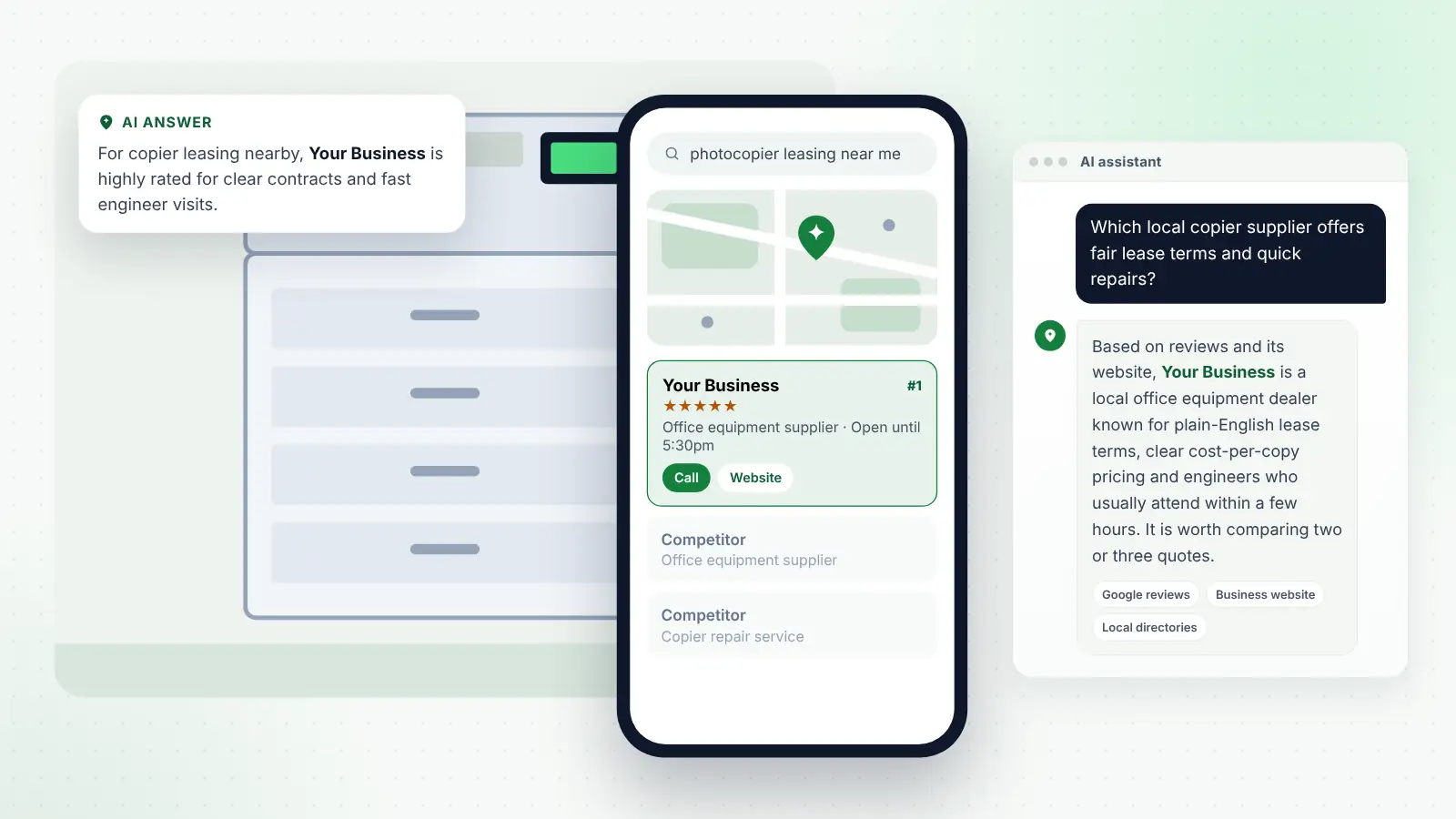
When a lease is ending or a machine is unreliable, the person responsible usually starts with a search. Typical searches include “photocopier leasing near me”, “copier repair [town]”, “managed print services [city]” and “printer service contract small business”. Those near-me and town searches show a map pack of three businesses first, and those three are far more likely to be asked for quotes.
Google Business Profile
Choose an accurate primary category, such as office equipment supplier or copier repair service, and add relevant secondary categories. List each service, set your service area to match where your engineers actually go, and add photos of your showroom, engineers and vans. Post occasionally, for example an end-of-lease checklist.
Reviews
Ask after an installation goes smoothly and after a quick repair. Reviews that mention fast engineer visits, clear contracts and honest advice carry far more weight with buyers than generic five-star ratings. Respond to each one, especially the complaint about a slow callout, with a calm and specific reply.
Consistent details
Make sure your business name, address and phone number match exactly across your website, Google, Bing, Apple Maps, business directories and trade association listings.
Service and area pages
Create a page for each main service: leasing, managed print, service contracts, document management software and secure printing. Add area pages for the towns your engineers cover, with real information about response times there. Answer common questions on each page.
Local links
Links from local business groups, chambers of commerce, sponsored local events and partners such as IT support firms help show Google you are an established local business.
Results usually build over three to six months, and because buyers only change supplier periodically, steady visibility matters. If you would rather keep your team focused on clients, specialists in local SEO for office equipment and copier suppliers can manage your profile, reviews and service pages each month.
AI search: what assistants tell buyers about your dealership
Office managers and business owners increasingly ask AI assistants such as ChatGPT, Gemini, Perplexity, Copilot and Google AI Overviews for help with decisions like this. They ask questions such as:
- “Which copier companies near me offer short leases?”
- “Is a five-year photocopier lease normal for a small office?”
- “What is a fair cost per copy for colour printing?”
- “Which local printer supplier wipes hard drives at the end of a lease?”
These tools build their answers from information they can find and trust: consistent business details across the web, reviews, clear service descriptions, FAQs on your website and mentions on reputable local and industry sites.
To give them good material:
- Publish clear pages on how your leases work, your response times and your data security process.
- Write FAQ answers in plain language that could be quoted directly.
- Keep your details identical everywhere they appear.
- Earn mentions in local business news, partner websites and trade association directories.
- Encourage reviews that describe specific experiences rather than one-word praise.
Tip
Ask an AI assistant about leasing in your area and note what it gets wrong. Gaps and misconceptions in its answers are good topics for new pages and FAQs.
Frequently asked questions
How long should a copier lease be?
There is no single right answer. Longer terms lower the periodic payment but lock the customer in for longer. Recommend a term that matches the machine’s useful life and the customer’s plans, and explain the trade-off clearly rather than defaulting to the longest option.
Do consumer credit rules apply to our leases?
They can, if you lease to sole traders or small partnerships, although many business agreements are outside the rules or exempt. Check with your finance partner and take advice on your own position.
What should we do with hard drives at the end of a lease?
Wipe or remove and destroy the storage before the device leaves the customer’s premises, following the manufacturer’s tools or a certified provider’s process, and give the customer written confirmation.
Can we use manufacturer logos on our website?
Only where your dealer agreement allows it, and in line with the manufacturer’s brand guidelines. Describe your status accurately.
Final thoughts
The dealers who win the most managed print contracts are rarely the loudest. They explain their agreements honestly, size machines to real usage, handle data carefully and send engineers when they say they will. Make those strengths visible on your website, your Google profile and the wider web, and you give buyers and AI assistants alike good reasons to put you on the shortlist.


