Insulation is one of the simplest ways to make a home warmer and cheaper to heat, and the UK has millions of homes with thin loft insulation, uninsulated floors and solid walls that lose heat all winter. Homeowners, landlords and housing providers all need installers who can recommend the right measure and fit it properly.
It is also a trade going through a period of change. The Great British Insulation Scheme (GBIS) closed on 31 March 2026, ECO4 is due to end on 31 December 2026, and the government’s Warm Homes Plan is moving support towards grants rather than energy supplier obligations. At the same time, cold calling, poorly fitted cavity insulation and spray foam problems have left many homeowners wary of the whole sector.
This guide covers how to start an insulation business in the UK as things stand in October 2026: the services to offer, the accreditations that matter, how funded and private work differ, spray foam and mortgage issues, VAT, honest marketing, costs and how to make sure local customers can find you.
Key points
- Most government-funded insulation work requires TrustMark registration and PAS 2030 certification, with a PAS 2035 retrofit coordinator overseeing each project.
- GBIS closed on 31 March 2026 and ECO4 is due to end on 31 December 2026, so plan for a business built mainly on private, self-funded customers.
- Insulation installed in homes is zero-rated for VAT until 31 March 2027, after which the reduced 5% rate applies.
- Cavity wall insulation from a registered installer can carry a 25-year CIGA guarantee, which homeowners and lenders recognise.
- Spray foam removal is a growing specialism, but surveys, mortgage lending and roof timbers all need careful handling.
- Honest marketing, without cold calls or “free insulation” claims, is now one of the strongest competitive advantages in the trade.
In this guide
- Loft, cavity, solid wall and floor: where the work is
- Accreditations: TrustMark, PAS 2030 and PAS 2035
- Cavity wall insulation and CIGA guarantees
- ECO4, GBIS and the Warm Homes Plan
- Spray foam removal and mortgage issues
- VAT on insulation
- Selling honestly in a trade with a cold-calling problem
- What it costs to get your first insulation van on the road
- Pricing your work
- Local SEO for insulation installers
- AEO and AI search for insulation businesses
- Frequently asked questions
- Final thoughts
Loft, cavity, solid wall and floor: where the work is
Insulation businesses typically offer some or all of the following:
- Loft and room-in-roof insulation. Top-ups, new installations, boarding on raised legs and insulating sloping ceilings. Quick jobs that often lead to further work.
- Cavity wall insulation. Injecting blown mineral wool, beads or other approved materials into suitable cavity walls, and extracting failed or unsuitable insulation where it has caused damp.
- Underfloor insulation. Insulating suspended timber floors from below or above, a valuable service in older homes.
- Internal wall insulation. Insulating solid walls from the inside with boards or systems, often alongside replastering and redecoration.
- Spray foam removal. Removing spray foam from the underside of roofs where it is causing problems with mortgages, surveys or timber condition.
External wall insulation usually sits with rendering and cladding specialists, and many insulation businesses partner with them rather than offering it directly.
Customers include homeowners responding to bills or an EPC, buyers dealing with survey findings, landlords meeting minimum energy efficiency standards and housing providers running retrofit programmes.
Accreditations: TrustMark, PAS 2030 and PAS 2035
There is no general licence to install insulation, but government-funded work has strict quality requirements, and private customers increasingly look for the same signals.
PAS 2030 and PAS 2035
PAS 2030 is the installation standard. It sets out how energy efficiency measures should be installed, and installers must be certified against it by an accredited certification body for each measure they fit, such as loft or cavity wall insulation.
PAS 2035 is the framework for the whole retrofit process. It requires a retrofit assessment of the home, a design, and a retrofit coordinator who oversees the project from assessment to evaluation. TrustMark guidance issued in late 2024 clarified how often coordinators must visit sites under PAS 2035:2023. You do not need to be a retrofit coordinator yourself, but you need to work alongside one on funded jobs.
TrustMark
TrustMark, the government-endorsed quality scheme for home improvement trades, matters a great deal in insulation. Installers on government-funded schemes such as ECO4 must be TrustMark registered, and TrustMark has tightened its compliance requirements following problems with some installations. For private customers, TrustMark registration is a recognisable sign that your business is vetted.
Other trust signals
- Manufacturer approvals for the systems and materials you install.
- Product certificates from bodies such as the BBA, showing materials are certified for their intended use.
- Trade association membership, for example the National Insulation Association.
- Insurance, including public liability, and employers’ liability once you take on staff.
Cavity wall insulation and CIGA guarantees
Cavity wall insulation is one of the most effective measures for suitable homes, but it is also where the trade’s reputation has been damaged most. Installing it in walls exposed to severe wind-driven rain, with defective pointing or render, or with blocked or narrow cavities can lead to damp problems that are expensive to fix.
The Cavity Insulation Guarantee Agency (CIGA) provides independent 25-year guarantees for cavity wall insulation fitted by its registered installers. If problems arise from materials or workmanship, CIGA works with the installer to put them right, and can step in if the installer is unable to. Homeowners, surveyors and conveyancers recognise CIGA guarantees, so registering is worth serious consideration if cavity work will be a core service.
Good practice before any cavity installation includes:
- Checking the walls. Cavity width, construction and any existing insulation, using a borescope where needed.
- Assessing exposure. Wind-driven rain and the condition of brickwork, pointing and render.
- Checking for defects. Gutters, downpipes, damp-proof courses and air bricks that must stay clear.
- Recording everything. Photos and the reasons a wall is or is not suitable.
Cavity extraction is also a legitimate and growing service. Homes where insulation has failed or was unsuitable need it removed carefully and the cause addressed before any reinstatement.
Tip
Tell customers when their walls are not suitable for cavity insulation. A short written note explaining why, and what the alternatives are, protects you and is exactly the kind of honesty that earns reviews and referrals.
ECO4, GBIS and the Warm Homes Plan
For years, much insulation work was funded through energy supplier obligations. That is changing, and a new business needs to plan around it.
Where the schemes stand
- GBIS closed on 31 March 2026 and was not extended.
- ECO4 was extended by nine months and is due to end on 31 December 2026. The government has confirmed that ECO will not be replaced by a new energy supplier obligation, with support moving to publicly funded schemes.
- The Warm Homes Plan, published in January 2026, sets out around £15 billion of public funding for home upgrades over this Parliament, including grants for low-income and fuel-poor households, support for social housing and low-interest loans to help other households upgrade their homes.
The government also consulted between June and September 2026 on reforming consumer protection for home upgrade schemes, so expect further changes to how funded work is checked. Schemes also differ in Scotland, Wales and Northern Ireland, so check what applies in each nation you work in.
What this means for a new business
Funded work can still be part of the mix, but it brings compliance costs, paperwork and payment terms set by others, and depending on one scheme is risky when schemes start and stop. A more resilient model combines private customers with a smaller share of funded or social housing work. Check GOV.UK and Ofgem for the latest scheme rules.
Spray foam removal and mortgage issues
Spray foam applied to the underside of roofs was widely sold as a quick fix, but many homeowners now find it causes problems when they sell or remortgage. Some lenders will not lend, or will only lend with further evidence, on homes with spray foam, and surveyors may ask for an independent specialist report.
The RICS consumer guide to spray foam insulation explains that spray foam can affect a surveyor’s opinion of value, that it can hide roof timbers and make defects harder to spot, and that it should be treated as a permanent installation because removal can damage the structure. It also warns homeowners about unsolicited cold-call offers to sell or remove spray foam.
If you offer removal:
- Inspect before quoting. Assess the foam, how it was applied and the visible timbers.
- Be clear about what removal involves. Explain that some timbers or the roof covering may need repair once the foam is off, and that you cannot know the full picture until it is removed.
- Provide good evidence. Before-and-after photos, a written report and details of any replacement insulation and ventilation help customers with their lender and buyer.
- Do not overstate outcomes. Lending decisions are made by lenders, not installers. Avoid promising that removal will guarantee a mortgage or sale.
VAT on insulation
Insulation installed in residential accommodation in Great Britain and Northern Ireland is currently zero-rated for VAT, with the zero rate running until 31 March 2027. From 1 April 2027 it is due to revert to the reduced rate of 5%. The rules on what counts as an energy-saving material and when the relief applies are set out in HMRC’s VAT Notice 708/6 on energy-saving materials.
Show clearly whether your prices include VAT, and ask an accountant how the relief applies to mixed jobs that include general building or decorating work.
Selling honestly in a trade with a cold-calling problem
Many homeowners have had calls or doorstep visits offering “free insulation” or “government grants”. If your marketing looks anything like that, customers will assume the worst.
Cold calling and the law
Unsolicited marketing calls are restricted under the Privacy and Electronic Communications Regulations, and calling numbers registered with the Telephone Preference Service without consent is unlawful. Consumer law also bans misleading claims and aggressive selling, and the Digital Markets, Competition and Consumers Act 2024 strengthened enforcement. Many councils run no-cold-calling zones and Trading Standards regularly warns residents about insulation scams.
What honest marketing looks like
- No cold calls or doorstep selling. Let customers come to you through search, referrals and reputation.
- No “free insulation” claims. Explain who may be eligible for funding, what they will pay and what the funding conditions are.
- Realistic savings. Avoid promising specific savings on bills. Refer customers to independent sources for typical estimates.
- Written quotes and cancellation rights. For many contracts agreed in a customer’s home, the Consumer Contracts Regulations give a 14-day cancellation period, which must be explained in writing.
- Clear guarantees. Say what is covered, for how long and who backs it.
Tip
Add a short “How we work” page to your website stating that you never cold call, explain any survey fee upfront and always quote in writing. It answers the question many customers are too polite to ask.
What it costs to get your first insulation van on the road
You can start with loft and underfloor work and add cavity, internal wall and spray foam removal as your skills and accreditations grow. These figures are rough guides and vary by supplier and area.
| Item | Typical cost | Notes |
|---|---|---|
| Van | £8,000–£20,000 | Must carry bulky rolls and sheets |
| Blowing machine | £3,000–£15,000 | For cavity and blown loft work; used units available |
| Access and survey kit | £500–£2,000 | Ladders, crawl boards, borescope, thermal camera |
| Hand and power tools | £800–£2,500 | Cutting, fixing and boarding tools |
| PPE and dust control | £300–£1,000 | Respirators, coveralls, eye protection, extraction |
| PAS 2030 certification | Varies | Annual fees and audits per measure |
| TrustMark registration | Varies | Annual fee, plus scheme provider costs |
| Insurance (first year) | Varies | Public and employers’ liability |
Training in working at height, asbestos awareness and confined spaces such as underfloor voids is also important.
Pricing your work
Price loft work by area and depth, including clearing, boarding and access, and cavity work by wall area and property type after a survey. Underfloor and internal wall insulation are best priced per project, including lifting floors or replastering. Break quotes down so customers can see what is included, and publish guide prices for typical jobs while making clear a survey confirms the final figure.
Local SEO for insulation installers
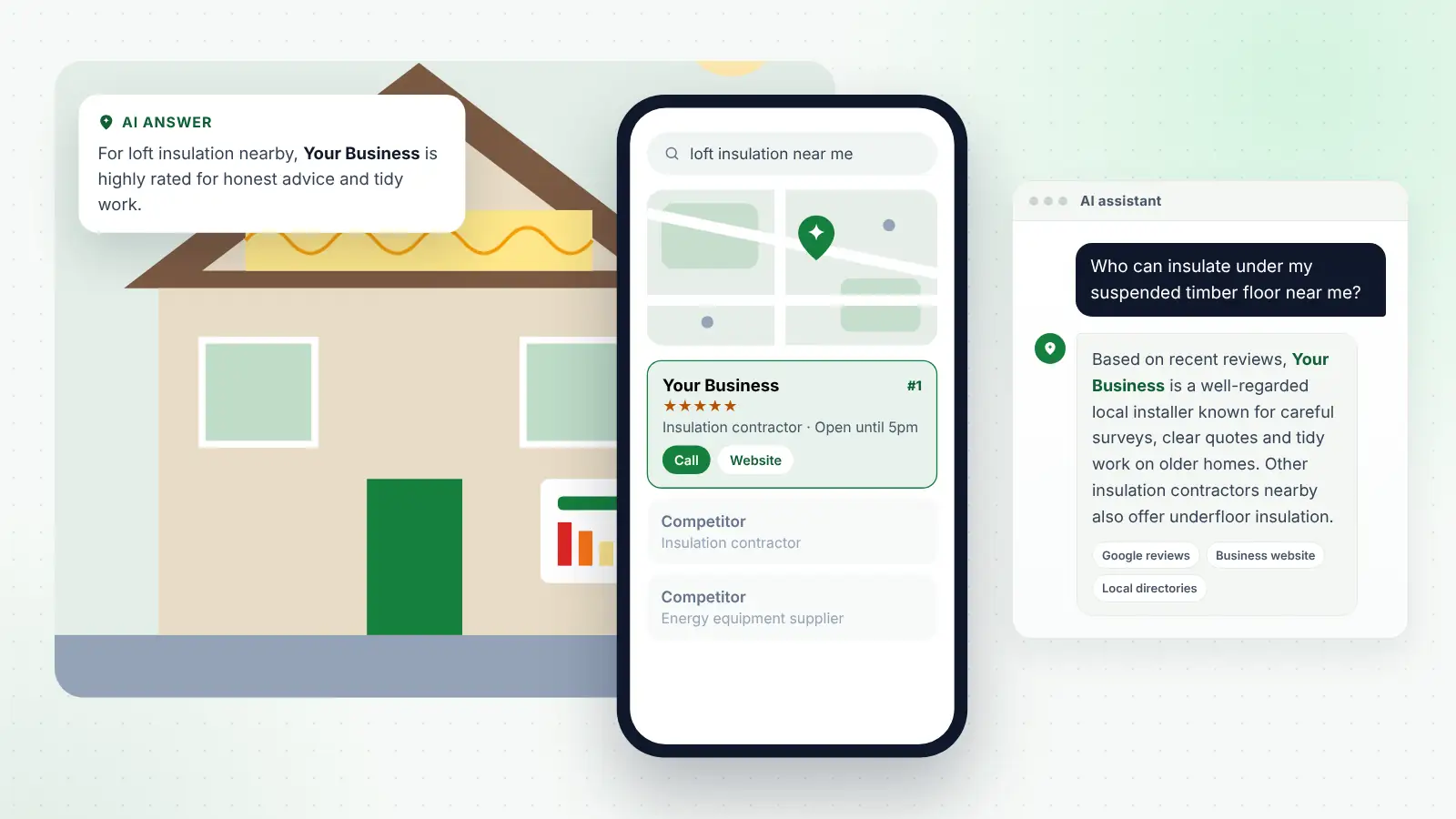
Most insulation searches are local. Someone notices their loft is half-empty, receives a high energy bill or reads a survey note about spray foam, then searches “loft insulation near me”, “cavity wall insulation installers [town]”, “underfloor insulation suspended floor”, “spray foam removal near me” or “internal wall insulation cost”. They usually compare a few businesses on the map, read the reviews and look for accreditations before they call.
The essentials:
- Complete your Google Business Profile. Choose an accurate primary category such as insulation contractor, list each service, set your service area and keep your hours current. Add real photos of lofts, floors and finished work, with permission.
- Show your credentials. Mention TrustMark, PAS 2030, CIGA, manufacturer approvals and insurance on your profile, website and listings.
- Collect detailed reviews. Reviews that mention tidy work, clear explanations and a warmer home are persuasive. Never offer incentives for positive reviews or post reviews yourself.
- Keep your details consistent. Your business name, phone number, website and area should match across Google, Bing, Apple, directories and the TrustMark register.
- Build service and area pages. Separate pages for loft, room-in-roof, cavity, underfloor, internal wall insulation and spray foam removal, plus pages for the main towns you cover.
- Earn local links. Trade association listings, local business groups, community energy groups and partner businesses all help.
You can do this yourself, or have specialists take it on while you focus on installations. Our page on local SEO for insulation installers explains how that works for sole traders and growing firms. Results usually build over three to six months, so start in spring or summer to be well placed for the autumn rush.
AEO and AI search for insulation businesses
Many homeowners now ask an AI assistant before contacting anyone. They might use ChatGPT, Gemini, Perplexity or Microsoft Copilot, or read an answer in Google AI Overviews, with questions such as:
- “Is my house suitable for cavity wall insulation?”
- “How thick should loft insulation be?”
- “Can I get insulation grants now ECO4 is ending?”
- “Who removes spray foam insulation near me?”
- “Is underfloor insulation worth it in a Victorian house?”
Answer engine optimisation (AEO) means giving these tools accurate, consistent information they can trust and repeat. For insulation businesses, that usually means:
- Consistent business information across every directory, listing and profile.
- Reviews that describe the job, the home and the result in the customer’s own words.
- Clear service descriptions that say exactly which measures you install, for which types of property and in which areas.
- Honest FAQs about suitability, costs, VAT, funding, guarantees and spray foam, with dates on anything time-sensitive.
- Mentions on reputable sites, such as trade body listings, local news, community energy groups and partner businesses.
Customers in this trade are wary of being misled, and AI answers tend to reflect cautious advice, so balanced, up-to-date content fits well. Nothing guarantees a recommendation, but the work overlaps closely with good local SEO.
Frequently asked questions
Do I need a licence to install insulation?
No general licence is needed for private work, but government-funded schemes require TrustMark registration and PAS 2030 certification for each measure. Customers increasingly expect the same standards, so working towards them from the start makes sense.
Is there still funded insulation work after ECO4?
ECO4 is due to end on 31 December 2026 and will not be replaced by a new supplier obligation, and GBIS has already closed. The Warm Homes Plan includes grant funding for low-income households and other support, but details and delivery routes are still developing, so check GOV.UK for current schemes.
Is spray foam removal a good service to offer?
It can be, as demand from homeowners facing mortgage or sale problems is real. It requires careful inspection, honest explanations about possible timber or roof repairs, and good written evidence for lenders and buyers.
Will VAT go up on insulation?
The zero rate for insulation in homes runs until 31 March 2027, after which it is due to return to 5%. Make sure your quotes show the rate clearly, especially for jobs booked close to that date.
Final thoughts
An insulation business that surveys carefully, recommends only suitable measures and sells honestly has a real advantage in a trade where trust has been damaged. Get your accreditations in place, understand where funding is heading, take spray foam and cavity work seriously, and make your written quotes and reports something customers are glad to share.
Then make sure people can find you. Keep your Google Business Profile accurate, collect detailed reviews, publish clear and dated advice, and build relationships with retrofit coordinators, surveyors, builders and landlords who will send steady work your way.