New windows and a new front door change how a home looks, how warm it feels and how secure it is. For most homeowners it is a large purchase they make only once or twice, so they research carefully, collect several quotes and pay close attention to who they let through the door. That caution is a challenge for a new installer, but it is also an opportunity: homeowners actively want a local company they can trust, and a well-run independent business can earn that trust quickly.
The trade has a mixed reputation from the days of aggressive doorstep selling, and customers have long memories. The installers who do well today are the ones who are certified, explain their guarantees clearly, quote honestly and fit neatly. None of that requires a huge budget, but it does require getting the foundations right before your first job.
This guide covers the practical steps to starting a window and door installation business in the UK: the building regulations that apply to replacement work, competent person schemes, consumer law, guarantees, equipment and costs, how to win your first customers and how to make sure homeowners find you on Google and in AI assistants.
Key points
- In England and Wales, replacement windows and doors must meet building regulations, and joining a competent person scheme such as FENSA or Certass lets you self-certify your work.
- Replacement work must not make energy efficiency, ventilation, means of escape or safety glazing worse than before, so you need to understand the relevant Approved Documents.
- Most installations are sold in the customer’s home, which usually gives the customer a 14-day right to cancel under the Consumer Contracts Regulations.
- An insurance-backed guarantee and protection for customer deposits are expected by homeowners and often required by schemes and trade bodies.
- Local SEO and AI search visibility matter because homeowners compare reviews, photos of real installations and accreditations long before they ask for a quote.
In this guide
- Decide what kind of installer you want to be
- Experience, skills and training
- Building regulations, FENSA and self-certifying your installs
- Consumer law, cancellation rights and contracts
- Guarantees, deposit protection and trade bodies
- Insurance, business set-up and suppliers
- Van, tools, access kit and what it all costs
- Pricing, surveys and winning your first jobs
- Local SEO: getting homeowners nearby to find your glazing firm
- Getting recommended by AI assistants (AEO)
- Keeping the fitting diary full as you grow
- Frequently asked questions
- Next steps
Decide what kind of installer you want to be
The window and door market covers several quite different businesses, and it helps to be clear from the start which one you are building. Your choice affects your products, suppliers, equipment, insurance and the customers you target.
Common routes include:
- Independent fitter or subcontractor. You install for other companies, retailers or builders. It is a lower-risk way to start because someone else sells the job, but margins are thinner and you depend on a few clients.
- Retail installer. You sell, survey and fit for homeowners directly. This is where most of the margin is, and also where certification, consumer law and marketing matter most.
- Specialist. Some businesses focus on composite and front doors, aluminium bifold and sliding doors, timber or heritage sash windows, or conservatories and orangeries. A clear specialism can make you easier to recommend.
- Repairs and maintenance. Misted sealed units, broken hinges, failed locks and draughty seals generate steady, lower-value work and a pool of customers who may later replace everything.
Many successful installers combine a retail installation offer with a repair service, because repair customers are often the warmest leads for future replacement jobs.
Experience, skills and training
There is no single licence to install windows and doors, but customers, schemes and suppliers all expect competence. Most installers learn the trade on the job, often working for an established company for several years before starting out alone. Formal routes include fenestration installation qualifications and apprenticeships, and some competent person schemes look for evidence of qualified or experienced installers when you apply.
Beyond the fitting itself, you need to be confident with:
- Accurate surveying and measuring, including spotting problems with lintels, cills and damp before you order.
- Removing old frames safely without damaging the opening, and dealing with any structural issues you uncover.
- Correct fixing, packing, sealing and finishing to the manufacturer’s instructions.
- Glazing, including when safety glass is required.
- Explaining products honestly, including energy ratings, security features and maintenance.
Health and safety training matters too. Working at height, manual handling of heavy glazed units and the risk of disturbing asbestos in older properties are all real hazards. If you employ anyone, you take on legal duties for their safety.
Tip
Measure every job yourself, or have a trusted surveyor do it, before ordering. A single made-to-measure frame ordered to the wrong size can wipe out the profit on a whole installation.
Building regulations, FENSA and self-certifying your installs
Replacement windows and doors are covered by building regulations. In England and Wales, if you replace the whole frame of a window or an external door in a home, the work needs to comply, and it has to be either approved by building control or self-certified by a registered installer. Repairs such as replacing a misted sealed unit, broken glass or a rotten sash generally do not need approval.
Competent person schemes
Competent person schemes let registered businesses certify that their own work meets building regulations, without applying to the council for every job. For replacement windows and doors, the best-known schemes include FENSA and Certass, and other government-authorised schemes such as NAPIT and Blue Flame Certification also cover this work. The scheme notifies the local council on completion and the homeowner receives a certificate.
That certificate matters. Solicitors ask for it when a house is sold, and homeowners increasingly check for it before they choose an installer. Without scheme membership, each job needs a building notice and inspection from building control, which adds cost, delay and paperwork that make you less competitive. Schemes assess your work and usually carry out inspections of completed installations, so expect to be audited.
Scotland and Northern Ireland have their own building standards systems, so if you work there, check the requirements with the local authority before you quote.
What the regulations require
Replacement work must not leave the home worse than it was before in several areas. The main ones to understand are:
| Area | Approved Document | What it means in practice |
|---|---|---|
| Energy efficiency | Part L | New windows and doors must meet minimum thermal performance, shown by a U-value or energy rating. The standards were tightened in 2022. |
| Ventilation | Part F | Ventilation must not be made worse, which usually means fitting background ventilators such as trickle vents. |
| Means of escape | Part B | Where a window is an escape route, the replacement must provide at least the same potential for escape, and never less than the minimum escape opening. |
| Safety glazing | Part K | Glass in doors and in low-level or door-adjacent windows must be safety glass. |
| Structure | Part A | Widening or creating openings, or work affecting lintels, needs proper structural consideration and may need separate approval. |
Read the current Approved Documents rather than relying on what you were taught years ago, because the requirements change. Your scheme and your product suppliers can also help you understand which frames and glazing specifications comply.
Listed buildings and homes in conservation areas may need consent before windows are replaced, and some properties have planning restrictions. If in doubt, tell the homeowner to check with the local council’s planning team before you take a deposit.
Consumer law, cancellation rights and contracts
Most window and door sales happen in the customer’s home after a survey. Under the Consumer Contracts Regulations, a contract agreed in the customer’s home is usually an off-premises contract, and the customer normally has 14 days to cancel. You must give clear written cancellation information and a cancellation form. If you fail to provide that information, the cancellation period can be extended by up to 12 months, and for an off-premises contract, failing to give the cancellation notice can be a criminal offence.
Two points catch out new installers:
- Made-to-measure products. There are exceptions for goods made to the customer’s specification, but how they apply to supply-and-fit contracts is not always straightforward. Take legal advice on your terms rather than assuming you can order frames the day you sign.
- Starting work early. Work should generally not start during the cancellation period unless the customer has expressly asked for it, and you have explained that they may have to pay for work done if they cancel.
Alongside cancellation rights, the Consumer Rights Act means your work must be carried out with reasonable care and skill, and products must be of satisfactory quality and as described. Clear written quotes, a proper contract, an agreed payment schedule and a record of what was agreed protect both you and the customer.
Avoid any sales technique that pressures people into signing on the spot, such as “today only” discounts. Apart from the legal risks, it is exactly what homeowners fear about the industry, and it shows up in reviews.
Guarantees, deposit protection and trade bodies
Homeowners expect a long guarantee on windows and doors, but a guarantee from a small company is only as good as that company’s future. That is why insurance-backed guarantees are standard in the industry. If your business ceases trading, the insurance-backed guarantee lets the customer still have the guarantee honoured for its remaining period. Competent person schemes commonly require installers to offer one, so check the specific conditions of the scheme you join.
Deposit protection is the other half. Customers are understandably nervous about paying a deposit to a company they have only just met, and deposit protection insurance means they get their money back if you cannot complete the work. Offering it, and explaining it simply, removes a common reason people hesitate.
Trade associations and accreditations
The Glass and Glazing Federation (GGF) is the main trade association for the glazing industry, and its members agree to follow a code of practice and offer consumer protection. Membership carries weight with homeowners, though it comes with vetting and ongoing costs. TrustMark registration and inclusion on vetted trader schemes can also help, particularly for customers who search those directories directly.
You do not need every badge on day one. Prioritise competent person scheme registration, an insurance-backed guarantee, deposit protection and proper insurance, then add trade body membership as you grow.
Insurance, business set-up and suppliers
Before you take your first job, set up the business properly. Decide whether to trade as a sole trader or a limited company, register with HMRC, open a separate business bank account and keep records from the start. If your turnover is likely to pass the VAT threshold, you will need to register for VAT, and an accountant who works with trades businesses can help you plan for that.
Insurance typically includes:
- Public liability insurance, which most schemes, suppliers and commercial clients require.
- Employers’ liability insurance, which is a legal requirement once you employ staff.
- Tools and van insurance, because you will carry valuable kit and glazed units.
- Professional indemnity or contract works cover, depending on the type of projects you take on.
Choosing suppliers
Most installers buy frames from fabricators rather than making them. Your fabricator relationship is one of the most important decisions you make, because their lead times, quality and service directly affect your reputation. Ask for references from other installers, visit the factory if you can, check their remake and damage policies and understand their trade terms. Many fabricators also offer marketing support and showroom samples.
Van, tools, access kit and what it all costs
You can start relatively lean, particularly if you already own tools, but a reliable van and safe access equipment are essential. Treat the numbers below as ballpark only: prices shift a lot between regions and suppliers, and second-hand kit can cost far less than new.
| Item | Typical cost | Notes |
|---|---|---|
| Van | £8,000–£25,000 | Needs space and racking for frames and glass |
| Hand and power tools | £2,000–£5,000 | Saws, drills, glazing tools, sealant guns, levels |
| Access equipment | £500–£3,000 | Ladders, platforms, scaffold towers or hire budget |
| Scheme registration | Varies | Joining fees, annual fees and per-job notification charges |
| Insurance | Varies | Depends on cover, turnover and staff |
| Samples and display kit | £500–£3,000 | Frame corners, door samples, colour swatches |
| Website and branding | £1,000–£4,000 | Logo, van livery, website, quote templates |
| Working capital | Several thousand pounds | You often pay fabricators before the customer pays in full |
Working capital is the one new installers most often underestimate. Between deposits, fabricator payments and final invoices, cash can be tight for the first few months, especially if a job is delayed.
Tip
Agree a clear payment schedule in your contract, such as a protected deposit at order and the balance on completion, and invoice the same day the job is signed off.
Pricing, surveys and winning your first jobs
Pricing windows and doors is about more than adding a margin to the fabricator’s price. Account for survey time, removal and disposal of old frames, making good, sealants and consumables, travel, scheme notification fees, the cost of the insurance-backed guarantee and the risk of remakes. Then compare your price against other local installers so you know where you sit.
Homeowners appreciate a clear written quote that explains exactly what is included: the product, profile and glazing specification, colour and hardware, removal and disposal, internal and external finishing, certification and the guarantee. Breaking it down shows the value behind the price and makes it easier for people to compare like with like.
Good sources of early work include:
- Friends, family and previous customers if you have worked in the trade before.
- Subcontract work for established installers or builders while your own pipeline grows.
- Local landlords, letting agents and property managers who need repairs and replacements.
- Builders and kitchen fitters who are asked about windows during other projects.
- Neighbours of your customers, who see new windows and doors going in and often ask.
Branded vans and a tidy site board outside the house do a lot of quiet marketing. With the customer’s permission, a short, polite note to nearby houses after an installation can generate enquiries from people who have been thinking about the same work.
Local SEO: getting homeowners nearby to find your glazing firm
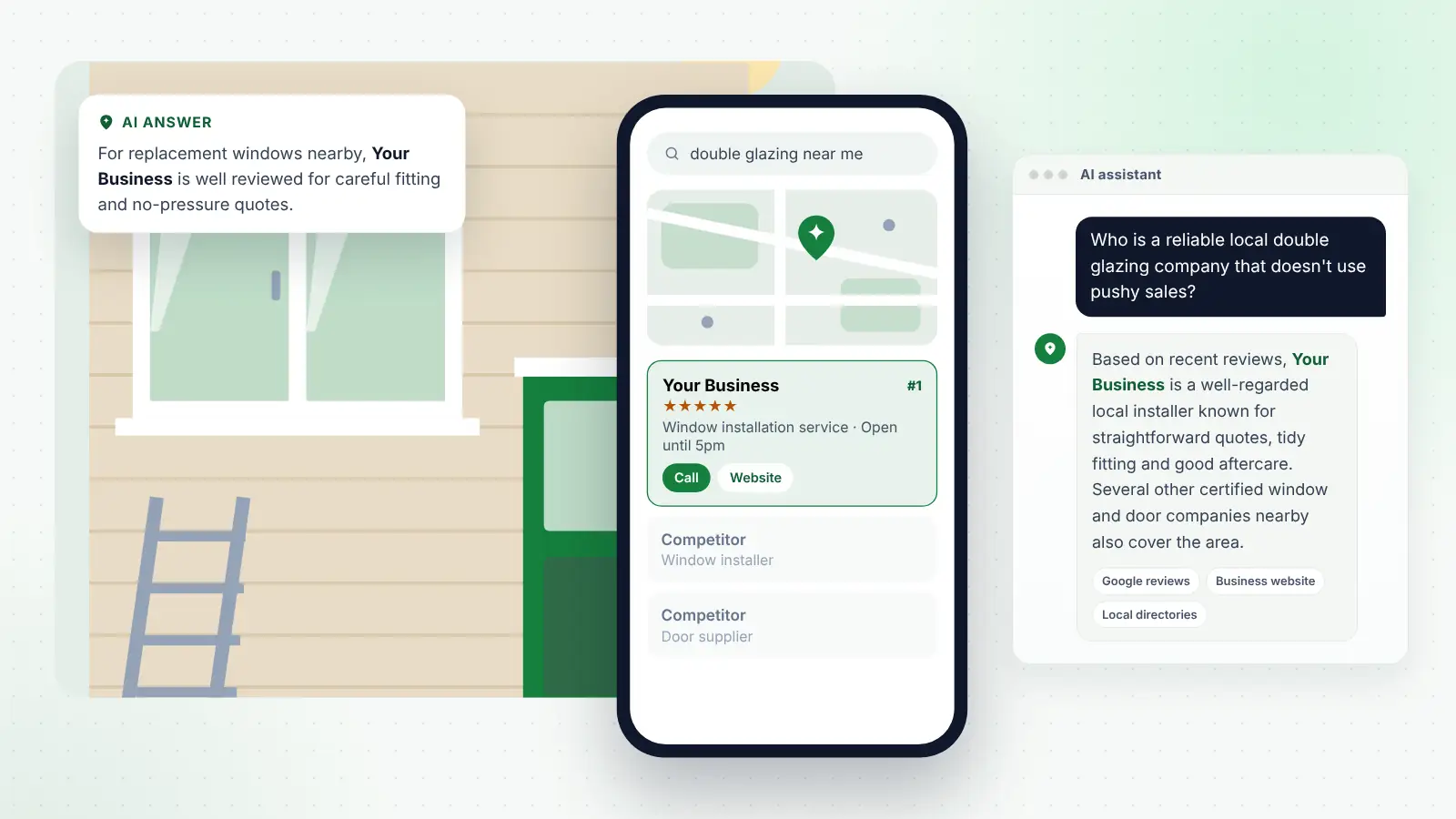
When a homeowner decides to replace their windows, the first thing many do is search Google for “double glazing near me”, “composite doors [town]” or “window fitters near me”. The map results at the top of the page, often called the local pack, show three businesses with their reviews, photos and opening hours. Being one of those three is one of the most effective ways for an independent installer to compete with national brands.
Local search favours businesses that are relevant, nearby and well regarded, which gives a local company a genuine chance. For a new glazing business, these are where the effort counts most.
Google Business Profile
Your Google Business Profile is often the first impression a customer has of you. Choose the most accurate primary category, such as window installation service, and add secondary categories for doors or conservatories if they genuinely apply. Fill in your service areas, a clear description of what you install, your accreditations and how quoting works. Add photos of real local installations regularly, showing before and after shots, close-ups of finishes and the house fronts where customers are happy for you to share them.
Reviews
Reviews carry a lot of weight in this trade because they speak directly to the things homeowners worry about. Ask every customer for a review once the job is complete and they are happy, and make it easy with a direct link. Reviews that mention tidy fitting, no pressure, good communication and how the windows have performed are more persuasive than a simple star rating. Reply to every review, including any critical ones, calmly and professionally.
The same company name, number and areas on every listing
Your business name, address and phone number should be identical everywhere they appear: your website, Google, Bing, Apple Maps, trade directories, your scheme listing and your trade association profile. Inconsistent details make it harder for search engines to trust that they have the right information about you.
Pages for each product and each town you fit in
A simple, fast website with a page for each main service, such as replacement windows, composite doors, bifold doors and repairs, helps Google understand what you do. Pages for the towns you cover, with genuinely useful local information and examples of work in that area, help you appear for searches there. Include your accreditations, guarantee details, guide prices if you are comfortable sharing them and an easy way to request a quote.
Local and industry links
Links from relevant websites help show search engines that you are a real, established business. Good sources include your supplier’s installer directory, trade association listings, local business groups, community sponsorships and home improvement websites.
Doing all of this consistently takes time alongside surveying and fitting, which is why some installers choose specialist help with SEO for window and door installers and double glazing companies so they can concentrate on the work itself. Whether you do it yourself or not, results usually build over three to six months rather than overnight.
Getting recommended by AI assistants (AEO)
A growing number of homeowners now ask AI assistants for help before they pick up the phone. They might ask ChatGPT “Who is a reliable double glazing company near me that doesn’t use pushy sales?”, ask Gemini “What should I check before choosing a window installer?”, ask Copilot “Are composite doors worth it and who fits them locally?”, or see a Google AI Overview summarising the options for “best window fitters in [town]”. Perplexity is used in a similar way, often with sources listed alongside the answer.
No AI assistant keeps a private league table of trustworthy glaziers. They draw on information that is already published about your business across the web, so the same groundwork that helps local SEO also helps AI visibility. In practice, they rely on:
- Consistent information. If your name, location, services and accreditations match across your website, Google profile, directories and scheme listings, AI tools are more confident about recommending you.
- Reviews. Detailed reviews on Google and other platforms help assistants describe what you are known for, such as tidy fitting or good aftercare.
- Clear service descriptions. Plain explanations of what you install, which areas you cover and how your process works make it easy for AI tools to match you to a question.
- FAQs. Pages that answer real customer questions, such as how long installation takes, whether you need a FENSA certificate, what an insurance-backed guarantee covers or how to fix misted double glazing, are exactly the kind of content these tools summarise.
- Mentions on reputable sites. Being listed or featured by trade associations, local news, community organisations and home improvement websites strengthens the picture AI tools build of your business.
For window and door installers this matters because the questions homeowners ask AI are often about trust and process, not just price. A business that has clearly answered those questions on its own website, and is consistently described by others, is in a better position to be mentioned.
Tip
Write down the ten questions homeowners ask you most often during surveys, then answer each one clearly on your website. Those same questions are what people type into Google and ask AI assistants.
Keeping the fitting diary full as you grow
Once you have a steady flow of work, the focus shifts to doing it consistently well. Keep a simple job management system for enquiries, surveys, orders, installation dates and certificates, so nothing slips through. Follow up with every customer after installation, register each job with your scheme promptly and make sure the certificate and guarantee documents reach the homeowner.
Growth options include taking on a second fitting team, opening a small showroom so customers can see and handle products, adding a specialist product range, or building a repair and servicing offer that keeps you in touch with past customers. Each step adds cost and responsibility, so grow at a pace your cash flow and quality can support. Your reputation is your most valuable asset, and it is easier to protect than to rebuild.
Frequently asked questions
Do I need to join FENSA or Certass to install windows?
You are not legally required to join a competent person scheme, but in England and Wales replacement windows and doors in homes must comply with building regulations. Without scheme membership, each job needs to go through building control, which adds time and cost. Most retail installers join a scheme so they can self-certify and give homeowners a certificate.
Can I start work as soon as the customer signs?
If the contract was agreed in the customer’s home, they usually have 14 days to cancel. You should generally only begin during that period if the customer expressly asks you to, and they need to understand they may have to pay for work done if they cancel. Take legal advice on how your terms handle made-to-measure products.
Do replacement windows need trickle vents?
Replacement work should not make the home’s ventilation worse, so background ventilation such as trickle vents is usually needed, particularly where the old windows had them. Check the current Approved Document F and your scheme’s guidance for the specific situation.
What is an insurance-backed guarantee?
It is insurance that protects the customer’s guarantee if your business stops trading. The insurer steps in so the customer can still have valid guarantee claims dealt with for the remainder of the guarantee period. Many competent person schemes require installers to offer one.
How soon will Google start sending me window and door enquiries?
Improvements to your Google Business Profile and listings can help within a few weeks, but stronger map rankings and AI visibility usually build over three to six months. Consistent reviews, photos and helpful content make the biggest long-term difference.
Next steps
Starting a window and door installation business is very achievable if you have the practical skills, but success depends on doing the less visible things well: registering with a competent person scheme, understanding the building regulations, handling cancellation rights properly and offering guarantees and deposit protection that give homeowners confidence.
With scheme registration, cancellation paperwork and guarantees sorted, put your energy into being visible and believable to local homeowners. A complete Google profile, a steady stream of genuine reviews, a clear website and consistent information across the web will help homeowners, and the AI tools they increasingly use, recognise you as a reliable local installer.