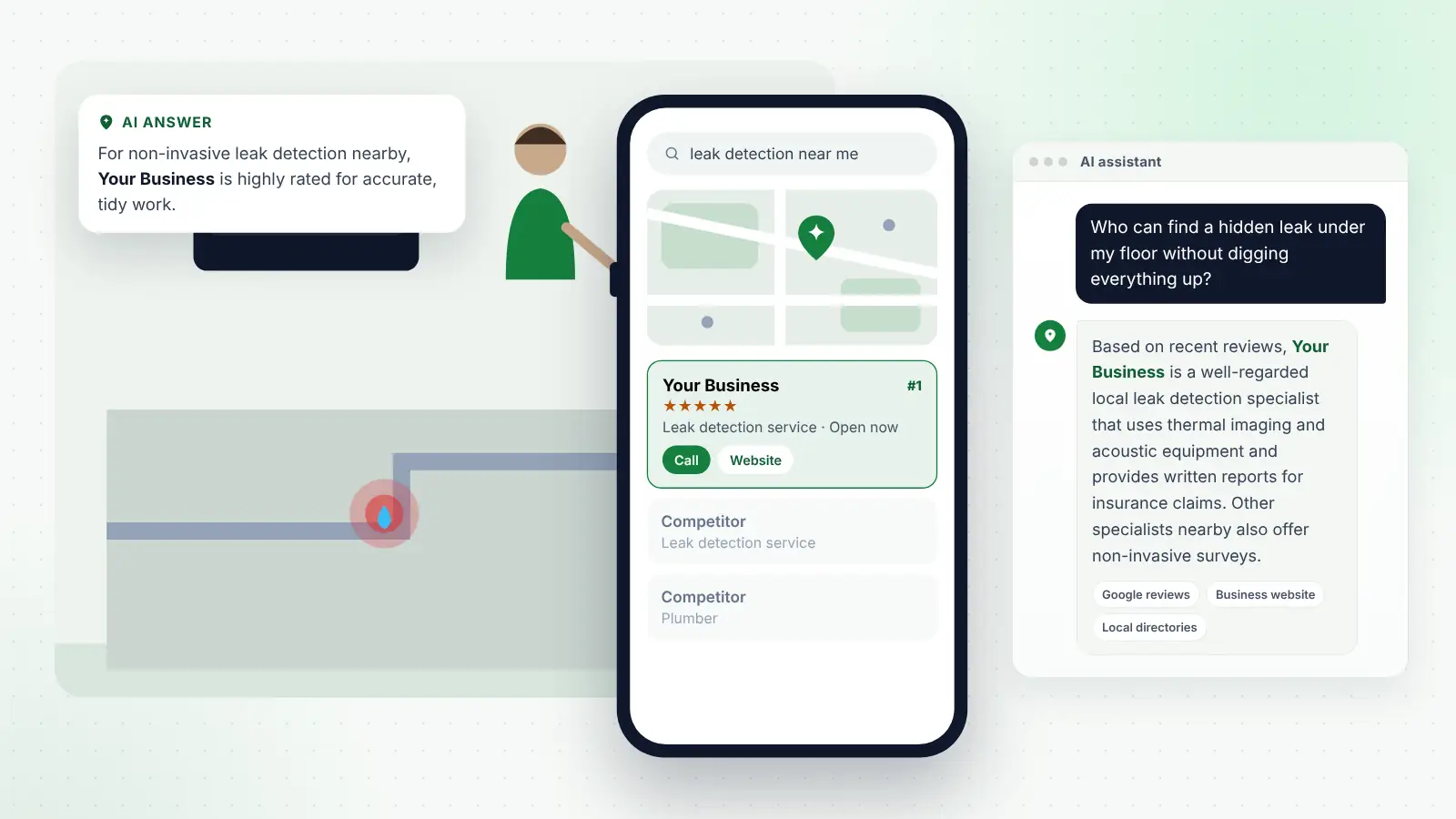
A hidden leak is one of the most stressful problems a homeowner can face. The ceiling is stained, the boiler keeps losing pressure or the water bill has doubled, and nobody can say where the water is going. A general plumber may start lifting floorboards or chasing out plaster in the hope of finding it. A leak detection specialist arrives with thermal cameras, acoustic microphones and tracer gas, and aims to pinpoint the source with as little disruption as possible.
Customers, insurers and loss adjusters pay for accuracy, a clear written report and a smaller repair bill. If you have a plumbing or heating background and patience with methodical testing, leak detection can be a specialist service with less price competition than general plumbing.
This guide covers the work itself, the equipment and training, the rules around supply pipes and water fittings, trace and access insurance work, the reports insurers expect, startup costs, pricing, honest marketing and how to get found by local customers and AI assistants.
In our November 2026 study, AI tools named 52% of businesses with 300 or more Google reviews, against 26% of those with fewer than 20.
Key points
- Leak detection is a diagnostic service: you are paid to locate the leak accurately and report clearly, often before anyone else carries out a repair.
- The core methods are thermal imaging, acoustic listening, tracer gas, moisture mapping and pressure testing, and most jobs need more than one of them.
- There is no single licence for leak detection, but thermography training, equipment training and plumbing knowledge give customers and insurers confidence.
- Much of the work involves home insurance trace and access cover, so clear, well-evidenced reports matter as much as finding the leak.
- Homeowners are usually responsible for their own supply pipe, and many water companies offer leak allowances when a leak is repaired promptly, which can bring regular mains leak work.
- Honest marketing that avoids guaranteed outcomes builds the trust that wins reviews, referrals and AI recommendations.
In this guide
- Understand the work and the market
- Methods and equipment
- Training and qualifications for leak detection
- Regulations, supply pipes and leak allowances
- Trace and access and insurance work
- Writing the reports insurers expect
- Startup costs
- Pricing your work
- Honest marketing and consumer law
- Local SEO for leak detection specialists
- AEO and AI search for leak detection
- Frequently asked questions
- Next steps
Understand the work and the market
Leak detection specialists find leaks that are hidden, intermittent or hard to reach. Typical jobs fall into a few groups:
- Central heating leaks, where a sealed system keeps losing pressure and the leak is under a floor, inside a wall or in a screed.
- Underfloor heating leaks, often in pipes buried in screed, where guessing the location is expensive.
- Mains and supply pipe leaks, where an unusually high water bill, low pressure or a wet patch in the garden suggests the external supply pipe is leaking.
- Escape of water and damp, including water coming through a ceiling, damp patches, shower and bath leaks and leaks behind tiling.
- Flat roof and building envelope leaks, where water ingress needs tracing back to its entry point.
Your customers include homeowners, landlords, letting agents, block managers, commercial property owners and the insurers, loss adjusters and claims companies acting on claims. Many homeowners do not know the service exists until a plumber or insurer suggests it.
Decide early whether you will only locate leaks or also repair them. Repairs increase the value of each job but change your insurance, qualifications and the questions customers ask.
Methods and equipment
Good leak detection is about combining methods and interpreting the results carefully. No single tool finds every leak.
Thermal imaging
A thermal camera shows surface temperature differences. It works well for hot water and heating leaks, which show as warm areas on floors or walls, and for mapping underfloor heating pipes. It is less useful for cold water leaks in some conditions, and reflections, draughts and materials can mislead an untrained eye.
Acoustic listening
Ground microphones and listening sticks pick up the sound of water escaping under pressure. Acoustic equipment is a mainstay for mains and supply pipe leaks and can be used inside on pressurised pipework. Background noise, pipe material and depth all affect how well it works.
Tracer gas
A safe tracer gas mixture is introduced into a drained or pressurised pipe, and a sensitive detector picks up the gas where it escapes through the floor or ground. It is especially useful for small leaks, plastic pipes and places where acoustic methods struggle.
Moisture mapping and pressure testing
Moisture meters map how far water has spread, which helps separate a leak from condensation or rising damp and shows the extent of damage for a claim. Pressure testing confirms whether a system or section of pipe is leaking at all, and isolating sections narrows the search.
Tip
Write down every reading, time and location as you work. Notes made on site are what turn a successful find into a report an insurer or loss adjuster will accept without further questions.
Training and qualifications for leak detection
Anyone can call themselves a leak detection specialist, so the credibility of your business rests on training, experience and evidence of competence.
Thermography training is one of the most widely recognised qualifications for this work. Level 1 thermography courses are run by several UK training providers and by the training arms of camera manufacturers. Some lead to certification under schemes based on the international standard for thermography personnel, ISO 18436-7, such as the PCN scheme run by the British Institute of Non-Destructive Testing. Check what a course covers, whether it includes building applications and whether it leads to a recognised certificate.
Equipment training from the manufacturers of your acoustic and tracer gas kit is worth completing, as interpretation matters more than the equipment itself.
Plumbing and heating knowledge is close to essential. You need to understand how sealed heating systems, unvented cylinders, underfloor heating manifolds and supply pipes work. If you carry out repairs, plumbing qualifications and membership of an approved contractor scheme, such as those on the WaterSafe register, add weight. If you will work on water company networks, expect to need a National Water Hygiene card.
Regulations, supply pipes and leak allowances
Leak detection itself is not a regulated activity, but several sets of rules shape the work and what you tell customers.
Water fittings regulations
The Water Supply (Water Fittings) Regulations 1999 apply in England and Wales, with equivalent water byelaws in Scotland and regulations in Northern Ireland. They set standards for plumbing connected to the public supply, to prevent contamination, waste and misuse of water. Certain work must be notified to the water supplier before it starts, including some external pipework laid outside the normal depth range. If you repair or replace supply pipes, follow the rules on materials, depth and backflow protection. WaterSafe has a clear guide to which plumbing work needs notifying.
Who owns the supply pipe
Customers are often surprised to learn that the supply pipe, which usually runs from the property boundary to the internal stop tap, is normally their responsibility. Water companies generally own the mains and the communication pipe up to the boundary, though arrangements vary, and shared supply pipes are jointly owned by the properties they serve. Explaining this simply on your website answers one of the most common questions behind mains leak searches.
Leakage allowance schemes
Many water companies offer metered customers a leak allowance, reducing the extra charges caused by a leak once it has been repaired. Conditions vary by company but commonly include repairing the leak within a set period, providing evidence of the repair and the leak not being caused by negligence. Some companies also offer free or subsidised supply pipe repairs, sometimes only for customers on support schemes. Some companies will also investigate a suspected supply pipe leak themselves, so find out what each local company offers. Leaks inside the property, heating leaks and cases outside a company’s scheme still need a specialist.
Tip
Write a short guide for each water company area you cover, explaining in general terms how to apply for a leak allowance and what evidence to keep. Always tell customers to check the current terms with their own water company.
Trace and access and insurance work
What trace and access cover is
Many home insurance policies include trace and access cover as part of buildings insurance. In general terms, it helps pay to find the source of an escape of water and to remove and replace the parts of the building damaged in finding it, such as floor tiles or plaster. It often does not pay for repairing the leaking pipe itself, and policies usually set a limit and an excess. Cover varies widely, so advise customers to read their policy or speak to their insurer rather than promising anything.
Working with insurers and loss adjusters
Insurance work can reach you in three ways: directly from policyholders who will claim, through referrals from loss adjusters and claims handlers, and through insurer or claims management contractor networks. Getting onto networks usually involves showing your insurance, qualifications, response times, reporting standards and pricing, then performing well enough to stay on.
Loss adjusters investigate and assess claims for insurers. They want a firm that turns up when promised, communicates calmly with the policyholder, finds the leak with minimal damage and reports facts rather than opinions. Be clear about who instructed you and who pays you, and never advise a customer on whether their claim will succeed.
Writing the reports insurers expect
A good report is often what the customer is really paying for. Insurers and loss adjusters generally want enough information to understand what happened, why and what it will cost to put right. A sound domestic report usually includes:
- Property address, client details, who instructed you and the date and time of attendance.
- The reported problem and what the customer observed.
- The methods and equipment used, including pressure test results with start and end pressures and duration.
- Findings, with the leak location marked on a sketch or plan and measured from fixed points.
- Thermal images alongside normal photographs, labelled so a non-specialist can follow them.
- Moisture readings showing the extent of the affected area.
- The likely cause, stated factually, and whether it appears consistent with the damage seen.
- Recommendations for repair and any access made, with what was disturbed and what needs making good.
Avoid jargon and do not overstate certainty: if a finding is a strong indication rather than a confirmed source, say so.
Startup costs
Costs vary with how much equipment you buy at the start and whether you buy new or used. The figures below are rough guides only and change with suppliers and specification.
| Item | Typical cost | Notes |
|---|---|---|
| Thermal imaging camera | £1,000–£8,000+ | Resolution and sensitivity matter for building work |
| Acoustic leak detection kit | £2,000–£8,000+ | Ground microphone and amplifier |
| Tracer gas detector and gas | £2,000–£6,000+ | Plus regulators and gas cylinders |
| Moisture meters and pressure test kit | £300–£1,500 | Pin and non-invasive meters |
| Pipe and cable locator | £500–£3,000 | Useful for mapping supply pipes |
| Training and certification | £1,000–£3,000 | Thermography and equipment courses |
| Insurance | Varies | Public liability and professional indemnity |
| Van, signage and website | Varies widely | A used van is fine to start |
Many specialists start with a thermal camera, moisture meters and pressure testing, then add acoustic and tracer gas equipment as work grows.
Pricing your work
Most leak detection businesses charge a fixed fee for a standard domestic survey, with extra charges for larger properties, commercial jobs, long supply pipes or return visits. State clearly what the fee includes: time on site, methods used and a written report.
Decide how you handle insurance customers. Many specialists ask the policyholder to pay and claim back, while network work is billed to the insurer or claims company at agreed rates. Whichever approach you take, explain it before you attend.
Explain in advance what happens if a leak is not located on the first visit.
Honest marketing and consumer law
Leak detection marketing can drift into promises no one can keep: “100% success rate”, “guaranteed no damage” or “insurers always pay”. Avoid them. Some leaks need more than one visit or a small access point, and trace and access cover depends on each policy.
Consumer protection law prohibits misleading claims, and advertising must follow the CAP Code enforced by the Advertising Standards Authority. Measured claims also protect your reviews and your relationships with loss adjusters.
Local SEO for leak detection specialists
Most leak detection jobs begin with a search on a phone. People type “leak detection near me”, “boiler losing pressure”, “water coming through ceiling” or “high water bill leak” and choose from the businesses on the map. If you are not there, the work tends to go to a franchise, a lead site or a general plumber.
Start with your Google Business Profile. Choose the most accurate primary category, add every service you offer, set your service area to the towns you genuinely cover and add real photos of your equipment, vans and thermal images (with customer permission). Keep your hours accurate, including any out-of-hours service.
Reviews matter in this trade. Ask every satisfied customer, and encourage them to mention what the problem was and what you found, such as an underfloor heating leak or a supply pipe under the drive. Those details help Google match you to similar searches and help future customers trust you.
Keep your business name, address and phone number consistent across directories, trade listings and insurer or network profiles. Your website should have a page for each main service, including trace and access, central heating leaks, underfloor heating, mains leaks and damp tracing, plus area pages for the main towns you serve. Local links from property websites, community organisations and partner trades build authority.
You can manage this yourself, or have specialists take it on while you focus on surveys. Our page on local SEO for leak detection specialists explains how that works for independent engineers and growing firms. Results usually build over two to three months, so start well before the busy winter period.
AEO and AI search for leak detection
More people now ask AI assistants such as ChatGPT, Gemini, Perplexity and Copilot, or read Google AI Overviews, before they call anyone. They ask questions like “how do I find a leak under my floor without digging it up?”, “does home insurance cover trace and access?” or “who can find a mains water leak near me?”
These tools draw on your website, Google profile, directory listings, reviews and mentions on reputable local and industry sites, and they recommend businesses they can describe confidently. To help them:
- Describe each method plainly, including when it works best and its limits.
- Publish clear FAQs on trace and access, supply pipe responsibility, leak allowances and what your report includes.
- Keep your services, areas and contact details identical everywhere.
- Encourage detailed reviews that mention specific jobs and towns.
- Earn mentions from local news, property websites, trade bodies and partner businesses.
This is the same work that helps your local SEO, so you rarely need a separate strategy.
Frequently asked questions
Do I need a licence to start a leak detection business?
There is no specific licence for leak detection in the UK. You will need appropriate insurance, and if you carry out plumbing repairs you must follow the water fittings regulations or byelaws. Recognised thermography and equipment training is strongly advisable for credibility with customers and insurers.
Do I need to be a plumber first?
It is not a legal requirement, but plumbing and heating knowledge makes the work far easier and safer. Many successful specialists come from plumbing, heating or building surveying backgrounds.
How do I get onto insurance work?
Build a track record with direct customers and loss adjusters first, keep your reports consistent and professional, and then approach claims management companies and contractor networks. Expect to show your insurance, qualifications, response times and sample reports.
Does home insurance always pay for leak detection?
No. Trace and access cover varies between policies, has limits and excesses, and may not include repairing the leak itself. Encourage customers to check their policy and speak to their insurer.
Can I offer a no-find, no-fee guarantee?
You can, but think carefully. Some leaks are intermittent or need several visits. If you offer it, explain the terms clearly and make sure the guarantee is something you can honour.
Next steps
Decide on your services, complete thermography and equipment training, build a clear report template, arrange insurance and buy the core kit. Then build relationships with plumbers, damp surveyors, restoration firms, letting agents and loss adjusters, and set up a strong Google Business Profile and website. Leak detection rewards accuracy, honesty and clear communication, and those same qualities are what customers, insurers and AI assistants look for when deciding who to recommend.