An established private physiotherapy clinic usually has a reasonable reputation, a core of loyal patients and at least one referral source that works well. What it often lacks is balance. One GP surgery or one rugby club sends most of the new patients, insured work drifts in without anyone managing it, and a fair share of self-referral patients come for an assessment and one follow-up, then disappear before they have finished their rehabilitation. The diary looks full in January and thin in August, and nobody is quite sure why.
Getting more physiotherapy patients is rarely about one big campaign. It is about having several dependable routes into the clinic, making each route easy for the patient, and helping patients complete the treatment they need so they get good outcomes and recommend you. Those outcomes, and the reviews and referrals that follow, are what bring the next patient.
This guide is for private clinics that are already trading. It covers measuring where patients come from, the self-referral journey, building relationships with GPs, gyms, sports clubs and personal trainers, working with private medical insurers, rebooking and completing courses of treatment, the rules on what you can claim, and how patients now find physiotherapists through Google and AI assistants. It is general information rather than regulatory advice.
Key points
- Track where every new patient comes from, because most clinics depend too heavily on one or two referral sources without realising it.
- Self-referral patients decide quickly, so clear prices, online booking and a reassuring first contact make a measurable difference.
- Referral partnerships with GPs, gyms, clubs and personal trainers work best when they are built on useful clinical communication, not on payments or promotional swaps.
- Each private medical insurer sets its own recognition criteria, authorisation process and fees, so manage insured work deliberately rather than by accident.
- Patients are more likely to complete treatment when they understand their plan from the first appointment, but booking should always reflect clinical need.
- Claims about conditions and results must be accurate, evidence-based and in line with HCPC standards and the UK advertising codes.
In this guide
- Map where your patients actually come from
- Make the self-referral journey easy
- Build referral relationships with GPs and other clinicians
- Work with gyms, sports clubs and personal trainers
- Working with private medical insurers
- Help patients complete their course of treatment
- Claims a physio clinic can and cannot make
- Reviews that tell the next patient what to expect
- Local SEO for a physiotherapy clinic
- AI search: how patients now ask for a physio
- Frequently asked questions
- Final thoughts
Map where your patients actually come from
Start with a simple question on every new patient form or booking: how did you hear about us. Then check it against what your software shows, because patients often say “Google” when they really searched your name after a friend recommended you. Over three to six months, a clear picture appears.
| Source | Typical patient | What they need from you | What to track |
|---|---|---|---|
| Self-referral from search | Someone in pain looking for help quickly | Clear prices, availability this week, reassurance you treat their problem | Enquiries, bookings, first-to-second visit rate |
| Word of mouth | Friend or family of a past patient | An easy way to book with the clinician they were recommended | Named clinician requests |
| GP or other clinician | Patient told to “see a physio” | Clear information for the referrer and the patient, plus timely reports where consented | Referrals by practice and outcome |
| Gym, club or personal trainer | Active person with a sports or training injury | Understanding of their sport, quick access, return-to-training plan | Referrals by partner |
| Private medical insurer | Policyholder with an authorisation code | Recognition by their insurer, simple billing | Authorisations, sessions used, fees received |
| Employer or occupational health | Employee with a musculoskeletal problem | Fast appointments, clear reports | Contracts and volumes |
If more than half your new patients come from one source, that is a risk. A change of personnel at a GP surgery or a new physio partner at the local club can sharply reduce your new patient numbers with little warning. The aim is a spread of sources, each worked on deliberately.
Make the self-referral journey easy
Self-referral patients are often the core of a private clinic. They have usually decided that waiting is not an option, they are comparing two or three clinics, and they want to book quickly. Small barriers lose them.
Walk through your own booking process as a patient would, on a phone, at nine in the evening:
- Can they see what you treat? A patient with Achilles pain wants to see Achilles problems, or at least running injuries, mentioned clearly.
- Can they see the price? Publish the cost of an initial assessment and follow-up appointments, how long each lasts and what is included.
- Can they book without calling? Online booking that shows real availability, including early, evening and Saturday slots if you have them, removes a major barrier.
- Do they know what to expect? A short explanation of the first appointment, what to wear, how long it lasts and whether they need a GP referral (for self-pay, usually not) reduces anxiety and no-shows.
- Is there a way to ask first? Some patients want a quick conversation before they book. A short free call with a physiotherapist, where offered, can help, as long as it does not replace a proper assessment.
Make red flag information easy to find. Your website should explain clearly when someone should see a GP, call NHS 111 or seek urgent care instead of booking physiotherapy. This protects patients and shows referrers and insurers that you take safety seriously.
Tip
Send every new patient a confirmation that includes the clinician’s name, the address with parking notes, what to wear and your cancellation policy. A clear confirmation helps reduce first-appointment no-shows and answers the questions patients would otherwise phone about.
Build referral relationships with GPs and other clinicians
Many patients still ask their GP about a musculoskeletal problem first. In a lot of areas, NHS patients can now see a physiotherapist in their GP practice as a first contact practitioner, or self-refer to NHS physiotherapy, but waiting times vary, and some patients will want to go privately. GPs, practice nurses, first contact physiotherapists and local consultants are useful contacts, but only if your clinic makes their job easier.
What tends to work:
- Introduce yourself properly. A short, professional letter or email to practice managers explaining what you offer, your clinicians’ areas of interest and how patients can book. Keep it factual.
- Send useful reports. With the patient’s consent, send concise updates to the referring clinician: findings, plan and any concerns. A referrer who receives clear reports is more likely to suggest your clinic again.
- Be clear about onward referral. Explain how you escalate when you suspect something needs medical review, such as a scan or a specialist opinion.
- Get to know local consultants. Orthopaedic and sports medicine consultants often recommend physiotherapy after surgery or injection. Good post-operative rehabilitation reports build these relationships.
- Respect professional boundaries. Do not offer payments, gifts of value or other incentives for referrals. Referrals should be based on the patient’s interest, and the HCPC standards require you to promote and protect service users’ interests and to declare conflicts of interest and not let them influence your judgement.
Healthcare referrals take time. Expect to build them over months through consistent, good-quality communication rather than a single mailing.
Work with gyms, sports clubs and personal trainers
Active people get injured, and the people they talk to first are often their coach, their personal trainer or the person running their club. These relationships can be some of the most productive for a private clinic, especially one with a sports or musculoskeletal focus.
Ideas that suit an established clinic:
- Injury talks and workshops. A short session for a running club on common injuries and when to get help, or a talk at a gym on returning to training after a layoff, builds trust with both the members and the organisers.
- Pitch-side or event cover. Covering a local event or a club’s matches, where you have the right training and insurance, puts your clinic in front of the people most likely to need you.
- Clear routes for trainers. Give personal trainers a simple way to suggest your clinic, and with the client’s consent, share relevant guidance on what the client can safely do in their sessions. Personal trainers are not clinicians, so the aim is joined-up support, not handing over treatment.
- Reciprocal value. When a patient is ready to return to training, recommending a reputable local trainer or class where appropriate is good care, and it strengthens the relationship.
- Partner page and mentions. A listing on the club or gym’s website, a mention in their newsletter or a page on your own site about your work with them all help patients and search engines connect you with that community.
Be careful with exclusive deals or discount schemes for members. Discounts are fine if they are clearly described, but avoid any arrangement where you pay for referrals or where the partner might feel obliged to recommend you over what suits their member.
Working with private medical insurers
Insured patients can be a valuable part of a private clinic’s workload, and some people will only use a clinic their insurer recognises. Insured work also comes with its own processes, so manage it deliberately.
Recognition
Each insurer sets its own requirements for recognising physiotherapists and clinics. These commonly include HCPC registration, professional indemnity, professional body membership, a minimum period of post-qualification experience, suitable premises and sometimes evidence of clinical audit or outcome measurement. Some insurers manage physiotherapy through their own networks, and some through third-party networks that hold contracts with clinics. Requirements and processes change, so check each insurer’s current provider information directly and keep your recognition details up to date.
How insured appointments usually work
Typically, the patient contacts their insurer, receives an authorisation for a number of sessions, and books with a recognised clinic. The clinic then bills the insurer, or the network, in line with the agreed process. Policies vary widely: some patients have an excess to pay, some have a limited number of sessions, and some need a GP or specialist referral before the insurer will fund treatment.
Practical steps:
- Ask the right questions at booking. Insurer, membership number, authorisation code, number of sessions authorised, and any excess.
- Explain what happens if authorised sessions run out. Patients should know whether they can request more, or continue as self-pay, before they reach the end.
- Keep billing tidy. Late or incomplete invoices are a common cause of unpaid insured work.
- Check the economics. Insurer and network fees are set by them and are often lower than self-pay rates. Decide how much insured work suits your clinic and staffing.
- List your insurers accurately. Say which insurers you are recognised by on your website and Google profile, and update the list when it changes.
Help patients complete their course of treatment
A common pattern in private physiotherapy is that patients feel a little better after one or two sessions and stop coming, before they have done the strengthening and progression that prevents the problem returning. That is worse for the patient and leaves the clinic with half-finished cases and fewer good outcomes to show.
The answer is not to book more sessions than people need. HCPC standards require you to act in the best interests of service users, and patients notice quickly if a clinic seems to stretch out treatment. The answer is a clear, shared plan:
- Explain the plan at the first appointment. Set out what you have found, what you expect to work on, a realistic estimate of how many sessions might be needed and how progress will be reviewed.
- Agree goals that matter to the patient. “Run 10k again”, “lift my grandchild”, “work at my desk without pain”. Progress towards a personal goal is a stronger reason to return than a vague instruction to “come back in a week”.
- Book the next appointment before they leave, when there is a clinical reason to, and explain why that timing matters.
- Give a good home programme. Use an exercise app or clear written guidance, and check it at each visit.
- Follow up missed or unbooked patients. A short message asking how they are getting on, with an easy way to rebook, catches people who meant to come back.
- Discharge properly. A clear end to treatment, with advice on what to do if symptoms return, leaves a good impression and is the right moment to ask for a review.
Track the average number of sessions per patient and the proportion who are formally discharged. A rising proportion of formal discharges is a useful sign that more patients are completing their plan, and it gives you more natural moments to ask for a review.
Tip
Ask each physiotherapist to note the agreed goal at the top of the patient’s record. Revisiting the patient’s own goal at each session keeps the plan focused and makes rebooking a natural conversation.
Claims a physio clinic can and cannot make
Physiotherapy marketing must follow the HCPC’s standards of conduct, performance and ethics, which require honesty, accurate information about your services and promotion that is not misleading. The CAP Code, enforced by the Advertising Standards Authority (ASA), also applies to your website, social media, paid ads and leaflets. The ASA treats health claims seriously, and it expects them to be backed by robust evidence.
In practice:
- Avoid promising cures or guaranteed results. “We fix back pain” or “pain-free in three sessions” is the kind of claim that causes problems. “We assess and treat back pain, and many patients improve with a course of physiotherapy” is accurate and still clear.
- Be careful with treatments where evidence is limited. If you offer techniques such as shockwave therapy, acupuncture or dry needling, describe them carefully and do not claim more than the evidence supports for each condition.
- Use titles correctly. “Physiotherapist” is a protected title, so make sure anyone described that way is HCPC registered. Use “chartered physiotherapist” only for members of the Chartered Society of Physiotherapy (CSP), and describe sports massage therapists or rehabilitators by their own titles.
- Do not discourage medical advice. Make clear when patients should see a GP or seek urgent care.
- Use testimonials honestly. Genuine reviews can show the experience patients had, but they cannot be used to support claims that would otherwise need evidence.
- Be clear about prices. Show the full cost and what is included, and explain any cancellation charges in advance.
Reviews that tell the next patient what to expect
Reviews influence where people book, and for physiotherapy they work best when they describe the problem and the experience: a clear explanation, a practical plan, a quick appointment for a running injury, helpful post-operative rehabilitation. Those details help a new patient with the same problem feel confident, and they help search engines and AI assistants understand what your clinic is known for.
Ask at discharge, when patients have seen progress, with a direct link to your Google review form. Ask every patient rather than only those you expect to be positive, and never offer incentives or write reviews yourself, because UK consumer protection law specifically prohibits fake and concealed incentivised reviews. When replying, thank the reviewer without confirming that they are a patient or mentioning their treatment, because confidentiality applies to public replies too.
Local SEO for a physiotherapy clinic
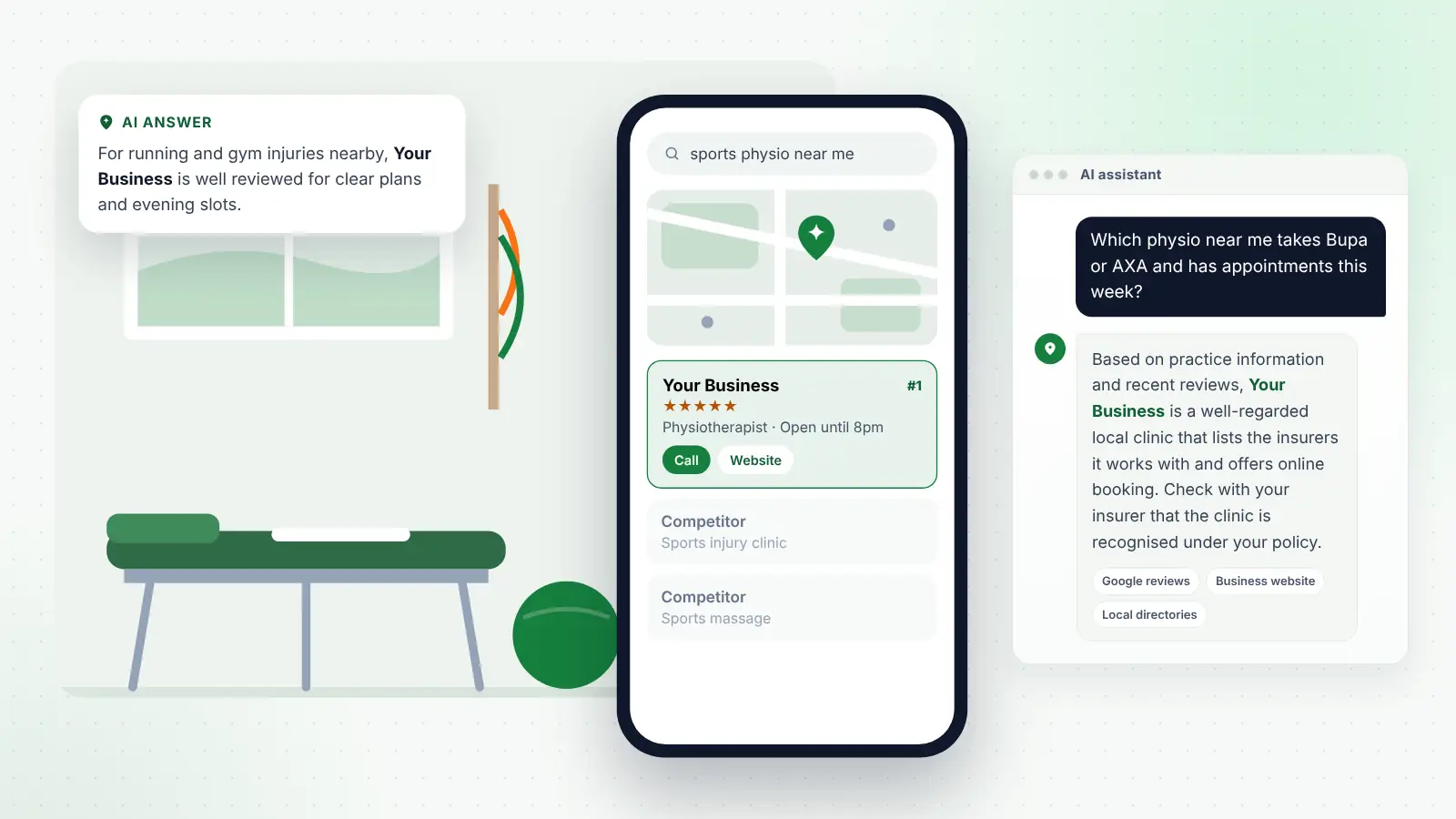
Self-referral patients search by problem and by place. Typical searches include “physio near me”, “sports physio [town]”, “physio for back pain near me”, “knee physio [area]”, “post-op rehab physio”, “physio that takes Bupa near me” and “physio open Saturday”. Many of these come from a phone, from someone in discomfort, who will often book with one of the first few clinics they see in the map results.
The main areas of local SEO for an established clinic are:
- Google Business Profile. Use “Physiotherapist” as your primary category and add secondary categories only if they genuinely apply. List your services, such as sports injury rehabilitation, post-operative rehabilitation, back and neck pain, and home visits, with accurate descriptions. Include opening hours, accessibility details, the insurers you work with where the profile allows, a booking link and real photos of the clinic and team. Post occasional updates, such as a new evening clinic or a talk at a local club.
- Reviews. A steady flow of genuine, detailed reviews, gathered at discharge, supports both ranking and patient choice.
- Consistent details. Your clinic name, address, phone number and website should match exactly across Google, Apple Maps, Bing, health directories, professional body listings and insurer or network directories. Out-of-date insurer listings are a common source of confusion.
- Condition and service pages. Give each main condition or service its own page, written in the words patients use: what the problem is, how you assess and treat it, what the patient can do in the meantime, when to seek medical advice, prices and how to book. Add clinician profiles with HCPC registration, special interests and postgraduate training. A clear page on insurers and referrals answers questions that otherwise come through the phone.
- Area and partner content. If you work with specific clubs or gyms, or serve several nearby towns, a well-written page about that work helps, without thin, repetitive location pages.
- Local links. Partner pages on club and gym websites, local news coverage of events you support, and community health activities all show search engines that you are an established part of the area.
Local SEO builds gradually, usually over three to six months, and the clinics that do well keep their information accurate as hours, clinicians and insurers change. If you would rather your clinicians spent their time with patients, local SEO for physiotherapists and private physio clinics can take on the profile, listings and condition content for you.
AI search: how patients now ask for a physio
More people now describe their problem to an AI assistant and ask where to get help, rather than typing a short search. They use ChatGPT, Gemini, Perplexity and Microsoft Copilot, and Google’s AI Overviews appear above many health and local searches.
Questions tend to be specific:
- “Which physio near me takes Bupa or AXA and has appointments this week?”
- “Is there a physio in [town] who specialises in running injuries?”
- “Where can I get rehab after a knee replacement near [area]?”
- “Do I need a GP referral to see a private physio?”
- “Which clinic near me offers pelvic health physiotherapy with a female physio?”
AI tools aim to give safe, reliable answers, so for health questions they lean on information that is consistent and trustworthy. For a physiotherapy clinic, that means:
- Consistent details across the web, including insurer and professional body directories as well as Google and your website.
- Clear descriptions of what you treat and who treats it, so the tool can match you to “running injuries” or “post-operative knee rehab”.
- Accurate insurer and referral information, so the tool can answer questions about Bupa, AXA Health, Aviva, Vitality or other insurers correctly, while patients still confirm with their insurer.
- Reviews that mention problems and outcomes in the patient’s own words.
- FAQs that answer real questions, such as GP referrals, appointment length, what to wear and how insured appointments work.
- Mentions on reputable sites, such as club and gym partner pages, local news and health directories.
Check from time to time what the main assistants say when asked about physiotherapy in your area, and correct any outdated information at the source, such as an old directory listing. This is often called answer engine optimisation, or AEO, and for a clinic it is mostly about being clear, accurate and consistent wherever patients and AI tools look.
Frequently asked questions
How can we get more GP referrals?
Introduce your clinic to local practice managers with clear, factual information, make it easy for patients to book, and with consent send concise reports back to referring clinicians. Consistent communication over months builds trust. Do not offer incentives for referrals.
Should our clinic work with private medical insurers?
It depends on your area, staffing and fee levels. Insured patients can add volume, and some people will only use a recognised clinic, but insurer fees are often lower than self-pay rates and each insurer has its own process. Many clinics work with a few insurers that are common locally rather than all of them.
Is it acceptable to encourage patients to rebook?
Yes, when there is a clinical reason. Explaining the plan, agreeing goals and booking the next session at the right interval helps patients complete their rehabilitation. Booking should always reflect clinical need, in line with HCPC standards.
Can we say we treat specific conditions on our website?
You can describe the conditions you assess and treat, accurately and in plain language. Avoid claiming to cure conditions or guaranteeing results, and make sure any claims about specific treatments are supported by good evidence, in line with HCPC standards and the CAP Code.
How long does it take to see more patients from Google?
Improvements to your profile and pages can start to help within weeks, but stronger visibility for searches such as “sports physio [town]” usually builds over three to six months, supported by steady reviews and consistent listings.
Final thoughts
A busier physiotherapy clinic rarely comes from one source. It comes from a spread of reliable routes: self-referral patients who find a clear, easy booking journey; GPs, consultants, gyms, clubs and trainers who trust your communication; and insurers you work with deliberately. Patients who understand their plan and complete their treatment get better results, and those results bring reviews and recommendations.
Keep your claims accurate and your information consistent, and make sure your Google profile, condition pages and directory listings say clearly what you treat, who treats it, which insurers you work with and how to book. That gives both patients and AI assistants what they need to point the next person in pain towards your clinic.