Teaching people to swim is one of the most rewarding small businesses you can run, giving children a life skill that keeps them safe and helping nervous adults overcome a long-held fear. Demand is steady too: parents see swimming as essential, and many prefer the smaller classes and warmer water independent swim schools offer.
Running one also carries serious duties of care. You work with children and vulnerable people in water, often in a pool you do not own, so qualifications, rescue training, safeguarding, insurance and a pool agreement must be in place before your first lesson. Commercially, pool time is your biggest cost, and how you run terms and waiting lists decides whether the school is profitable.
This guide covers the qualifications you and your teachers need, the Swim England Learn to Swim Programme, pool hire, safeguarding, insurance, pricing and term booking, and how to use local search and AI search to fill your classes.
In our Google Maps and AI study, ChatGPT or Google AI Mode named 48% of businesses in positions 4 to 6 on Google Maps, but only 23% of those in positions 13 to 15: the further down the map, the less often AI recommends you.
Key points
- To teach independently you need a recognised Level 2 swimming teaching qualification, such as the Swim England Level 2 Teaching Swimming qualification or the STA Level 2 Swimming Teacher qualification.
- Teachers also need rescue or lifeguard training suitable for the pool and type of session, plus first aid and regular competency checks.
- Pool time is your main constraint, so agree a written hire agreement that sets out supervision, emergency procedures and who is responsible for what.
- Anyone teaching or helping with children should have an appropriate DBS check, safeguarding training and a clear safeguarding policy to follow.
- Termly booking, honest waiting lists and clear progression through stages keep classes full and income predictable.
- Families search locally for lessons by age and stage, so clear lesson information, reviews and consistent listings help you get found on Google and by AI assistants.
In this guide
- Is running a swim school right for you?
- Teaching qualifications: Swim England and STA
- The Swim England Learn to Swim Programme
- Finding and hiring pool time
- Safeguarding swimmers and teacher DBS checks
- Insurance
- Lesson types: babies, children and adults
- Pricing, term booking and waiting lists
- Local SEO for swim schools
- AI search and swim schools
- Common mistakes to avoid
- Frequently asked questions
- Next steps
Is running a swim school right for you?
Most swim schools are started by experienced teachers wanting more control over class sizes, standards and income; others by business owners who employ qualified teachers. Be clear which role you will play.
Before you look for pool time, think about:
- Who you will teach. Babies and toddlers with a parent, children working through the stages, adults, swimmers with additional needs, or a mix.
- How you will teach. Small groups, one-to-one lessons, holiday crash courses or school swimming contracts.
- Where you will teach. A hired hotel, school, gym or leisure centre pool, a hydrotherapy pool, or eventually your own.
- Your local market. What leisure centres and other swim schools offer and charge, how long their waiting lists are and which ages they struggle to serve.
Gaps often exist for baby classes at times that suit working parents, small groups for nervous children, adult beginners and swimmers with additional needs.
Teaching qualifications: Swim England and STA
The two main UK routes into swimming teaching are Swim England Qualifications and the Swimming Teachers’ Association (STA). Pool operators, insurers and parents will expect your teachers to hold a recognised qualification from one of them, or an equivalent.
Swim England Qualifications
The Swim England Level 1 Swimming Assistant (Teaching) qualification prepares you to support a qualified teacher. The Swim England Level 2 Teaching Swimming qualification allows you to plan and teach lessons independently, and requires the Level 1 or an equivalent Swim England qualification first. The minimum age for both is 16, and courses run through approved training providers. See Swim England’s guide to becoming a swimming teacher for current details.
In August 2026, Swim England Qualifications announced new early years qualifications for teaching children aged 0 to 5: the SEQ Level 2 in Teaching Swimming to Early Years, a full entry route for new teachers, and a shorter SEQ Level 2 in Teaching Early Years Swimming for teachers who already hold a Level 2 swimming teaching qualification.
STA qualifications
The STA’s main qualification is the STA Level 2 Swimming Teacher Qualification, which covers teaching non-swimmers through to improvers, children and adults. The STA also offers specialist awards, including the Baby and Pre-School Award and an award in teaching disability swimming. Its qualifications are regulated by Ofqual, Qualifications Wales and CCEA, and the Level 2 course currently includes 12 months of STA membership with insurance cover.
Which should you choose?
Both are widely recognised, so choose on the framework you plan to follow, local course availability and membership benefits. Never leave an assistant to teach a class alone.
Tip
Keep a training record for every teacher: qualification, rescue award, first aid, DBS check, safeguarding training and renewal dates. Pool operators and insurers may ask to see it.
The Swim England Learn to Swim Programme
Many swim schools in England follow the Swim England Learn to Swim Programme because parents recognise its badges and stages. It has four frameworks:
- Pre-School Framework. Discovery Duckling, Duckling and I CAN awards for babies and young children.
- Learn to Swim Framework, Stages 1 to 7. A games-led framework for children from around 4 to 11. By the end of Stage 7, swimmers should be able to swim 25 metres.
- Aquatic Skills Framework, Stages 8 to 10. Skills from different aquatic sports.
- Adult Swimming Framework. Awards for adult learners.
Swim England also runs Learn to Swim Accreditation, a quality mark for organisations in England delivering the programme. Providers are assessed across areas such as compliance, workforce development, the swimmer pathway, programming, marketing and customer satisfaction, and accredited providers can use the logo and appear with a mark in Swim England’s swim school directory. See the Learn to Swim Accreditation page.
You do not have to use the Swim England programme. The STA has its own learn-to-swim awards and some schools design their own, but be clear about the stages and how swimmers move up.
Finding and hiring pool time
Pool time is the biggest constraint on growth, even with a long waiting list.
Where swim schools teach
- Hotel and health club pools. Often available during the day and at weekends and usually warm, but sometimes small.
- School pools. Independent schools in particular may hire pools in the evenings, at weekends and in holidays.
- Leisure centre pools. Possible in some areas, though peak times usually go to the operator’s own lessons and clubs.
- Hydrotherapy and specialist pools. Very warm water suits babies and swimmers with additional needs, at a higher cost.
What to agree with the pool operator
Ask for a written hire agreement covering:
- Days, times and length of each slot, and notice periods for changes or cancellation.
- The hire fee and what happens if the pool closes for maintenance.
- Who provides lifeguard cover, if needed, and the rescue qualifications your teachers must hold.
- The pool’s normal operating procedure and emergency action plan, and training for your staff in both.
- Changing room arrangements, especially supervision of children.
- Water temperature, depth and any equipment you can use or store.
- Insurance requirements and who is responsible for which risks.
Supervision and rescue cover
Pool operators are responsible for health and safety on their premises, and HSE’s guidance Health and safety in swimming pools (HSG179) sets out what is expected. Industry guidance on supervising swimming lessons, backed by bodies including Swim England, the STA and RLSS UK, says teachers should be trained and assessed to spot swimmers in difficulty, carry out rescues and give first aid. Depending on the qualification, the type of session and the site’s risk assessment, a separate lifeguard may also be needed, particularly when the teacher is in the water. Class sizes should come from the pool’s risk assessment, and your insurer may set its own limits.
Tip
Ask the pool operator for its risk assessment and operating procedures before your first lesson, and walk through the emergency action plan with every teacher on site. It also shows the operator you take safety seriously.
Safeguarding swimmers and teacher DBS checks
Parents trust you with children who may be undressed, nervous and physically supported by an adult, so safeguarding must be part of how the school runs.
- DBS checks. In England and Wales, teachers and helpers working with children should have the appropriate Disclosure and Barring Service check, usually an enhanced check with a barred list check for regulated roles. Swim England requires its affiliated clubs to renew DBS checks every three years, a sensible benchmark for swim schools too. Scotland uses Disclosure Scotland’s PVG scheme and Northern Ireland uses AccessNI.
- A safeguarding policy. Set out how you prevent harm, how concerns are reported and who your designated safeguarding lead is. Swim England’s safeguarding policy, Wavepower, is a useful reference.
- Training. Every teacher and helper should complete safeguarding training and refresh it regularly.
- Practical rules. Clear guidance on physical contact, changing rooms, photography and messaging parents protects swimmers and staff.
- Records. Keep secure records of concerns, incidents and accidents.
Explain your safeguarding approach on your website, as careful parents look for it.
Insurance
Insurance protects you, your teachers, your swimmers and your relationship with the pool operator.
| Cover | What it protects | Notes |
|---|---|---|
| Public liability | Claims from swimmers, parents or the public for injury or damage | Pool operators usually require it before you can hire |
| Professional indemnity | Claims arising from your teaching or advice | Often bundled with public liability for teachers |
| Employers’ liability | Claims from employees | A legal requirement if you employ staff, with limited exceptions |
| Equipment cover | Floats, mats and teaching aids | Useful if you store kit on site |
| Business interruption | Lost income if you cannot teach | Check whether pool closures are covered |
Swim England, the STA and specialist brokers offer cover. Check the limits, whether self-employed teachers are covered and whether all your lesson types are included.
Lesson types: babies, children and adults
Baby and toddler lessons
Parent-and-baby classes are often a family’s first contact with your school. They need warm water, short sessions, small classes and a calm teacher who coaches the parent as much as the child, ideally with a specialist early years qualification. Answer common questions about age, swim nappies and water temperature on your website.
Children’s lessons
Weekly group lessons through the stages are the core of most swim schools. Group by ability and explain how children move up. Nervous children, those with additional needs and older beginners often do better in very small groups or private lessons.
Adult lessons
Many adults never learned to swim or are frightened after a bad experience, and need privacy and patience. Adult courses in early morning or evening slots can fill pool time that children cannot use.
Pricing, term booking and waiting lists
Most swim schools charge by the term or monthly direct debit, which gives you predictable income to cover pool hire. To set prices, work out your true cost per lesson: pool hire, teacher pay, insurance, equipment, booking software and marketing, divided by the swimmers you realistically fill. Small classes cost more per swimmer, which is fine as long as you explain why.
Be clear about:
- Term dates and lesson length, published well in advance.
- Missed lessons, and whether you offer make-up sessions.
- Notice and refunds, including what happens if the pool closes.
- Re-enrolment, with a deadline before places go to the waiting list.
Popular schools usually have waiting lists, especially for baby and weekend classes. Record age, ability and preferred times, be honest about likely waits and offer places in a consistent order.
Local SEO for swim schools
Swimming lessons are a local, weekly commitment, so parents search close to home, often with an age or stage in mind: “baby swimming lessons near me”, “swimming lessons for 5 year olds”, “adult swimming lessons beginners” or “private swimming lessons near me”. The schools that appear first on Google Maps and in the main results tend to get most of the enquiries.
Google Business Profile
Google’s guidelines say ongoing classes held at a location you do not own or have authority to represent are not eligible for a profile, so a profile at a hired hotel or school pool is usually not allowed. If you have your own pool or a staffed office where you meet customers, a profile may be possible. Check the current guidelines first, and where you can have a profile:
- Choose the most accurate primary category, such as swimming school.
- Add your services: baby, toddler, children’s, adult and private lessons.
- Upload real photos, with parental permission for any images of children.
- Link to your booking system or waiting list, and keep hours and holiday closures up to date.
Reviews
Ask for reviews at natural moments, such as when a child moves up a stage, and reply politely to every one. Reviews mentioning patient teachers and growing confidence are particularly persuasive.
Matching swim school details on every directory
Keep your school’s name, contact details and venues the same on your website, Google, Apple Maps, Bing, family activity directories, booking platforms and social profiles, including Swim England’s directory or council activity listings if you appear there.
A website with lesson and venue pages
Give each lesson type its own page, and each venue a page with address, parking, changing, water temperature and timetable. Explain your stages, class sizes and qualifications.
Local links
Mentions from school newsletters, parenting blogs, local news, clubs and your venues’ websites all build trust.
If you would rather focus on teaching, specialist help with local SEO for swim schools and swimming teachers can take care of your listings, content and links while you run the poolside.
AI search and swim schools
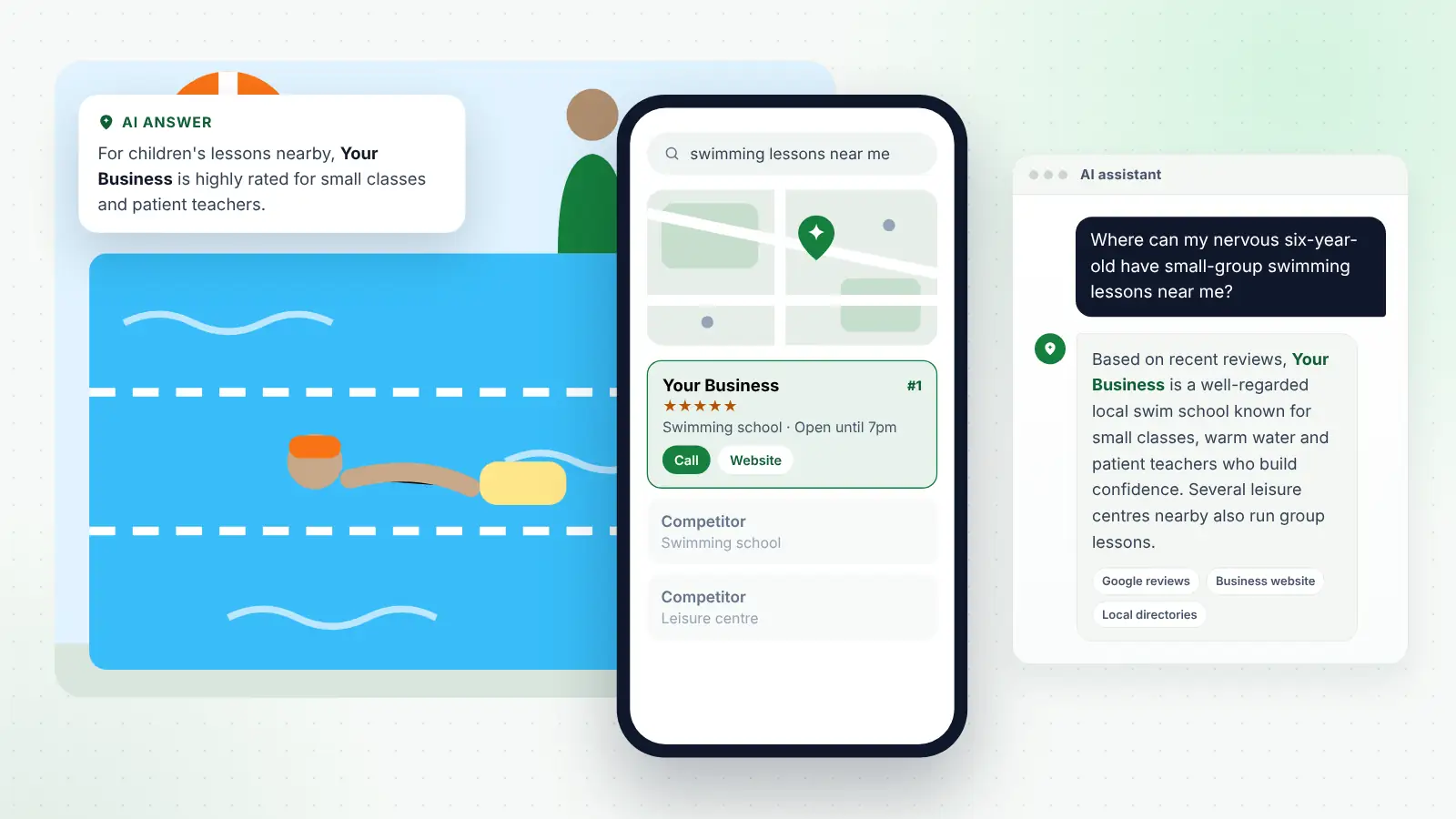
More parents now ask ChatGPT, Gemini, Perplexity, Copilot or Google AI Overviews questions such as “where can my nervous six-year-old have small-group swimming lessons near me?”, “which swim schools near me teach babies from three months?” or “where can an adult beginner learn to swim near me?”
When a parent asks a chatbot about lessons nearby, it leans on swim school details it can find and verify online. To improve your chances of being mentioned:
- Keep your information consistent. The same name, venues, lesson types and contact details everywhere.
- Describe your lessons plainly. Who each class is for, ages and stages, class sizes, lesson length and water temperature.
- Publish an FAQ. What to bring, what happens in the first lesson, how stages work and how the waiting list works.
- Earn reviews. AI tools often reflect themes from reviews, so specific reviews help.
- Be mentioned on reputable sites. Directories, local news, school and nursery websites and community pages.
AI visibility builds gradually, usually over two to three months alongside local SEO, and cannot be guaranteed.
Common mistakes to avoid
- Relying on one pool. If the venue closes, your business stops, so find a second venue once established.
- Underpricing small classes. Leisure centre prices for smaller classes leave no margin for hire increases.
- Vague policies. Unclear rules on missed lessons and refunds cause most disputes.
- No progression route. Families leave once a child can swim unless there is something next, such as advanced stages, clubs or lifesaving.
Tip
Before each term, check every teacher’s rescue award, first aid, DBS check and insurance renewal dates against your timetable, so nobody is taken off poolside unexpectedly.
Frequently asked questions
Do I need a qualification to teach swimming?
In practice, pool operators, insurers and parents expect a recognised Level 2 teaching qualification, such as Swim England Level 2 Teaching Swimming or the STA Level 2 Swimming Teacher Qualification, plus suitable rescue training for the pool and type of session.
Do swimming teachers need a DBS check?
Teachers and helpers working with children should have the appropriate check, usually an enhanced DBS check with a barred list check for regulated roles in England and Wales. Scotland and Northern Ireland have their own schemes.
What age can babies start swimming lessons?
Many swim schools welcome babies from a few months old, but ages vary by provider, pool and water temperature. Set a clear policy and direct parents to current NHS guidance for health questions.
How long does it take to fill classes?
It depends on your area and competition. Local search and AI visibility usually build over two to three months, so start promoting well before your first term.
Next steps
Get the qualifications, rescue training, safeguarding and insurance in place first, secure reliable pool time on clear terms, and design a timetable that suits local families and adults.
Then make it easy for people to find and choose you: clear lesson information, honest prices and policies, a well-run waiting list and a steady flow of reviews.