Security installation can be a rewarding and resilient business. Homes and businesses need intruder alarms, CCTV, access control and door entry, and every system you fit needs servicing, repairs and eventually upgrading. An installer who builds a base of maintenance and monitoring contracts can create steady, recurring income that carries the business through quieter months.
It is also a trade where trust and standards matter more than in most. Customers are letting you into their home or premises, learning how their security works and often handing you codes and keys. Insurers may specify the system they will accept, police response to monitored alarms depends on meeting national requirements, and CCTV brings data protection responsibilities for your customers. Getting the foundations right from the start protects you, your customers and your reputation.
This guide covers the main steps to starting a security installation business in the UK, from choosing your services and gaining certification to police response, grading, CCTV privacy, pricing and getting found by local customers.
Key points
- Police response to a monitored intruder alarm depends on the NPCC Security Systems Policy, which requires the installer to be certified by a UKAS-accredited body such as NSI or SSAIB and the system to receive a unique reference number (URN) from the police.
- Intruder alarms are designed to a grade from 1 to 4 under BS EN 50131, applied in the UK through PD 6662, and the grade should match the risk and the insurer’s requirements.
- Customers using CCTV can have data protection obligations, especially businesses and homeowners whose cameras record beyond their boundary, so good installers advise on positioning and privacy.
- An SIA licence applies to certain contracted security activities such as public space surveillance monitoring, and mains electrical work in homes may fall under building regulations.
- Most installers grow through reviews, referrals, recurring maintenance contracts and a strong local search presence.
In this guide
- Decide what kind of security business you want to run
- NSI and SSAIB certification
- Police response and URNs
- Understanding alarm grades
- CCTV, privacy and data protection
- SIA licensing and electrical regulations
- Setting up the business
- Pricing and building recurring income
- Local SEO: getting found by homeowners and businesses nearby
- AI search: being suggested as a trusted installer
- Building referrals and partnerships
- Frequently asked questions
- Next steps
Decide what kind of security business you want to run
Security installation covers a wide range of work. It helps to decide early where you want to focus, because it shapes your training, certification, equipment and the customers you target.
- Domestic alarms and CCTV. Wireless and wired intruder alarms, home CCTV and video doorbells, smart security linked to apps. This is often where new installers start.
- Commercial intruder alarms. Shops, offices, warehouses and industrial units, frequently specified by insurers, often monitored and sometimes requiring police response.
- CCTV and remote monitoring. Larger camera systems, remote viewing, video analytics and systems connected to a remote video response centre.
- Access control and door entry. Fobs, cards, keypads, intercoms and gate automation for blocks of flats, offices, schools and healthcare sites.
- Maintenance and takeovers. Servicing existing systems, including those whose original installer has closed or stopped supporting them.
Many installers begin with domestic work while building the experience and paperwork needed for certification, then add commercial and monitored systems once they are approved. Others come from an electrical or locksmith background and add security as a natural extension.
Skills and training
There is no single licence to install an alarm, but customers, insurers and certification bodies all expect competence. Useful foundations include electronic security qualifications, manufacturer training on the panels and cameras you plan to fit, networking knowledge for IP CCTV and cloud-connected systems, and working at height and health and safety training. Spending time working for an established, approved installer is one of the best ways to learn the paperwork, design standards and customer handling that make the difference.
NSI and SSAIB certification
The two main certification bodies for security installers in the UK are the National Security Inspectorate (NSI) and the Security Systems and Alarms Inspection Board (SSAIB). Both are UKAS-accredited and inspect member companies against the relevant British and European standards.
Certification typically involves:
- Setting up documented procedures for design, installation, commissioning, handover and maintenance.
- Keeping records of surveys, system designs, certificates and service visits.
- Showing competence through qualified staff and suitable equipment.
- Passing an initial assessment, including inspection of completed installations.
- Ongoing surveillance visits, usually annually, to check that standards are maintained.
NSI offers different levels of approval. Its Silver scheme focuses on technical standards, while NACOSS Gold adds a quality management system to ISO 9001. Silver is often seen as a stepping stone for smaller firms. SSAIB offers its own certification schemes for intruder alarms, CCTV, access control and other systems.
Certification is not a legal requirement for every job, but it is the key that opens police-response alarms, most commercial work and many insurer-specified systems. It is also one of the clearest trust signals you can show customers.
Tip
Plan for certification from day one. Keep proper survey notes, design records and handover certificates on every job, even before you apply, so that you have a track record ready to show the assessor.
Police response and URNs
For a monitored intruder or hold-up alarm to receive a police response, it must meet the National Police Chiefs’ Council (NPCC) Security Systems Policy, which applies across England, Wales and Northern Ireland. Police Scotland has similar requirements.
In broad terms:
- The installer, and the company that maintains and monitors the system, must be certified by a UKAS-accredited certification body such as NSI or SSAIB and recognised by the local police force.
- The system must be installed to the relevant standards and connected to an approved alarm receiving centre (ARC).
- The installer applies to the police for a unique reference number (URN) for the system. Police forces charge an administration fee for this, normally payable by the customer, so check the current amount with the force concerned.
- When the alarm activates, the ARC verifies it and passes it to the police using the URN.
New systems are generally expected to use confirmation technology, so that a single detector triggering on its own is not treated as a confirmed intrusion. This cuts false alarms, which matter a great deal: under the policy, a system that generates repeated false alarms in a rolling 12-month period can be warned and then have its police response withdrawn, leaving keyholder response only. Reinstatement usually requires remedial work and a period free of false calls.
Systems without a URN, such as bells-only alarms or self-monitored smart systems, do not receive a guaranteed police response. That is fine for many customers, but you need to explain the difference honestly. Never describe a system as “police monitored” unless it genuinely has a URN.
Understanding alarm grades
Intruder alarm systems in the UK are designed to a security grade under BS EN 50131, applied through the UK guidance document PD 6662. The grade reflects the expected skill and equipment of an intruder and determines the level of tamper protection, signalling and component performance required.
| Grade | Typical risk | Common examples |
|---|---|---|
| Grade 1 | Low risk, opportunist intruder with little knowledge of alarms | Rarely specified on its own; some very low-risk sites |
| Grade 2 | Low to medium risk, intruder with some knowledge and simple tools | Most homes and many small shops and offices |
| Grade 3 | Medium to high risk, experienced intruder with portable equipment | Higher-value homes, warehouses, pharmacies, stock-holding businesses |
| Grade 4 | Very high risk, organised intruder with sophisticated equipment | High-security and critical sites |
A good survey sets the grade based on the property, its contents and the customer’s insurance. Commercial insurers often specify the grade and signalling they require, so ask to see the insurer’s requirements before you design a commercial system. Record the grade on your quotation and certificate so there is no ambiguity later.
CCTV, privacy and data protection
CCTV is a large part of most installers’ work, and it is where customers most often need guidance they did not expect.
Domestic CCTV
The Information Commissioner’s Office (ICO) explains that if a home CCTV system or smart doorbell records beyond the property boundary, such as a street, a neighbour’s garden or a shared driveway, data protection law applies to the homeowner. They then need a clear reason for recording, should limit what is captured, display signs, keep footage secure, delete it regularly and handle requests from people who ask for footage of themselves. The ICO’s guidance on home CCTV systems is worth reading and sharing with customers.
Practical steps you can take on every domestic job:
- Position cameras to cover the customer’s own property wherever possible.
- Use privacy masking to block out neighbours’ windows and gardens.
- Think carefully before enabling audio recording, which is more intrusive.
- Set a sensible retention period on the recorder or cloud service.
- Explain these choices in your handover, and note them on your paperwork.
Neighbour disputes over cameras are common. An installer who has advised responsibly, and recorded that advice, is in a much stronger position if a complaint arises.
Business CCTV
Businesses using CCTV that captures people will usually need to register and pay the data protection fee to the ICO, decide how long to keep footage, display signs, protect the footage and respond to subject access requests. Where cameras may be high risk, such as monitoring staff, a data protection impact assessment may be needed. The ICO’s page on CCTV for your organisation sets out the main steps.
You are not your customer’s data protection adviser, but making them aware of these responsibilities, and designing systems that make compliance easy, is part of a professional service.
SIA licensing and electrical regulations
When an SIA licence applies
The Security Industry Authority (SIA) licenses certain security activities carried out under a contract for services. Public space surveillance (CCTV) licensing covers using CCTV to guard premises or people, for example contracted operators watching live or recorded footage to prevent or investigate crime or disorder. Key holding under contract is also a licensable activity. Installing and maintaining equipment is generally separate from these activities, but if you plan to offer contracted monitoring, remote video response or key holding, check the SIA’s guidance on whether you need an SIA licence before you start.
Part P and mains wiring
Much alarm and CCTV work uses low-voltage cabling, but panels, recorders, gate motors and power supplies often need a mains connection. In England, electrical work in homes falls under Part P of the Building Regulations, and certain jobs, such as installing a new circuit, are notifiable. You can either register with a competent person scheme or notify building control. If you also fit panels and power supplies in Wales, Scotland or Northern Ireland, check their own building regulations, which are not identical. Many installers either qualify and register for this work or partner with a registered electrician.
Setting up the business
Structure, insurance and paperwork
Decide whether to trade as a sole trader or limited company, register with HMRC and keep good records from the start. Insurance is essential: public liability, employers’ liability if you take on staff, professional indemnity if you design systems, cover for tools and stock, and van insurance. Some insurers offer policies designed for security installers.
Vetting and customer data
Customers and certification bodies expect staff to be vetted, and BS 7858 is the British Standard commonly used for screening people in security roles. You will also hold sensitive information such as alarm codes, system designs and keyholder details, so treat it carefully, restrict access and think about your own data protection responsibilities.
Startup costs
| Item | Rough guide | Notes |
|---|---|---|
| Van and racking | Varies widely; used vans keep costs down | Branded vans help local recognition |
| Tools and test equipment | From a few hundred to a few thousand pounds | Drills, cable tools, ladders, signal and network testers |
| Initial stock | Varies by systems you fit | Panels, detectors, cameras, recorders, cable |
| Training and manufacturer courses | Varies by course | Some suppliers offer free product training |
| Certification (NSI or SSAIB) | Application and annual fees | Check current fees with each body |
| Insurance | Varies by cover and turnover | Shop around for security trade policies |
| Software | Typically a monthly subscription | Quoting, job management, service reminders |
| Website and marketing | Varies | A clear site and Google profile matter most |
All figures vary by area, supplier and the scale you start at. Building relationships with one or two trade distributors helps with credit terms and technical support.
Pricing and building recurring income
Customers find security pricing hard to compare because systems vary so much. Clear, structured quotes help you win on value rather than price alone.
- Quote from a proper survey. Walk the property, discuss risks and insurance, and explain the grade and equipment you recommend.
- Break down the quote. Equipment, installation, any monitoring or app subscription, and annual maintenance should be clear.
- Offer good, better, best options. For example, a wireless bells-only alarm, a monitored system and a confirmed police-response system.
- Sell maintenance at the point of sale. Annual or twice-yearly servicing is often required for monitored and insured systems, and it provides recurring income.
- Offer takeovers. Many systems are left without support when an installer retires. Taking them over, servicing them and upgrading where needed builds your customer base.
Tip
Track the share of your income that comes from maintenance and monitoring. A rising recurring base makes cash flow steadier and the business more valuable if you ever sell it.
Local SEO: getting found by homeowners and businesses nearby
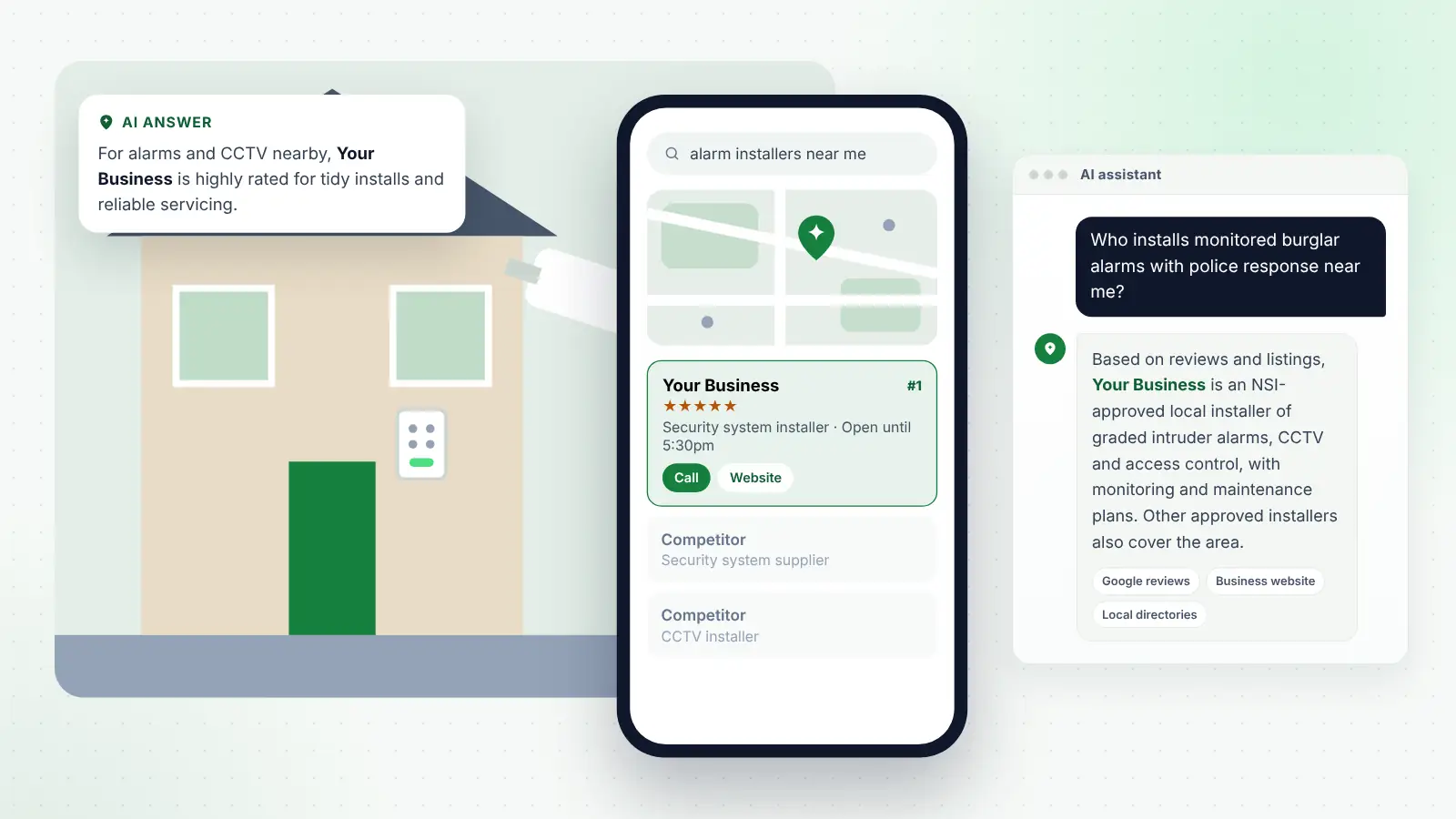
Most people buying an alarm or CCTV system do not already know an installer. They search on Google, often on their phone, and frequently straight after a burglary in their street or a news story about break-ins nearby. Searches such as “burglar alarm installers near me”, “CCTV installation [town]”, “alarm engineer call out” and “access control for flats” are local, and the businesses shown on the Google map get most of the calls.
Businesses search too, usually with more specific needs: “NSI approved alarm company”, “monitored alarm for shop”, “CCTV for warehouse” or “door entry system repair”. Being visible for these searches helps you win the higher-value commercial work.
Google Business Profile
For someone shaken by a nearby break-in, your Google profile is usually the first impression they get of your company. Make it complete and accurate:
- Choose the most accurate primary category, such as security system installer, and add relevant secondary categories.
- Set it up as a service-area business if you work from home, listing the towns you genuinely cover.
- Add each service separately: intruder alarms, CCTV, access control, door entry, maintenance, monitoring.
- Mention your NSI or SSAIB certification and insurance in your description.
- Upload real photos of neat installations, panels, cameras, keypads and your branded van, avoiding anything that reveals a customer’s address or system layout.
- Keep opening hours accurate, and make clear whether you offer emergency call-outs.
Reviews
Security is a high-trust purchase, so reviews carry a lot of weight. Ask every customer for a review after handover, ideally with a direct link. Reviews that mention tidy cabling, clear explanations, reliability and quick response to faults are especially persuasive. Reply to every review politely, and handle any complaints calmly and professionally.
Matching details across directories and certification registers
Your business name, address and phone number should be identical across your website, Google profile, Bing Places, Apple Business (which replaced Apple Business Connect in 2026), UK directories, trade body listings and your NSI or SSAIB register entry. A mismatch, such as an old phone number on a register entry, leaves Google unsure which details to trust and makes cautious customers wonder too.
Pages for each system you fit and each town you cover
Your website should have a separate page for each main service, explaining what is involved, the options available and what customers should expect. Area pages for the main towns you cover help, provided each contains useful local information rather than copied text. Explain grades, monitoring and police response in plain English, show your certification and include guide prices where you can.
Local links and mentions
Links from local business groups, chambers of commerce, community organisations, suppliers you work with and local news coverage help show search engines that you are an established local business. Writing helpful security advice for a local publication or residents’ group is a natural way to earn them.
If you would rather focus on installations while specialists handle your online visibility, local SEO for security and CCTV installers is one option worth considering. Whichever route you take, expect alarm and CCTV enquiries from search to build gradually over three to six months.
AI search: being suggested as a trusted installer
More people now ask AI assistants such as ChatGPT, Gemini, Perplexity, Copilot and Google’s AI Overviews for advice and recommendations. A homeowner might ask “Do I need a monitored alarm or is a smart alarm enough?” or “Who installs police-response alarms near me?”. A business owner might ask “Which CCTV companies near me are NSI approved?” or “What grade of alarm does my shop insurance need?”.
These tools try to give a measured, reliable answer, so they draw on information they can confirm across the web. To be recommended, help them understand what you do and why you are trustworthy:
- Consistent information everywhere. Matching details on your website, Google profile, directories and certification register.
- Reviews. A steady flow of genuine reviews describing the work you did and the service you gave.
- Clear service descriptions. Plain explanations of the systems you install, the areas you cover and the customers you work with.
- Helpful FAQs. Answers to real questions about grades, monitoring, URNs, maintenance, wireless versus wired systems and CCTV privacy.
- Mentions on reputable sites. Trade bodies, local business organisations, suppliers and local news.
AI search is still evolving, and no one can guarantee a recommendation. But the work that helps you appear in AI answers is the same work that builds trust with customers, so it is never wasted.
Tip
Write down the questions customers ask on surveys and answer them on your website. Those are exactly the questions people now put to AI assistants.
Building referrals and partnerships
Search brings new customers, but relationships often bring the steadiest work. Consider partnerships with:
- Letting agents, property managers and housing providers who need systems fitted, serviced and maintained across many properties.
- Builders, electricians and kitchen or extension firms who can recommend you to their customers.
- Locksmiths, who are often called after a break-in and can refer customers for alarms and CCTV.
- Insurance brokers, who can point commercial clients towards approved installers.
- Local businesses and schools, which often need intruder alarms, CCTV and access control together.
Keep in touch with past customers with service reminders and occasional updates about upgrades. A customer who trusts you with their alarm is likely to come back for cameras, door entry or a new system when they move.
Frequently asked questions
Do I need to be NSI or SSAIB approved to install alarms?
Not for every job, and you can legally install bells-only and self-monitored systems without certification. However, approval by a UKAS-accredited certification body such as NSI or SSAIB is needed for police-response alarms, and many commercial customers and insurers expect it. It is also a strong trust signal for homeowners.
How do I get a URN for a customer’s alarm?
Once your company is certified and recognised by the local police force, you apply to that force for a URN for each qualifying system, which must be installed to the relevant standards and connected to an approved alarm receiving centre. The police charge an administration fee, usually passed on to the customer.
Do I need an SIA licence to install CCTV?
Installing and maintaining CCTV is generally separate from the activities the SIA licenses. A public space surveillance licence applies to certain contracted CCTV monitoring work, and key holding under contract is also licensable. If you plan to offer monitoring or key holding, check the SIA’s guidance first.
What grade of alarm should I recommend?
Base the grade on a proper risk assessment and any insurer requirements. Grade 2 suits most homes and many small businesses, while higher-risk sites may need Grade 3 or above. Record the grade clearly on your quote and certificate.
How long before an alarm and CCTV business is on a steady footing?
It varies by area, experience and how quickly you build a maintenance base. Many installers find that reviews, referrals and recurring contracts build steadily over the first couple of years, and local SEO usually takes three to six months to show stronger results.
Next steps
Starting a security installation business takes careful preparation: training, the right insurance, a plan for NSI or SSAIB certification, a clear understanding of police response and grading, and responsible advice on CCTV and privacy. Get those foundations right and you can build a business with loyal customers and steady recurring income.
Just as important is being easy to find when someone nearby needs a system fitted. A complete Google profile, consistent details, genuine reviews and a website that answers real questions will help you appear both in local search and in the AI tools people increasingly use to choose a trusted installer.