Window cleaning is one of the most dependable small businesses you can start. The work is repeat by nature: once a household or shop takes you on, they usually want a clean every four, six or eight weeks for as long as you keep turning up. Startup costs are modest compared with many trades, you can begin as a sole trader with one van, and there is real scope to grow into gutter, fascia, conservatory roof and commercial work.
The business is simple to understand, but it is not simple to do well. Profit depends on how tightly packed your round is, how safely you work, how reliably you show up and how good you are at keeping customers. Working at height carries genuine legal duties, and the way you deal with waste water and gutter debris matters more than many newcomers expect.
This guide covers what it takes to start a window cleaning business in the UK: the safety rules, equipment, insurance and licensing, how to price and plan a round, the services that add value, and how to make sure local customers find you when they search.
Key points
- Window cleaning is built on repeat customers, so a dense, reliable round matters more than a high price per house.
- The Work at Height Regulations 2005 apply, and HSE guidance favours avoiding work at height where possible, for example with water-fed poles.
- Public liability insurance is essential, and employers’ liability insurance is a legal requirement once you take on staff.
- England and Wales have no general window cleaner licence, but many Scottish councils require one, so check with your council.
- Gutter, fascia, conservatory roof and commercial cleaning raise the value of each customer and help through quieter months.
- Local SEO and AI search help you win customers in the streets you already cover, which is where new work is most profitable.
In this guide
- Understand how a window cleaning business makes money
- Working at height: the law and HSE guidance
- Water-fed poles and pure water systems
- Insurance, licences and registration
- Waste water and the environment
- Poles, pure water kit and what it costs to start
- Pricing and building a profitable round
- Add-on services and seasonality
- Filling your first streets with customers
- Local SEO for window cleaners
- AEO and AI search for window cleaning businesses
- Frequently asked questions
- Final thoughts
Understand how a window cleaning business makes money
Most window cleaning businesses earn the bulk of their income from a residential round: a list of regular customers visited on a fixed cycle, usually every four to eight weeks. Each clean is a small amount of money, but a customer who stays for several years is worth a lot, and a well-planned round lets you complete many houses in a day with little travel between them.
Alongside the round, there are several other types of work:
- Gutter clearing and fascia, soffit and cladding cleaning. Higher-value jobs, often once or twice a year, that you can offer to your existing customers.
- Conservatory roof cleaning. Popular in spring and summer when roofs turn green, and a natural add-on for houses you already clean.
- Commercial work. Shops, offices, cafés, schools, care homes and blocks of flats. Low-level shop fronts may be cleaned weekly or fortnightly; larger buildings may be cleaned on contract.
- One-off cleans. New builds, end-of-tenancy work for letting agents and homes being prepared for sale.
The key point is density. Ten new customers in streets you already work are worth far more than ten customers spread across the county, because you spend your day cleaning rather than driving. Every marketing decision, including how you approach local SEO, should support a tighter round.
Working at height: the law and HSE guidance
Window cleaning is work at height, and the Work at Height Regulations 2005 apply. HSE guidance for window cleaners explains that work at height must be properly planned, supervised and carried out by competent people using the right equipment. The Health and Safety at Work etc. Act 1974 also applies, including to self-employed window cleaners whose work could put others at risk. You can read HSE’s guidance on working at height while window cleaning.
The hierarchy you should follow
HSE sets out a simple order of priorities:
- Avoid working at height where reasonably practicable, for example by using a telescopic water-fed pole from the ground or cleaning from inside.
- Use an existing safe place of work, such as a balcony or the inside of the building.
- Use suitable access equipment where there is no safe existing place.
- Minimise the distance and consequences of a fall where the risk cannot be eliminated, using fall arrest equipment where appropriate.
Ladders
Ladders are still used for some window cleaning, but HSE makes clear they are not the default choice. They are suited to low-risk, short-duration tasks. The ladder must be strong and long enough for the job and free of defects, and because most ladder falls happen when the ladder moves, stability is critical. Check ground conditions, the weather and the surface the ladder rests on, and tie it to a secure point where you can.
Risk assessments and planning
Before you take on a property, think about its height, access routes, ground conditions, nearby hazards and how you will move equipment around safely. Write down your risk assessment, review it when conditions change and make sure anyone working for you understands it. Higher-risk work, such as rope access or powered access platforms, needs specialist training, equipment and a written method statement. Plan how you would rescue someone in an emergency before the work starts: HSE is clear that relying on the emergency services alone is not acceptable.
Tip
Keep a short written risk assessment for each type of property you clean, plus notes on any individual house with unusual hazards such as a steep drop, a glass roof or overhead cables. It protects you, satisfies commercial clients and is quick to update.
Water-fed poles and pure water systems
Most window cleaners now use water-fed poles for the majority of their work. A telescopic pole carries purified water up to a brush, and because the water has had its minerals removed, it dries without spots, so there is no need to squeegee. The method lets you clean upper windows, frames and sills from the ground and is the main reason working at height has become far less common in the trade.
A typical setup includes:
- A pure water system. Usually reverse osmosis and de-ionisation (RO/DI) filtration, either at your base or on the van.
- A van-mounted tank and pump. The tank size depends on your round and van payload.
- Hose reels and hose. Long enough to reach the back of houses without moving the van too often.
- Poles and brushes. Carbon fibre and hybrid poles are lighter but cost more; most cleaners carry more than one length.
The best practice guidance on water-fed poles, produced by the Federation of Window Cleaners with contributions from HSE, the Energy Networks Association and others, highlights several risks you need to manage:
- Overhead power lines. Purified water has low conductivity, but systems should still be treated as potentially conductive, and electricity can arc without contact. Never raise a pole near overhead lines, and only extend and lower it in areas you have checked are safe.
- Trip hazards from hoses across pavements, paths and drives.
- Slips on wet or icy surfaces, particularly in winter.
- Manual handling. Long poles put strain on your shoulders and back, so use the lightest pole that reaches without overreaching and take regular breaks.
- Legionella. Water left warm and stagnant in tanks and filters can allow bacteria to grow, so change filters, service the system and drain it if it will stand idle in warm weather.
Insurance, licences and registration
Insurance
Public liability insurance is essential. If you break a window, damage a conservatory roof or someone trips over your hose, you need cover. Commercial clients and managing agents will usually ask to see your certificate, and some will specify a minimum level of cover. Take on a second pair of hands, even part time, and employers’ liability insurance becomes compulsory. You should also consider van insurance that covers business use, cover for your equipment and tools (water-fed pole kit is valuable and attractive to thieves) and personal accident or income protection cover, since a few weeks off work can be costly for a sole trader.
Licensing
There is no general licence to work as a window cleaner in England or Wales, although it is always worth checking with your local council. Scotland is different. Many Scottish councils require window cleaners to hold a licence under the Civic Government (Scotland) Act 1982, and in those areas each person working as a window cleaner, including employees, usually needs their own licence. Conditions vary by council but can include a minimum level of public liability insurance, an identity badge that must be worn while working and a fit and proper person check. If you plan to work in Scotland, contact the council for each area you cover before you start.
Registering to carry gutter waste
If you clear gutters and take the debris away in your van, you are transporting waste from your business activity. In England, businesses that transport waste must register as a waste carrier, and registration is usually free if you only carry waste you produce yourself. The system in England is being replaced by a new permit-based regime, with the main changes due from July 2027, so check the current requirements with the Environment Agency, or the equivalent body in Scotland, Wales or Northern Ireland, before you start offering gutter clearing.
Other essentials
Register as self-employed with HMRC or set up a limited company, keep proper records from day one and think about how you will store customer details securely. A trade association membership, such as the Federation of Window Cleaners, can give you access to safety training, guidance and insurance schemes, and is a recognised trust signal for customers.
Waste water and the environment
Water-fed pole cleaning uses pure water and usually no detergent, which makes it far kinder to the environment than older methods. Even so, the water that runs off a window, frame or conservatory roof carries dirt, and some jobs produce heavier contamination: conservatory roof and cladding cleaning may involve cleaning products, and gutter clearing produces sludge and debris.
Government guidance on pollution prevention explains that surface water drains discharge directly to the environment, so only clean water should go into them. Contaminated water should go to the foul drain, with your water company’s permission, or be collected and removed. Detergents in particular can cause pollution if they reach rivers and streams. The gov.uk pollution prevention guidance for businesses sets out the basics.
In practice:
- Use products sparingly and choose ones suitable for exterior cleaning where run-off is likely.
- Bag gutter debris rather than washing it down drainpipes into surface water drains.
- Never empty dirty buckets or tanks into roadside gullies.
- Ask commercial clients about their drainage if you clean large areas of glass or cladding.
Poles, pure water kit and what it costs to start
You can start with relatively little, particularly if you begin with ladders and traditional tools on low-rise homes and add water-fed pole kit as your round grows. These figures are rough guides only and vary by supplier, specification and area.
| Item | Typical cost | Notes |
|---|---|---|
| Small van | £5,000–£15,000 | Used is fine; check payload for a water tank |
| Pure water system (RO/DI) | £500–£3,000 | Base-fed or van-mounted options |
| Van tank, pump and hose reel | £800–£3,000 | Complete van systems can cost more |
| Water-fed poles and brushes | £300–£2,000 | Carbon fibre is lighter but dearer |
| Ladders and traditional kit | £200–£800 | Squeegees, applicators, buckets and scrims |
| Gutter vacuum system | £1,000–£4,000 | Optional; add once you have demand |
| Insurance (first year) | Varies | Public liability and equipment cover |
| Round management software | £10–£50 per month | Scheduling, reminders and payments |
Running costs include filters and resin for your water system, fuel, van maintenance, insurance and software. Budget for replacing brushes, hoses and filters regularly.
Tip
Before buying an expensive van system, try a base-fed setup with a simple tank. You will learn what tank size, hose length and pole length your round actually needs before you spend serious money.
Pricing and building a profitable round
How to price
Most window cleaners price residential work per property, based on the number and size of windows, access and whether frames, sills, doors and conservatories are included. Some think in terms of a target rate per hour and work backwards: if a house takes twenty minutes, the price should reflect what you need to earn for that time, plus travel, materials and the cost of quiet weeks.
Common pricing mistakes include:
- Underpricing to win work, then struggling to raise prices later.
- Accepting scattered customers whose travel time wipes out the profit.
- Not charging separately for conservatory roofs, internal cleans or difficult access.
- Forgetting the cost of chasing payment, which can take hours each month.
Getting paid
Chasing money is one of the most frustrating parts of running a round. Offering online card payments, bank transfer or direct debit, with a reminder sent after each clean, saves time and reduces bad debt. Be clear from the start about when payment is due.
Planning the round
Group customers by street and area and clean them on the same day each cycle. Use software to schedule work, send “we’ll be with you tomorrow” messages and record notes such as gate codes or a dog in the garden. Some window cleaners buy an existing round from someone who is retiring, which can give you immediate income. If you do, check the customer list, payment history and how recently each house was cleaned, and ask how the price per house was agreed.
Add-on services and seasonality
Window cleaning is affected by weather and daylight. Winter rounds are slower, rain can push work back and short days limit how many houses you can clean. Add-on services help even this out:
- Gutter clearing in autumn, after leaves fall, and before winter.
- Fascia, soffit and cladding cleaning, often sold alongside gutter work.
- Conservatory roof cleaning in spring and early summer.
- Internal window cleaning for customers who want it, particularly in winter.
- Commercial work, which is less dependent on daylight and often follows a fixed schedule.
Offer these to existing customers first. They already trust you, and a gutter clean booked while you are on site is quick and profitable. Keep the line between window cleaning and general domestic cleaning clear on your website, so customers know exactly what you do.
Filling your first streets with customers
- Door-knocking and leaflets in the streets where you already have work, so each new customer makes your round denser.
- Neighbour referrals. A card left after each clean, and a modest thank-you for referrals, encourages customers to recommend you.
- Letting agents, property managers and estate agents, who need windows cleaned before viewings and at the end of tenancies.
- Local shops and offices on the high streets you already pass.
- Local Facebook groups and community noticeboards, used sparingly and helpfully.
- Reviews. Ask every customer for a Google review, especially in your first year.
Local SEO for window cleaners
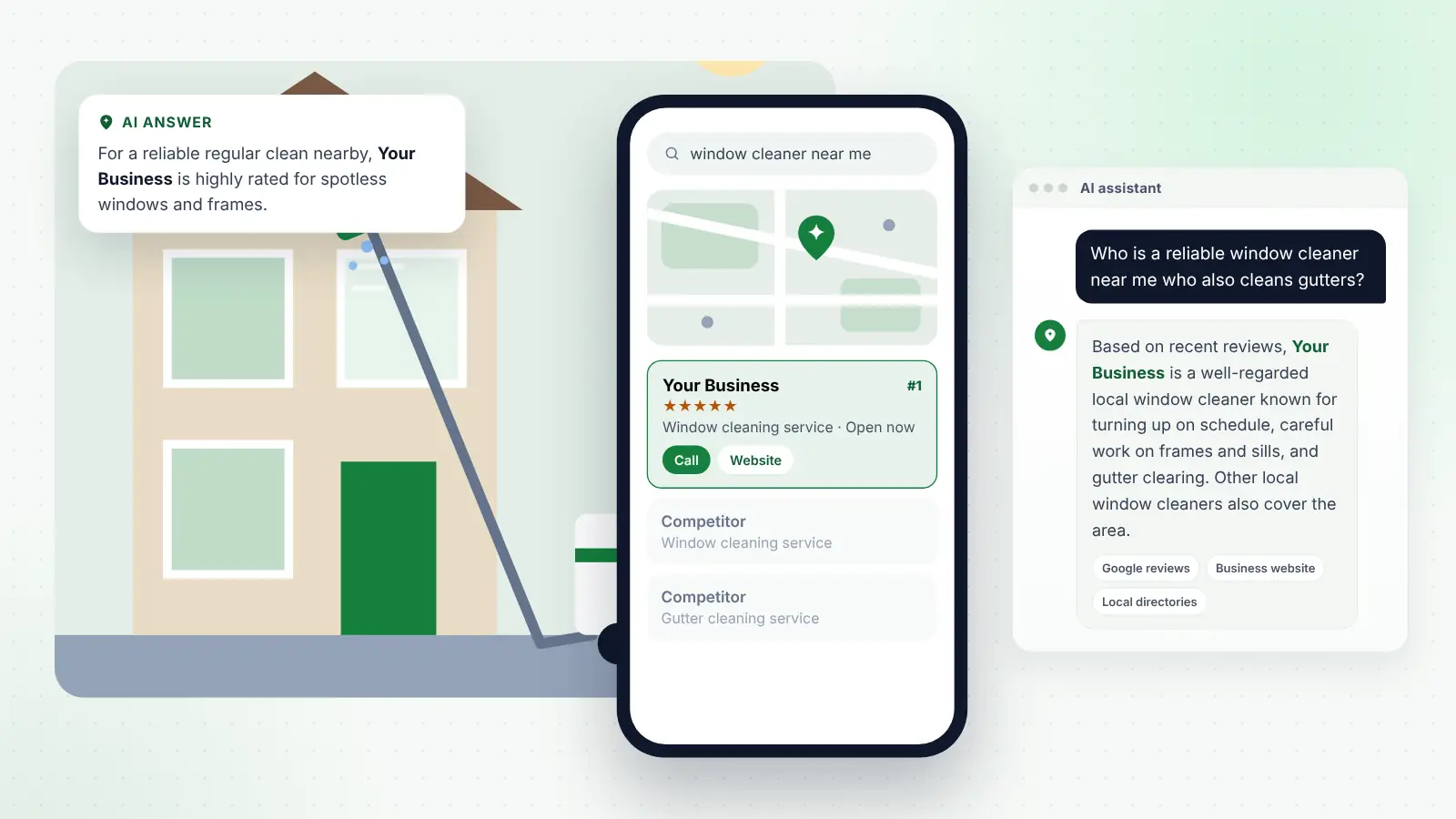
When someone moves into a new home, or their old window cleaner retires, they usually search on their phone: “window cleaner near me”, “window cleaning [town]”, “gutter cleaning near me”, “conservatory roof cleaning [area]” or “commercial window cleaners [city]”. They compare the businesses at the top of the map, look at reviews and contact one or two. Being in that top group in the areas you already cover is one of the most cost-effective ways to grow a round.
The essentials:
- Complete your Google Business Profile. Choose an accurate primary category, list each service you offer, set your service area to the towns you actually cover and keep your contact details and hours accurate.
- Add real photos. Your van, your kit, before-and-after shots of conservatory roofs and gutters, and you or your team at work all show that you are a genuine local business.
- Collect detailed reviews. Reviews that mention reliability, clean frames and sills, good communication and careful work around gardens are especially persuasive.
- Use one set of details everywhere. Give the same trading name, mobile number, website and round area on Google, local directories, the Federation of Window Cleaners listing and your Facebook page.
- Build service and area pages. Separate pages for window cleaning, gutter and fascia cleaning, conservatory roofs and commercial work, plus pages for the main towns and villages on your round, help you appear for specific searches.
- Earn local links. Local business groups, sponsorship of a youth sports team, community websites and trade association directories all help.
You can do this yourself, or hand it to specialists if your time is better spent on the round. Our page on local SEO for window cleaners explains how that works for sole traders and growing firms. Expect results to build over three to six months, so starting in winter helps you be ready for the spring rush.
AEO and AI search for window cleaning businesses
Plenty of homeowners now put the question to an AI assistant before they open a map app. That could be ChatGPT, Gemini, Perplexity or Microsoft Copilot, or the AI Overview at the top of Google, asked things like:
- “Who is a reliable window cleaner near me who also cleans gutters?”
- “How often should I have my windows cleaned?”
- “Is a water-fed pole as good as traditional window cleaning?”
- “How much does conservatory roof cleaning cost?”
- “Which window cleaners near me do shop fronts?”
Answer engine optimisation (AEO) means giving these tools clear, consistent information they can trust and repeat. For a window cleaner, that usually means:
- Consistent business information wherever you are listed, so AI tools are confident about who you are and where you work.
- Reviews that describe the service, the area and qualities such as reliability and care.
- Clear service descriptions stating exactly what you clean, how often, and which areas you cover.
- A helpful FAQ page answering common questions about cleaning frequency, pure water, what happens if it rains, payment and whether customers need to be at home.
- Mentions on reputable local and industry sites, such as trade association directories, local business networks and community websites.
This matters for window cleaners because customers are choosing someone they will let into their garden every few weeks for years. A business that explains its methods, insurance and service area clearly is more useful to them and more likely to be referenced in AI answers. Nothing can promise you a mention, but the groundwork is almost the same as what keeps your round visible on the map.
Frequently asked questions
Do I need a licence to be a window cleaner?
In England and Wales there is no general window cleaner licence, though it is worth checking with your local council. In Scotland, many councils require window cleaners to hold a licence under the Civic Government (Scotland) Act 1982, often with conditions such as minimum insurance and an identity badge. Check with each council you plan to work in.
Can I still use ladders?
Yes, but HSE guidance treats ladders as suitable for low-risk, short-duration work rather than the default. Where you can clean safely from the ground with a water-fed pole, that is generally the preferred option under the Work at Height Regulations 2005. If you use ladders, make sure they are suitable, in good condition and stable.
What insurance does a window cleaner need?
Public liability insurance is the essential starting point, and commercial clients will often ask for proof of it. Employers’ liability insurance is a legal requirement once you employ staff. Equipment, van and personal accident cover are also worth considering.
Is water-fed pole cleaning as good as traditional cleaning?
Done properly, with well-maintained pure water equipment, it gives a streak-free finish and cleans frames and sills as well as glass. Many customers like it because it keeps you off ladders and cleans upper windows from the ground. Traditional methods still have a place for some internal and detailed work.
How do I find work in winter?
Gutter clearing before winter, internal cleans and commercial contracts help keep income steady. Plan your round so that bad weather days can be caught up quickly, and keep customers informed when work moves.
Final thoughts
A successful window cleaning business is built on reliability, safe working and a well-planned round. Work from the ground wherever you can, keep your equipment and insurance in order, check the licensing rules if you work in Scotland and handle waste water and gutter debris responsibly.
Then focus on growing the round in the streets you already cover. Keep your Google Business Profile accurate, collect detailed reviews, explain your services clearly and offer add-on work to the customers who already trust you. Over time, that combination builds a dense, dependable round that is worth far more than the sum of its houses.