Many music schools start with one teacher, one instrument and a spare room. A pianist takes on a few pupils after school, word spreads at the school gate, and within a couple of years the diary is full from half past three until eight. Some teachers stay happily solo. Others add a second room, bring in guitar, drums and singing teachers, start group classes and grow into a proper music school.
Whichever route you take, running a music teaching business involves more than good playing. You will be working with children, often one to one, so safeguarding and DBS checks matter from the first lesson. You need the right insurance, a sensible approach to noise if you teach at home, clear fees and terms, and an understanding of how VAT treats private tuition. And you need a steady stream of new pupils, because even loyal families eventually move on.
This guide covers each of those steps for the UK as they stand in October 2026, from choosing a business model and exam boards to DBS checks, memberships, VAT, music licensing and getting found by local families and adult learners on Google and in AI assistants.
Key points
- There is no legal licence to teach music privately, but your experience, teaching approach and the exam boards you work with are what families judge you on.
- Since 21 January 2026, self-employed teachers in eligible roles with children can apply for an enhanced DBS check themselves through a registered umbrella body.
- Individual teachers working as sole traders or partners can usually treat private music tuition as VAT-exempt; tuition delivered through a limited company or by employed teachers is treated differently.
- Membership of the ISM or the Musicians’ Union includes public liability insurance and useful support, and both are trust signals for parents.
- If you teach from home, plan for noise, neighbours and the Google Business Profile rules on home-based and service-area businesses.
- Most pupils find lessons by searching for an instrument nearby, so a complete Google profile, reviews and clear instrument pages matter more than general advertising.
In this guide
- Choose your music teaching model
- Skills, qualifications and exam boards
- Safeguarding, DBS and teaching children one to one
- Insurance and professional memberships
- Teaching from home: space, noise and neighbours
- Setting up the business
- Pricing, terms and invoicing
- Music licensing, concerts and recordings
- Local SEO: getting found by families and adult learners
- AI search: getting suggested when parents ask for a music teacher
- Keep pupils playing
- Frequently asked questions
- Next steps
Choose your music teaching model
The way you teach shapes almost everything else: your costs, your insurance, your Google profile and how many pupils you can take. Most teachers start with one model and add another later.
| Model | How it works | Main advantages | Main challenges |
|---|---|---|---|
| Teaching from home | Pupils come to a room in your house | Low cost, no travel, your own instrument | Noise, parking, privacy, limited hours |
| Visiting teacher | You travel to pupils’ homes | Popular with busy families, no premises | Travel time between lessons, fewer lessons per evening |
| Schools work | You teach in schools during the day, privately or via a music service | Fills daytime hours | Depends on school timetables and agreements |
| Hired studio or hall | You rent rooms by the hour | Professional setting, room for groups | Hire costs, moving equipment |
| Music school | Several teachers and rooms, often several instruments | Scalable, one brand for families | Employment, management, premises costs |
| Online lessons | Lessons by video call | Wider reach, no travel | Harder for young beginners, more competition |
Group classes deserve a special mention. Early-years music, beginner ukulele or recorder groups, rock school bands and adult beginner piano groups can earn more per hour than individual lessons, and they often feed pupils into one-to-one lessons later. They also need more space, more planning and a clear approach to safeguarding when several children are present.
Skills, qualifications and exam boards
Anyone can legally set up as a private music teacher in the UK. That makes your teaching credentials more important, not less, because parents have little else to go on when comparing teachers.
What families look for
- Your own musicianship: grades, diplomas, a music degree or professional performing experience.
- Teaching experience: how long you have taught, which ages and levels, and whether you have taught pupils with additional needs.
- A teaching qualification or diploma: several exam boards offer teaching diplomas, and some universities and conservatoires run instrumental teaching courses.
- A clear approach: how you teach beginners, whether you teach reading music from the start, and how you balance exam pieces with music pupils enjoy.
Choose the exam boards you will offer
Graded exams are not compulsory, and many adult learners never take one. But many parents like the structure and sense of progress that grades give, and higher grades can count towards UCAS points for university applications. These are the main boards UK teachers work with:
| Exam board | Best known for | Worth knowing |
|---|---|---|
| ABRSM | Classical instruments, singing and music theory | The most widely recognised board for classical piano and orchestral instruments |
| Trinity College London | Classical, jazz and Rock and Pop syllabuses | Its Rock and Pop grades cover guitar, bass, drums, keys and vocals |
| RSL Awards (Rockschool) | Contemporary guitar, bass, drums, keys and vocals | Popular with teenagers who want to play the music they listen to |
| LCM (London College of Music Examinations) | A wide range of instruments and styles | Awarded by the University of West London |
Most boards now offer recorded or digital exam options alongside face-to-face exams, which makes it easier for small teachers to enter pupils. Check each board’s current syllabus, entry process and rules on theory requirements before you promise a family a particular route. Some boards, for example, ask for a theory or musicianship qualification before higher practical grades.
Tip
Offer at least one classical and one contemporary route if you teach piano, guitar or singing. A pupil who loses interest in classical grades may stay for years on a rock and pop syllabus.
Safeguarding, DBS and teaching children one to one
Most music lessons are one to one, often in a home, often with a child. Parents know this, and many will ask about checks and safeguarding before they book.
The DBS position for self-employed teachers
In England and Wales, there is no general legal requirement for a self-employed private music teacher to hold a DBS check, but most parents expect one. Until recently, self-employed people struggled to get anything beyond a basic check, because an organisation normally had to apply on their behalf.
That changed on 21 January 2026. Self-employed people and personal employees in eligible paid roles can now apply for an enhanced DBS check, including a barred list check where the role qualifies, through a registered DBS umbrella body. GOV.UK’s announcement on enhanced DBS checks for self-employed workers explains the route and links to a tool for finding an umbrella body that accepts self-employed applicants. Parents cannot apply for a check on your behalf.
Once you have a certificate, join the DBS Update Service. It lets parents and organisations check, with your permission, whether anything has changed, which answers the common question of how recent your check is. In Scotland, checks and the PVG scheme are handled by Disclosure Scotland, and Northern Ireland has its own arrangements through AccessNI.
If you employ or contract other teachers, you are responsible for checking them. Schools and music services you work for will usually carry out their own checks too.
Safe habits for the teaching room
A DBS certificate is only part of the picture. A sensible written policy should cover:
- Who can be in the house or building during lessons, and whether parents can sit in.
- Teaching in a room with a door that can be left open or has a glass panel where possible.
- Rules for physical contact when correcting posture or hand position, explained to parents in advance.
- Contacting pupils only through parents for under-16s, and never through personal social media.
- How you run online lessons, including recording, a parent nearby and a suitable room.
- What you do if a child tells you something worrying, and who you would report it to.
Short safeguarding courses are widely available, and the ISM and other music bodies publish guidance aimed specifically at instrumental teachers.
Insurance and professional memberships
You will want public liability insurance from day one, covering injury to pupils or parents and damage to property. If you visit pupils’ homes, check that the policy covers you there. If you employ anyone, employers’ liability insurance is usually a legal requirement.
Two professional bodies are especially relevant:
- The Independent Society of Musicians (ISM) offers membership that includes public liability insurance, legal advice, guidance for private teachers and a public directory where members can be listed.
- The Musicians’ Union (MU) offers membership that includes public liability cover, some instrument insurance, legal advice and support for teachers.
Compare what each includes for your situation, as benefits and cover levels change. Either membership also tells parents you take your teaching seriously, so mention it on your website and profile.
Two other things are easy to forget:
- Tell your home insurer if pupils come to your house. Business visitors can affect home insurance, and some policies exclude business use unless you declare it.
- Insure your instruments and equipment properly, especially if you transport a keyboard, guitars or a PA system to lessons or venues.
Teaching from home: space, noise and neighbours
Teaching from home keeps costs low, but it brings practical questions that are worth answering before you advertise.
Noise
Acoustic piano and singing usually cause few problems at sensible hours. Drum kits and amplified guitar are another matter. Councils can act against noise that amounts to a statutory nuisance, so a neighbour’s complaint is worth taking seriously early.
- Talk to neighbours before you start, and give them your number.
- Keep lessons within reasonable hours, especially at weekends.
- Use electronic drum kits or mesh heads for beginners, and practice pads for technique.
- Keep amplifiers low and use headphones or amp modellers where you can.
- Consider soundproofing improvements such as heavy curtains, door seals and acoustic panels for the teaching room.
Planning, leases and parking
Occasional teaching from a spare room rarely changes the character of a home, but a steady stream of pupils, group classes or extra traffic can. If you plan to teach a lot of lessons, check with your local council’s planning team. If you rent, or own a leasehold flat, read your tenancy or lease for restrictions on business use, and check your mortgage terms. Think about where parents will park and wait, because inconsiderate parking is one of the quickest ways to fall out with neighbours.
Setting up the business
Registering with HMRC
Most private teachers start as sole traders and register for Self Assessment with HMRC. Keep records of lesson income and costs such as music, instruments, insurance, travel, membership fees and a reasonable share of home costs for your teaching room. An accountant who works with self-employed musicians can help you decide when, or whether, a limited company makes sense.
VAT and private tuition
VAT is one of the most important things to understand before you grow. HMRC treats private tuition as exempt from VAT when it is supplied by an individual teacher acting independently, as a sole trader or a partner, in a subject ordinarily taught in schools or universities. Music qualifies. Exempt income does not count towards the VAT registration threshold.
The position changes as you grow. Tuition supplied through a limited company is not covered by the private tuition exemption, and neither are lessons delivered by teachers you employ or subcontract. A music school that becomes VAT-registered may therefore need to charge VAT on lessons taught by other teachers. Take advice from an accountant before you incorporate or take on staff, because the structure you choose can make a real difference to your fees.
Data protection and terms
You will hold names, contact details, ages and sometimes health or learning needs information about children. Store pupil records securely, hold no more than lessons actually require, and find out whether your music school owes the Information Commissioner’s Office its data protection fee. Put your lesson terms in writing: how you invoice, your notice period, what happens to missed lessons and how you handle holidays.
Pricing, terms and invoicing
Lesson fees vary widely by area, instrument, experience and whether you travel. Look at what established teachers near you charge, and position yourself on experience and service rather than undercutting.
| Decision | Common options | Things to consider |
|---|---|---|
| Lesson length | 30, 45 or 60 minutes | 30 minutes suits most young beginners; longer lessons for higher grades and adults |
| Billing | Termly in advance, monthly, or pay as you go | Termly billing reduces cancellations and admin |
| Missed lessons | Charged, rescheduled within limits, or swapped | Be clear and consistent from the start |
| Travel | Included within an area, or a travel charge | Group visiting lessons by area to save time |
| Trial lesson | Free, discounted or standard price | A paid trial tends to attract committed families |
| Exam fees | Passed on at cost | Explain extra lessons or accompanist fees before entry |
Termly invoicing with a half-term’s notice is common and helps protect your income, especially in September and January when families reorganise their weeks. Whatever you choose, publish the essentials on your website so parents can compare you before they get in touch.
Tip
Your hardest slots to fill are usually daytime and late evening. Offer them to adult learners, retired beginners and home-educated children, and describe them clearly on your website and profile.
Music licensing, concerts and recordings
Teaching your own pupils one to one does not usually raise music licensing questions, but other activities can. If you play recorded music in a public or business setting, such as a waiting area, group classes or an open day, check with PPL PRS whether you need TheMusicLicence. If you hold a pupils’ concert, the venue may already have a licence covering live performance, so ask before you book. Before you post videos of pupils performing copyright music on social media or your website, get parents’ written consent and check the platform’s rules on copyright music.
Local SEO: getting found by families and adult learners
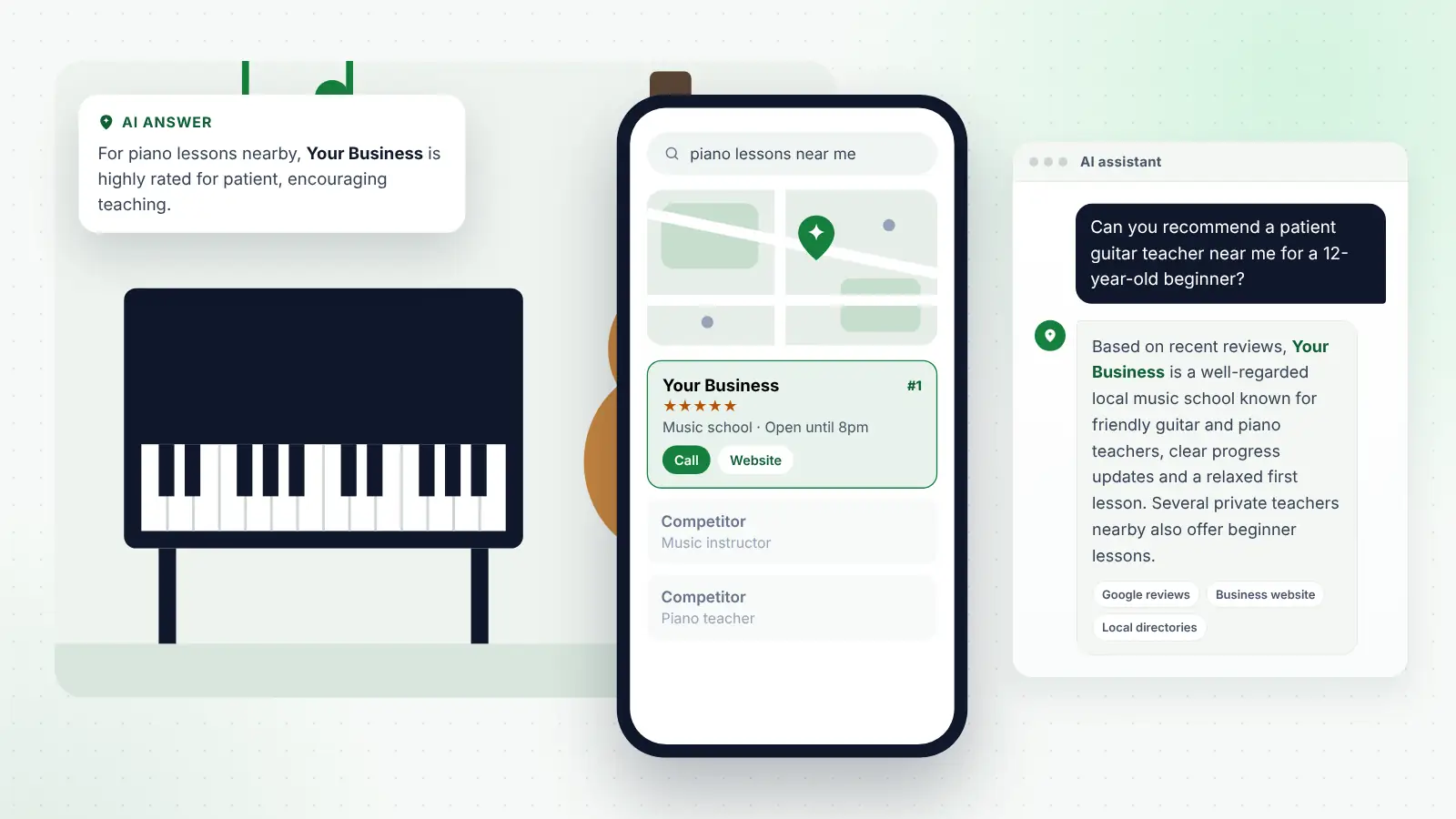
Most people looking for music lessons search for a specific instrument close to home. “Piano lessons near me”, “guitar teacher in [town]”, “drum lessons for kids” and “singing lessons for adults” are typical. They see a map with three or four teachers, compare reviews, look at a website or two and send a message. If you are not in that map, many families never see you.
Local SEO is the work of making sure you appear in those searches and look like the right choice. If you would rather focus on teaching, you can have specialists handle local SEO for music schools and private music teachers for you, but the basics below are worth understanding either way.
Set up your Google Business Profile correctly
Google’s rules depend on how you teach:
- Pupils come to you: you can show your address, as long as you are genuinely there to teach during the hours you list.
- You visit pupils: set up a service-area profile with your home address hidden, and list the towns or areas you cover.
- Both: show your address and add a service area.
- Online only: a Google Business Profile is generally not appropriate, so focus on your website and directories.
Google’s guidelines for representing your business explain these rules. Choose the most accurate primary category, such as Music school or Music instructor, and add instrument-specific categories where they exist. Fill in your services with each instrument and lesson type, add real photos of your teaching room and instruments, and keep your hours accurate, including term breaks.
Ask parents and adult learners for reviews after milestones
Reviews are one of the strongest signals for both Google and families. Ask at natural high points: after a first exam, a concert, the end of a term or when a pupil plays a piece they are proud of. Send a direct link and a short, friendly message. Reviews that mention the instrument, your patience and the pupil’s progress are more useful than a generic “great teacher”. Reply to every review, briefly and personally, without naming children.
Match your details across every music listing
Your business name, address or service area, phone number and website should match everywhere: your Google profile, your website, the ISM directory if you are listed, local family directories, music teacher listings and social media. If one directory shows an old studio address or phone number, Google and AI assistants find it harder to trust which music teacher they are looking at.
Build a website with instrument pages
A simple, well-organised website wins more pupils than an elaborate one. Include:
- A page for each instrument you teach, covering ages, levels, exam boards and lesson lengths.
- A page for adult learners, so grown-ups know they are welcome.
- Your fees, terms and how to book a trial lesson.
- Your experience, qualifications, DBS status and memberships.
- Where you teach, with area pages only where you genuinely teach or visit.
- An FAQ answering the questions parents actually ask, such as the best age to start piano or whether a child needs their own instrument.
Earn local links
Links from respected local websites help Google trust you. Realistic opportunities include school newsletters and PTA sites, local choirs, orchestras and bands you play with, community centres and halls you hire, local music shops, and community news sites covering your pupils’ concerts or charity performances.
AI search: getting suggested when parents ask for a music teacher
More parents and adult learners now ask AI assistants for recommendations instead of scrolling through search results. ChatGPT, Gemini, Perplexity, Copilot and Google’s AI Overviews all answer questions such as “Who’s a good piano teacher near me for a six-year-old?”, “Where can an adult beginner learn guitar in [town]?” or “Which music school near me does Rockschool drum grades?”
These tools do not have their own opinion of you. They build answers from what they can find and trust across the web. That usually includes:
- The same name, address and number for your school on your website, Google profile and music directories.
- Reviews that describe what you teach and what pupils and parents value.
- Clear service descriptions that say exactly which instruments, ages, levels and exam boards you cover.
- FAQs written in plain language, answering the specific questions people ask.
- Mentions on reputable sites, such as professional directories, local news and community websites.
For a music teacher, the detail matters. “Music lessons” is vague. “Piano and keyboard lessons for children from age five and adults, ABRSM and Trinity exams up to Grade 8, in [town] and nearby villages” gives an AI assistant something concrete to match against a question. Write that kind of description once and use it consistently on your website, profile and listings.
AI search and local SEO reinforce each other. The same reviews, consistent details and clear pages that help you appear in the map also make you easier for AI tools to recommend. Results build steadily, usually over three to six months, rather than overnight.
Tip
Ask a few AI assistants the questions your ideal pupils would ask, such as “drum lessons for a teenager near [town]”. Note who is recommended and what information those teachers publish that you do not.
Keep pupils playing
Winning a new pupil takes effort, so keeping them matters just as much. Most pupils who stop do so in the first few months, or at natural break points such as September, a house move or a change of school.
- Set early, visible goals: a first complete piece, a song to play for grandparents or a short informal concert.
- Let pupils choose some music: a film theme or a favourite song alongside technical work keeps practice going.
- Update parents regularly: a short note every few weeks shows progress and value.
- Run informal concerts: they give pupils a goal and families a reason to stay, and often produce reviews.
- Plan the next step: the next grade, a band or ensemble, or moving from keyboard to piano.
- Welcome siblings and parents: many adults start lessons after watching their children learn.
Frequently asked questions
Do I need a qualification to teach music privately?
No. There is no legal requirement for a private music teacher in the UK to hold a particular qualification. Parents and adult learners will still look at your own playing standard, teaching experience and approach, so show these clearly. A teaching diploma or relevant degree is a useful extra trust signal.
Do music teachers need a DBS check?
It is not generally a legal requirement for a self-employed private teacher, but most parents expect one. Since 21 January 2026, self-employed people in eligible roles with children can apply for an enhanced DBS check themselves through a registered umbrella body. Join the DBS Update Service so parents can check your certificate is current.
Do I need to charge VAT on music lessons?
If you teach as an individual sole trader or partner, private music tuition is usually exempt from VAT, and that income does not count towards the registration threshold. Lessons supplied through a limited company or delivered by teachers you employ are treated differently, so speak to an accountant before you incorporate or take on staff.
Can I teach drums from home?
Often, yes, but plan carefully. Talk to your neighbours, keep sensible hours, use electronic kits or mesh heads where you can, and improve the soundproofing of your teaching room. If complaints continue, the council can investigate noise as a possible statutory nuisance, so it is better to solve problems early.
Should I join the ISM or the Musicians’ Union?
Both include public liability insurance and support that can be valuable to private teachers, and either membership reassures parents. Compare the current benefits, insurance limits and teacher resources of each before deciding, and mention whichever you join on your website and Google profile.
Next steps
A successful music teaching business rests on a few solid foundations: good teaching, a clear offer, proper checks and insurance, sensible terms and a reputation that spreads. Decide how and where you will teach, choose your exam boards, get your DBS check and insurance in place, and understand how VAT applies before you grow beyond yourself.
Then make it easy for the right pupils to find you. A complete Google Business Profile, regular reviews, clear instrument pages and consistent details across the web will help you appear when families and adult learners search nearby or ask an AI assistant for a recommendation. Build those steadily alongside your teaching, and your diary can fill from people who found you directly.