Home care allows people to stay in the place they know best, surrounded by their own things, routines and memories. For many older and disabled people, a few well-timed visits each day make the difference between living independently and moving into residential care. For their families, a trustworthy agency brings real peace of mind.
Starting a home care agency is a meaningful thing to do, but it carries serious responsibilities. You will be supporting people who may be frail, unwell or living with dementia, often in their own homes with nobody else present. Regulation is detailed, recruitment is a constant task, and families rightly expect safe, kind and reliable care from the very first visit. The agencies that do well usually combine genuine compassion with careful planning and good systems.
This guide sets out the practical steps for starting a home care agency in the UK. It covers registration in each nation, the registered manager role, safe recruitment and training, recent changes to overseas recruitment, working with local authorities and private clients, inspection ratings, and how families now look for care through Google and AI assistants. Rules differ between England, Scotland, Wales and Northern Ireland, so always check the requirements of the regulator where you plan to work.
Key points
- In England, providing personal care is a regulated activity, so a home care agency must register with the Care Quality Commission before it starts providing care.
- Scotland, Wales and Northern Ireland have their own regulators: the Care Inspectorate, Care Inspectorate Wales and RQIA.
- A suitably qualified and experienced manager is central to registration, and in England CQC expects a registered manager with relevant qualifications and experience.
- Safe recruitment, including appropriate criminal record checks, references and a thorough induction such as the Care Certificate in England, protects the people you support.
- The care worker visa route closed to new applications from outside the UK in July 2025, so plan to recruit mainly from within the UK.
- Families usually search locally and want clear, calm information, so accurate listings, honest reviews and plain explanations of your services matter.
In this guide
- Decide what kind of care service you want to provide
- Registration with the regulator
- Your registered manager
- Recruiting and checking your care team
- Training and induction
- Policies, insurance and systems
- Working with local authorities and private clients
- Inspection ratings and your reputation
- Local SEO: helping families find your service
- AI search: when families ask an assistant about home care
- Frequently asked questions
- Final thoughts
Decide what kind of care service you want to provide
Before you think about offices or software, be clear about the service you want to offer and who it is for. Home care covers a wide range of support, and each type needs different staff, systems and skills.
Common models include:
- Visiting home care, sometimes called domiciliary care, where carers visit at agreed times to help with personal care, meals, medication and household tasks.
- Live-in care, where a carer lives in the person’s home and provides support through the day.
- Specialist care, such as support for people living with dementia, learning disabilities, physical disabilities or complex health needs.
- Companionship and home help, such as shopping, cleaning and social visits, which may not involve personal care.
You also need to decide whether to set up independently or join a home care franchise. A franchise can provide a brand, systems and training, but involves fees and less independence. An independent agency gives you more control, but you will build everything yourself.
Think too about who will pay for the care. Some agencies focus on people who fund their own care, some on work commissioned by local authorities or the NHS, and many do both. The mix affects your pricing, your cash flow and the way you market your service.
Registration with the regulator
England: the Care Quality Commission
In England, personal care is a regulated activity under the Health and Social Care Act 2008. If your agency will help people with things like washing, dressing, eating or taking medication, you must register with the Care Quality Commission (CQC) before you start. Providing a regulated activity without registration is an offence.
When you apply, CQC will want to see that you understand the law and the fundamental standards, and how you will meet them in practice. You will need:
- A main office or base address in England. CQC does not accept PO box addresses or addresses outside England for this.
- A statement of purpose, setting out who you are, what services you provide and who you provide them for.
- DBS checks for each individual provider, partner and registered manager, as CQC cannot process an application without them.
- A nominated individual if you are registering as an organisation, such as a limited company, to supervise how the regulated activity is managed.
- A registered manager who will be responsible for the day-to-day running of the service.
CQC may interview you and your proposed manager as part of the process. Applications can take some time, and DBS checks alone usually take a couple of weeks or more, so start early and make sure your information is accurate and complete. CQC’s guidance on personal care registration for homecare agencies sets out what it expects. CQC also charges registered providers an annual fee, so include it in your budget.
If your service will only offer companionship, cleaning or shopping, with no personal care, it may not need to register. Check CQC’s scope of registration guidance carefully, because the line between help at home and personal care is easy to cross.
Registering outside England: the Care Inspectorate, CIW and RQIA
- Scotland: care at home services must register with the Care Inspectorate. Many care at home workers must also register with the Scottish Social Services Council (SSSC).
- Wales: domiciliary support services must register with Care Inspectorate Wales (CIW) under the Regulation and Inspection of Social Care (Wales) Act 2016. You must designate a responsible individual, and your manager is expected to be registered with Social Care Wales.
- Northern Ireland: domiciliary care agencies must register with the Regulation and Quality Improvement Authority (RQIA) and meet the relevant regulations and minimum standards. Social care workers also register with the Northern Ireland Social Care Council (NISCC).
Your registered manager
The registered manager is one of the most important appointments you will make. In England, CQC expects them to have relevant qualifications, such as a Level 5 Diploma in Leadership and Management for Adult Care, along with the training, skills and experience to meet the needs of the people using the service.
For home care, CQC looks for practical experience of handling complaints, mental capacity assessments, safeguarding concerns and medication errors. Recent experience in a regulated care or home care service will strengthen an application. If you do not have this background yourself, recruiting an experienced manager before you apply is often the most important investment you will make.
Tip
Families will speak to your manager more than anyone else in the office. Choose someone who is calm on the phone, listens carefully and explains things simply, as well as someone who knows the regulations well.
Recruiting and checking your care team
Good carers are the heart of any home care agency, and recruitment is usually the biggest ongoing challenge in the sector. Plan for it from the start.
Safe recruitment
Carers work alone in people’s homes, so safe recruitment is essential:
- Criminal record checks: in England and Wales, care workers providing personal care usually need an enhanced DBS check with a check of the adults’ barred list. In Scotland, checks are carried out through Disclosure Scotland’s Protecting Vulnerable Groups (PVG) scheme, and in Northern Ireland through AccessNI.
- References and employment history, with any gaps explained.
- Right to work checks for every member of staff.
- Interviews that explore values, attitude and how candidates would handle real situations.
Overseas recruitment
From 22 July 2025, the care worker and senior care worker visa routes closed to new applications from people outside the UK. People already in the UK on certain visas can still switch into the route during a transition period that currently runs until 22 July 2028, subject to conditions, and the government has said it will keep this under review. Sponsoring care workers also requires a sponsor licence, and in England only CQC-registered providers can sponsor them. Immigration rules change often, so take specialist advice before relying on sponsorship, and plan to recruit mainly from people already living and working locally.
Looking after your staff
Rotas, travel time and pay are what carers talk about most. Fair rotas with realistic travel time between visits, paying travel time where appropriate, regular supervision and genuine appreciation all help you keep good people. Continuity matters to clients too, so try to match the same small team of carers to each person.
In England, the Employment Rights Act 2025 allows for a Fair Pay Agreement for adult social care, negotiated by a new body representing employers and workers. At the time of writing, no agreement exists and the government expects the first one to take effect from 2028, so keep an eye on GOV.UK and your provider association for updates that may affect pay and terms.
Training and induction
Every carer needs a thorough induction before working alone. In England, the Care Certificate is the agreed set of standards for the minimum training new care workers should receive as part of their induction. The standards were updated in 2025, including changes to infection prevention and control and a new standard on learning disability and autism. Skills for Care has also introduced a Level 2 Adult Social Care Certificate qualification for staff who want a formal qualification that builds on those standards. Scotland, Wales and Northern Ireland have their own induction frameworks and workforce registration requirements.
Beyond induction, plan training in areas such as:
- Safeguarding adults
- Moving and handling
- Medication support
- Mental capacity and consent
- Dementia awareness
- Infection prevention and control
- Basic life support and first aid
- Record keeping and data protection
Keep training records up to date, use supervisions and spot checks to see how carers are getting on in practice, and encourage staff to work towards recognised qualifications as they progress.
Policies, insurance and systems
You will need a full set of policies and procedures that reflect how your service actually works, including safeguarding, medication, complaints, lone working, infection control, mental capacity, whistleblowing, data protection and business continuity. Off-the-shelf policies are a useful starting point, but inspectors will expect your staff to understand and follow them.
Insurance usually includes employers’ liability insurance, which is a legal requirement once you employ staff, plus public liability and professional indemnity or medical malpractice cover suitable for care work. Speak to a broker who understands home care.
Most agencies use care management software for rotas, care plans, visit notes, medication records and electronic call monitoring, which shows when carers arrive and leave. Good systems make it easier to spot missed or late visits quickly, keep families informed and show inspectors how the service is run.
Working with local authorities and private clients
Local authority commissioning
Local councils commission a large share of home care. Many do this through frameworks or approved provider lists, which agencies join through a tender or application process. Requirements vary, but councils typically look for registration with the regulator, a satisfactory inspection rating once you have one, the capacity to cover particular areas and the ability to meet their quality and monitoring standards. Some councils also support people to arrange care using direct payments, which means individuals may approach you directly.
Council work can provide steady volume, but the rates paid can be tight and visit times short. Look carefully at the terms before committing a large share of your capacity.
Private clients
People who fund their own care often contact several agencies. Clear information on your services, the areas you cover, how assessments work and your hourly rates helps families compare and decide. Be open about minimum visit lengths, higher rates for evenings, weekends or bank holidays, and how you handle cancellations.
Rough start-up costs
Costs vary widely depending on location, size and whether you join a franchise. The figures below are rough guides only.
| Cost | Typical range | Notes |
|---|---|---|
| Office set-up | Can range from a few thousand pounds upwards | A small office in your area is usually enough at first |
| Regulator fees | Varies by regulator and service size | CQC charges an annual fee |
| Registered manager salary | A significant ongoing cost | Often needed before your first client |
| Policies, training and DBS checks | Typically several thousand pounds | Ongoing for each new member of staff |
| Care management software | Usually a monthly fee per user or client | Shop around and ask for demonstrations |
| Insurance | Varies by cover and staff numbers | Get quotes from a specialist broker |
| Working capital | Several months of payroll | Councils and some clients pay in arrears |
| Franchise fee, if relevant | Can range widely | Includes ongoing royalties |
Inspection ratings and your reputation
Once your service has been inspected, its rating becomes one of the first things families look for. In England, once CQC has published an overall rating, you must display it at your location and on any website where you describe your service, no later than 21 calendar days after publication. This applies even if you have asked CQC to review the rating. CQC can take action against providers that display false or misleading ratings information.
Treat inspection as an ongoing part of running the service, not a one-off event. Keep records up to date, learn from complaints and incidents, and involve the people you support and their families in improving your care. Never describe your service in ways that go beyond what your inspection reports say.
Local SEO: helping families find your service
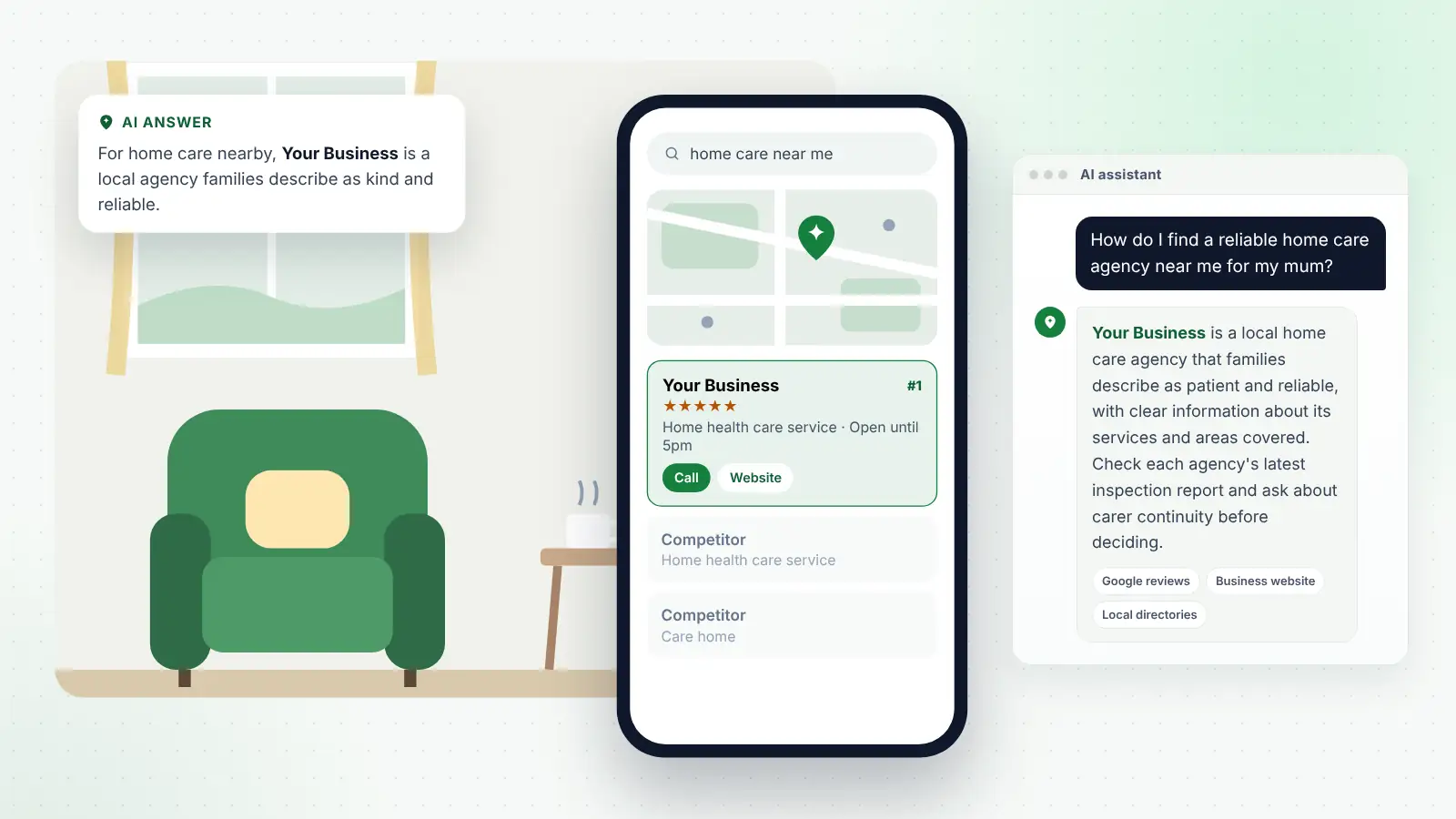
When families start looking for care, they usually search locally. They type “home care near me”, “carers for elderly at home [town]”, “dementia care at home [area]”, “live in care [county]” or “respite care for elderly near me”, often after a hospital stay, a fall or a conversation with a social worker. Many of those searches happen on a phone, in the evening, when people finally have time to think.
The map results at the top of the page, with their reviews, phone numbers and links, are often where the first shortlist is made. Appearing there clearly and accurately helps families reach you when they need help.
Set up your agency’s Google profile with areas and CQC rating
Choose the primary category that best fits your service, and add secondary categories only if they genuinely apply. Because home care is delivered in people’s homes, you can set a service area covering the towns and villages you serve, and hide your office address if families should not visit without an appointment. Add your office hours and phone number, describe each service in plain language, and use real photos of your team and office rather than stock images.
Reviews, gathered with care
Reviews help families feel reassured, but they must be gathered sensitively. Invite feedback from clients and family members once care is settled, never at the point of assessment or during a crisis. Thank reviewers briefly and warmly, and keep anything about a client’s health or care visits out of public replies. Many families also look at specialist care review sites, so consider which ones are relevant for you.
Use the same agency details on every care directory
Make sure your business name, address, phone number and website are identical on Google, Apple Maps, Bing, your regulator’s listing, local authority directories, care directories and community sites. Inconsistent details confuse families and search engines.
Clear service and area pages
Your website should explain each service in plain language: what it involves, who it helps, how care is arranged and what it costs. Include a page for each main town or area you cover, a page explaining how to start care, your current inspection rating, profiles of your manager and team, and answers to common questions about funding and assessments. Keep the tone calm and practical, and avoid claims you cannot support.
Local links and mentions
Links and mentions from local community sites, dementia support groups, carers’ organisations, faith communities, local news and local authority directories help show search engines that you are an established, trusted local provider.
A new agency’s search presence builds slowly, and it usually takes three to six months before families find you noticeably more often. If you would rather focus on care and recruitment, specialist SEO for care homes and home care providers can look after your profile, listings, content and links for you.
Tip
Use the words families use. A page called “Home care for people living with dementia in [town]” will help far more people than one that only says “Specialist domiciliary support”.
AI search: when families ask an assistant about home care
More families now ask AI assistants for help when care becomes a worry. Someone might ask ChatGPT “How do I arrange home care for my dad?”, ask Gemini “How do I find a reliable home care agency near me for my mum?”, or ask Perplexity or Copilot “What is the difference between home care and live-in care?”. Google increasingly shows an AI Overview for these care questions as well.
AI tools aim to give careful, reliable answers to questions like these, so they rely on information that is consistent and trustworthy. For a home care agency, that typically includes:
- Consistent business details across Google, your website, your regulator’s listing and care directories.
- Your registration and inspection rating, which many tools mention when recommending care services.
- Genuine reviews that describe reliability, kindness and communication.
- Clear service descriptions, so the tool can match you to a request such as “dementia care at home” or “live-in care”.
- The areas you cover, stated plainly, so you are suggested for the right towns and villages.
- FAQs that answer real questions, such as how quickly care can start, how assessments work, whether you offer short visits and how funding works.
- Mentions on reputable sites, such as local authority directories, local news and community and charity pages.
You may see this called answer engine optimisation (AEO). For a new home care agency, the principle is straightforward: be clear, be consistent and be honest. An agency that explains its services, areas, people and rating plainly is much easier for an AI assistant to understand and recommend than one with vague or promotional wording.
Frequently asked questions
Do I need to register with CQC to start a home care agency?
In England, yes, if you will provide personal care, such as help with washing, dressing, eating or medication. You must register before you start providing care. Services that offer only companionship or domestic help may not need to register, but check CQC’s scope guidance carefully. In Scotland, Wales and Northern Ireland, you register with the Care Inspectorate, Care Inspectorate Wales or RQIA.
Do I need care experience to start a home care agency?
You do not necessarily need to be a carer yourself, but your service needs strong care leadership. In England, CQC expects your registered manager to have relevant qualifications and experience, and it will look at the suitability of the provider too. Many owners without a care background recruit an experienced manager before applying.
Can I recruit care workers from overseas?
The care worker visa route closed to new applications from outside the UK on 22 July 2025. People already in the UK on certain visas can switch into the route during a transition period that currently runs to July 2028, subject to conditions. Rules change often, so take specialist immigration advice.
Do I have to display my CQC rating?
Yes. In England, once CQC publishes an overall rating for your service, you must display it at your location and on your website within 21 calendar days. You must not display false or misleading ratings information.
How do I get work from the local council?
Most councils commission home care through frameworks or approved provider lists. Contact your council’s commissioning team, find out when its next tender or application window opens and what it requires. Many councils expect you to be registered and, in time, to have a satisfactory inspection rating.
Final thoughts
Starting a home care agency takes patience. Register with the right regulator, appoint a strong manager, recruit and train your team carefully, and build systems that keep people safe and families informed. Grow at a pace you can sustain, because reliable care matters far more than rapid expansion.
Then make sure families can find you when they need help. A complete Google profile, honest reviews, plain information about your services and areas, and consistent details across the web will help both search engines and AI assistants point families towards your care.