Drainage is one of the least glamorous trades and one of the most dependable. Every house, shop, restaurant and school has drains, and sooner or later they block, crack, sag or get invaded by tree roots. Add buyers who want a survey before they exchange, builders who need drains located before they dig, and insurers who need a report before they approve a claim, and there is steady demand in almost every part of the country.
It is also a trade with more rules than many people expect. A drainage engineer works in and around sewage, sometimes in confined spaces, often with high-pressure water and heavy equipment, and frequently takes waste away from site. Customers increasingly want proof that you know what you are doing, and commercial clients and insurers will ask for it in writing.
This guide covers the practical steps of starting a drainage business in the UK: who is responsible for which pipe, the regulations and standards that apply, the equipment and costs involved, how to price, where early work comes from, and how to get found by local customers on Google and in AI assistants. It is written for engineers setting up on their own or with a small team, not for large utility contractors.
In our study of 8,320 Google Maps listings, ChatGPT or Google AI Mode named 48% of businesses in positions 4 to 6 on Google Maps, but only 23% of those in positions 13 to 15: the further down the map, the less often AI recommends you.
Key points
- Since October 2011, most shared private sewers and lateral drains in England and Wales are the water company’s responsibility, so understanding ownership saves wasted call-outs and builds trust.
- There is no single drainage licence, but confined space rules, Building Regulations Part H, waste law and water company permissions all shape what you can do.
- CCTV surveys coded to the WRc Manual of Sewer Condition Classification (MSCC5), and membership of schemes such as NADC’s DrainSafe, help you win surveys, commercial and insurance work.
- In England, waste carrier registration is being replaced by a new permit-based regime, so check how the change affects you if you remove waste.
- Drainage searches are urgent and local, so a strong Google Business Profile, steady reviews and clear information for AI assistants matter from the first week.
In this guide
- Is starting a drainage business right for you?
- Who is responsible for which drain
- Regulations, standards and safety
- Registering and insuring the drainage business
- How much does it cost to start a drainage business?
- Pricing call-outs, surveys and repair quotes
- Winning the first drainage jobs
- Local SEO for drainage companies: getting found on Google Maps
- AI search: how customers ask assistants about drainage
- Adding vans, contracts and relining after year one
- Common mistakes new drainage businesses make
- Frequently asked questions
- Final thoughts
Is starting a drainage business right for you?
Drainage work splits into several quite different types of business. Most firms start with a mix, but it helps to know where you want to end up:
- Reactive unblocking — blocked toilets, sinks, gullies and main drains, cleared with rods or a jetter. These calls tend to be urgent and late at night, and they are how most new households first come across you.
- CCTV surveys — diagnostic surveys when a drain keeps blocking, pre-purchase surveys for homebuyers, and pre-build surveys before an extension. Lower physical effort, and they often lead to repair work.
- Repairs and relining — patch repairs, full-length lining, root cutting and excavations. Higher value per job, but you need more skill, more kit and good written quotes.
- Commercial and planned maintenance — restaurants with grease problems, schools, care homes, retail units and managed property. Regular, predictable income with tighter paperwork.
- Insurance work — surveys and repairs where a homeowner is claiming on their buildings insurance, either directly or through an insurer’s appointed contractors.
Be honest about the physical side as well. Drainage involves heavy lifting, foul water and unsociable hours, and the emergency side of the business only works if someone answers the phone at ten at night. Many owners start by covering out-of-hours themselves, then decide later whether to keep it, share it or drop it.
If you are coming from plumbing, you will already know some of the domestic side. The difference is that drainage firms usually specialise in what happens once wastewater leaves the building, and the survey, relining and commercial work is a business in its own right.
Who is responsible for which drain
This is the single most useful thing to understand before you start, because customers ask about it constantly and getting it wrong costs money.
On 1 October 2011, most private sewers and lateral drains in England and Wales that connected to the public sewer network were transferred to the regional water and sewerage companies. In simple terms:
- A drain that serves only one property and sits within its boundary is usually still the owner’s responsibility.
- A lateral drain — the section serving a single property but running outside its boundary, for example under the pavement — generally became the water company’s responsibility.
- A sewer that serves more than one property, including shared pipes running through neighbouring gardens, generally became the water company’s responsibility.
- Private pumping stations serving shared sewers were transferred in a later phase, though a pumping station serving only one property normally stays with its owner.
There are exceptions, such as pipes that do not connect to the public network and drains discharging to septic tanks or treatment plants. Scotland and Northern Ireland have their own arrangements through Scottish Water and NI Water, so check the rules for wherever you work.
In practice, this means a CCTV survey often decides who pays. If the blockage or collapse is on a shared section, the customer may be able to report it to the water company instead of paying you for a repair. Telling them that honestly loses you a job in the short term, but it is exactly the kind of advice that earns five-star reviews and repeat work.
Tip
Write a short, plain-English page on your website explaining who is responsible for which section of drain in your area, with a link to your local water company’s reporting page. It answers the question customers search for most and gives AI assistants accurate information to pass on.
Regulations, standards and safety
There is no single licence to run a drainage company in the UK. Instead, several sets of rules apply depending on the work you do.
Confined spaces
Manholes, inspection chambers, sewers, interceptors and tanks can all be confined spaces, where there is a risk from toxic gases, lack of oxygen, flooding or being unable to get out. The Confined Spaces Regulations 1997 require you to avoid entry where it is reasonably practicable to do the work another way, to use a safe system of work where entry is necessary, and to have proper emergency arrangements in place before anyone goes in.
The HSE’s approved code of practice, Safe work in confined spaces (L101), explains what this means in practice. Most domestic drainage work is done from the surface with rods, jetters and cameras, which is the point: if you cannot avoid entry, your engineers need the right training, gas monitoring, rescue equipment and a second person on site. Commercial clients will ask to see your risk assessments and training records.
Building Regulations Part H
Approved Document H covers drainage and waste disposal in England, including foul water drainage, rainwater drainage, septic tanks and treatment systems, and building over or near sewers. New drainage and significant alterations to existing drainage are building work, so they usually need building regulations approval through building control. Like-for-like repairs and relining are not usually notifiable, but check with your local building control body if you are unsure, especially when you are altering the layout or connecting new pipes. Wales has its own version of the regulations.
Building over or near public sewers
Because so many sewers now belong to water companies, extensions and other building work close to a public sewer usually need the water company’s agreement, often called a build-over agreement. Many water companies apply this to work within 3 metres of a public sewer, and some require a CCTV survey of the sewer before and after the work. Building control will also check the work against Part H.
This creates useful work for drainage firms: locating and mapping sewers before an extension, carrying out pre-construction and post-construction surveys to the water company’s specification, and repairing any damage found. Each water company sets its own process, so learn the requirements for the companies whose areas you cover.
Survey coding standards
If you carry out CCTV surveys, the expected standard in the UK is to code defects using the WRc Manual of Sewer Condition Classification, now in its fifth edition (MSCC5). Coding to MSCC5 means your reports describe cracks, displaced joints, roots and deformation in a consistent way that other contractors, surveyors, water companies and insurers understand.
Formal training matters here. The National Association of Drainage Contractors (NADC) runs a domestic CCTV inspection training programme that covers coding and classifying defects to MSCC5, and surveys from trained, accredited operators carry more weight with insurers and solicitors.
Trade association membership
The NADC is the main trade association for drainage contractors and focuses on raising standards and training across the industry. Its DrainSafe approved contractor scheme checks that operatives are trained and competent for the services offered, and registered contractors agree to a code of practice covering minimum insurance, fair terms, a complaints process and independent arbitration. Membership is not compulsory, but it gives customers and commercial clients a recognised mark to look for.
Waste carrier registration and the reform in England
If you take away waste — silt, sludge, fats, debris from excavations or tankered liquid waste — you currently need to register as a waste carrier, and you must keep waste transfer records and take waste only to sites permitted to accept it. Most drainage firms carrying other people’s waste need upper tier registration.
The system is changing in England. Regulations made in July 2026 replace waste carrier, broker and dealer registration with a permit-based regime for anyone controlling or transporting waste, with stricter checks on the people running the business and a requirement for technical competence. The main changes are expected to take effect from July 2027, and existing registration holders will move across in stages, generally when their current registration expires. Wales is keeping its existing registration system for now. Check the Environment Agency’s guidance before your registration renewal date, and budget for the new permit fees.
Registering and insuring the drainage business
Structure, tax and VAT
Many drainage engineers start as sole traders, registering with HMRC for Self Assessment. A limited company separates personal and business finances and can suit firms planning to buy expensive kit or take on staff, but it brings more admin. An accountant who works with trades can compare both based on your expected income.
VAT registration becomes compulsory once taxable turnover passes £90,000 across any rolling 12 months. Commercial and insurance work can push turnover up quickly, because relining materials, excavation and tankering costs all count.
Insurance
Drainage work carries real risk, and clients will ask to see your certificates:
- Public liability insurance — essential, and commercial clients and trade schemes usually set a minimum level.
- Employers’ liability insurance — a legal requirement once you employ staff.
- Contract works and professional indemnity — worth discussing with a broker if you produce survey reports that buyers, insurers or solicitors rely on.
- Vehicle and equipment cover — jetters, cameras and lining kit are expensive and attractive to thieves.
Make sure your insurer knows exactly what you do. Policies written for general plumbing may exclude excavation, confined space entry or high-pressure jetting.
How much does it cost to start a drainage business?
Equipment is the biggest variable. You can start with rods, a van-pack jetter and a basic push camera, then add survey software, relining kit and larger jetting units as work grows. The figures below are rough guides only and vary by supplier, specification and whether you buy new or used.
| Item | Typical cost | Notes |
|---|---|---|
| Van | £10,000–£25,000 | Used is fine to start; it must carry the weight of your kit |
| Rods, plungers and hand tools | £300–£1,000 | The basics for most domestic unblocks |
| Jetter | £3,000–£15,000+ | Portable units are cheaper; van-pack units cost more but save time |
| CCTV camera system | £3,000–£15,000+ | Survey software for MSCC5 reports may be extra |
| Relining and patch repair kit | £2,000–£10,000+ | Many firms subcontract relining at first |
| Safety equipment | £500–£2,000 | Gas detectors, PPE, barriers, rescue kit if entering confined spaces |
| Training | Varies | Confined space, CCTV coding and jetting courses |
| Insurance | Several hundred to a few thousand pounds a year | Depends on cover and the work you do |
| Waste registration or permit | Varies | Check current fees with your environmental regulator |
| Van livery and website | £500–£3,000 | Clear branding helps with emergency calls |
Leasing or finance can spread the cost of a jetter or camera, but only take on repayments your early income can support. A firm with modest kit and steady cash flow is in a better position than one with a new van-pack unit and a quiet diary.
Pricing call-outs, surveys and repair quotes
Drainage customers are often anxious about cost. They have a problem they cannot see, and they worry a simple unblock will turn into an open-ended bill. Clear pricing is one of your best sales tools.
- Work out your true costs. Add up your van, fuel, insurance, finance, waste disposal, software and target salary, then divide by the hours you can realistically bill.
- Set a clear call-out structure. Many firms charge a fixed price for a standard unblock, with separate rates for out-of-hours work. Say exactly what the price includes.
- Price surveys as products. A pre-purchase CCTV survey with a written report and footage is easy to explain at a fixed price, and buyers like knowing the cost up front.
- Quote repairs in writing. Itemise the work, reference the survey findings, state what is excluded and give your guarantee on liners or excavations.
- Be honest about responsibility. If the problem is on a section the water company is responsible for, say so before you quote.
Tip
Send customers the survey footage and a plain-English summary alongside the coded report. Homeowners, buyers and insurers can then see the defect for themselves, which makes your repair quote much easier to accept.
Winning the first drainage jobs
Early work usually comes from a mix of sources. The most reliable relationships for drainage firms tend to be:
- Estate agents, conveyancers and surveyors — who recommend pre-purchase drain surveys, particularly for older properties or homes with large trees nearby.
- Builders, architects and extension specialists — who need drains located, surveyed and sometimes diverted before work starts.
- Letting agents and property managers — a steady stream of reactive blockages across their portfolios.
- Plumbers and other trades — many plumbers pass on drain work they do not have the kit for.
- Commercial sites — restaurants, pubs, schools and care homes that benefit from planned maintenance rather than repeated emergencies.
- Insurance work — loss adjusters and insurers appoint contractors for claims, often through approved panels that expect insurance, accreditation and properly coded reports.
Pay-per-lead platforms and national call centres can fill gaps, but jobs are often shared between several firms or come with high fees. Customers who find you directly, by searching or asking an AI assistant, are worth far more over time, so start building that visibility from the beginning.
Local SEO for drainage companies: getting found on Google Maps
Most drainage enquiries start with a search. Someone with a toilet that will not flush or water rising in a manhole types “blocked drain near me” or “emergency drain unblocking” into Google, looks at the map results and calls one of the first three or four companies they see. Less urgent customers search for “CCTV drain survey near me” or “drain relining cost” and compare a few options before booking.
That makes the map pack the most valuable space for a drainage business, and it is shaped mostly by your Google Business Profile, your reviews and how consistently your details appear across the web.
Building a drainage Google Business Profile that gets calls
Most drainage firms operate as service-area businesses, which means your home or yard address can be hidden and Google shows the areas you cover instead. To get the most from your profile:
- Choose the most accurate primary category, such as “Drainage service”, and add secondary categories that genuinely match your work.
- List each service separately: unblocking, jetting, CCTV surveys, pre-purchase surveys, relining, excavations, commercial maintenance.
- Set realistic service areas based on where you can reach quickly, rather than an entire region.
- Keep your hours accurate, and only show 24-hour opening if someone genuinely answers the phone.
- Add photos of your van, equipment and real jobs. Before-and-after camera stills of a root intrusion or a relined pipe are far more convincing than stock images.
Ask for a review after every unblock and survey
Reviews influence both where you appear and who customers call. Ask every customer, ideally by text with a direct link on the same day. Reviews that mention the job — “cleared our blocked drain within an hour” or “clear CCTV report before we bought the house” — help you appear for those specific searches. Respond to each review in a calm, professional tone, including the occasional complaint about a call-out fee.
Use the same drainage business details on every listing
Your business name, phone number and service area should be identical on your website, Google profile, trade scheme listings, directories such as Yell, Checkatrade or TrustATrade if you use them, and local business sites. Inconsistent details make it harder for Google and AI tools to be confident about your business.
Pages for each drain service and each town you cover
A clear website does a lot of work for a drainage company. Include separate pages for each main service, explaining what it involves, typical timescales and guide prices. Add area pages for the towns you genuinely cover, with local detail such as the water company responsible for sewers there or common issues in older housing stock. Show your credentials clearly: trade scheme membership, MSCC5-trained operators, insurance and waste registration or permit number.
Getting links from letting agents, surveyors and local sites
Links and mentions from relevant local websites build authority. Good sources include local business groups, community sponsorships, estate agents and conveyancers you work with, property and home improvement blogs, and trade association directories. A practical article for a local property website explaining what buyers should look for in a drain survey is genuinely useful and earns a natural link.
All of this takes steady effort, and results usually build over two to three months rather than weeks. If you would rather stay on the tools, specialists in SEO for drainage companies and drain engineers can look after the profile, listings, content and links for you each month.
AI search: how customers ask assistants about drainage
More people now ask AI assistants such as ChatGPT, Gemini, Perplexity, Copilot and Google’s AI Overviews for help before they pick up the phone. Drainage problems suit this kind of question, because customers often do not know what is wrong or who is responsible:
- “Who is responsible for a blocked drain outside my house?”
- “Do I need a drain survey before buying a 1930s house?”
- “What is drain relining and is it better than digging up the pipe?”
- “Who can unblock a drain tonight near me?”
- “Which drainage companies near me do surveys for insurance claims?”
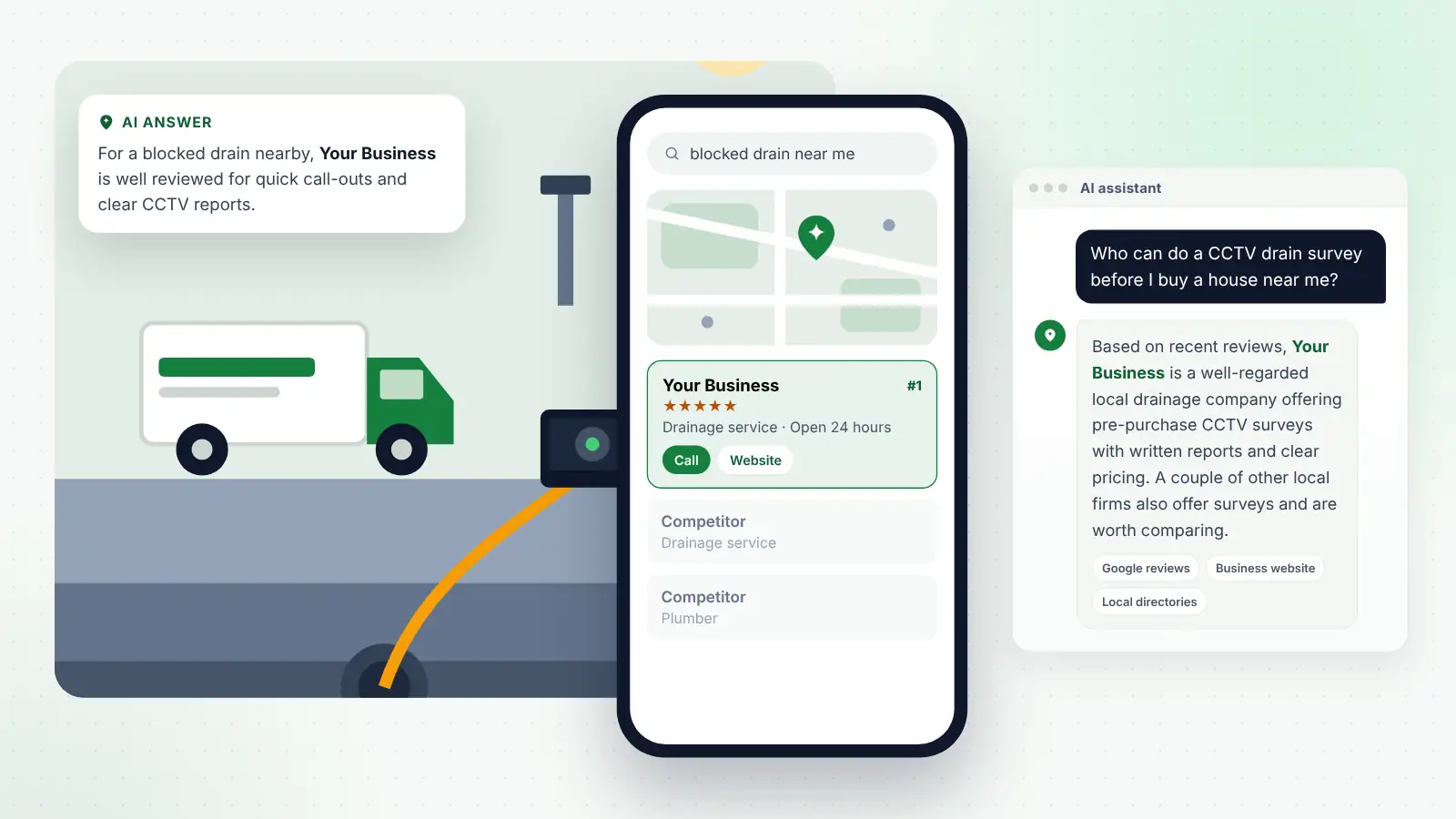
When someone asks an assistant who can clear a blocked drain tonight, it assembles the answer from trustworthy information published about local drainage firms. For a drainage company, that means:
- Consistent business information — the same name, services and areas on your website, Google profile and directories.
- Clear service descriptions — plain explanations of each service, who it is for and what the customer receives, such as footage and a coded report.
- Helpful FAQs — honest answers about responsibility, costs, response times and when a problem is the water company’s to fix.
- Reviews — a healthy volume of recent reviews that describe real jobs.
- Mentions on reputable sites — trade scheme listings, local news, property websites and partner businesses that confirm you are established.
AI visibility builds on the same foundations as local SEO, so the work reinforces itself. The firms most likely to be recommended are the ones that explain things clearly and are described consistently wherever an assistant looks.
Adding vans, contracts and relining after year one
Once you have steady reactive work, the question becomes how to grow without simply working longer hours.
- Move up the value chain. Every unblock is a chance to offer a survey, and every survey is a chance to quote a repair. Investing in relining kit or forming a reliable partnership with a relining specialist can raise your average job value.
- Build recurring revenue. Planned maintenance agreements with commercial sites, such as regular jetting for a restaurant with grease problems, smooth out the gaps between emergencies.
- Get on insurance panels. Insurance work requires good paperwork and accurate coded reports, but it can provide a steady flow of surveys and repairs.
- Hire carefully. A second engineer lets you cover more call-outs, but only if they are properly trained in confined spaces, jetting and your reporting standards.
- Specialise in your area. If your patch has lots of older terraces with clay pipes or new estates with adoption issues, become known for that.
Common mistakes new drainage businesses make
- Ignoring who owns the pipe. Charging for work on a section the water company is responsible for leads to complaints and poor reviews.
- Underestimating confined space risk. Never let anyone enter a manhole or chamber without assessment, gas monitoring and a rescue plan.
- Poor survey reports. Vague notes and uncoded footage undermine trust with buyers, solicitors and insurers.
- Vague pricing. Customers who feel they were surprised by the bill rarely leave good reviews.
- Waste shortcuts. Taking waste to the wrong place or without the right registration risks fines and your reputation, and the new rules in England will bring stricter checks.
- Leaving online visibility until later. By the time the diary goes quiet, competitors already own the map.
Frequently asked questions
Do I need a licence to start a drainage business?
There is no single drainage licence in the UK. You need to comply with health and safety law, including the Confined Spaces Regulations 1997, follow Building Regulations where you install or alter drainage, and hold waste carrier registration or, in England once the new regime applies to you, a waste permit if you remove waste. Trade scheme membership and training are voluntary but expected by many clients.
Do I need CCTV equipment from the start?
Not necessarily, but it helps. A camera lets you diagnose repeat blockages, prove the job is complete and offer surveys. Many firms start with a basic push camera and upgrade to a system with MSCC5 reporting software once survey work grows.
Can I do pre-purchase drain surveys without formal training?
You can film a drain, but buyers, solicitors and insurers increasingly expect reports coded to MSCC5 by a trained operator. Formal CCTV coding training makes your reports more credible and reduces the risk of disputes.
How do I get insurance claims work?
Insurers and loss adjusters often use approved contractors or panels. They usually look for appropriate insurance, accreditation, properly coded survey reports and reliable response times. You can also help homeowners prepare evidence for their own claims, but be careful to describe defects accurately and never overstate damage.
Is drainage work seasonal?
Demand runs all year, but autumn leaves, heavy rain and winter freezes often bring extra call-outs, and the run-up to Christmas can be busy with kitchen blockages. Pre-purchase surveys follow the property market. Planned maintenance and commercial contracts help even out quieter periods.
Final thoughts
A drainage business can be steady and profitable, but it rewards firms that combine good engineering with honesty and clear paperwork. Understand who is responsible for each pipe, follow the safety and waste rules, produce reports people can rely on and price your work clearly.
Build your online visibility from the start as well. Customers with a blocked drain choose quickly, and the companies that appear first on the map and in AI recommendations get most of those calls, along with the surveys and repairs that follow.