Children’s activity clubs come in many shapes. A football coach runs Saturday sessions for six-year-olds, a drama teacher hires a church hall after school, and a multi-sport holiday camp looks after sixty children a day through the summer. What they share is a customer who is not the child but the parent, and that parent is asking two questions at once: will my child enjoy it, and will they be safe?
The clubs that grow well get the basics right early. They know whether they need to register with Ofsted, they show their safeguarding and DBS arrangements without being asked, they price and book in a way that suits working families, and they are easy to find when parents search for something to do in the holidays.
This guide is for anyone starting or growing a children’s activity business in the UK: sports coaching, multi-sport holiday camps, after-school clubs, drama, coding, gymnastics, baby and toddler classes and franchise operators. The registration details apply to England; Scotland, Wales and Northern Ireland have their own regulators and rules.
Key points
- Decide your activity, age range and format first, because they shape your Ofsted position, pricing and booking.
- Single-activity coaching is often exempt from compulsory Ofsted registration, but joining the voluntary Childcare Register lets many parents pay with Tax-Free Childcare.
- Enhanced DBS checks with barred list information, a real safeguarding policy, first aid cover and the right insurance are non-negotiable for parents.
- Term bookings, early rebooking for existing families and a well-used waiting list create predictable income and show you where to expand.
- Parents search at predictable moments, so your Google profile, website and AI search visibility need to be ready before each term and holiday.
In this guide
- Choose your activity, ages and format
- Ofsted registration, Tax-Free Childcare and vouchers
- Safeguarding, DBS checks and first aid
- Insurance, venues and setting up
- Pricing, term bookings and waiting lists
- Holiday camps and the HAF programme
- School partnerships and franchising
- Local SEO for children’s activity clubs
- When parents ask AI for a club
- Frequently asked questions
- Next steps
Choose your activity, ages and format
Start with a clear offer. The choices you make here affect your registration status, staffing, venue and how parents find you.
- The activity. A single activity, such as football, drama or coding, is easy to explain and market. A multi-activity camp suits working parents who want full days, but it can change your registration position.
- The age range. Baby and toddler classes, under-fives, primary and secondary age are different markets. Younger children need more adults, shorter sessions and parents who often stay.
- The format. Weekly term-time classes, after-school clubs on school sites, weekend sessions, holiday camps, parties and one-off workshops all have different rhythms. Many clubs start with one and add others once they have a following.
A useful test is whether a parent could describe your club in one sentence at the school gate. “Multi-sport holiday camp for ages five to eleven at the leisure centre, 8.30 to 5.30” is easy to pass on. “Fun activities for kids” is not.
Ofsted registration, Tax-Free Childcare and vouchers
This is where new providers most often go wrong, because the answer depends on exactly what you offer. The government’s childcare registration exemptions guidance is worth reading in full and rechecking whenever your offer changes.
When registration may be compulsory
Broadly, most providers caring for children from birth up to age eight must register with Ofsted, on the Early Years Register for younger children or the compulsory part of the Childcare Register for older ones. The exemption that matters most to activity providers covers tutoring or coaching for children aged three and over in one or two of these areas: school or homework support, sports, performing arts, arts and crafts, or religious, cultural or language studies. The activity must be the main focus and aim to improve children’s skills; generic play, such as a bouncy castle, does not count.
The exemption has limits:
- For children aged three to five, it applies only where they attend for less than four hours a day. Children aged five and over can attend for longer.
- Offering activities in three or more of the listed areas removes the exemption, which catches many multi-activity holiday camps.
- If you care for each child for less than two hours a day, you are generally not eligible to register, unless you provide before or after-school care.
It is an offence to provide childcare that needs registration without being registered, so if you are unsure, check with Ofsted or your council’s childcare team before you take bookings.
Why the voluntary register matters
Even if you are exempt, you may be able to join the voluntary part of the Childcare Register, which is also open to providers caring only for children aged eight and over. Many clubs do because parents usually need a registered, approved provider to pay with Tax-Free Childcare, and the same applies to parents still using employer childcare vouchers. The voucher scheme closed to new applicants in October 2018, but some parents who joined before then still use it.
With Tax-Free Childcare, the government adds £2 for every £8 a parent pays in, up to £2,000 per child per year, or £4,000 for a disabled child. It covers children up to the September after their 11th birthday, or 16th for disabled children. Holiday clubs and after-school clubs are listed as eligible, as long as the provider is approved and signed up to receive payments. For a family booking a week of summer camp, that top-up can decide which club they choose.
Tip
If you accept Tax-Free Childcare, say so on every booking page, your Google profile and your holiday camp pages. It is one of the questions parents ask most, and one of the details clubs most often leave out.
Safeguarding, DBS checks and first aid
Parents rarely ask to see your safeguarding policy, but they notice whether you seem to have one.
DBS checks
Anyone who regularly coaches, teaches, supervises or cares for children is likely to be in regulated activity. Government guidance on DBS checks in sport sets out the frequency test: more than three days in any 30-day period, or overnight between 2am and 6am with the chance of face-to-face contact with children. A weekly club easily meets it. People in regulated activity need an enhanced DBS check including the children’s barred list.
Two points catch new clubs out:
- From 1 September 2026, the supervision exemption no longer applies, so regular volunteers helping under a lead coach can now be in regulated activity and need the same level of check.
- Self-employed coaches cannot usually apply for an enhanced check themselves, so you will normally go through a registered umbrella body or the organisation that engages you. The DBS Update Service saves repeat applications.
Safeguarding policy and first aid
Write a safeguarding and child protection policy that fits your club, not a template you have never read. Name your designated safeguarding lead, explain how concerns are reported and recorded, and cover safer recruitment, collection, photography, social media, toilets and changing, and missing children. Train every member of staff and volunteer on it and review it each year. If your activity has a national governing body, check its safeguarding requirements and any club accreditation scheme, which gives parents a recognised badge to look for.
Have qualified first aiders at every session, with paediatric first aid where you work with young children. Collect medical, allergy and emergency contact details at booking, make sure the lead coach has them on the day, keep an accident book and tell parents about any injury at collection.
Insurance, venues and setting up
Before you open bookings, make sure the basics are covered.
| Item | Why it matters | Notes |
|---|---|---|
| Public liability insurance | Covers injury to children, parents and others | Venues and schools will ask to see it |
| Employers’ liability insurance | Legally required for most businesses with employees | Check casual staff and volunteers are covered |
| Abuse and professional indemnity cover | Some policies cover allegations and advice | Ask a specialist broker what is included |
| Venue agreement | Sets hours, access, cleaning and cancellation | Get holiday blocks confirmed in writing |
| Booking system | Takes payments, consents and medical details | Choose one that handles waiting lists |
| Risk assessments | Shows you have thought through hazards | One per venue and activity |
| Data protection | You hold children’s personal and medical data | Check whether you need to pay the Information Commission fee |
Insurance costs vary with the activity and numbers, so get quotes from a broker who understands children’s activities. Venues are often the hardest part: holiday availability is limited and popular slots go early, so ask about storage, parking, drop-off space and exclusive use.
Pricing, term bookings and waiting lists
Most clubs sell weekly sessions by the term or half-term, and holiday camps by the day or week. Term bookings give you predictable income and committed families; pay-as-you-go suits tasters and toddler classes, where attendance varies.
- Offer a free or low-cost taster, then convert to a term booking.
- Give existing families a short window to rebook before places open to everyone.
- Offer sibling discounts and a slightly lower daily rate for full camp weeks.
- Publish clear prices and what they include, such as early drop-off, late pick-up or lunch.
- Set a clear cancellation and refund policy, and stick to it.
A waiting list is not just a queue. It tells you which ages, days and venues are oversubscribed. If your Saturday under-sevens session has twenty children waiting, that is a strong case for a second session. Keep waiting lists in your booking system, contact families promptly when a place opens, and ask whether they would take another slot.
Tip
Ask every family on a waiting list which other days and venues they could manage. Three or four families who could all do Wednesday after school is often enough to justify a new class.
Holiday camps and the HAF programme
Holiday camps can be the most profitable part of the business, but also the most seasonal. Parents plan summer childcare well before term ends, and many book half-terms only a few weeks ahead. Open bookings early and show what a day looks like: times, early and late options, what to bring, lunch and how children are grouped by age.
The Holiday Activities and Food (HAF) programme is funded by the Department for Education in England and coordinated by local councils. It provides holiday activities and at least one healthy meal a day for children eligible for benefits-related free school meals, mainly over the Easter, summer and Christmas holidays, and the government has announced funding running to the 2028 to 2029 financial year. Councils commission local providers, often through open calls, and expect standards on food, physical activity, safeguarding and enhanced DBS checks. HAF places can sit alongside your paid camps and help you fill venues, so contact your council’s HAF team to find out how it commissions providers.
School partnerships and franchising
Many schools buy in after-school and lunchtime clubs, and some rent their sites for holiday camps. A partnership gives you a ready audience, a trusted venue and often a mention in newsletters and on the school website. Approach the headteacher or school business manager with a short proposal: what you will run, for which year groups, the cost, and how you handle safeguarding, DBS checks, registers and collection. Offer a free trial session, then deliver reliably, because schools talk to each other.
Franchises offer a ready-made brand, curriculum, systems and marketing support in exchange for an upfront fee and ongoing royalties. You are tied to the franchisor’s rules, including how you use your own website and listings, so speak to existing franchisees and take independent legal advice. An independent club has more freedom but builds its reputation from scratch.
Local SEO for children’s activity clubs
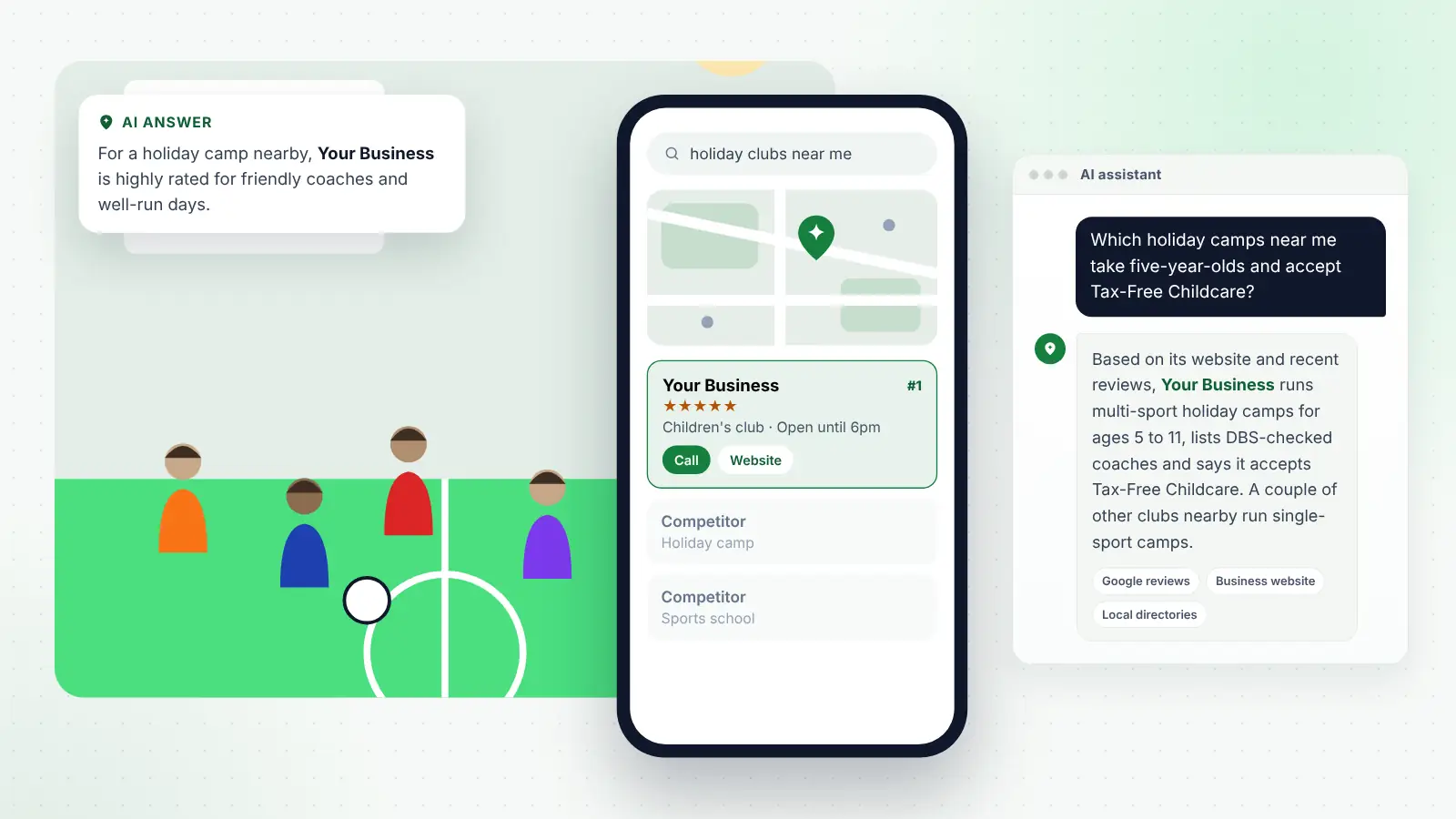
Parents search close to home at predictable times: before each school holiday, at the start of term, or when a child shows a new interest. They type searches like “holiday club near me”, “football for 5 year olds”, “kids drama classes near me” and “toddler classes this week”. The clubs near the top of Google Maps and the local results are the ones that make the shortlist.
Google Business Profile
Check eligibility first. Google’s guidelines say an ongoing class at a location you do not own or have authority to represent is generally not eligible for a profile, so a club that only hires school halls may not qualify at those venues. If you have your own staffed venue or office, set up a profile there with an accurate category, your activities and age groups, hours, a booking link and real photos of sessions taken with parental consent. Where you cannot have a profile, your website and listings do more of the work.
Reviews
Parents trust other parents. Ask for reviews at natural moments, such as the end of a camp week or a term showcase, with a short link. Reviews that mention friendly coaches, good organisation or support for a nervous child help both parents and search engines. Answer each review warmly, and respond calmly to any parent who raises a concern.
Website, listings and local links
Give each activity, age group and venue its own clear page with times, prices, what to bring and how to book. Put holiday camp pages live well before parents start looking and keep them year to year so they build visibility. Add a page covering safeguarding, DBS, first aid, insurance and registration, and link to it from your booking pages.
Keep your name, contact details and booking link identical across council family directories, local parenting sites, governing body club finders and school websites. Links from schools, community groups and local news are valuable because national brands cannot easily copy them. If you would rather have specialists handle this, our SEO for children’s activity clubs and holiday camps is built around exactly these steps.
When parents ask AI for a club
More parents now ask AI assistants instead of typing short searches. They ask ChatGPT, Gemini, Perplexity or Copilot things like “what holiday camps near me take five-year-olds?” or “is there a coding club for ten-year-olds in our town?”, and Google’s AI Overviews often answer similar questions at the top of the results.
Assistants piece together answers from details they can find and check about a club. For an activity club, that means:
- Clear descriptions of each activity, age range, venue, session times and price.
- Answers to common questions, such as whether parents stay, how children are grouped and how to pay.
- Consistent details across your website, Google profile and directories.
- Reviews that mention ages, activities and experiences in parents’ own words.
- Mentions on reputable sites, such as school websites, council directories, governing body club finders and local news.
Try asking an AI assistant the questions your parents ask. If it cannot say what ages you take or whether you accept Tax-Free Childcare, that information is probably missing or unclear on your own site. An FAQ section on each activity and camp page is one of the simplest fixes.
Frequently asked questions
Do I need Ofsted registration to run a football club?
Often not, if you coach one or two activities, such as a sport, within the conditions in the exemptions guidance. Younger children attending for longer, or a mix of three or more activity types, can change that, so check the current guidance and contact Ofsted if in doubt.
Can parents pay for my club with Tax-Free Childcare?
Only if you are an approved provider signed up to receive payments, which for most activity clubs in England means being on the Childcare Register. Many exempt clubs join the voluntary part so that parents can use it.
What qualifications do I need to coach children?
There is no single legal qualification for every activity, but parents and venues expect a recognised coaching or teaching qualification, an enhanced DBS check, safeguarding training and first aid. Many activities have governing body awards that parents recognise.
How do I get onto my council’s HAF programme?
Contact your council’s HAF team or check its website for open calls. Councils set out their requirements and deadlines, and many commission providers ahead of the Easter and summer holidays.
Next steps
Decide exactly what you will offer and to which ages, check your registration position, put safeguarding, DBS checks, first aid and insurance in place, and choose a booking system that handles term bookings and waiting lists. Then make sure parents can find and trust you online, with a clear website, accurate listings, genuine reviews and answers to the questions they ask most. Each term and holiday should then become easier to fill than the last.