An independent jeweller sells something most customers buy only a handful of times in their lives. An engagement ring, a pair of wedding bands, a watch for a milestone birthday or a remodel of a grandmother’s ring is a considered purchase, made with a lot of emotion and a fair amount of anxiety about whether the price is fair and the quality is real. That is exactly where a good independent can beat the chains and the online ring brands: knowledge, honesty, craftsmanship and a person the customer can come back to.
The difficulty is that many of those customers now start their research online, months before they ever walk into a shop. If they cannot find you, cannot see your work, or cannot tell whether you are trustworthy, they will shortlist someone else. Meanwhile the everyday work that keeps the workshop busy, such as repairs, resizing, watch batteries, valuations and buying unwanted gold, also starts with a search on a phone.
This guide is mainly for established independent jewellers who want to grow from where they are, with short notes for anyone opening a new shop. It covers positioning, the core service lines, the legal basics around hallmarking, money laundering rules and lab-grown diamonds, pricing, reviews and how to appear in local search and AI recommendations.
Key points
- Decide what your shop is known for, whether that is bridal, bespoke, watches, antique and pre-owned or repairs, and make it visible everywhere customers look.
- Repairs, resizing and valuations bring people through the door and often lead to bigger purchases years later, so treat them as marketing as well as income.
- Display the Hallmarking Act dealer’s notice, describe metals and stones accurately and always say clearly when a diamond is lab-grown.
- If you accept or make cash payments of 10,000 euros or more for goods, you must register with HMRC as a high value dealer before you do so.
- Price ranges and “from” prices help customers book an appointment with confidence, and headline prices must include any mandatory charges.
- Your Google profile, reviews and service pages feed both Google Maps and AI assistants, which are increasingly asked to recommend jewellers.
In this guide
- Decide what you want to be known for
- Make bridal and bespoke easier to buy
- Repairs, resizing and watches: the everyday front door
- Valuations and buying gold
- The legal basics every jeweller should get right
- Pricing with confidence
- Reviews, referrals and wedding partnerships
- Local SEO for independent jewellers
- AI search: how customers ask for jeweller recommendations
- Managing the seasons
- Notes for new jewellers
- Frequently asked questions
- Final thoughts
Decide what you want to be known for
Most independent jewellers do a bit of everything, and that is fine for day-to-day trade. For marketing, though, trying to say everything usually means nobody remembers anything. Pick two or three things you genuinely do better than the competition nearby and build your messaging around them.
Common positions that work well for independents include:
- The bridal specialist. A strong range of engagement rings and wedding bands, a relaxed appointment experience and expert advice on diamonds and metals.
- The bespoke workshop. Designs made on the premises, CAD visuals, remodelling of inherited jewellery and a named designer or goldsmith customers can meet.
- The watch specialist. Authorised brands, pre-owned watches, servicing, straps and batteries.
- The antique and pre-owned jeweller. Vintage and estate jewellery, with knowledgeable descriptions and honest condition notes.
- The trusted repairer. Fast, reliable repairs, resizing, re-tipping, chain soldering and stone setting, often for other local shops as well as the public.
Be honest about where you are not strong. If you do not have the range to compete on designer watches, do not lead with them. Customers and search engines both respond better to a clear, specific identity than to a long, generic list.
Tip
Write a single sentence that describes your shop as a happy customer would, such as “the family jeweller in town with its own workshop, where you can have a ring designed and made”. Use that sentence as the starting point for your website homepage and Google Business Profile description.
Make bridal and bespoke easier to buy
Engagement and wedding rings are usually the highest-value, highest-margin work in an independent shop, and they are also where customers feel most uncertain. Many couples have read conflicting advice online about diamond grading, ring sizes, metals and budgets. The jeweller who makes the process feel simple and safe tends to win.
Offer appointments, not just opening hours
Couples often want undivided attention and some privacy when choosing a ring. Offer bookable consultations, including evenings or weekends if you can, and make booking easy from your website and Google profile. Say how long an appointment lasts, whether it is free and what to bring, such as inspiration photos or an existing ring for sizing.
Explain the bespoke process step by step
Bespoke work can feel risky to customers who have never done it. A short, clear page answering the obvious questions removes much of that worry:
- An initial consultation to discuss style, stones, metal and budget.
- Sketches or CAD renders for approval, and how many changes are included.
- A deposit, with a clear explanation of when it is and is not refundable.
- Making, with a realistic timescale, and when you will update the customer.
- Collection, sizing checks and aftercare such as cleaning and claw checks.
Show your own work wherever you can. Real photographs of rings you have made, ideally with a short note about the brief, persuade far more than stock images or supplier photography.
Lab-grown and natural diamonds
Many couples now ask about lab-grown diamonds, usually because of price. Whatever you sell, be ready to explain the difference calmly and without disparaging either option. Customers trust jewellers who help them understand the trade-offs, including how resale and long-term value may differ, rather than pushing them one way.
Be very careful with wording. In 2026 the Advertising Standards Authority upheld complaints against jewellery adverts that did not make clear upfront that the diamonds were lab-grown. Whether a diamond is natural or synthetic is material information, so use a qualifier such as “lab-grown” or “laboratory-created” in the advert, product title and description itself, not only on a page the customer reaches after clicking.
Repairs, resizing and watches: the everyday front door
Repairs and small jobs are easy to undervalue because each one brings in relatively little. But they are often the first time a local person walks into your shop, and how you treat them shapes whether they come back for a bigger purchase later.
A few things make a real difference:
- Clear timescales and prices. Give an estimate when the item is handed in, and call before doing anything that will cost more.
- Proper receipts and tracking. Record each item carefully, with a description and photograph, so nothing is lost or confused.
- Updates without chasing. A text when the job is ready saves the customer ringing to ask and makes your shop feel organised.
- A quick follow-up. A thank-you message with an invitation to leave a review turns a battery change into a reputation-building moment.
Watch batteries, strap changes and pressure testing are regular, predictable reasons for people to visit. If you offer them, say so clearly on your website and Google profile, along with whether customers can wait or need to leave the watch with you.
Valuations and buying gold
Insurance valuations and buying unwanted gold and jewellery both depend heavily on trust. Customers worry about being underpaid, or about paying for a valuation that their insurer will not accept.
Valuations
The National Association of Jewellers (NAJ) runs the Institute of Registered Valuers, whose members are assessed before joining and must keep up continuing professional development to stay registered. If you or a member of your team is a registered valuer, say so prominently and explain in plain English what that means for the customer. Publish your valuation fees or a fee structure, explain how long a valuation takes, what the written valuation includes and whether the customer can wait with the item. Gemmology qualifications such as those from Gem-A are also worth listing.
Buying gold and second-hand jewellery
Buying unwanted gold can be a steady source of stock and scrap value, but it needs good controls. Keep a record of every purchase, check identification, and train staff to notice anything that suggests an item may be stolen. Note that the Scrap Metal Dealers Act 2013 excludes gold, silver and alloys containing 2 per cent or more gold or silver from its definition of scrap metal, so that licensing regime is not the one that usually applies to buying gold jewellery. Some local authorities have their own rules on dealing in second-hand goods, so check with your council.
Explain your process openly on your website: how you test and weigh items, how you calculate an offer, that customers are under no obligation to accept, and what identification they need to bring. Transparency here builds the kind of reputation that brings people back when they are ready to buy.
The legal basics every jeweller should get right
Most established jewellers know these rules well, but they are worth checking against your current processes, staff training and website. New shops should treat this section as a starting checklist and take professional advice.
| Area | What applies | What to check |
|---|---|---|
| Hallmarking | Hallmarking Act 1973 | Articles described as gold, silver, platinum or palladium must be hallmarked unless exempt by weight |
| Dealer’s notice | Hallmarking Act 1973 | The approved dealer’s notice is displayed conspicuously on your premises |
| Money laundering | Money Laundering Regulations, supervised by HMRC | Register as a high value dealer before accepting or making cash payments of 10,000 euros or more |
| Describing stones | Advertising codes and consumer protection law | Lab-grown, treated and simulant stones are described clearly and upfront |
| Pricing | Digital Markets, Competition and Consumers Act 2024 | Headline prices include all mandatory charges |
| Distance sales | Consumer Contracts Regulations 2013 | Cancellation rights for online and phone sales, and the exception for personalised goods |
Hallmarking
Under the Hallmarking Act 1973, it is an offence to describe an article as gold, silver, platinum or palladium, or to supply or offer to supply it with that description, unless it is hallmarked or exempt. The exemption weights are below 1 gram for gold, 7.78 grams for silver, 0.5 grams for platinum and 1 gram for palladium. There are four UK assay offices, in Birmingham, Edinburgh, London and Sheffield.
Anyone dealing in precious metals must display the approved dealer’s notice, which explains the hallmarks, in a conspicuous position on their premises. A separate version designed for online use is available from the assay offices, and it is good practice to show it on your website if you sell online. Business Companion, the trading standards guidance service, has a clear summary of hallmarking rules you can check your processes against.
Anti-money laundering
Any business that accepts or makes high value cash payments of 10,000 euros or more, or the equivalent in any currency, for goods must register with HMRC as a high value dealer before it does so. Linked payments count, including instalments and amounts that appear to have been split up to stay below the limit, and the rule applies whether you are taking cash for a sale or paying cash to buy. HMRC’s guidance on high value dealer registration sets out what registration involves.
Many jewellers choose not to register and instead set a firm cash limit well below the threshold. If you do that, write the policy down, train every member of staff on it and apply it consistently.
Pricing and distance selling
Under the Digital Markets, Competition and Consumers Act 2024, rules on drip pricing took effect on 6 April 2025. Headline prices must include any mandatory fees or charges, so if every ring order includes a compulsory charge, it belongs in the price you show. The same Act also bans fake reviews, which matters for how you collect and present customer feedback.
If you sell online or over the phone, customers generally have a 14-day right to cancel under the Consumer Contracts Regulations 2013. There is an exception for goods made to the consumer’s specifications or clearly personalised, which can cover genuinely bespoke pieces and engraved items. Explain clearly in your terms and at the point of sale when the exception applies, and take advice if you are unsure, because a ring chosen from stock and simply sized may not be treated the same way as a piece designed from scratch.
Pricing with confidence
Many independent jewellers are reluctant to show any prices online, worried that customers will compare them with internet retailers. In practice, a complete absence of prices often stops people booking at all, because they assume you will be expensive.
You do not need to list every piece. Ranges and starting prices are usually enough:
- Engagement rings “from” a starting price, with an explanation of what drives the cost up.
- Wedding bands by metal and width.
- Bespoke projects with a typical starting budget.
- Common repairs and resizing, with a note that complex work is quoted individually.
- Valuation fees or a fee structure.
Pair prices with an explanation of value: the workshop on site, the aftercare included, the grading reports supplied and the time you spend with each customer. That context helps customers understand why your price differs from a website selling at volume.
Tip
Add a short “What affects the price of a diamond ring?” section to your engagement ring page. It helps couples set a realistic budget, answers a question they often ask AI assistants, and positions you as the expert before they visit.
Reviews, referrals and wedding partnerships
For high-value, emotional purchases, reviews do a lot of the selling. A detailed review that mentions how patient you were, how you explained the options and how the finished ring looked is far more persuasive than a row of five stars.
Ask at the right moment. For bridal and bespoke customers, that is usually when they collect the piece or shortly after the proposal. For repairs, it is when the item is returned. A short message with a direct link to your Google review form makes it easy. Never offer incentives for positive reviews, never post reviews yourself or ask staff to, and reply to every review politely, including critical ones.
Local partnerships can also bring steady referrals of engaged couples. Wedding venues, planners, photographers, bridal shops and florists all meet couples at the right time. Exhibiting at wedding fairs, or hosting a ring-sizing and cleaning evening, keeps your name in front of people when they are making decisions.
Local SEO for independent jewellers
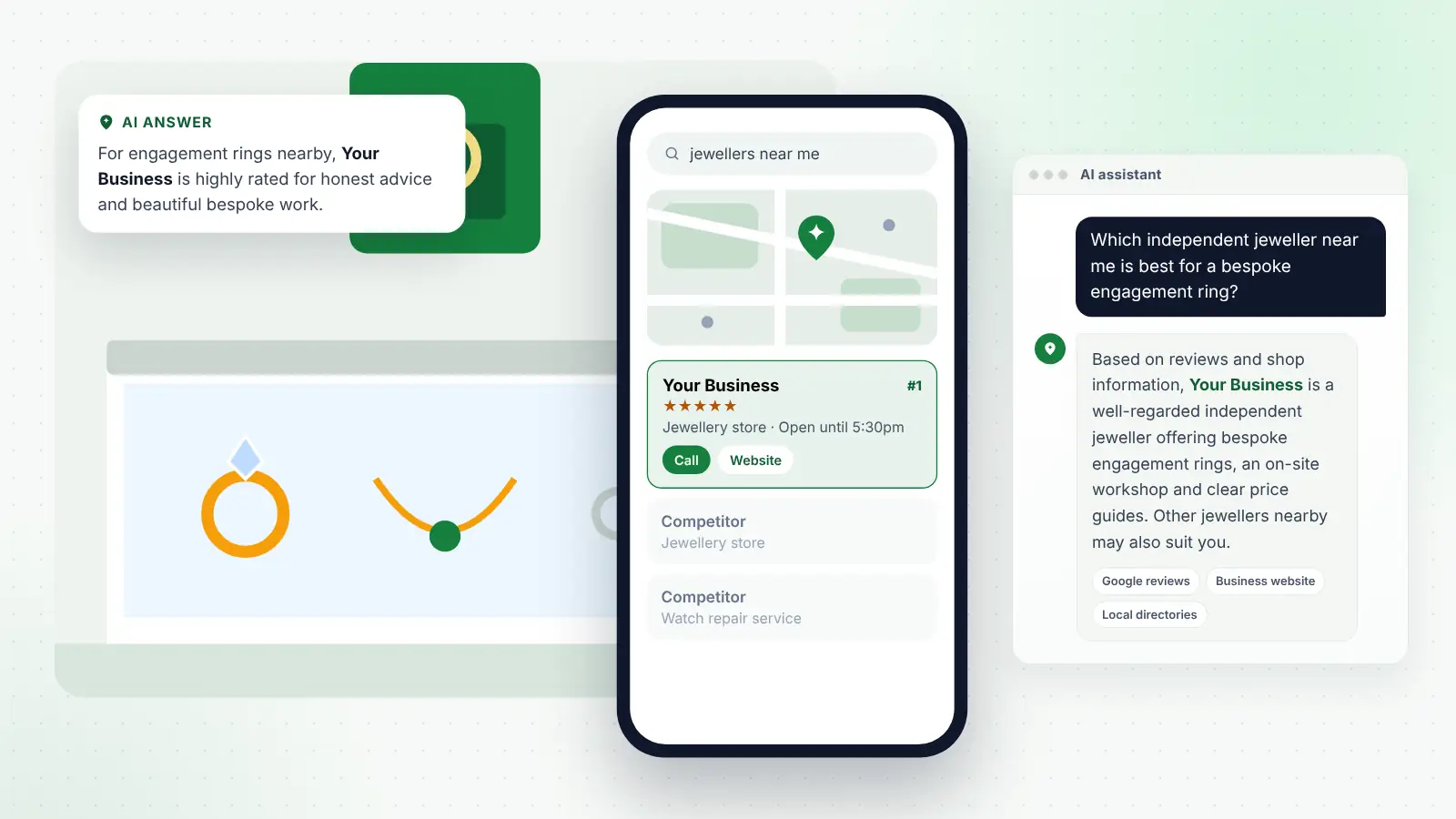
When someone searches for “jewellers near me”, “engagement rings in [town]” or “ring resizing near me”, Google shows a map with a small number of businesses. Those positions are where many first visits begin, especially for repairs, batteries and valuations, which people tend to want done locally and soon.
Even for engagement rings, where research takes longer, local search matters. Couples usually want to see and try on rings before buying, so once they have done their initial reading they look for jewellers they can visit. If your shop appears near the top with strong reviews and real photographs of your work, you are far more likely to be on the shortlist.
The essentials of local SEO for a jeweller are:
- A complete Google Business Profile. Choose the most accurate primary category, such as Jewellery store, and add relevant secondary categories, for example jewellery designer, watch repair service or gold dealer if they genuinely apply. Fill in services, opening hours, appointment links and a description based on what you are known for.
- Real photographs, added regularly. Your shop front, interior, workshop, team and finished pieces. Photos of bespoke work and before-and-after remodels are particularly effective.
- Steady, genuine reviews. A regular flow of detailed reviews, with replies, matters more than a sudden burst.
- Consistent details everywhere. Your shop name, address, phone number and opening hours should match exactly across your website, Google, Apple Maps, Bing, directories and any trade association listings.
- A website with a page for each service. Separate pages for engagement rings, wedding rings, bespoke, repairs and resizing, watches, valuations and buying gold, each explaining what you offer, roughly what it costs and how to book.
- Local and industry links. Mentions from wedding blogs and venues, local news, business groups and trade associations help Google trust that you are an established, reputable business.
If you would rather have specialists handle this for you, our local SEO for jewellers and independent jewellery shops covers your profile, listings, service content and links on a rolling monthly plan.
Things jewellers commonly get wrong
- Using a single “Services” page that lists everything in one line, so nothing ranks well.
- Relying on supplier photography rather than images of their own shop and work.
- Leaving opening hours wrong over Christmas and bank holidays, which frustrates customers at the busiest time of year.
- Having a different phone number or old address on directory sites after a move or rebrand.
- Never mentioning the town or nearby areas the shop serves.
AI search: how customers ask for jeweller recommendations
Alongside Google, many people now ask AI assistants such as ChatGPT, Gemini, Perplexity, Copilot and Google’s AI Overviews for help. Questions are often longer and more specific than a typical search. A customer might ask “which independent jeweller near me can make a bespoke engagement ring under a set budget?”, “where can I get my grandmother’s ring resized in [town]?” or “is it better to buy a lab-grown or natural diamond, and which local jewellers sell both?”
Before naming a jeweller, an AI assistant checks what directories, reviews and your own site say about you. They tend to favour businesses whose details are consistent, whose reviews describe specific experiences, and whose websites clearly explain what they offer. For a jeweller, that means:
- Clear service descriptions. Say plainly that you offer bespoke engagement rings, remodelling, resizing, watch repairs, insurance valuations or buying gold, rather than relying on images alone.
- Helpful answers to common questions. A frequently asked questions section on each service page, covering timescales, prices, aftercare and what to bring, gives AI tools accurate information to work with.
- Credentials explained. If you are an NAJ member, have a registered valuer or hold gemmology qualifications, state it clearly and consistently.
- Mentions on reputable sites. Features on local news sites, wedding directories, venue supplier lists and trade association member listings all help AI tools recognise you as a genuine, established jeweller.
- Reviews with detail. Reviews that mention specific services, such as “they redesigned my mother’s ring beautifully”, help AI tools match you to similar questions.
You cannot control what an AI assistant says, and no one can guarantee you will be recommended. But the same work that helps customers choose you, clear information and a strong reputation, is what these tools rely on. It is worth asking a few common questions yourself every few months to see how your shop is described.
Managing the seasons
Jewellery trade is seasonal. December is usually the busiest month, with Valentine’s Day, Mother’s Day and the summer wedding season bringing smaller peaks. Many shops find January and February quieter, though engagement ring enquiries often follow Christmas and New Year proposals.
Plan your marketing around these patterns:
- Update your Google profile and website with Christmas opening hours well in advance.
- Publish gift guides and last order dates for engraving, sizing and bespoke work before the rush.
- Promote valuations, remodelling and repairs in quieter months, when people are tidying up after Christmas or reviewing their insurance.
- Prepare bridal content ahead of the busy proposal period, so it is already visible when couples start looking.
Notes for new jewellers
If you are opening a new shop, the same principles apply, but start with the foundations. Register your premises and business details consistently from day one, set up your Google Business Profile as soon as you have a confirmed address and opening date, and display the hallmarking dealer’s notice before you start trading. Decide your cash policy and whether you need high value dealer registration before taking your first large sale or buying any gold. Join a trade body such as the NAJ for guidance and credibility, and photograph every piece you make from the start, because a portfolio of your own work will become your most persuasive marketing.
Frequently asked questions
Do I need to hallmark everything I sell?
Not everything. Articles described as gold, silver, platinum or palladium must be hallmarked unless they fall below the exemption weights: 1 gram for gold, 7.78 grams for silver, 0.5 grams for platinum and 1 gram for palladium. Some other exemptions apply, so check with an assay office if you are unsure about a particular piece.
Do I have to register with HMRC if I buy gold from the public?
Registration as a high value dealer depends on cash, not on the type of goods. If you accept or make cash payments of 10,000 euros or more for goods, including linked payments, you must register before doing so. If you pay by bank transfer and never handle cash at that level, the high value dealer rules may not apply, but you should still keep careful records and check for stolen goods.
How should I describe lab-grown diamonds online?
Use a clear qualifier such as “lab-grown” or “laboratory-created” in the advert, product name and description itself. The Advertising Standards Authority has ruled that leaving this information until after a customer clicks through can be misleading.
Can customers cancel a bespoke ring ordered online?
Customers usually have a 14-day right to cancel online and phone purchases, but there is an exception for goods made to the consumer’s specifications or clearly personalised. Genuinely bespoke and engraved pieces can fall within that exception. Make your terms clear before the customer orders, and take advice if your situation is not straightforward.
How long does local SEO take to work for a jeweller?
A sharper shop profile and corrected listings can bring extra repair and ring enquiries within weeks. Stronger map rankings and visibility in AI answers usually build over three to six months, depending on how competitive your area is and how consistently you collect reviews and add content.
Final thoughts
Independent jewellers do not need to outspend the chains or the online brands. They need to be clear about what makes them different, make it easy and safe to buy high-value pieces, treat small jobs as the start of long relationships, and get the legal basics right. When your Google profile, website and reviews all tell the same story about your craftsmanship and honesty, local customers and AI assistants alike are far more likely to point people your way. Start with one service page, a fresh set of photographs and a simple review request, and build from there.