A roller shutter is one of those things customers never think about until it lets them down. A shop owner cannot lock up because the curtain has jammed halfway, a warehouse loses half a day because the loading bay door will not open, or a fire risk assessor points out that a fire shutter has not been tested for years. At that moment they need someone competent, quickly, and most of them do not have a shutter company in mind.
Much of the work arrives as an emergency, but the most valuable customers are the ones who stay: retailers, landlords and facilities managers who need regular servicing and someone reliable.
This guide is for roller shutter owners who want steadier, better-paid work, from training and safety law to fire shutters, security ratings, maintenance contracts and being found online.
Key points
- DHF training is widely recognised in the door and shutter trade, and it is one of the clearest ways to show customers your engineers are competent.
- Powered shutters are machinery under the Supply of Machinery (Safety) Regulations 2008, and BS EN 13241 is the product standard for industrial and commercial doors, so installation paperwork and force testing matter.
- Fire shutters need regular, documented maintenance and testing, and the people responsible for premises have legal duties to keep fire safety equipment in working order.
- LPS 1175 security ratings help commercial buyers compare security shutters, but only certified products can claim them.
- External shopfront shutters often need planning permission, and advising customers properly protects both of you.
- Planned maintenance contracts, a reliable emergency service and strong local search visibility are what turn one-off call-outs into a stable business.
In this guide
- Decide which work you want more of
- Training and the Door and Hardware Federation
- Powered shutter safety and the law
- Fire shutters: testing, maintenance and records
- Security shutters and LPS 1175
- Planning permission for shopfront shutters
- Running a reliable emergency service
- Planned maintenance contracts
- Local SEO for roller shutter companies
- AI search and answer engines
- Frequently asked questions
- Final thoughts
Decide which work you want more of
“Roller shutters” covers a wide range of work, and companies that grow steadily usually know which parts of it they want to lead with. The main areas are:
| Type of work | Typical customers | What they care about |
|---|---|---|
| Shop and commercial security shutters | Retailers, takeaways, offices, pharmacies | Security, appearance, speed of fitting, planning |
| Industrial roller doors and high-speed doors | Warehouses, factories, logistics and trade units | Reliability, downtime, safety, servicing |
| Fire resisting shutters | Commercial buildings, schools, kitchens, landlords | Certification, testing, records, compliance |
| Electric domestic window and door shutters | Homeowners, holiday lets, rural properties | Appearance, insulation, noise, ease of use |
| Repairs and planned maintenance | All of the above | Response time, honesty, clear reports |
Each needs a different pitch. A homeowner choosing electric window shutters wants colours and quiet motors; a facilities manager wants training records, risk assessments and a maintenance log. Give each its own page and photos.
Training and the Door and Hardware Federation
Roller shutter engineers do not need a licence in the way gas engineers do, so customers rely on other signals to judge competence. The most recognised in this trade is the Door and Hardware Federation (DHF), the trade association for powered doors, gates, shutters and door hardware.
Its core course is a one-day Level 2 Award in Industrial and Garage Door Safety, aimed at installation and maintenance engineers. It covers hazard identification, risk assessment, safety testing and safe installation. A two-day option adds a Level 4 Award covering legislation, technical files and compliance, intended for managers and people who supervise engineers or sign off paperwork. DHF says refresher training is needed every three years. Current course details are on the DHF industrial and garage door training page.
In 2025 DHF added a Level 3 Award in Compliance and Safety of Fire Resisting Roller Shutter Doors, covering legislation, certification evidence, installation, maintenance and non-compliance. If you work on fire shutters, it is a strong credential to hold.
For new starters, DHF has also developed a Level 2 apprenticeship for the door, gate and shutter sector, combining an NVQ Diploma with its safety award.
Tip
List each engineer’s training on your website and in your tender documents, with a sentence explaining what it means. “DHF trained” is more persuasive when a facilities manager understands what the course covers.
Powered shutter safety and the law
Machinery and product standards
In Great Britain, powered doors and shutters are machinery under the Supply of Machinery (Safety) Regulations 2008. Whoever designs, builds or puts a powered shutter into service is responsible for making sure it is safe, and HSE has made clear that this can include installers who assemble systems on site or convert manual shutters to electric operation. A powered door needs a technical file, user and maintenance instructions and a Declaration of Conformity, with the appropriate marking. Great Britain currently recognises CE marking alongside UKCA marking for many products, but check the current position for the products you supply.
Industrial and commercial doors, including roller shutters, are also construction products, with BS EN 13241 as the product standard. BS EN 12453 sets out safety-in-use requirements and test methods for powered doors, including force limits, and BS EN 12604 covers mechanical aspects. HSE’s safety bulletin on powered doors, gates and barriers explains that meeting the standards alone may not be enough to satisfy the machinery regulations, which is why a proper risk assessment for each installation matters.
Force testing and safety devices
Force testing measures the force a closing door exerts if it meets an obstruction. It should be carried out at commissioning and repeated as part of maintenance, because springs weaken, settings drift and safety devices fail over time. Safety edges, photocells, presence detection and protection against the curtain falling if a spring or suspension component fails are all part of a safe installation. The risk assessment should reflect who may be near the shutter, including members of the public.
Duties in the workplace
Employers and those in control of workplaces have duties under the Workplace (Health, Safety and Welfare) Regulations 1992, including maintaining workplace equipment and making sure powered doors have suitable safety features. Many commercial customers do not know this, and explaining it calmly is one of the most effective ways to win maintenance work. If you find an unsafe shutter, explain why, make it safe if you can, and put your findings in writing.
Fire shutters: testing, maintenance and records
Fire resisting roller shutters protect openings in compartment walls, closing automatically when the fire alarm activates. The paperwork matters as much as the engineering.
Evidence of performance
Fire resistance should be backed by test evidence and, ideally, third-party certification, and the shutter must be installed as tested, including guides, fixings and the supporting wall. Keep that evidence organised for every product you supply.
Be clear about terminology too. BS 8524 covers active fire curtain barrier assemblies, the fabric curtains often used in open-plan spaces, rather than steel fire shutters. Buyers often mix the two up.
Maintenance and drop testing
Fire shutters can sit open for months without moving, which is why they need regular maintenance. Servicing typically includes checking the curtain, guides and barrel, the closing and release mechanism, the interface with the fire alarm, any battery backup and the controlled descent. A drop test, where the shutter is released and allowed to close as it would in a fire, is the clearest way to show it works. The frequency should follow the manufacturer’s instructions and the building’s fire risk assessment.
The Fire Safety Order
In England and Wales, the Regulatory Reform (Fire Safety) Order 2005 requires the responsible person for most non-domestic premises to keep fire safety facilities, equipment and devices maintained and in efficient working order. Scotland and Northern Ireland have their own equivalent legislation. In practice, customers need records showing their fire shutters have been inspected and tested.
Tip
Give every fire shutter customer a clear service report with the date, test results, defects found and photos. A tidy record is what a fire risk assessor or insurer asks for, and it is what makes customers renew with you.
Security shutters and LPS 1175
For retailers holding high-value stock, the security level of a shutter matters as much as its appearance. LPS 1175, published by the Loss Prevention Certification Board (LPCB), part of BRE, is the best-known standard for rating physical security products such as shutters, doors and grilles.
Under Issue 8 of the standard, ratings combine a letter and a number, such as A1 or C5. The letter reflects the tools and number of attackers used in testing, and the number reflects the minimum delay in minutes the product provides. Older products may still be described using the earlier SR1 to SR8 ratings. Certified products are listed by LPCB, so you and your customers can check a claim.
Some practical points:
- Only claim a rating your product holds. A shutter that looks similar to a certified one is not certified.
- Match the rating to the risk and to insurance. Some insurers ask for a particular level of protection, so ask customers to check their policy.
- Install as certified. Fixings, guides and locking arrangements all affect real-world performance.
Planning permission for shopfront shutters
This is the area where shop owners most often get caught out. Many councils treat an external shutter as a material change to the appearance of a building, so external shutters often need planning permission. Internal shutters and grilles fitted behind the glass usually do not.
Councils commonly prefer open lattice or perforated designs over solid shutters, because solid shutters make high streets look closed and unwelcoming after dark, and some expect the shutter box to be recessed or hidden behind a fascia and painted to suit the shopfront. Listed buildings and conservation areas get closer attention, and listed building consent may also be needed. Domestic external shutters can need consent too, particularly on flats, listed homes and in conservation areas.
Rules vary between councils, so advise customers to check with the local planning authority before ordering. Building that check into your quotes protects them from enforcement action and you from fitting a shutter that has to come down.
Running a reliable emergency service
A stuck shutter at closing time cannot wait until Monday, so 24-hour call-outs are one of the best ways to win new customers, and one of the quickest ways to collect poor reviews if done badly. A reliable service usually depends on:
- A phone that is actually answered, by a person or a well-managed call handling service, not a voicemail.
- Clear call-out charges, stated before an engineer is sent, including any out-of-hours rate.
- Honest arrival times, with an update if the engineer is delayed.
- A focus on making the premises secure, even if the full repair needs parts and a return visit.
- A written follow-up explaining what failed, what was done and what is recommended.
If you advertise 24-hour cover, make sure your rota can deliver it.
Planned maintenance contracts
Maintenance contracts turn a shutter company from busy into stable, bringing predictable income and first refusal on repairs and replacements. To sell them well:
- Explain what a service includes, such as lubrication, adjustment, safety device checks, force testing where appropriate, fire shutter drop tests and a written report.
- Offer simple tiers, for example a single annual visit, more frequent visits for heavily used doors, and options that include priority emergency response.
- Price per door with multi-site discounts, which suits retailers, landlords and facilities managers.
- Send reminders and reports without being chased.
- Propose a contract after every repair, particularly where the fault was caused by a lack of servicing.
Local SEO for roller shutter companies
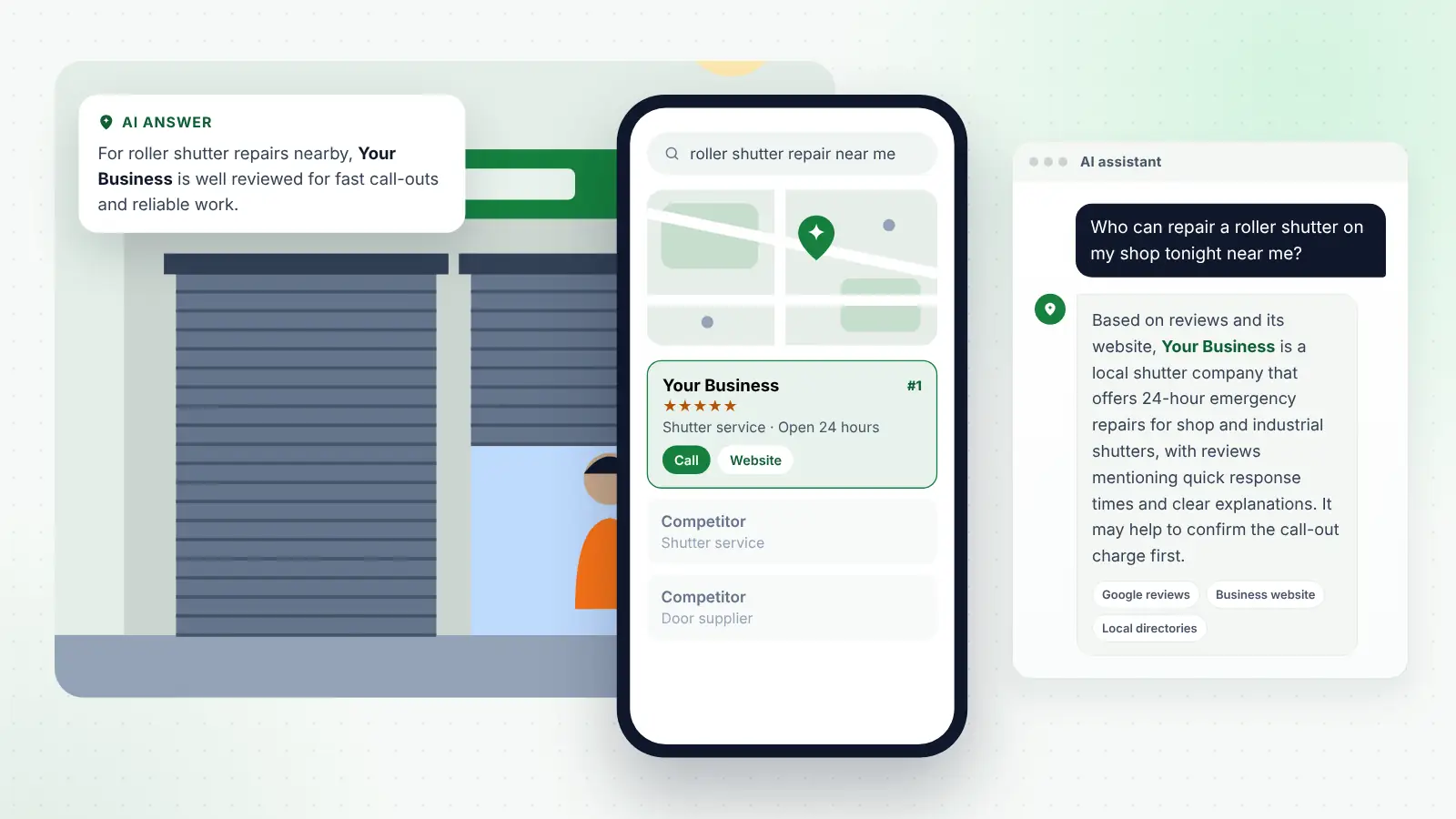
When someone types “roller shutter repair near me” into Google, they usually see a map with three local businesses before the ordinary results. For emergency work in particular, being in that group, with good reviews and clear opening hours, often decides who gets the call.
The searches are specific. Shop owners type “shop shutters fitted”, “security shutters for shops” or “emergency shutter repair 24 hour”. Facilities managers search for “fire shutter servicing”, “industrial roller door repairs” or “roller shutter maintenance contract”. Homeowners look for “electric roller shutters for windows”. Each needs its own page that answers it properly.
The main elements of local SEO for a shutter company are:
- Google Business Profile: choose the most accurate primary category, list every service, set your service area, show emergency hours accurately, and add photos of real installations regularly, from shopfronts to loading bays.
- Reviews: ask every satisfied customer, especially after emergency repairs and installations. Reviews that mention the job, such as “fixed our shop shutter late on a Saturday”, help both customers and search engines understand what you do.
- Consistent details: keep your business name, address and phone number identical across your website, Google, Bing, Apple Maps, trade directories, your DHF listing and any manufacturer installer lists.
- A website with service and area pages: separate pages for shop security shutters, industrial doors, fire shutters, domestic shutters, repairs and maintenance contracts, each explaining your process, training and typical lead times. Add pages for the towns you genuinely serve.
- Local links: mentions from shopfitters, builders, fire risk assessors and security installers you work with, local business groups, trade associations and local news coverage of interesting projects.
If you would rather stay focused on engineering, specialist local SEO for roller shutter companies can look after your profile, listings, content and links for you.
Tip
Make sure your Google opening hours match what you actually offer. If you provide 24-hour emergency repairs but your profile says you close at 5pm, you may miss the calls that matter most.
AI search and answer engines
More people now ask AI assistants for recommendations rather than scrolling through search results. A shop owner might ask ChatGPT, Gemini, Perplexity or Copilot “who can repair a roller shutter on my shop tonight near me?”, and Google increasingly shows an AI Overview at the top of the results that summarises local options. Facilities managers ask questions such as “which companies service fire shutters in our area?”
AI tools draw on details about your shutter firm they can verify. For a shutter company, that usually means:
- Consistent information across the web, so your name, location, services and emergency cover match everywhere.
- Reviews that describe the type of job and the experience, such as response times and clear explanations.
- Clear service descriptions that state what you install and service, which areas you cover and whether you work on fire and security shutters.
- FAQs on your website that answer real questions, such as planning permission, security ratings, fire shutter testing and what a service visit includes.
- Mentions on reputable sites, including trade associations, manufacturer installer lists, local business directories and partner websites.
Write down the questions customers ask every week and answer each one clearly on your website. Results from both local SEO and AI search build gradually, usually over three to six months, and nobody can honestly guarantee a particular position.
Frequently asked questions
Do I need to join the DHF?
It is not a legal requirement, but membership is widely recognised and gives access to technical guidance, codes of practice and training. For commercial and fire shutter work, it can help you get onto tender lists.
Do I have to force test every powered shutter I repair?
Anyone who repairs or maintains a powered shutter should leave it safe, and force testing is the recognised way to show closing forces are within safe limits. Whether a full test is needed depends on the door and its safety devices, so follow the manufacturer’s instructions, industry guidance and your risk assessment, and record what you did.
Can I service fire shutters I did not install?
Yes, many companies do, but you need to understand the product and keep within the manufacturer’s requirements. If a shutter lacks evidence of its fire performance or has been modified, explain the risk to the customer in writing rather than simply signing it off.
Should domestic shutters be a separate part of the business?
Often, yes. Electric window and door shutters sell on appearance, insulation and convenience, and homeowners need a different sales process from commercial clients. Give domestic work its own pages and photos, and make sure any wiring complies with the building regulations for electrical work in homes.
Final thoughts
Decide which work you want more of, make your training and safety standards visible, and build a maintenance offer that gives customers a reason to stay. Then check your Google Business Profile and emergency hours, ask for reviews and give each main service its own page.
Roller shutters are bought in a hurry and kept for years. The companies that grow are the ones who are easy to find in that hurried moment and easy to rely on long afterwards.