Garage doors are easy to ignore until something goes wrong. A snapped spring, a door that will not close on a winter evening, or a tired up-and-over door that spoils the front of a newly renovated house all send homeowners looking for help, usually from someone local who can come out quickly. That makes the garage door trade a genuinely local business, with a steady mix of urgent repairs, planned replacements and automation work.
It is also a trade with more responsibility than many newcomers expect. A powered garage door is heavy machinery that opens and closes on its own, often where children, pets and cars move around it. The law treats it accordingly, and installers who fit or automate doors carry real legal duties. Getting those right is what separates a business that lasts from one that is one accident away from trouble.
This guide covers the practical steps to starting a garage door business in the UK: choosing your market, training, powered door safety law, electrical work, planning and consumer rights, suppliers, equipment and costs, winning your first jobs, and making sure local customers find you on Google and in AI assistants. It describes the position in Great Britain as it stands in October 2026; rules differ in places for Northern Ireland, so check separately if you work there.
Key points
- Powered garage doors are covered by the Supply of Machinery (Safety) Regulations 2008 in Great Britain, and whoever automates a door or completes a powered installation is usually treated as its manufacturer, with the duties that brings.
- BS EN 13241 is the product standard for garage doors, and force testing to BS EN 12453 is the recognised way to show a powered door’s closing forces are within safe limits, both at installation and at servicing.
- The Door and Hardware Federation (DHF) is the main trade body, and its Level 2 safety award is widely recognised training for door engineers.
- New electrical circuits and consumer units are notifiable under Part P in England, and replacing a garage door does not normally need planning permission unless the property is listed or in a conservation area.
- Local SEO and AI search visibility matter because most customers have no installer in mind and choose on reviews, photos of real work and how quickly you can help.
In this guide
- Decide what kind of garage door business you want to run
- Learning the trade: springs, tracks and motors
- Powered door safety law in Great Britain
- Wiring door operators and Part P
- Planning permission
- Selling doors in the home: cancellations and deposits
- Door manufacturers, stock and delivery times
- Vans, tools and what it costs to start
- Pricing and winning your first jobs
- Local SEO for garage door companies
- Getting named by AI assistants when someone needs a door fixed
- Building repeat work from servicing and upgrades
- Frequently asked questions
- Next steps
Decide what kind of garage door business you want to run
The garage door market covers several quite different businesses, and being clear about which one you are building shapes your training, suppliers, insurance and marketing.
Common routes include:
- Repair and servicing engineer. You fix springs, cables, rollers, motors and remote controls, and service powered doors. Startup costs are lower, work comes in all year and call-outs often lead to replacements.
- Domestic supply and installation. You survey, sell and fit up-and-over, roller, sectional and side-hinged doors for homeowners, often with automation. Order values are higher, but you need supplier accounts, a good van and working capital.
- Automation specialist. You convert existing manual doors to electric operation and upgrade openers and controls. This is skilled work with significant legal responsibility, covered in detail below.
- Fitting for others. You install for manufacturers, retailers or larger door companies. Someone else wins the order, which reduces risk while you build a reputation, but you depend on a few clients.
- Commercial and industrial. Roller shutters, high-speed doors and sectional doors on business premises bring larger contracts and maintenance agreements, but also stricter workplace safety duties and customer expectations.
Many successful companies start with repairs and domestic installs, then add servicing contracts and light commercial work once they have the experience and paperwork to support it.
Learning the trade: springs, tracks and motors
There is no licence required to fit or repair garage doors, but the work is physically demanding and genuinely hazardous. Springs on up-and-over and sectional doors store a great deal of energy, doors are heavy, and a powered door that has been set up badly can trap or crush someone. Most engineers learn on the job, working for an established installer before going independent.
The DHF runs a one-day Level 2 Award in Industrial and Garage Door Safety for installation and maintenance engineers already working in the trade. It covers hazard identification, risk assessment, safety testing, structural strength, protection against doors falling, electrical and control safety, hold-to-run operation, force limitation and presence detection. A second-day Level 4 course covers the legislation, technical files and declarations of conformity, and is aimed at managers and people who sign off compliance. DHF says its training complements the relevant NVQ rather than replacing it, and that refreshers are needed every three years. You can find current details on the DHF industrial and garage door training page.
Beyond formal training, you need to be confident with:
- Surveying openings accurately, including headroom, side room, drive-through height and the condition of the frame and brickwork.
- Advising on which door type suits each garage, car, budget and level of use.
- Handling and adjusting springs and cables safely, using the correct tools.
- Setting up operators, safety edges and photocells, and carrying out force testing.
- Working safely when lifting heavy panels and working at height.
Tip
Never adjust or release a tensioned spring without the right tools and training. Spring work causes some of the most serious injuries in this trade, and a customer’s attempt to fix it themselves is often the reason you have been called.
Powered door safety law in Great Britain
This is the most important legal area for a garage door business. In Great Britain, powered doors and gates are treated as machinery under the Supply of Machinery (Safety) Regulations 2008, which brought the EU Machinery Directive into UK law and remain in force. Garage doors are also construction products, covered by the Construction Products Regulations 2013, with BS EN 13241 as the relevant product standard.
Who counts as the manufacturer
If you supply a complete powered door from a manufacturer and install it exactly as designed, the manufacturer carries most of the product duties. The picture changes when you assemble the system yourself. HSE guidance on powered gates explains that the person who carries out final assembly becomes the “Responsible Person”, and that where existing manual gates are converted to power operation, the installer usually becomes the manufacturer. The DHF applies the same principle to doors, warning that powered garage doors should never be treated as simple off-the-shelf products.
In practice, if you fit a motor kit to a customer’s existing up-and-over door, or combine a door from one supplier with an operator from another, you should assume the manufacturer’s duties are yours. HSE’s legal responsibilities guidance sets out the principles clearly.
What the duties involve
For a powered installation where you are the manufacturer, the main steps are:
- Assess the risks. Identify every hazard, such as crushing, shearing, impact, drawing in and the door falling, and design them out or control them.
- Meet the essential safety requirements, normally by following the relevant standards, including BS EN 12453 on safety in use of power-operated doors.
- Force test the door. Where the door relies on limiting its closing force, measure the forces at each hazard point with a calibrated force tester and confirm they are within the limits the standard sets.
- Compile a technical file containing the risk assessment, test results, component details and instructions.
- Issue a Declaration of Conformity in English and apply the conformity marking. Great Britain currently recognises CE marking alongside UKCA marking for many products, and the DHF describes a CE or UKCA conformity label as a requirement for powered garage doors.
- Hand over clear instructions covering safe use, emergency manual operation and the servicing the door needs.
Residual risks and the household
The DHF also advises installers to carry out a residual risk assessment for each home and to discuss it with the householder. Children, elderly or disabled users, pets, cars parked under the door, and a door that opens onto a pavement all change what is needed. If the customer declines a safety recommendation, such as additional photocells, record that in writing. Health and safety law places duties on owners of powered doors at workplaces, but not on private homeowners, which makes the installer’s advice and paperwork even more important in domestic work.
Servicing and repairs
Anyone who repairs or maintains a powered door must leave it safe. The DHF’s TS 013 code of practice, which covers installation, commissioning, repair and maintenance of garage doors and gates, treats force testing as part of regular planned maintenance as well as commissioning, because springs weaken, settings drift and safety devices fail over time. If you find a door that is unsafe, explain why, make it safe if you can, and put your findings in writing.
Wiring door operators and Part P
Most automated garage doors need a power supply, and the electrical side brings its own rules. In England, Part P of the Building Regulations covers electrical safety in dwellings. According to the Planning Portal, installing a new consumer unit, installing a complete new circuit and altering circuits in special locations such as around baths and showers are notifiable. Running a new circuit out to a garage is therefore notifiable work, either to building control or through an electrician registered with a competent person scheme.
Connecting an operator to a suitable existing supply may not be notifiable, but it must still be safe and meet BS 7671, the IET Wiring Regulations. Scotland and Wales have their own building rules, so check locally. Unless you are qualified and registered, work with a competent electrician and keep their certificates with your job records.
Planning permission
Replacing a garage door, or changing a manual door to an electric one, does not normally need planning permission, because the work is usually covered by permitted development rights. Permission may be needed for listed buildings, properties in conservation areas, and changes that noticeably alter how the house looks from the street. Some estates also have restrictive covenants or planning conditions about the design of doors. If in doubt, advise the customer to check with their local planning authority before ordering.
Converting a garage into a habitable room is a separate project with its own planning and building regulations questions, so do not let a customer assume a new door covers it.
Selling doors in the home: cancellations and deposits
Many garage door orders are agreed after a survey at the customer’s home, which brings consumer law into play.
The 14-day right and made-to-measure doors
An order agreed on the homeowner’s drive is normally an off-premises contract under the Consumer Contracts Regulations, usually giving 14 days to cancel. The regulations exclude goods made to the consumer’s specifications or clearly personalised, and a door made to the measurements, colour and finish the customer has chosen will often fall within that exception.
The exception is narrower than it looks:
- Stock-size doors and standard parts are not made to the customer’s specification and can be subject to the normal cancellation right.
- Supply-and-fit contracts include a service, and how the rules apply to mixed contracts is not always straightforward. Have a solicitor look over your door order terms instead of copying a generic template.
- Information duties still apply. Your paperwork should explain clearly that the door is made to order and what that means for cancellation.
- Faulty goods and poor workmanship are different. Under the Consumer Rights Act, goods must be of satisfactory quality, fit for purpose and as described, and installation must be carried out with reasonable care and skill.
Deposits
Deposits are normal for made-to-order doors, because you often pay the manufacturer before you are paid in full. State the amount and payment schedule in writing before the customer agrees, keep the deposit proportionate to your genuine commitment, and remember that if a customer has a right to cancel and uses it, payments must be refunded. Terms that let you keep more than your real losses risk being unfair.
Door manufacturers, stock and delivery times
Your supplier relationships shape your reputation, because their quality, lead times and warranty support directly affect your customers. Most independents buy from one or two main door manufacturers and an operator brand they know well, which makes servicing, spares and paperwork far simpler.
When choosing suppliers, check:
- Whether doors come with a Declaration of Performance and conformity marking, and what documentation is supplied for powered systems.
- Whether door and operator are designed and tested to work together, which simplifies your compliance.
- Typical lead times for made-to-measure doors, colours and finishes, and how they change in busy periods.
- Warranty terms on doors, springs and motors, and how claims are handled.
- Availability of spares for older doors you will meet on repair jobs.
- Trade terms, delivery, dealer listings and any approved installer schemes.
Vans, tools and what it costs to start
A repair-led business can start fairly lean. Domestic installation needs a larger van and more working capital. These are ballpark figures that vary by region, supplier and whether kit is new or used.
| Item | Typical cost | Notes |
|---|---|---|
| Van | £8,000–£25,000 | Long wheelbase with roof rack or racking for panels and tracks |
| Hand and power tools | £1,500–£4,000 | Drills, saws, spring winding bars, levels, fixings |
| Force tester | Varies | Calibrated device needed for powered door testing, with regular recalibration |
| Lifting and access equipment | £300–£2,000 | Platforms, ladders, panel lifting aids |
| Training | Varies | DHF courses, NVQ and manufacturer training |
| Spares stock | £1,000–£5,000 | Springs, cables, rollers, remotes, common motor parts |
| Insurance | Varies | Public liability and product liability, employers’ liability once you employ staff |
| Website and branding | £1,000–£4,000 | Logo, van livery, website, quote and handover templates |
| Working capital | Several thousand pounds | Suppliers are often paid before the customer pays in full |
Set the business up properly before your first job. Choose between sole trader and limited company, register with HMRC, keep door job takings in their own bank account and log every invoice and spring order from day one. Employers’ liability insurance is a legal requirement once you employ staff, and product liability cover deserves particular attention if you act as the manufacturer of powered installations.
Pricing and winning your first jobs
Pricing
Price each job to cover the door or parts, your survey, fitting and travel time, disposal of the old door, any electrical work, testing and paperwork, warranty risk and a fair margin. Compare your prices with other local installers, not with online door retailers selling to DIY customers. Your price includes a proper survey, safe installation, force testing, documentation and someone to call if anything goes wrong, so explain that in your quote.
For repairs, be clear about call-out charges and what they include. Customers with a stuck door are anxious about cost, and transparency builds trust quickly.
Finding early customers
Good sources of early work include:
- Previous customers and contacts if you have worked in the trade.
- Fitting and repair work for manufacturers, retailers and larger door companies.
- Builders, window and door installers, driveway contractors and electricians whose customers ask about garage doors.
- Letting agents, landlords and property managers who need reliable repairs.
- Neighbours of recent installs, since a smart new door is very visible from the street.
Tip
Photograph the old door before you remove it and the finished door afterwards, with the customer’s permission. Before-and-after photos of local homes are some of the most persuasive marketing you will have.
Local SEO for garage door companies
When a door breaks or a homeowner decides to replace one, many start by searching Google for “garage door repair near me”, “electric garage doors [town]” or “garage door spring replacement”. Above the ordinary results, Google shows a map pack of three nearby door firms, each with star ratings, photos and hours. For urgent repairs especially, being one of those three often decides who gets the call.
Local search favours businesses that are relevant, nearby and well regarded, so a genuinely local company has a fair chance against national brands and lead generation sites. For a door company, the work below matters most.
Google Business Profile
Choose the most accurate primary category, such as garage door supplier, and add secondary categories only if they genuinely apply. Run the van from home with no showroom? Then list yourself as a service-area business and keep the house address off the profile. Fill in your service areas, a clear description of the doors and repairs you offer, your opening hours and any out-of-hours availability, and add photos of real installations regularly, from roller doors on new builds to automated sectional doors and repaired up-and-overs.
Reviews
Reviews carry a lot of weight because customers are letting you work on something heavy and expensive at their home. Ask every customer for a review once the job is complete, using a direct link. Reviews that mention a quick response, clear advice, tidy fitting and how the new door looks are far more persuasive than a star rating on its own. Answer every review, good or bad, calmly and courteously.
One set of details on every dealer locator and directory
Your business name, address and phone number should match exactly everywhere: your website, Google, Bing, Apple Maps, directories, your DHF listing if you join, and any manufacturer dealer locator. Inconsistent details make it harder for search engines to trust what they know about you.
A website with a page per door type and town
A simple, fast website with a page for each main service, such as roller doors, sectional doors, up-and-over doors, side-hinged doors, automation and repairs, helps Google understand what you offer. Add a page for each main town you fit doors in, showing local installs, so you have a chance of appearing when people there search. Include guide prices if you are comfortable sharing them, typical lead times, your safety testing and handover process, and an easy way to book a survey or report a fault.
Local and industry links
Links from manufacturers, trade bodies and local sites signal that your door company is genuine and well established. Good sources include trade association and manufacturer listings, local business groups, community sponsorships, home improvement websites and local property professionals.
This takes time alongside surveys and installs, which is why some companies choose specialist help with local SEO for garage door companies so they can focus on the work. Whichever route you take, expect progress to build over three to six months, not in the first week.
Getting named by AI assistants when someone needs a door fixed
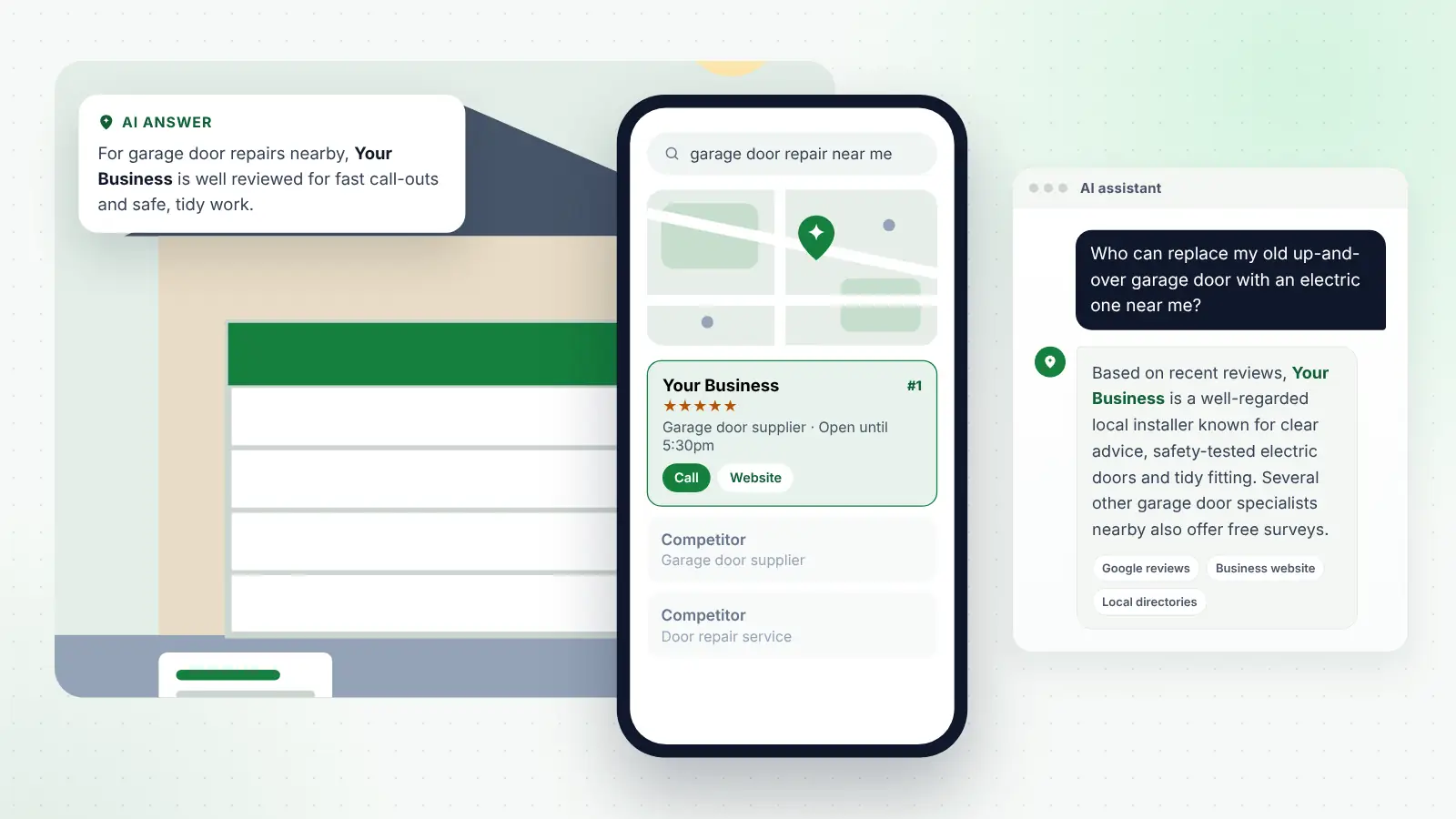
More homeowners now ask AI assistants before they contact anyone. Someone might ask ChatGPT “Who can replace my up-and-over garage door with an electric one near me?”, ask Gemini “Is a roller or sectional garage door better for a short drive?”, ask Copilot “Why does my garage door open and then reverse?”, or see a Google AI Overview summarising options for “garage door repair in [town]”. Perplexity is used the same way, often listing its sources beside the answer.
These tools do not keep a secret list of good garage door companies. They draw on what is already online about your door company, so the work that helps on the map helps here too. In practice, they rely on:
- Consistent information. When your name, location, services and area match across your website, Google profile, directories and association listings, AI tools are more confident about mentioning you.
- Reviews. Detailed reviews help assistants describe what you are known for, such as fast repairs or careful automation work.
- Clear service descriptions. Plain explanations of the doors you supply, the repairs you handle and the areas you cover make it easy to match you to a question.
- FAQs. Pages answering real questions, such as how long a new door takes to arrive, whether an existing door can be automated, what safety features an electric door should have, or what to do when a spring breaks, are exactly what these tools summarise.
- Mentions on reputable sites. Listings and features from trade bodies, manufacturers, local news and home improvement websites strengthen the picture AI tools build of your business.
For garage door companies this matters because many of the questions people ask AI are about diagnosing a problem or choosing the right door, not just price. A business that has answered those questions clearly, and is described consistently by others, is in a much better position to be recommended.
Building repeat work from servicing and upgrades
Once work is coming in, the focus shifts to doing it consistently well. Use a simple system to track enquiries, surveys, orders, delivery dates, installs and service reminders, so customers always know what is happening. Keep a complete job file for every powered installation, including the risk assessment, force test results, declaration and handover notes. That paperwork protects you if anything is questioned years later.
Servicing is one of the best ways to grow steadily. An annual service for powered doors keeps them safe, gives you regular contact with customers and often leads to replacement orders when older doors reach the end of their life. Other growth options include a second engineer, commercial maintenance contracts, a small showroom, or adding related products such as automated gates, once you have the training and experience for them. Take on extra vans and contracts only as fast as your cash and fitting standards allow.
Frequently asked questions
Do I need a licence to fit garage doors?
No specific licence is needed, but powered doors are covered by machinery safety law, and anyone who automates a door or completes a powered installation usually takes on the manufacturer’s duties. Training, careful testing and good paperwork are essential, alongside the usual business registration, insurance and consumer law obligations.
Is force testing a legal requirement?
The law requires powered doors to be safe, and BS EN 12453 is the recognised standard for showing that. Where a door relies on limiting its closing force, measuring those forces with a calibrated tester is the accepted way to demonstrate it is within safe limits, both at installation and at servicing.
Can customers cancel an order for a made-to-measure garage door?
Goods made to the customer’s specification are generally excluded from the 14-day cancellation right for off-premises contracts. Stock items can still be cancelled, faulty goods and poor workmanship are covered by the Consumer Rights Act, and supply-and-fit contracts can be complicated, so take legal advice on your terms.
Should I join the DHF?
It is not compulsory, but the Door and Hardware Federation is the main trade body for the industry. Its training and codes of practice are widely recognised, and membership helps show customers and commercial clients that you take safety seriously.
How quickly will Google bring in door repair enquiries?
A better Google Business Profile and tidied listings can start bringing calls within a few weeks. Ranking higher on the map and being recommended by AI tools usually takes three to six months, depending on local competition. Cold snaps bring a rush of broken springs, so get set up before winter.
Next steps
Starting a garage door business is very achievable with good practical skills, but success depends on getting the less visible foundations right: proper safety training, a clear understanding of your duties when you automate or install powered doors, force testing and documentation on every job, safe electrical work, fair terms and reliable suppliers.
With the basics sorted, focus on being the door firm people find quickly and trust. A complete Google profile, photos of real local installations, a steady flow of genuine reviews and consistent information across the web will help homeowners, and the AI tools they increasingly use, recognise you as a safe, reliable local garage door company.