Many yoga and pilates studios start with one teacher, a handful of mats and a weekly class in a church hall. Over time the regulars multiply, the timetable grows and renting someone else’s space every evening starts to feel limiting. Opening a studio of your own is a natural next step, but it is also a significant commitment, with rent, fit-out and a timetable that has to fill week after week.
The studios that do well are rarely the ones with the most expensive fit-out. They are the ones with well-trained teachers, a timetable built around when local people can actually attend, simple pricing, a warm welcome for beginners and a steady stream of new students who can find them easily.
This guide covers each of those steps for the UK, from teacher training and insurance to choosing between renting space and leasing your own studio, setting prices, licensing music, running online classes and getting found online, including through AI assistants.
Key points
- Yoga and pilates teaching is not regulated by law, but insurers, studios and students expect recognised training, such as British Wheel of Yoga qualifications, a 200-hour yoga teacher training course or a Level 3 pilates diploma.
- Insurance for every style and setting you teach in is essential, and many venues will ask to see it.
- Renting halls and rooms keeps risk low, while your own studio gives you control but brings fixed costs that must be covered every month.
- A simple pricing structure, usually drop-ins, class packs and memberships with a clear introductory offer, makes it easier for new students to start.
- If you play music in classes, you will usually need TheMusicLicence from PPL PRS, and online classes have separate rules.
- Most new students search for a class nearby or ask an AI assistant, so a strong Google profile and clear class information matter.
In this guide
- Get the right teacher training
- Insurance and professional membership
- Renting space or opening your own studio
- Build your timetable
- Set your prices
- Music licensing
- Online classes and hybrid timetables
- Health questionnaires and advertising claims
- Local SEO: being found by people looking for a class nearby
- AI search: getting your classes suggested by assistants
- Keep students coming back
- Frequently asked questions
- Next steps
Get the right teacher training
Yoga and pilates teaching are not legally regulated in the UK, so there is no single licence to teach. In practice, insurers, studios, gyms and informed students expect recognised training, and the quality of your teaching is what keeps students coming back.
Yoga teacher training
There are two main routes. The British Wheel of Yoga, which Sport England recognises as the national governing body for yoga, offers Ofqual-regulated Level 4 qualifications through its awarding arm. These are longer, more structured courses that are well regarded in the UK. Many other schools offer 200-hour teacher training courses, often following the standards set by Yoga Alliance in the United States, and 300-hour or 500-hour courses for further training.
UK-based Yoga Alliance Professionals treats a 200-hour course as the minimum to join as a teacher, and the British Wheel of Yoga runs a route for 200-hour teachers who want to progress to its Level 4 Diploma. Whichever route you choose, look at the teaching hours, the amount of supervised practice teaching, the anatomy content and the experience of the trainers.
Pilates instructor training
For mat pilates, the usual starting point is a Level 3 diploma in teaching or instructing pilates matwork from a regulated awarding body. Course titles vary between awarding bodies, and some are endorsed by CIMSPA, the professional development body for the sport and physical activity sector. Reformer and other equipment-based pilates usually need separate, additional training, often with a specific method or school.
Specialist and ongoing training
Pregnancy and postnatal classes, classes for older adults and classes for people with long-term health conditions all call for specialist training. They are also popular, so adding them can help fill daytime slots. Keep a current first aid certificate, and plan regular continuing professional development so your teaching stays fresh.
Tip
Before you pay for a teacher training course, check that the insurer you plan to use accepts it and, if you want to join a professional body, that the body recognises it. Not every short online course meets those standards.
Insurance and professional membership
Insurance is essential, and most halls, gyms and studios will ask to see your certificate before you teach. Look for a policy designed for yoga or pilates teachers that includes:
- Public liability insurance, covering injury to students or members of the public, or damage to property.
- Professional indemnity insurance, covering claims that your instruction caused injury or loss.
- Equipment cover for mats, props and, especially, reformers, which are expensive to replace.
- Employer’s liability insurance, if you employ teachers or staff, which is usually a legal requirement.
Check that the policy covers every style you teach, including hot yoga, aerial yoga or reformer classes, and every setting, including outdoors and online. Self-employed teachers who teach at your studio should hold their own insurance, and you should check it.
Professional membership is voluntary but useful. Bodies such as the British Wheel of Yoga, Yoga Alliance Professionals and pilates associations offer directory listings, continuing professional development and, in some cases, insurance options for members.
Renting space or opening your own studio
This is the biggest decision you will make, because it shapes your costs and how quickly you can grow.
| Option | How it works | Advantages | Things to watch |
|---|---|---|---|
| Hiring halls and rooms | You book community halls, gyms or clinic rooms by the hour | Low risk, easy to test demand | Limited times, storage, no control over the space |
| Teaching for gyms and studios | You are paid per class by another business | No rent, steady work | Lower earnings, no control over pricing |
| Sharing a studio | You share a lease or sub-let space with other teachers | Lower costs, shared marketing | Clear agreements needed on timetable and costs |
| Your own studio | You lease premises and run a full timetable | Full control, room to grow a team | Lease, fit-out, rates and fixed monthly costs |
Testing demand first
Many studio owners build a following in rented halls before taking on a lease. If several of your hall classes are regularly full, and you know where your students live and when they can come, you have far better evidence that a studio will work.
Choosing premises
When you look at a unit, think about:
- Floor space and ceiling height for the class sizes you want, and for reformers if you plan to offer them.
- Floors, heating and ventilation, which matter even more for hot yoga.
- Changing rooms, toilets and showers.
- Soundproofing, especially above or beside other businesses or homes.
- Parking, public transport and accessible access.
- Planning use class and lease terms, including any restrictions on fitness use or opening hours.
- Business rates, and whether small business rate relief may apply.
Get professional advice before signing a lease, and agree a realistic budget for fit-out. Reformer studios in particular need a large investment in equipment before the first class.
Build your timetable
Your timetable should be built around when local people can actually come, not when you would like to teach.
- Start with peak times. Early mornings, lunchtimes in business areas, evenings and weekend mornings are usually busiest.
- Use daytime slots for specific groups, such as pregnancy, postnatal, gentle or over-60s classes.
- Label classes clearly by style and level, such as “Beginners’ vinyasa”, “Mat pilates, all levels” or “Yin, gentle”.
- Keep it consistent. Students build routines, so avoid moving classes around.
- Review attendance monthly and replace classes that are consistently quiet.
A four- or six-week beginners’ course is one of the most effective ways to bring in new students, because it gives them a clear start date, a group at the same level and a reason to keep coming.
Set your prices
Prices vary widely by area, style and class size. Reformer classes and small specialist sessions usually cost more than large mat classes. Research what local studios and gyms charge and position yourself honestly. Most studios offer a combination of:
- Drop-in classes for occasional visitors and people trying you out.
- Class packs, such as five or ten classes with an expiry date, for students who come most weeks.
- Monthly memberships, either unlimited or a set number of classes, which give you the most predictable income.
- An introductory offer, such as a beginners’ course or a few classes for a set price.
- Private sessions for one-to-one or small group teaching, priced higher.
Keep the options few and clear. A pricing page with fifteen choices puts people off. Write clear terms covering cancellation windows, late arrivals, pack expiry and how memberships can be paused or cancelled.
Music licensing
If you play recorded music in classes, you will usually need TheMusicLicence from PPL PRS, which covers playing music in public, including in fitness and dance classes. If you teach in a gym or hall, ask whether the venue’s licence covers your classes, because arrangements vary.
Online classes are treated differently. PPL PRS has published guidance on online fitness classes, which explains that a separate PRS for Music digital licence may be needed. PPL’s temporary policy for classes streamed live to students’ homes applies only to existing TheMusicLicence holders, has conditions on class length, group size and platforms, and is currently due to end on 31 December 2026 unless PPL extends it. Social media platforms have their own rules too. Check the current position before you stream classes with music, or teach online without music.
Online classes and hybrid timetables
Online classes can extend your reach to students who move away, travel for work or cannot always get to the studio. Common options include live-streamed classes, an on-demand library of recorded classes, and hybrid classes streamed from the studio.
Keep a few things in mind:
- Insurance must cover online teaching, and you should ask students to confirm they have a safe space to practise.
- Health questionnaires are still important for online students.
- Recording and privacy. Tell students if a class is being recorded and avoid showing other participants without consent.
- Pricing. Online-only memberships are usually cheaper than studio memberships, and many studios include them as an extra.
Health questionnaires and advertising claims
Ask every new student to complete a short health questionnaire covering injuries, medical conditions and pregnancy, and encourage them to tell the teacher before class. Health information is special category data under UK data protection law, so store it securely, explain how you use it in a privacy notice and check whether you need to pay the data protection fee to the Information Commissioner’s Office.
Be careful with health claims in your marketing. Your website, Google profile and social media are covered by the CAP Code, which the Advertising Standards Authority (ASA) enforces. The ASA’s advice on yoga says mild claims that yoga can help with relaxation, mood, sleep, tension and general wellbeing are likely to be acceptable, and claims about strength, balance, flexibility and posture are likely to be acceptable when they relate to healthy people who practise regularly. Claims beyond those need robust evidence, usually clinical trials, and you should avoid suggesting classes can treat medical conditions such as asthma. The same caution is sensible for pilates.
Tip
Describe what happens in each class and how students usually feel afterwards, rather than what it will cure. “A slow, steady class to help you unwind” is both compliant and more inviting than a list of health benefits.
Local SEO: being found by people looking for a class nearby
Yoga and pilates are local habits. Most people want a class within easy reach of home or work, so they search on their phone and choose from the first few studios they see. Common searches include “yoga classes near me”, “reformer pilates [town]”, “beginners yoga course near me”, “hot yoga studio”, “pregnancy yoga near me” and “pilates class tonight”. Local SEO is about making sure your studio appears for those searches and looks like a welcoming choice.
The map results at the top of Google, with photos, ratings, opening hours and a link to your timetable, often decide which studio gets the booking. Appearing there consistently matters most in January and September, when many people decide to start something new.
Set up a Google Business Profile built around your timetable
If you have your own studio, list it at that address. If you only hire halls by the hour, Google’s guidelines don’t allow a profile for an ongoing class at a venue you don’t own or have authority to represent, so focus on your website, timetable and directory listings until you have a space of your own. Choose the most accurate primary category, such as “Yoga studio” or “Pilates studio”, describe the styles and levels you teach, link your booking page and timetable, and add real photos of your studio, teachers and classes (with students’ permission).
Collect reviews from real students
Reviews are one of the strongest signals for local search and one of the first things a nervous beginner reads. Ask students after a beginners’ course or when they renew a membership, and give them a direct link. Reviews that mention teachers by name, class styles and the atmosphere help you appear for related searches.
Use the same studio details on every booking app
Use the same studio name, address, phone number and website on Google, Apple Maps, Bing, social media, class-booking platforms and professional body directories. Inconsistent details confuse search engines and students.
Build a useful website
Create a page for each main class style and level, explaining what happens, who it suits and what to bring. Add teacher profiles with their training, a clear pricing page and a page for beginners that answers common questions about what to wear, whether they need their own mat and how to choose a first class.
Earn local links
Links and mentions from physiotherapy clinics, running clubs, maternity groups, local employers, wellbeing events and local news show search engines your studio is an active part of the community. A free community class or a workshop for a local charity is often a natural way to earn one.
Local SEO takes time, and results usually build over three to six months. If you would rather spend your time teaching, specialist SEO for yoga and pilates studios can look after your profile, listings, content and links.
AI search: getting your classes suggested by assistants
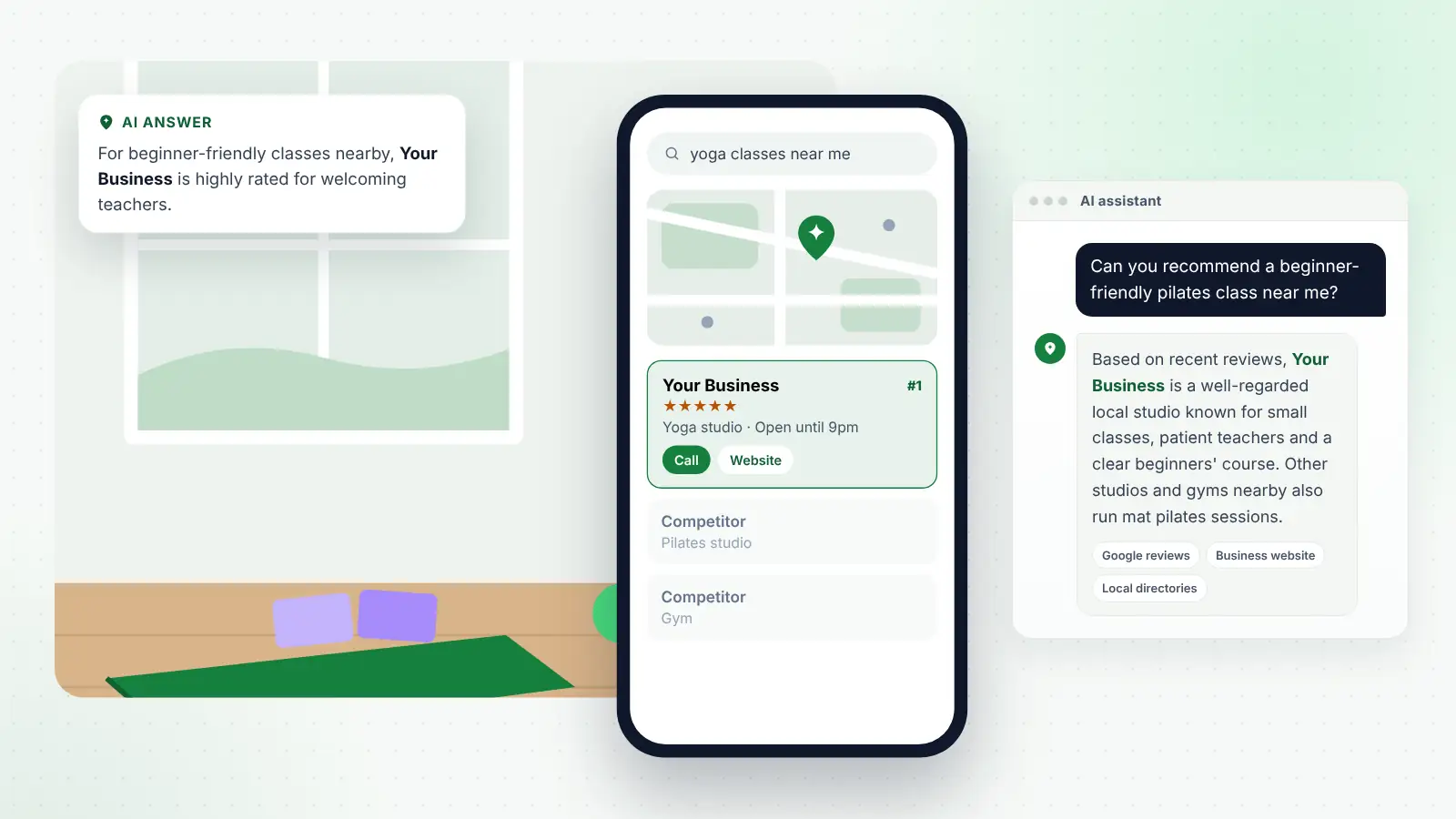
More people now ask AI assistants where to find a class. Someone might ask ChatGPT “Can you recommend a beginner-friendly pilates class near me?”, ask Gemini for “a reformer pilates studio in [town] with early morning classes”, or ask Perplexity or Copilot for “pregnancy yoga near me on Saturdays”. Google’s AI Overviews also summarise options for many fitness and wellbeing searches.
These tools aim to give a specific, confident answer, so they rely on information they can find and check across the web. For a studio, that usually means:
- Matching studio details on your Google profile, website, class-booking apps and directories.
- Reviews that describe the classes, teachers and atmosphere, such as “great for complete beginners” or “small reformer classes”.
- Clear class descriptions with style, level and times, so the tool can match you to requests like “beginners”, “pregnancy” or “early morning”.
- FAQs that answer real questions about what to wear, class sizes, pricing and how to start.
- Mentions on reputable sites, such as professional body directories, local news features or partner pages of local clinics and clubs.
Making your studio easy for these tools to understand is known as answer engine optimisation (AEO). Being specific helps most. A studio whose website, profile and reviews all clearly describe small beginners’ reformer classes is far more likely to be suggested for that question than one that just says “classes for everyone”. Keep health claims measured, because AI tools tend to repeat what you say about yourself.
Keep students coming back
Retention is what makes a studio sustainable. Students stay when they feel welcome, notice progress and build a routine. Learn names, follow up after a first class, and give every newcomer a clear next step, such as a class pack or membership offer. Track how many trial students become regulars, which classes they join and when people stop coming, so you can act early.
Community matters too. Workshops, themed courses, social events and retreats give students reasons to stay involved, and referral offers encourage them to bring friends who are likely to be similar to your best students.
Frequently asked questions
Do I need a qualification to teach yoga or pilates?
There is no legal requirement, but insurers, venues and students expect recognised training. For yoga, that usually means a British Wheel of Yoga qualification or a 200-hour teacher training course. For mat pilates, a Level 3 diploma from a regulated awarding body is the usual starting point, with separate training for reformer work.
What insurance do I need to run a studio?
Most studios need public liability and professional indemnity insurance as a minimum, plus equipment cover for reformers and props and employer’s liability insurance if you employ staff. Make sure every style, setting and online class is covered.
Do I need a music licence for yoga classes?
If you play recorded music in classes, you will usually need TheMusicLicence from PPL PRS. If you teach in someone else’s venue, ask whether their licence covers your classes. Streaming classes online with music has separate requirements, so check the current PPL PRS guidance.
Should I rent a hall or open my own studio?
Renting halls keeps risk low and lets you test demand. Opening your own studio gives you control over the space and timetable, but you need enough regular students to cover rent and running costs every month. Many owners build a following in halls before taking on a lease.
Can I say yoga helps with back pain or anxiety?
Be careful. ASA guidance generally accepts mild claims about relaxation, mood, sleep and wellbeing, and claims about strength and flexibility for healthy people who practise regularly. Claims about treating medical conditions need robust evidence, so describe the class and how students feel rather than what it treats.
Next steps
Opening a yoga or pilates studio is about more than a beautiful room. Train well, insure every way you teach, test demand before you commit to a lease, and build a timetable and pricing structure that suit local people. Then put the basics in place: health questionnaires, secure records, music licensing and clear terms.
Finally, make sure people searching for a class nearby can find you, understand your timetable and see what your students say. A strong Google profile, steady reviews and clear, honest information across the web will help both search engines and AI assistants send the right students through your door.