Complementary therapists rarely struggle for skill or care. What holds many practices back is visibility and trust: new clients cannot easily tell a trained, insured, registered practitioner from someone who took a weekend course, and the advertising rules mean you cannot simply list the problems people come to you with.
This guide is for acupuncturists, reflexologists, hypnotherapists, Reiki practitioners, aromatherapists, Bowen therapists and those whose work overlaps with sports and remedial massage. It covers trust signals, licensing, what you can say in your marketing, working alongside GPs, and being found on Google Maps and in AI assistants.
The thread running through it is simple: describe your training, your approach and what a session involves, honestly and clearly. That is what the rules require and what cautious clients want.
Key points
- Join a register accredited by the Professional Standards Authority and show it everywhere, because it is a trust signal clients can check.
- Check council registration or licensing rules before you open or move premises, as they differ between London, the rest of England, Wales and elsewhere.
- Keep every health claim within CAP guidance for your therapy, and never imply anyone should delay or avoid medical treatment.
- Write about what a session involves, your training and how clients describe the experience, rather than outcomes or cures.
- Build referral relationships by showing GPs, physios and other professionals that you work alongside medical care and know your limits.
- A complete Google Business Profile, genuine reviews and clear session pages help you appear in both local search and AI recommendations.
In this guide
- Why trust decides where clients book
- Registers, insurance and showing you are credible
- Licensing, consent and record keeping
- What you can and cannot claim
- Describing sessions instead of outcomes
- Working alongside GPs, physios and other professionals
- Reviews and retention
- Local SEO for acupuncturists and complementary therapists
- AI search and the client who asks first
- Frequently asked questions
- Final thoughts
Why trust decides where clients book
Most people booking a complementary therapy for the first time are a little wary. They may worry about needles or simply not know what happens in a reflexology or hypnotherapy session. Before they book, they look for reassurance on a few points:
- Are you properly trained and registered? A recognisable register they can check matters more than a list of certificates.
- Is it safe and professional? Clean premises, insurance, a proper consultation and clear consent.
- What actually happens? How long the session lasts, what they wear, whether they talk or lie quietly, what you do.
- What does it cost? First session, follow-ups and any packages.
- Will I be pressured? Into long courses of treatment, or into stopping medical treatment.
None of these is about promised results. Practices that grow steadily answer them before a client has to ask.
Registers, insurance and showing you are credible
Most complementary therapies are not regulated by law in the way that physiotherapy or osteopathy are, so anyone can use titles such as “reflexologist” or “hypnotherapist”. That makes voluntary registration important.
Accredited Registers
The Professional Standards Authority (PSA) runs the Accredited Registers programme, which assesses registers of practitioners who are not statutorily regulated against its standards. Registers in the programme include the British Acupuncture Council (BAcC) for traditional acupuncturists, the Complementary and Natural Healthcare Council (CNHC), which covers a range of disciplines including reflexology, aromatherapy, hypnotherapy, Reiki, Bowen therapy and massage. Check the PSA’s list for the current registers covering your therapy.
Being on an accredited register shows that you meet set training, insurance and conduct standards and that there is a complaints process. Show it on your website, Google profile and booking page, and link to your entry on the register so clients can check it.
Insurance
Professional indemnity and public liability insurance are basic expectations, and registers generally require them. Make sure your policy covers every therapy you offer, everywhere you practise and anything unusual such as cupping or moxibustion. Tell your insurer before you add a new therapy.
Qualifications and special interests
List your qualifications in plain English, with the awarding body and length of training, and mention any special interest, such as working with people who are nervous of needles. Avoid titles or wording that could suggest you are medically qualified when you are not.
Tip
Add a short “Training and registration” section to your About page with your register, membership number and a link to your public entry. It answers the question many cautious clients are too polite to ask.
Licensing, consent and record keeping
Before you open a clinic room or move premises, check whether your council requires registration or a licence. The rules depend on where you are and what you offer.
| Where you practise | What may apply | Who to ask |
|---|---|---|
| England outside London | Councils can require acupuncturists and their premises to be registered under the Local Government (Miscellaneous Provisions) Act 1982, with local byelaws on hygiene | Your council’s environmental health or licensing team |
| Many London boroughs | A special treatment licence for treatments including acupuncture, massage, aromatherapy and reflexology, unless an exemption applies | Your borough’s licensing team |
| Wales | A personal special procedure licence for acupuncture and an approved premises or vehicle certificate, required since 29 November 2024 | Your local authority |
| Scotland and Northern Ireland | Separate local arrangements | Your council |
In London, some register members may be eligible for an exemption. The CNHC explains how this works for its registrants in its guide to special treatment licences in London, but councils still differ, so ask yours directly. Home visits and mobile work can also be treated differently, so check rather than assume.
Consent and records
Take a proper case history at the first session, including medication and whether the client is under medical care. Explain what you plan to do, any likely reactions and that they can stop at any time, then record their consent.
Client notes contain health information, which is special category data under UK data protection law. Store notes securely, keep them only as long as your register and insurer advise, and check with the Information Commissioner’s Office whether you need to pay its data protection fee.
What you can and cannot claim
Your website, Google Business Profile, social media, leaflets, directory listings and shared testimonials are all advertising under the CAP Code, which the Advertising Standards Authority (ASA) enforces. Health claims need robust evidence, and you should not claim to treat conditions that need medical supervision unless you are suitably qualified. CAP publishes guidance for each therapy, so read the entry for every therapy you offer.
The broad picture by therapy
- Acupuncture. CAP guidance accepts a short list of claims, such as short-term relief of certain kinds of pain and headache, and they must be presented as temporary. Claims about fertility, anxiety, insomnia, depression, addictions and many other conditions have been ruled against.
- Reflexology. Claims that clients find it relaxing, and that it can improve mood, aid sleep and promote wellbeing, are likely to be acceptable. Claims about treating conditions are not.
- Hypnotherapy. The CAP advice on hypnotherapy accepts that hypnotherapy can be used to help relieve anxiety, aid sleep and help with confidence, among a few other areas. Smoking cessation claims need particular care: success rates need rigorous evidence, ads should not imply a habit can be broken without the client’s own effort, and depression, addictions, eating disorders and other serious conditions should not be referred to unless treatment is supervised by a suitably qualified health professional.
- Reiki. Relaxation, wellbeing and emotional and spiritual effects are likely to be acceptable. CAP says it has seen no evidence that Reiki has a physical healing effect.
- Aromatherapy. Claims should focus on the massage, such as helping people de-stress and relax, rather than on the oils treating anything.
- Bowen and massage overlaps. Keep to relaxation, comfort and easing muscle tension, and check the CAP guidance on massage and bodywork.
Wording that stays on the right side
CAP’s general guidance gives a useful pattern: link a therapy to a feeling or wellbeing, not to a medical condition. “Many clients find reflexology deeply relaxing” is measured. “Reflexology for IBS” is a condition claim. “An aromatherapy massage can help you de-stress and unwind” works where “aromatherapy for insomnia” does not.
The lines not to cross
- Never discourage medical treatment. Do not suggest a client can stop medication, skip a GP appointment or use your therapy instead of medical care. A disclaimer saying you are not a substitute for medical care does not fix a page that implies otherwise.
- Testimonials. A client’s words cannot make a claim you could not make yourself, even if they are genuine.
- Old content. Google posts, old blog posts and directory listings count too, so audit them once a year.
Tip
For every page, ask: does this describe what happens in a session, or what it will do for someone’s health? Rewrite anything in the second group unless the CAP guidance for that therapy specifically supports it.
Describing sessions instead of outcomes
The rules do not leave you with nothing to say. They push you towards the content clients find most useful anyway: what to expect.
For each therapy you offer, write a page that covers:
- Who you are and how you trained, with your register and a photo.
- What happens at a first session: the consultation, questions you ask and how long it takes.
- What the treatment involves: for acupuncture, the needles and how they feel; for reflexology, lying back while you work on the feet or hands; for hypnotherapy, talking first and then a relaxed, guided state in which the client stays in control.
- Practical details: what to wear, parking, access and home visits.
- How many sessions people usually have, phrased as a typical pattern with a review point, not a requirement.
- Prices and session lengths, including any packages and gift vouchers.
- When to see a GP first, and that you are happy to work alongside their medical care.
Photographs of your actual room and a short introductory video do more for nervous clients than persuasive copy.
Working alongside GPs, physios and other professionals
Referrals from other professionals are valuable, and they depend on trust. GPs, physiotherapists, midwives, osteopaths and counsellors will only point clients towards therapists they believe are safe, well trained and realistic about what they offer.
- Introduce yourself properly. A short letter or email covering your training, register, insurance and the therapies you offer, with no health claims.
- Show that you know your limits. Explain that you ask about medical history, encourage clients to keep their GP informed and refer people on when something needs medical attention.
- Communicate with consent. If a client is also seeing a physio or another professional, offer to share relevant notes with their permission.
- Be useful. Offer a relaxation session for a staff wellbeing day or a talk for a carers’ group.
Yoga and Pilates studios, gyms, salons without therapy rooms and local employers are also good partners. Keep a simple list of who has sent clients to you, and thank them.
Reviews and retention
Reviews influence where you appear on Google Maps and reassure people who are nervous about trying something new.
- Ask at the right time, usually after a few sessions or when a client has enjoyed a session, with a direct link to your Google review form.
- Ask everyone, not just the happiest clients. UK consumer law bans fake reviews and hidden incentivised reviews, so never offer discounts or gifts in return.
- Reply carefully. Thank reviewers without confirming any health details or that they are a client for a particular reason.
- Watch for claims. If you share a review on your website, it becomes part of your advertising, so do not reuse one that mentions a condition you could not advertise.
For retention, explain at the first session how many sessions people often choose and when you will review progress. Book the next appointment before the client leaves, send reminders and let people rearrange easily online. Priority booking for busy times such as December rewards regulars without pushing large prepaid packages.
Local SEO for acupuncturists and complementary therapists
Nearly all of your clients will come from within a short drive, and most will search on a phone. Typical searches include “acupuncture near me”, “reflexology [town]”, “hypnotherapist near me”, “Reiki session near me”, “acupuncturist open Saturday”, “reflexology gift voucher” and “hypnotherapy to stop smoking [area]”. People usually choose from the first few practices on the map, comparing ratings, distance, photos and prices.
Local SEO is the work of making sure your practice appears in those results and looks trustworthy when it does.
Google Business Profile
Choose the primary category that matches your main therapy, such as “Acupuncturist” or “Reflexologist”, and add secondary categories for the others. List each therapy as a service with a short, compliant description and price. Keep hours accurate, add a booking link and upload real photos of your room and yourself. If you visit clients, set up as a service-area business.
Keep your register entries in step
Your practice name, address, phone number and website should match exactly across Google, Apple Maps, Bing, your register’s directory and wellbeing directories, and the name on your register entry should match your website.
A website with therapy and area pages
Build a page for each therapy, following the “describing sessions” approach above, plus an About page with your registration, a prices page, a first-visit page and an FAQ page. If you see clients from several nearby towns or work from more than one room, a genuine page for each location, with parking and travel information, helps you appear in those areas.
Local links and mentions
Referral partners are also your best source of local links: a Pilates studio’s recommended practitioners, a gym’s partner page or a local wellbeing event listing. These show search engines your practice is established locally.
Expect visibility to grow over three to six months. If you would rather spend that time with clients, specialist SEO for acupuncture and complementary therapists can manage your profile, listings, compliant therapy pages and local links for you.
AI search and the client who asks first
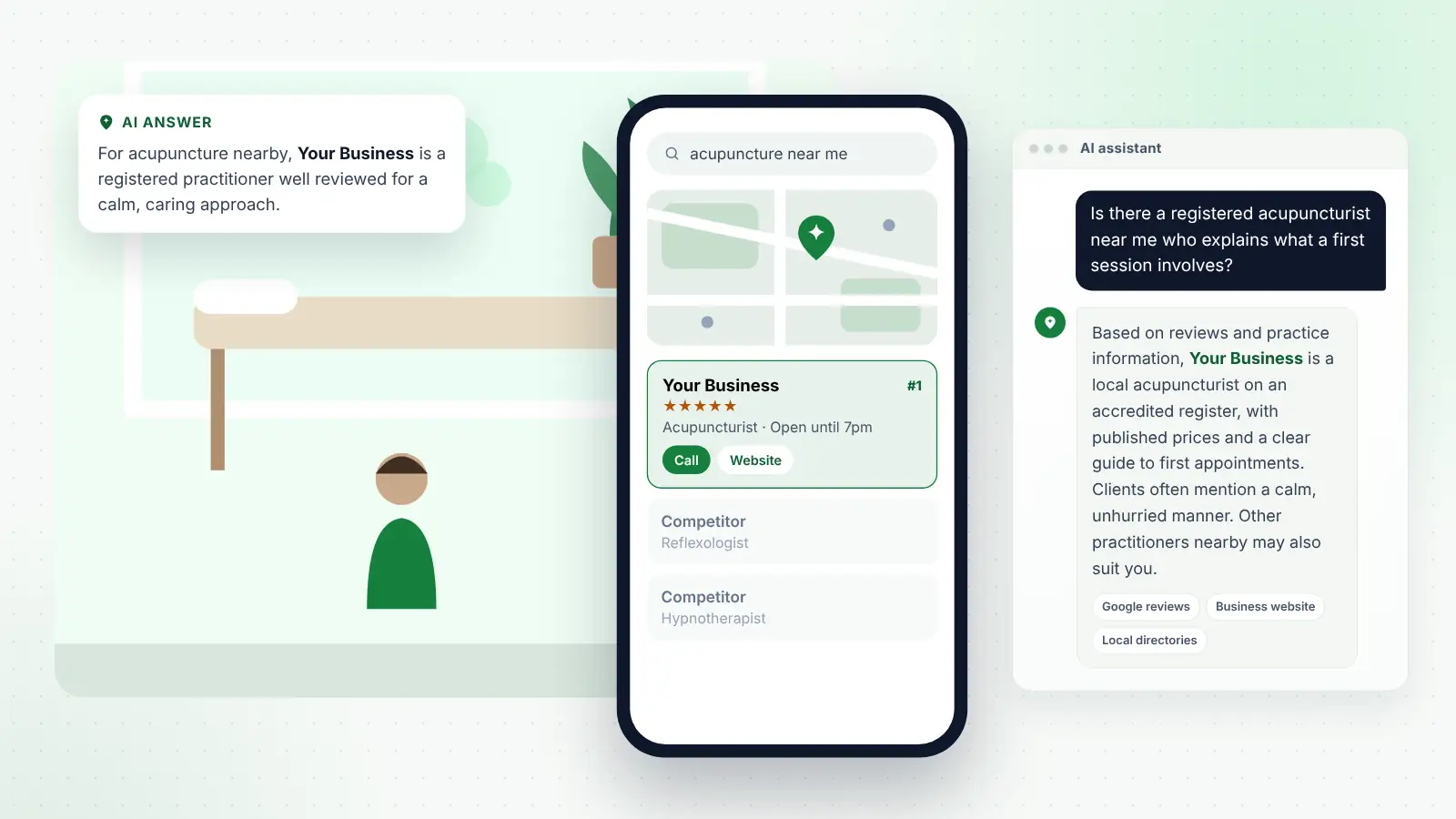
More people now ask an AI assistant before they book. Someone might ask ChatGPT “what happens at a first acupuncture appointment?”, ask Gemini for “a registered reflexologist near [town] who does evenings”, ask Perplexity “is hypnotherapy to stop smoking worth trying near me?” or ask Copilot “how do I check if an acupuncturist is qualified?”. Google’s AI Overviews also appear above many of these searches.
AI assistants form answers from what they can find and verify online. For a complementary therapy practice, that means:
- Clear session descriptions let an assistant explain what you do and what a first visit involves.
- Visible registration, on your site and in your register’s public directory, helps it describe you as a registered practitioner.
- Published prices and session lengths let it answer cost questions with your practice included.
- FAQs on needles, what to wear, pregnancy, home visits, gift vouchers and working alongside a GP give it accurate material to use.
- Reviews that describe the experience shape how it summarises you.
- Consistent details and mentions on reputable sites, including your register and partner pages, add independent confirmation.
This is often called answer engine optimisation, or AEO, and it fits the advertising rules well: accurate information about who you are and what a session involves is what an AI assistant needs, and what the ASA expects.
Frequently asked questions
Can I mention conditions on my website if clients ask about them?
Only within the CAP guidance for your therapy, which for most therapies means very few, if any. You can still answer questions such as “can I have reflexology while pregnant?” by explaining how you adapt a session, without suggesting the therapy treats anything.
Does being on an accredited register mean I can make more health claims?
No. Registration shows that you meet training, insurance and conduct standards, which is valuable for trust, but it does not change the evidence the ASA expects for health claims. CAP’s acupuncture guidance notes that the ASA has yet to consider whether practitioners on an accredited register are suitably qualified to refer to conditions that need medical supervision, so stay cautious.
Do I need a licence to practise from home?
It depends on your council, the therapy and whether clients come to you. Acupuncture in particular often needs registration or a licence for the practitioner and premises, so contact your council before you start.
How should I respond if a client wants to stop their medication?
Tell them to speak to their GP or prescriber before making any change, and record that you gave this advice. Never suggest that your therapy can replace prescribed treatment.
Final thoughts
Growing a complementary therapy practice responsibly comes down to a few habits: join an accredited register and show it, check your licensing, keep claims within CAP guidance, describe your sessions clearly and build relationships with professionals. Then make sure your online information reflects all of that consistently.
Do those things well and you give clients, referral partners, search engines and AI assistants good reasons to see you as a safe, professional choice.