Ask the owner of a busy independent garage where their work comes from and the answer is rarely advertising. It is the same few thousand cars, coming back for their MOT every year and a service somewhere in between, plus the repairs those visits uncover. A garage with a loyal base can plan its workshop weeks ahead. A garage without one spends its time chasing the next phone call and competing with fast-fit chains on price.
The difference between the two is not luck or location. It is a set of habits: reminding people at the right time, making servicing affordable to budget for, showing customers exactly what their car needs, answering the “will it affect my warranty” question with confidence, being ready for hybrids and EVs, and planning for the months when the phone goes quiet.
This guide is for garages that are already trading and want more of their customers to come back. It covers each of those habits in turn, along with how Google and AI assistants now influence which garage a driver books with for their next MOT.
Key points
- The annual MOT is your most valuable appointment, because it is the one visit almost every driver has to make, and it leads to servicing and repair work.
- Drivers can already get a free MOT reminder from GOV.UK, so your reminder has to add something: a booking slot, a combined MOT and service, or a reason to choose you.
- Photo and video health checks, with work graded by urgency, build trust faster than anything you can say at the reception desk.
- Many owners of newer cars still believe they must use a dealer to protect their warranty. Explaining the real position clearly wins work from cars that would otherwise never reach you.
- MOT demand follows the March and September registration plate cycle, so quiet months are predictable and can be planned for.
- Clear service pages, detailed reviews and consistent details help you appear on Google Maps and in AI assistant answers when drivers look for a garage they can trust.
In this guide
- Why the MOT is the front door of your business
- MOT reminders that people actually act on
- Service plans: helping customers budget for maintenance
- Show the work: photo and video health checks
- The dealer myth: servicing newer cars at an independent
- EV and hybrid servicing: get ahead of the dealer assumption
- Quiet months: plan around a predictable cycle
- Local SEO for garages: be the one drivers find and trust
- AI search: what an assistant says when asked about your garage
- Frequently asked questions
- Final thoughts
Why the MOT is the front door of your business
In Great Britain, most cars need their first MOT by the third anniversary of registration and then every year. That makes it the closest thing a garage has to guaranteed repeat demand. The MOT itself, with its legally capped maximum fee, is rarely where the profit is. Its value is what it leads to: the service you book alongside it, the brake pads it flags, the tyres on the advisory list, and the trust that makes the customer ring you, not a chain, when a warning light comes on in November.
It helps to think in terms of the lifetime of a customer rather than the value of a single visit. A driver who books their MOT with you each year, services the car with you and brings their next car too might be worth many times the value of one test over the years they own it. That is why discounting MOTs heavily to attract new faces rarely works on its own. Discount hunters move on next year. The garages that grow treat each first MOT as the start of a relationship and put their effort into the second and third visits.
Three numbers are worth tracking in your garage management system, even roughly:
- MOT retention. Of the cars you tested last year, how many came back this year?
- Service attachment. What share of MOT customers also book a service with you?
- Advisory conversion. When you flag work as an advisory or amber item, how often is it booked with you within a few months?
You do not need perfect data. Even a rough sense of these figures shows where customers are slipping away.
MOT reminders that people actually act on
Most garage software sends MOT reminders, and most garages switch them on and forget them. The problem is that drivers increasingly receive several: one from the government’s free MOT reminder service, one from their insurer or a car app, and sometimes one from a garage they used once three years ago. A generic “your MOT is due” message from you is easy to ignore.
Your reminder needs to do something the others do not.
Make it easy to say yes
The most effective reminders include a specific offer of time: “Your MOT is due on 14 March. We have slots on 3, 4 and 7 March. Reply with a date or book online.” A reply-to-book text removes the effort of phoning during working hours, which is often the real reason people put it off.
Use the early testing rule
Drivers can have an MOT up to a month (minus a day) before their current certificate runs out and keep the same renewal date. Many do not know this. Mentioning it in your reminder lets you spread bookings into quieter weeks and stops customers leaving it until the last day, when you may be full.
Combine visits
Suggest an MOT and service together when the timing fits. Customers save a trip, and you get a longer, more profitable job booked weeks in advance. If the service is not due, say so. Recommending only what is needed is part of what keeps people loyal.
Get the timing and sequence right
A sensible pattern for many garages is a first reminder around four to five weeks before the due date, a follow-up a fortnight later if there is no response, and a final short message a week before. After that, stop. Repeated messages to a customer who has gone elsewhere damage goodwill and can breach your obligations under data protection and electronic marketing rules if they have opted out.
Tip
Ask every new customer at the desk how they prefer to be reminded: text, email or phone. A reminder sent the way someone actually reads messages is worth three sent the way your software defaults to.
Service plans: helping customers budget for maintenance
Main dealers have used monthly service plans for years. Independents can offer them too, and they do two useful things: they spread the cost for the customer, and they make it far more likely the car comes back to you rather than going elsewhere when the service is due.
A simple plan usually covers:
- An annual service at the level the car needs, following the manufacturer’s schedule.
- The MOT, booked at the same time where possible.
- Sometimes extras such as a winter check, a discount on labour or free brake fluid tests.
The customer pays a fixed monthly amount by direct debit, and you know that car will be in your workshop each year.
Points to think through before you launch one:
- Keep it to maintenance. A plan that pays for routine servicing is straightforward. Once a plan starts promising to pay for unexpected repairs or breakdowns, it may start to look like insurance or a warranty product, which brings regulation. If you want to include anything beyond planned maintenance, take advice first.
- Price it honestly. The monthly cost should be clearly explained against the cost of paying per visit. Customers who later feel they paid more than they would have otherwise do not stay.
- Set clear terms. What happens if they sell the car, move away or miss payments? How much notice do they give to cancel? Write it in plain English.
- Handle the money carefully. Customers are paying in advance for work you have not yet done. Keep good records of what each customer has paid and what they have received.
Plans suit garages with a stable customer base and good admin. If your reminder system is not working yet, fix that first.
Show the work: photo and video health checks
The single biggest worry drivers have about garages is being sold work they do not need. They cannot see under the car, they do not know what a worn bush looks like, and they have heard stories about long lists of “urgent” repairs.
Short video health checks, sent to the customer’s phone while the car is on the ramp, answer that worry directly. The technician films the brakes, tyres, suspension and anything else of note, explains what they are seeing, and the customer receives a link with the video and a list of recommendations. Several garage software providers now build this in, but a phone and a simple process is enough to start.
Grade the work by urgency
Most garages that do this well use a simple traffic-light system.
| Grade | What it means | What the customer sees | How to follow up |
|---|---|---|---|
| Red | Unsafe or a likely MOT failure | Clear video and a written explanation of the risk | Ask for authorisation before any work starts |
| Amber | Wearing, will need attention soon | Measurement or photo with an estimate of remaining life | Add to their record and remind them in a few months |
| Green | Checked and in good condition | Short confirmation it was inspected | Mention it in the summary so they know it was looked at |
The green items matter more than they appear. When a customer sees that you checked their brakes and told them they were fine, they trust you when you later say something does need doing.
Make authorisation easy
Never carry out additional work without the customer’s agreement. A health check link with an “approve” button, or a quick call with the video already in their hand, gets faster decisions than a technician trying to describe a CV boot over the phone. Keep a record of what was approved and when.
Use the MOT history
Drivers, and anyone buying a car, can look up a vehicle’s MOT history online, including advisories. Your amber items and MOT advisories should tell the same story. If the MOT notes an advisory, explain it in plain English on the invoice so the customer understands what it means for next year.
Tip
Ask technicians to say the registration number at the start of each health check video. It reassures the customer that the video really is their car, and it removes any doubt if questions come up later.
The dealer myth: servicing newer cars at an independent
Many owners of cars under three years old assume that if they go anywhere but the main dealer, their manufacturer warranty will be void. This belief sends a lot of work to dealers that independents could do, and it is often the first thing a new customer asks.
UK competition law, which includes specific rules for the motor sector overseen by the Competition and Markets Authority, is designed to keep the servicing and repair market open to independent garages. In general, a manufacturer cannot refuse to honour its warranty simply because routine servicing was done by an independent, provided the work follows the manufacturer’s schedule and uses parts of matching quality. The exact terms are in each manufacturer’s warranty booklet, and customers should always check theirs.
What you should be clear about with customers:
| What owners often believe | The practical position |
|---|---|
| “Only the dealer can service my car under warranty” | Independents can generally carry out routine servicing, provided they follow the manufacturer’s schedule and use suitable parts |
| “Any non-genuine part voids everything” | Parts of matching quality are generally acceptable for servicing, but check the warranty terms |
| “The independent can do my warranty repair” | Repairs covered by the warranty are carried out free by the manufacturer’s network, so the customer should go there for those |
| “Recalls will be missed if I leave the dealer” | Recalls are handled by the manufacturer’s network regardless of where the car is serviced, and you can check for outstanding ones |
| “My service history will not count” | A properly recorded service, with the manufacturer’s schedule followed, still forms part of the car’s history |
To win this work, you need to show that you do it properly:
- Follow the manufacturer’s service schedule for that specific model and record what was done in detail.
- Use correct-specification oils and fluids, and keep the part numbers on the invoice.
- Update the digital service record where the manufacturer allows independent access, or provide a clear printed record.
- Check for any outstanding recalls and tell the customer if one needs doing at a dealer.
Put a page on your website that explains this calmly. It is one of the most useful pages an independent garage can have.
EV and hybrid servicing: get ahead of the dealer assumption
Hybrid and electric cars bring a second version of the dealer myth: “I assumed only the dealer could touch a hybrid.” For a garage with properly trained staff, that assumption is an opportunity. Owners of older hybrids, in particular, are often well out of warranty and looking for a cheaper, friendlier alternative.
The work is different. EVs have no oil changes, but they still need brakes, tyres, suspension, cabin filters, coolant for battery thermal systems and checks on high-voltage components. Brakes on EVs and hybrids are often used less because of regenerative braking, which can lead to corrosion and seized parts rather than wear. Tyres can wear faster on heavier cars. Explaining these differences shows the customer you understand their car.
Practical steps:
- Train to the right level. The IMI’s TechSafe standards are widely used to show the level of high-voltage competence each technician holds. Make sure anyone working on these cars is trained for the tasks they carry out.
- Equip properly. Insulated tools, PPE, a designated bay and clear isolation procedures.
- Publish what you do. Name the makes and models you regularly service and the work you can and cannot do. “We service Toyota and Lexus hybrids, including hybrid system health checks” is far more useful than “EVs welcome”.
- Set a fair EV service price. EV services involve less work in some areas and more checks in others. Price them clearly so customers do not assume they are paying for an oil change they do not need.
Quiet months: plan around a predictable cycle
Many garages treat quiet spells as bad luck. In fact, a large part of MOT demand is predictable, because new registrations peak in March and September when the registration plates change. Three years later, those cars arrive for their first MOT. Add the post-Christmas squeeze on household budgets and the August holiday period, and the shape of the workshop year becomes clear.
| Period | What usually happens | What to do |
|---|---|---|
| January–February | Tight budgets after Christmas, some cold-weather breakdowns | Promote MOT early testing, battery checks and spread-the-cost service plans |
| March | Plate-change MOT peak for three-year-old cars | Fill early with reminders sent in late January and February |
| April–June | Steady, with pre-holiday checks | Push air conditioning servicing and pre-holiday health checks |
| July–August | School holidays, customers away | Target local businesses and fleet work; offer collection and delivery |
| September | Second plate-change MOT peak | Book ahead, as in March |
| October–December | Winter preparation, dark evenings | Winter checks on batteries, lights, tyres and wipers |
Ways to smooth the quieter weeks:
- Business and fleet accounts. Local firms with vans, tradespeople and taxi operators need predictable servicing and are often happy to book into your quiet weeks.
- Collection and delivery. Collecting cars from workplaces fills slots with customers who would not otherwise come in.
- Amber item follow-ups. The advisories and amber items you recorded months ago are a ready list of genuine, needed work. A polite message saying “We noted your rear tyres were at 3mm in March; they may be worth checking now” is helpful, not pushy.
- Early MOTs. Use the month-minus-a-day rule to pull March and September bookings into the weeks either side.
Local SEO for garages: be the one drivers find and trust
When a driver needs an MOT, they usually search on their phone: “MOT near me”, “MOT and service [town]”, “garage open Saturday near me”, “hybrid service [town]” or “independent Audi service near me”. Google shows a map with a short list of garages, and many drivers choose from that list based on distance, reviews and what the listing says.
For an independent, this is where you compete directly with dealers and national chains. A well-maintained profile with detailed reviews can sit above a much bigger business.
Google Business Profile
- Choose the most accurate primary category, and add secondary categories such as MOT testing where they genuinely apply.
- List each service separately: MOT, interim and full service, diagnostics, air conditioning, hybrid and EV servicing, warranty-friendly servicing.
- Keep opening hours accurate, including Saturdays and bank holidays.
- Add real photos of the workshop, team and waiting area, and short clips from health checks with customers’ permission and registration plates obscured where appropriate.
- Post occasional updates, such as early MOT reminders before the March and September peaks.
Reviews that talk about brakes, warranties and honesty
Ask for a review when you send the invoice or the health check summary, with a direct link. Reviews that mention specific things, such as “they sent a video of my brakes”, “serviced my new car without affecting the warranty” or “honest about what could wait”, are exactly what the next nervous driver is looking for. Answer each one, even the driver unhappy about an MOT fail, with a calm reply that addresses what actually happened to their car. Never offer incentives for positive reviews or write fake ones.
Matching garage details on every listing
Your business name, address and phone number should match exactly across your website, Google profile, The Motor Ombudsman listing if you are accredited, parts supplier garage finders and directories. Inconsistencies confuse both customers and search engines.
Service and area pages
Give each main service its own page on your website, with guide prices, what is included and how to book. The pages that tend to matter most for retention-focused garages are MOTs, servicing (with your service levels explained), servicing under warranty, hybrid and EV servicing, and service plans. Area pages for nearby towns help if you genuinely serve them, especially with collection and delivery.
Local links
Links from local business groups, sports clubs you sponsor, local news and supplier directories show Google you are an established local business. A handful of relevant links is better than many weak ones.
All of this builds over three to six months. If you would rather spend that time in the workshop, you can have specialists in local SEO for car garages and MOT centres look after your profile, reviews and service pages each month.
AI search: what an assistant says when asked about your garage
Drivers increasingly ask AI assistants before they search, and their questions are often the exact worries this guide covers:
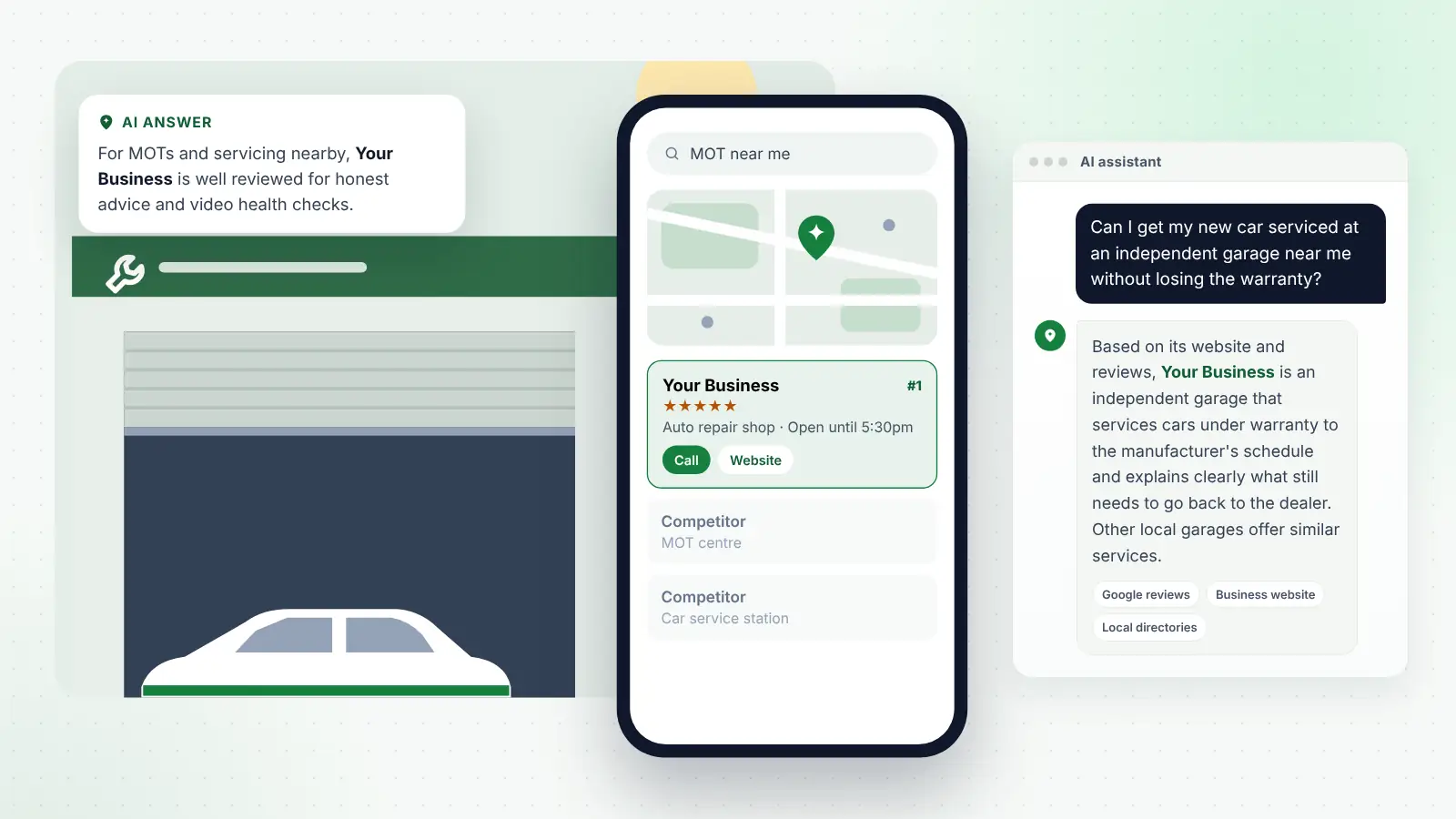
- “Can I get my new car serviced at an independent garage without losing the warranty?”
- “Which garage near me is good for a hybrid service?”
- “Is there an honest garage in [town] that sends videos of the work?”
- “When can I get my MOT done early?”
ChatGPT, Gemini, Perplexity, Microsoft Copilot and Google’s AI Overviews all answer questions like these. When they recommend specific garages, they rely on information they can find and cross-check: your website, Google profile, reviews across platforms, accreditation listings and mentions on local sites.
What that means in practice:
- Answer the warranty question on your website. A clear, accurate page about servicing cars under warranty is exactly what an assistant summarises when a driver asks.
- Describe your process. Explain your health checks, how you grade work and how you ask for authorisation. That gives AI tools evidence that you are transparent.
- Be specific about EV and hybrid work. Name the makes, the training and the services you offer.
- Keep details consistent. Your hours, services and accreditations should read the same everywhere.
- Build an FAQ. Early MOTs, how long a service takes, whether you offer courtesy cars, how service plans work. Short, honest answers help customers and assistants alike.
AI recommendations cannot be guaranteed or bought, but a garage whose information is clear, consistent and backed by detailed reviews gives these tools far more to work with.
Frequently asked questions
How far in advance should I send MOT reminders?
A first reminder around four to five weeks before the due date works well for many garages, with a follow-up a couple of weeks later. Because drivers can test up to a month (minus a day) early and keep their renewal date, earlier reminders also help you fill quieter weeks.
Do I need to tell customers about the warranty position?
It is worth doing, because many owners of newer cars assume they must use a dealer. Explain that independent servicing to the manufacturer’s schedule, with suitable parts, generally keeps the warranty intact, that warranty repairs and recalls go through the manufacturer’s network, and that they should check their own warranty booklet.
Are service plans worth it for a small independent garage?
They can be, if your admin and reminders are already working well. Keep plans to planned maintenance, price them transparently and set clear terms for cancellation and selling the car. Take advice before including anything that pays for unexpected repairs.
Will video health checks slow the workshop down?
There is a short learning curve, but a quick video usually saves time on phone calls explaining work and gets faster decisions from customers. Keep videos short and focused on the items that matter.
How can I fill the workshop in January and August?
Plan for them. Promote early MOTs, follow up amber items recorded earlier in the year, offer collection and delivery, and build business and fleet accounts that can book into quieter weeks.
Final thoughts
A loyal MOT and service base is built one visit at a time. Send reminders that make booking easy, give customers a way to budget, show them their own car, explain the warranty position honestly and be ready for the hybrids and EVs arriving on your ramps. Then make the same evidence visible online, through your Google profile, reviews and service pages, so that the next driver searching for an honest local garage has a good reason to choose you. Garages that do these things consistently tend to find their workshop diary becomes steadier and easier to plan, year after year.