Most beauty salon menus grow by accident. A therapist trains in something new, a client asks for a treatment you used to do, a supplier offers a course with a starter kit, and before long the menu runs to three pages. Some of those treatments are booked every day. Others have not been booked for months but still take up shelf space, training time and a line on your insurance schedule. A few are quietly losing money every time they are performed, because nobody has costed them since the product price went up.
A well-designed treatment menu works the other way round. It is built deliberately around a handful of treatments you are known for, priced from real costs, supported by add-ons, courses and retail that make sense to clients, and presented so that people can find, understand and book what they want without phoning you. It is also safe: every treatment is covered by training, insurance and a clear patch test and consultation policy.
This guide is for beauty salons that are already trading and want a menu that is easier to sell, more profitable and ready for the proposed changes to aesthetics regulation in England. It also covers how your menu shapes the way clients find you on Google and through AI assistants.
Key points
- Give every treatment on your menu a job — hero, maintenance, entry point or add-on — and remove anything that does not earn its place.
- Price each treatment from its real cost per hour, including product, room time and overheads, then check it against what local clients will pay.
- Courses and memberships build loyalty, but they need clear terms, and new subscription rules under the DMCC Act are expected to apply from January 2027.
- A written patch test policy, followed for every relevant treatment, protects clients and keeps your insurance valid.
- Before adding any new treatment, check training, insurance, council licensing and, for aesthetics, the government’s proposed restrictions on high-risk procedures in England.
- Clients search by treatment name, so a clear online menu with a page per main treatment is the foundation of your local and AI search visibility.
In this guide
- Give every treatment a job
- Cost each treatment properly
- Build your menu around hero treatments
- Use add-ons and upgrades sparingly
- Courses, packages and memberships
- Retail that supports the menu
- Patch tests and consultation policies
- Adding new treatments responsibly
- Review your menu and prices every year
- Presenting your menu online
- Local SEO: turning your menu into searches you appear for
- AI search: how assistants match clients to treatments
- Frequently asked questions
- Final thoughts
Give every treatment a job
Start by printing your menu and your booking report for the last six months side by side. For each treatment, note how often it was booked, how long it takes, roughly what it costs you to deliver and whether clients who have it tend to come back. Then decide what job it does for the salon.
| Menu role | Typical examples | How to price it | Watch out for |
|---|---|---|---|
| Hero treatment | Signature facial, lash extensions, brow lamination | Confident, value-based pricing that reflects expertise | Being discounted to compete with cheaper salons |
| Maintenance | Infills, tints, waxing, gel removal and reapply | Steady, fair pricing with rebooking at checkout | Running late and losing margin on short slots |
| Entry point | Brow shape, express facial, mini manicure | Accessible price to win new clients | Becoming the only thing clients ever book |
| Add-on | Lash tint with lift, hand mask, LED upgrade | Small, clearly priced extras | Too many options slowing down booking |
| Course or package | Facial or skin treatment courses, waxing bundles | Modest saving for commitment, paid upfront or in stages | Unclear terms on expiry and refunds |
Anything that does not fit a role, or that is booked a handful of times a year, is a candidate for removal. Cutting a slow treatment frees training budget, stock and space on the menu for the treatments you want to be known for. A focused menu is also easier for clients to understand than a long one.
Cost each treatment properly
Many salons set prices by looking at competitors, then adjust when something feels wrong. A more reliable method is to know your cost per treatment room hour and build up from there.
- Work out your hourly overhead. Add up rent, rates, utilities, insurance, software, cleaning, laundry, card fees and any other fixed costs for a month. Divide by the number of hours your treatment rooms are realistically booked, not the hours you are open.
- Add the therapist cost. For employed therapists, include wages, employer National Insurance, pension contributions and holiday pay per hour. For commission, use the commission percentage.
- Add product and consumables. Include the real cost of products, disposables, wax, pads and single-use items for each treatment.
- Include the whole appointment. A 45-minute facial often occupies the room for an hour once you include consultation, set-up and cleaning down.
- Set your target margin. Decide what profit each hour should make, then check whether the price still sits sensibly against local competitors.
If your turnover is approaching the VAT registration threshold, currently £90,000 of taxable turnover in a rolling 12 months, factor VAT into your pricing plans early. Salons that register suddenly, without having adjusted prices, can find much of their margin disappears. Your accountant can help you plan for it.
Tip
Recost your top ten treatments every time a key supplier raises prices. A small product increase on a treatment you do forty times a month adds up quickly.
Build your menu around hero treatments
A hero treatment is the one people mention when they recommend you. It might be a signature facial, natural-looking lash extensions, brow work or a specialist waxing service for first-timers. It should be something you do consistently well, that clients can describe in a sentence, and that brings in clients who also book other things.
To make a treatment a hero:
- Name it clearly. A name that says what it is, such as “Signature Hydrating Facial (75 minutes)”, is easier to search for and book than a purely branded name.
- Train everyone to the same standard. If clients only want one therapist, it is a personal following rather than a salon hero.
- Put it first. Lead your website menu, Google profile services and social content with it.
- Collect proof. Ask clients who had the treatment for a review that mentions it, and keep a gallery of genuine, unedited results with consent.
- Price it with confidence. Hero treatments should not be your cheapest offer. Clients choosing them are buying expertise and results.
Use add-ons and upgrades sparingly
Add-ons raise the average spend without needing more clients, but too many make booking confusing. Two or three well-chosen extras per treatment group is usually enough, for example a tint with a lash lift, a paraffin treatment with a manicure or an LED upgrade with a facial.
Price add-ons clearly and keep them genuinely optional. Make sure the extra time is built into the appointment length in your booking system, or you will run late for the rest of the day.
Courses, packages and memberships
Courses and memberships encourage regular visits and smooth out cash flow. They also create obligations, because clients have paid for services you have not yet delivered.
Courses and prepaid packages
Treatment courses, such as a series of skin treatments a few weeks apart, are common and useful where the treatment genuinely works better as a course. Keep the terms simple and visible:
- What is included, how many sessions and the recommended interval.
- How long the course remains valid, and what happens if the client is unable to continue for medical reasons.
- Whether sessions can be transferred to another person or another treatment.
- What refund applies if the client cancels part-way through, and what happens if your salon closes or the therapist leaves.
Consumer terms must be fair and transparent under the Consumer Rights Act 2015. A short expiry date or a blanket “no refunds” line on an expensive prepaid course is the kind of term that causes complaints. Keep a record of sessions used so you can account for remaining value accurately.
Memberships and subscriptions
Monthly memberships, such as a set number of treatments or a discount on maintenance services in return for a monthly payment, can work well for maintenance-heavy menus. If you run one, be aware that the Digital Markets, Competition and Consumers Act 2024 introduces a new regime for consumer subscription contracts. The government has said it expects the rules to apply from January 2027. They include clear information before sign-up, reminders, a cooling-off period and making it straightforward for clients to cancel. If you are designing or relaunching a membership now, build it around those principles from the start and check the latest official guidance before launch.
Retail that supports the menu
Retail works best when it follows from the treatment. A client who has just had a facial and been shown how to use a cleanser at home is far more likely to buy than one browsing a shelf. Choose a small range that matches your hero treatments, make sure therapists use and understand it, and recommend it as aftercare rather than as a sales add-on.
Keep stock tight, check expiry dates, and make sure your insurance includes product liability if you sell retail. If you sell products on your website, standard online selling rules apply, including the right for consumers to cancel most distance purchases.
Patch tests and consultation policies
Patch tests are part of the menu, not an inconvenience to hide. Many tints, lash and brow products, lash adhesives and some skin products carry manufacturer instructions to carry out a sensitivity or patch test before treatment, often 24 to 48 hours beforehand, and to repeat it at intervals or if the client’s health changes. Insurers commonly require you to follow those instructions and keep records.
A clear policy covers:
- Which treatments need a test, based on the instructions for each product you use.
- When the test must be done before the treatment, and how often it needs repeating for existing clients.
- How it is recorded, including date, product, area tested, result and the client’s confirmation.
- What happens if a client declines. Many insurers will not cover a treatment if a required test was refused, so your policy should say you will not proceed.
- How clients book it. A free, quick patch test appointment listed on your online menu removes friction and avoids clients turning up untested.
Pair this with a consultation form for every new client, updated regularly, covering allergies, medication, skin conditions and pregnancy where relevant.
Adding new treatments responsibly
New treatments keep a menu fresh, but each one brings training, insurance, equipment and sometimes licensing obligations. Before adding anything, work through a short checklist.
- Training. Choose accredited training that your insurer recognises, rather than a short course bundled with a product kit. Keep certificates on file for every therapist who performs the treatment.
- Insurance. Confirm in writing that the treatment is named on your policy before you take a booking.
- Council licensing and registration. Skin piercing treatments, including semi-permanent make-up, microblading, electrolysis and ear piercing, usually need council registration in England, while Wales and Scotland run their own licensing schemes. Most London boroughs also license a wider range of special treatments, including massage, manicure, electrical treatments and lasers. Some councils regulate other skin-penetrating treatments locally, so ask before you start.
- Equipment and premises. Check ventilation, hygiene, waste disposal and any room requirements for the treatment.
- Demand and fit. Ask whether the treatment supports your hero services and your clients, or whether it simply looks good on a supplier’s flyer.
Aesthetics and England’s planned rules
If you are thinking about non-surgical cosmetic procedures, take extra care. The Health and Care Act 2022 gave the government powers to introduce a licensing scheme for non-surgical cosmetic procedures in England. On 21 October 2026 the government published a consultation on restricting high-risk cosmetic and wellbeing procedures, which runs until 13 January 2027. It proposes that procedures such as deep chemical peels, certain laser and intense pulsed light treatments, non-resorbable facial fillers and intravenous drips should only be performed by specified healthcare professionals, such as doctors, dentists and independent prescribing nurses, at providers registered with the Care Quality Commission, and only for over-18s.
At the time of writing, these restrictions are proposals and are not yet in force, and no start date has been set. The government has also said that licensing of lower-risk high-street treatments will follow at a later stage. If any part of your menu involves lasers, peels, fillers or injectables, follow the consultation, speak to your insurer and trade body, and avoid investing heavily in equipment or training for treatments that may soon be restricted to healthcare professionals.
Some rules already apply. In England, it is illegal to give botulinum toxin injections or fillers for cosmetic purposes to anyone under 18. Botulinum toxin products are prescription-only medicines and cannot be advertised to the public, including on social media.
Review your menu and prices every year
Set a fixed point each year to review the whole menu. Remove treatments that are rarely booked, recost the rest and adjust prices where needed. Small, regular increases are easier for clients to accept than a large jump after several years.
When you raise prices, give regular clients notice, explain briefly that costs have risen, and honour existing bookings at the old price. Most loyal clients understand. If a treatment cannot be priced profitably at a level clients will pay, that is a sign it may not belong on your menu.
Presenting your menu online
Your online menu is often the first thing a potential client reads. If it is hard to find, out of date or vague about prices, they move on to the next salon.
- Show prices or clear starting prices. “From” prices are fine if you explain what changes the price, such as length or skin assessment.
- Include unavoidable fees in the price. Since April 2025, the DMCC Act has required mandatory fees, such as compulsory booking fees, to be included in the headline price shown to consumers.
- Describe each treatment honestly. Say what it involves, how long it takes, how long results last, aftercare and who it suits or does not suit.
- Follow advertising rules. The ASA expects claims to be backed by evidence and before-and-after images to be genuine and not exaggerated by filters or editing. Get written consent before using client photos.
- Keep the menu identical everywhere. Your website, Google profile services, booking system and social media should show the same names and prices.
Tip
Use the names clients actually type alongside your formal treatment names. “Brow lam”, “Russian lashes” and “hot wax” belong on your menu if that is what people search for.
Local SEO: turning your menu into searches you appear for
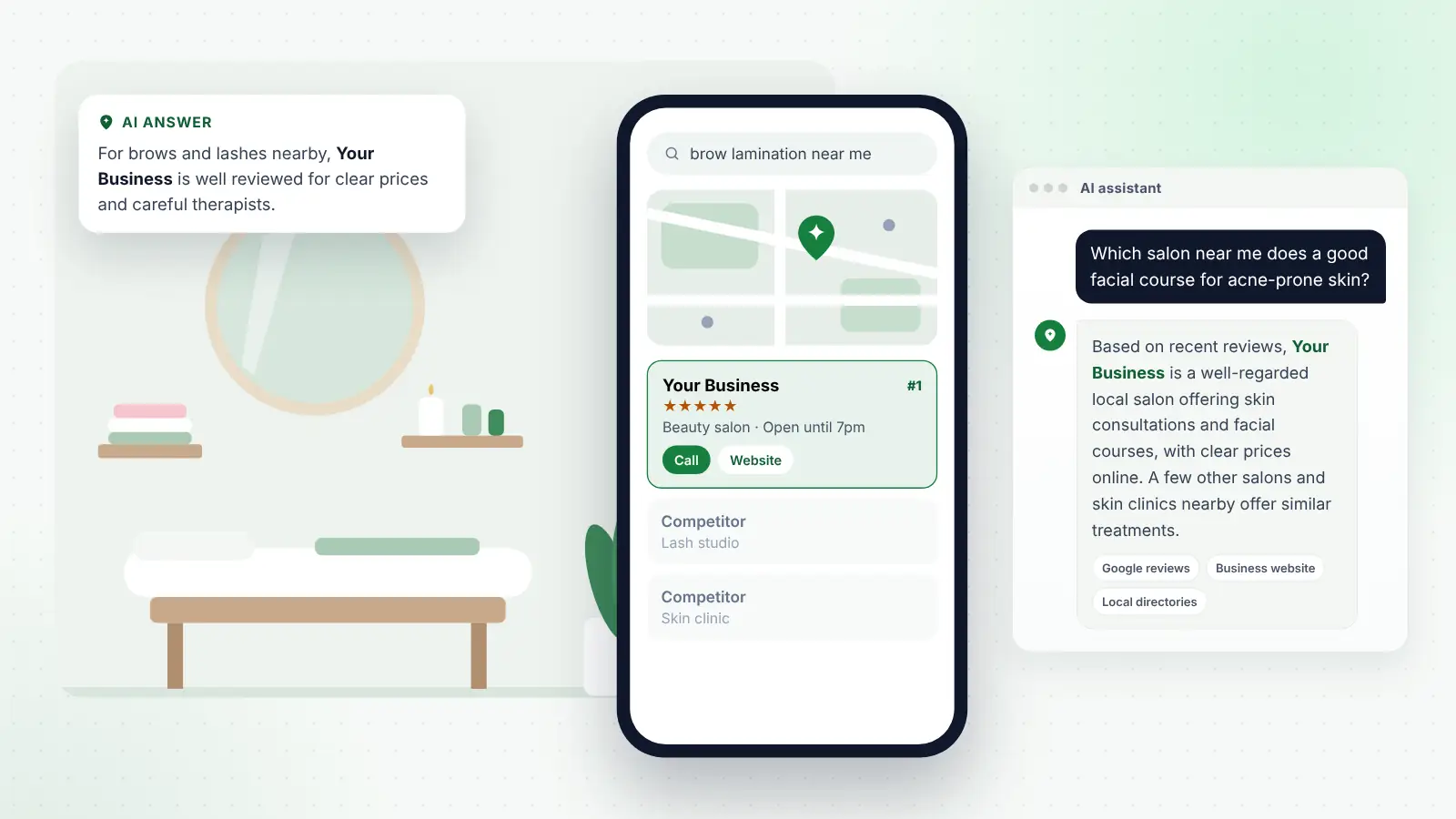
Very few people type the words “beauty salon” and stop there. They search for the treatment they want, usually on a phone and often with a timeframe in mind: “brow lamination near me”, “lash lift [town]”, “facial for acne [area]”, “Brazilian wax first time near me”, “gel nails open Sunday”. Your treatment menu is therefore your local SEO plan. Every hero treatment and maintenance service is a search that someone nearby is typing.
Google Maps results, with their photos, ratings and prices, usually appear before ordinary website results, and that is where most comparisons happen.
Put your menu on your Google Business Profile
Choose the most accurate primary category, such as “Beauty salon”, and add secondary categories only where they genuinely apply. Add each main treatment as a service with a description and price, link your booking page and post genuine photos of results and your treatment rooms. Keep hours and holiday closures accurate.
Reviews that name treatments
Ask clients for a review after a treatment they loved, ideally mentioning what they had. A steady flow of reviews that say “brow lamination”, “sensitive skin facial” or “first Brazilian wax” helps you appear for those searches and reassures people with the same need.
A page per main treatment
Give each hero treatment and main treatment group its own page on your website, covering what it is, how long it takes, price, aftercare, patch test requirements and common questions. These pages are what Google matches to specific searches, and they answer the questions that would otherwise come in by phone or message.
Matching menu details and a few local links
Keep your name, address, phone number, booking link and prices consistent across Google, Apple Maps, Bing, social media, booking platforms and directories. Earn a few genuine local links from a business association, a wedding directory, local press or a charity event you have supported.
Treatment pages and profile work pay off gradually, over three to six months. If you would rather focus on clients, specialist SEO for beauty salons and treatment studios can handle your profile, treatment pages, listings and links.
AI search: how assistants match clients to treatments
More people now ask AI assistants what to book and where. Someone might ask ChatGPT “Which salon near me does a good facial course for acne-prone skin?”, ask Gemini “Where can I get brow lamination in [town] that won’t damage my brows?”, ask Perplexity whether a lash lift is suitable for short lashes, or ask Copilot for a salon that patch tests before tinting. Google’s AI Overviews also summarise local options at the top of many searches.
To answer, these tools rely on information they can find and cross-check:
- Consistent treatment names, prices and details across your website, Google profile and booking platforms.
- Clear treatment descriptions, including who a treatment suits, how long results last and aftercare.
- Reviews that describe treatments and results in clients’ own words.
- FAQs answering real questions, such as how long brow lamination lasts or whether a patch test is needed.
- Mentions on reputable sites, such as local news, trade bodies and awards.
Shaping your menu so assistants can quote it is part of what is known as answer engine optimisation (AEO). A focused, clearly described menu gives AI tools something specific to recommend. A salon with a detailed page on its acne-friendly facial course, transparent terms and reviews that mention it is far easier to suggest for that question than one with a generic list. Keep claims accurate and measured, especially for skin treatments, because responsible, consistent information is more likely to be trusted and repeated.
Frequently asked questions
How many treatments should a beauty salon offer?
There is no right number, but most salons benefit from a shorter menu built around a few hero treatments, supporting maintenance services and a small number of add-ons. If a treatment is rarely booked and does not support your main services, consider removing it.
Should treatment prices go on the salon website?
In most cases, yes. Clear prices or starting prices reduce enquiries, help clients choose and build trust. Any unavoidable fees must be included in the price you display.
Are treatment courses a good idea?
They can be, where a treatment genuinely works better as a series. Keep terms clear on validity, transfers and refunds, and keep accurate records of sessions used.
Do I need a patch test for every treatment?
Not for every treatment, but many tints, lash and brow products and some skin products require one under the manufacturer’s instructions. Follow those instructions, record each test and check your insurer’s requirements.
Can I add laser or skin peels to my menu?
Possibly, depending on the treatment, your training, insurance and local licensing. The government is consulting on restricting certain laser treatments and deep chemical peels to qualified healthcare professionals in England, so check the latest position before investing.
Final thoughts
A profitable treatment menu is a set of deliberate choices: what you want to be known for, what each treatment costs, how clients move from an entry treatment to a regular routine, and how safely each service is delivered. Review it every year, keep it focused and price it from real numbers rather than from the salon down the road.
Then present it clearly everywhere clients look. A menu that is easy to understand on your website, your Google profile and your booking system helps clients book, helps search engines match you to the right searches and makes it easier for AI assistants to recommend you.