Starting a building company is a big step up from working as a tradesperson on someone else’s site. You are no longer responsible only for your own work. You become responsible for the whole project: the people on site, the safety of the homeowner’s family, compliance with building regulations, the programme, the budget and the finish.
That responsibility is also what makes a good building firm valuable. Homeowners planning an extension, loft conversion or renovation are often spending more than they have ever spent on anything except the house itself. They want a builder who is organised, honest about costs and timescales, and properly set up. If you can show them that, you can build a business that is not forced to compete on price alone.
This guide covers the practical steps to set up a building company in the UK, the legal duties that come with running projects, and how to build a steady pipeline of work.
Key points
- Decide early which projects you will specialise in, because it shapes your pricing, team, insurance and marketing.
- Building regulations apply to most extensions, loft conversions and structural work, and you need to understand your duties as a contractor or principal contractor.
- Under CDM 2015, a domestic client’s duties usually pass to the contractor or principal contractor, so on most home projects that means you.
- CIS will apply when you pay subcontractors for construction work, with registration, verification and monthly returns.
- FMB membership, TrustMark registration, insurance-backed warranties and clear written contracts all help homeowners trust you.
- Local SEO and AI search visibility help homeowners find and shortlist you during the months they spend researching a project.
In this guide
- Choose the type of building company you want to run
- Get the building firm’s foundations right
- Understand building regulations and building control
- Health and safety: CDM 2015 for domestic projects
- Paying subcontractors under CIS
- Insurance, contracts and warranties
- Memberships homeowners recognise
- Startup costs to plan for
- Pricing projects and managing cash flow
- Local SEO for builders: getting found by homeowners
- AI search: how homeowners now research builders
- Frequently asked questions
- Final thoughts
Choose the type of building company you want to run
“Builder” covers a huge range of work. Before you register a company or buy a van, decide where you want to compete.
- General building and small works: repairs, garden walls, small alterations and maintenance. Lower value, but a good way to build reviews and relationships.
- Extensions: single-storey and two-storey extensions, often the core of a domestic building firm.
- Loft conversions: specialist work with its own structural, fire safety and access challenges.
- Renovations and refurbishments: whole-house projects that may include structural changes, new kitchens and bathrooms, and full redecoration.
- New builds: higher risk, more capital needed and more complex warranty and regulatory requirements.
Many firms start with small works and extensions, then specialise as they build a reputation. Specialising makes it easier to price accurately, train your team and show customers a portfolio of similar projects.
Get the building firm’s foundations right
Choose a business structure
Some builders start as sole traders, but many building companies operate as limited companies. A limited company keeps business and personal finances separate and can be more tax efficient at higher profits. It also comes with more administration, including annual accounts and filings at Companies House. Speak to an accountant who understands construction before deciding.
Register with HMRC
You will need to register for the right taxes, which may include Corporation Tax or Self Assessment, PAYE if you employ people, and the Construction Industry Scheme. Once your VAT-taxable turnover goes over £90,000 in any rolling 12-month period you must register for VAT. Building projects are high value, so many building firms reach that threshold quickly. Plan for it from the start rather than being caught out.
Open a business bank account and use proper software
Keep the business finances completely separate. Accounting software that links to your bank, handles CIS deductions and produces professional quotes and invoices will save a great deal of time.
Understand building regulations and building control
Most extensions, loft conversions, structural alterations and many renovation jobs need to comply with the Building Regulations. These cover structure, fire safety, ventilation, drainage, energy efficiency, electrics and more. Planning permission is a separate matter; a project can be permitted development and still need building regulations approval.
Building control routes
Building work is checked by a building control body. In England, that can be your local authority building control team or a private registered building control approver. Since April 2024, building control professionals in England have had to register with the Building Safety Regulator as registered building inspectors, and private building control firms must register as registered building control approvers. In practice, this means you should check that whoever is inspecting your work is properly registered.
For domestic work, approval is usually sought through either a full plans application, where drawings are checked before work starts, or a building notice, which is quicker to set up but carries more risk if problems are found later. On larger or more complex projects, full plans approval usually gives everyone more certainty.
Dutyholder responsibilities
Since October 2023, the Building Regulations in England have set out duties for the people involved in building work, including clients, designers, contractors, principal designers and principal contractors. Contractors must plan, manage and monitor their work so that it complies, and must not start until they are satisfied the client is aware of their own duties. Where there is more than one contractor, a principal contractor coordinates the work for compliance. If you are the main builder on a home extension, that is likely to be you.
Make sure you or someone in your team understands these duties properly, keeps records of inspections and checks, and can demonstrate competence for the work you take on. If you work in Wales, Scotland or Northern Ireland, the system differs, so check with your local building control team.
Tip
Agree with the homeowner, in writing, who is responsible for submitting the building control application and paying the fees. Confusion over this is a common cause of delays and disputes at completion.
Health and safety: CDM 2015 for domestic projects
The Construction (Design and Management) Regulations 2015, known as CDM 2015, apply to all construction work, including work on people’s homes. For a building firm, the key point is what happens to the client’s duties when the client is a homeowner.
According to the HSE’s guidance for domestic clients, a domestic client’s duties normally pass to someone else:
- On a single-contractor project, the contractor takes on the client duties as well as their own.
- On a project with more than one contractor, the principal contractor takes on the client duties.
- If the homeowner has appointed a designer such as an architect on a project with more than one contractor, they can agree in writing for the designer to take on the client duties instead, as principal designer.
Because most extensions and renovations involve several trades, the builder running the job is very often the principal contractor and therefore responsible for the client duties too. In practice, that means planning the work, preparing a construction phase plan proportionate to the project, making sure welfare facilities are available, coordinating trades, managing risks such as working at height, excavations and dust, and keeping the homeowner and their family safe.
Larger projects may also need to be notified to the HSE. Check the HSE’s guidance on notification for the current criteria.
Paying subcontractors under CIS
As soon as you pay subcontractors for construction work, such as bricklayers, roofers, plasterers or groundworkers, you are likely to be a contractor under the Construction Industry Scheme.
As a contractor, you must register with HMRC, verify each subcontractor before you pay them, make the correct deduction from their payments, and send a monthly return to HMRC. HMRC’s CIS guidance sets the deduction at 20% for registered subcontractors, 30% for unregistered subcontractors, and 0% for those with gross payment status. Deductions are made from the labour element, not from materials the subcontractor has paid for directly.
CIS does not usually apply to the payments homeowners make to you for work on their own home. If you also subcontract for other builders or developers, you will be a subcontractor under the scheme on those jobs as well.
You should also check each worker’s employment status. Someone who works only for you, on your schedule, with your tools and under your direction may legally be an employee, whatever you both call the arrangement.
Insurance, contracts and warranties
Insurance
Typical insurance for a building company includes:
| Cover | What it protects | Notes |
|---|---|---|
| Public liability | Injury or damage to third parties and property | Many customers and trade bodies ask for proof |
| Employers’ liability | Claims from your employees | Generally a legal requirement if you employ staff |
| Contract works | The work in progress, materials and existing structure | Important on extensions and renovations |
| Plant and tools | Owned and hired equipment | Check cover for theft from vans and sites |
| Professional indemnity | Design advice you give | Relevant if you offer design and build |
Premiums vary widely by turnover, type of work and claims history, so get several quotes through a broker who understands construction.
Written contracts
Every project should have a written contract. It should set out the scope of work, drawings and specifications, price, payment stages, programme, how variations are agreed and priced, who handles building control, and what happens if there is a dispute. Industry-standard forms of contract for home building work are available, and some trade bodies provide their own.
If you agree a contract in the customer’s home, consumer law gives them a cancellation period, so make sure your contract and process cover this properly.
Warranties and guarantees
Insurance-backed warranties and deposit protection give homeowners reassurance that work will be put right, or deposits protected, if a builder ceases trading. Some trade bodies offer warranty products to members. New-build homes usually need a structural warranty for mortgage lenders, which is a more specialist requirement to research before taking on that kind of work.
Memberships homeowners recognise
Federation of Master Builders
The Federation of Master Builders (FMB) is one of the best-known trade associations for builders in the UK. According to the FMB’s joining information, membership is open to sole traders and small and medium-sized construction businesses with at least 12 months’ trading history. Applicants are vetted on trading and credit history, director checks for limited companies and proof of public liability insurance, and an assessor inspects one of their sites.
Because membership requires a trading history, a new company may need to wait before applying. Use that first year to build a portfolio, keep thorough records and collect reviews.
TrustMark
For extensions, refurbishments and other domestic building work, TrustMark is the quality scheme backed by the Government. Firms register through approved scheme providers, often trade associations, which check technical competence, trading practices and customer service. Many homeowners look for the TrustMark logo when choosing a builder.
Startup costs to plan for
Costs depend heavily on the type of work you take on and whether you buy or hire equipment. As a rough guide, these are the main areas to budget for:
| Item | What to consider |
|---|---|
| Vehicles | A van or tipper; used vehicles can keep early costs down |
| Tools and plant | Buy what you use daily and hire larger plant as needed |
| Insurance | Public and employers’ liability, contract works and tools |
| Company setup and accountancy | Formation, bookkeeping software and an accountant |
| Health and safety | PPE, welfare facilities, training and site signage |
| Marketing | Website, van signwriting, site boards and your online presence |
| Working capital | Enough to cover materials and wages before stage payments arrive |
Working capital is the item new firms most often underestimate. Even with stage payments, you will usually pay for materials and labour before the customer pays you.
Pricing projects and managing cash flow
Building projects can lose money quickly through underestimating, unclear scope or unpriced changes. A few habits protect your margin:
- Visit the site properly before pricing and note anything that could add cost, such as access, drainage or ground conditions.
- Price from drawings and a written specification wherever possible.
- Include clear provisional sums for items that cannot yet be priced accurately.
- Agree a written process for variations, with prices approved before work goes ahead.
- Set stage payments linked to clear milestones, such as foundations, wall plate, roof on and first fix.
- Review costs against your budget weekly, not just at the end.
Homeowners appreciate builders who are open about costs. Explaining what drives the price builds trust and makes you less likely to be compared on the total alone.
Local SEO for builders: getting found by homeowners
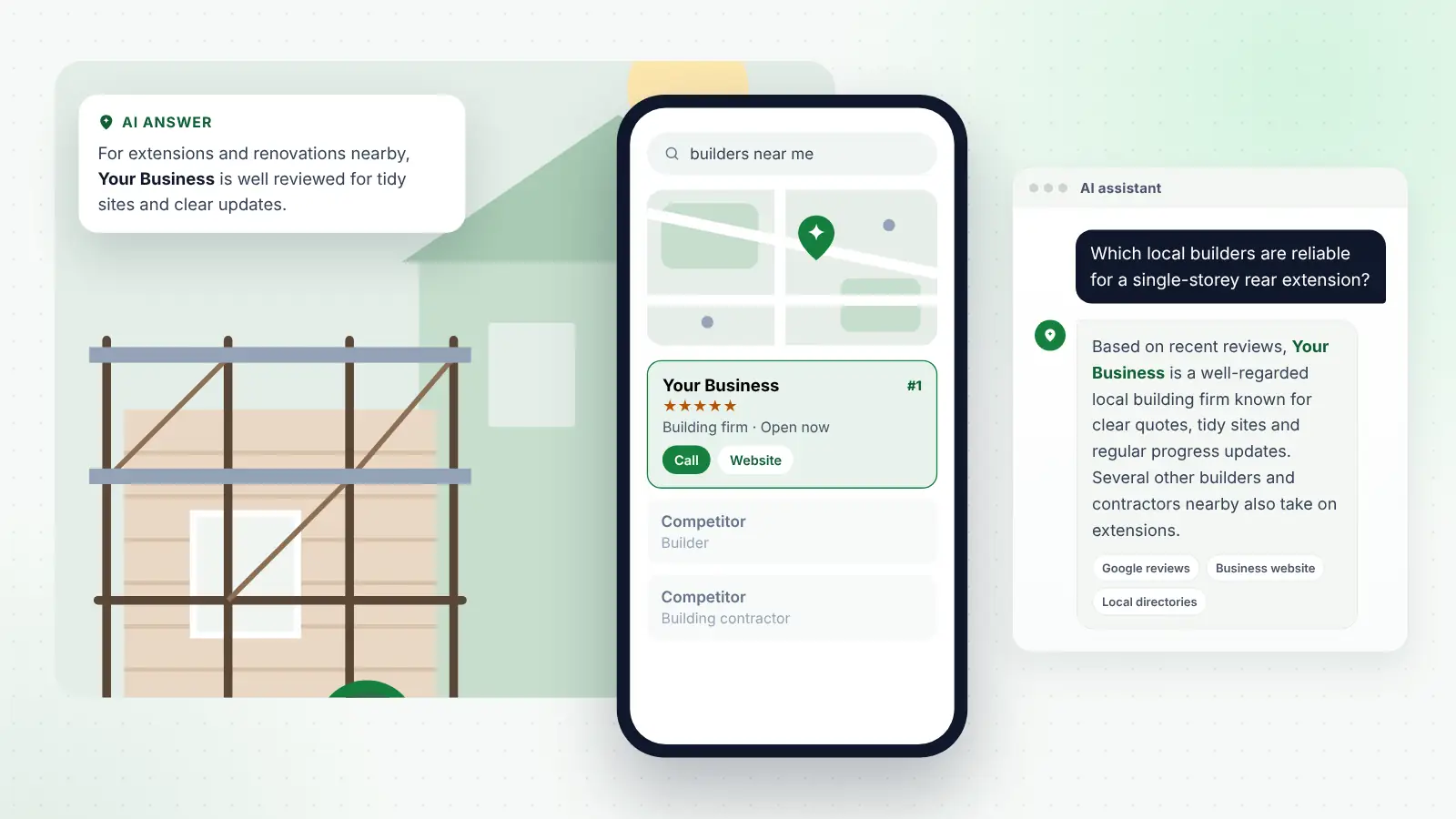
Homeowners usually start planning building projects months before work begins. They search for local builders, read reviews carefully and study photos of previous work before contacting anyone. Common searches include “builders near me”, “house extension builders [town]”, “loft conversion companies near me”, “single storey extension cost” and “local builder for small jobs”.
For many of these searches, Google shows a map with a short list of local businesses above ordinary results. Being on that list, with strong reviews and real project photos, is one of the most reliable ways for a building firm to generate enquiries.
Google Business Profile
Claim and verify your profile and choose an accurate primary category, such as Builder or Building firm. If you do not have an office customers visit, set it up as a service-area business with the towns you genuinely cover. List each type of project you do, from extensions to renovations, with a short description. Add photos at every stage of each project, not just the finished result, because progress photos show customers how organised and tidy your sites are.
Reviews that talk about the build itself
Building reviews are most persuasive when they describe the project and the experience: communication, tidiness, sticking to the programme and the quality of finish. Ask for a review at handover, when the customer is happiest, and make it easy with a direct link. Reply to every review professionally.
Consistent listings
Make sure your business name, phone number and service area are identical across your website, Google profile, trade body listings and directories. Inconsistencies can weaken how much search engines trust your details.
A website built around projects
Create a page for each main service, such as extensions, loft conversions and renovations, and include case studies with photos, a description of the work and roughly how long it took. Area pages for the main towns you cover, with genuine local project examples, help you appear in more specific searches.
Local links and mentions
Links from your trade body listing, suppliers, local business groups, architects you work with and local news coverage of community projects all help show that you are an established local firm.
Building visibility takes time, and results usually build over three to six months. Some builders handle all of this themselves; others prefer to hand it to a team that specialises in SEO for builders and building companies so they can stay focused on running sites.
AI search: how homeowners now research builders
More homeowners are now asking AI assistants such as ChatGPT, Gemini, Perplexity and Microsoft Copilot for help planning a project, and Google often shows an AI Overview above its normal results. Their questions are detailed: “Which builders near me are good at kitchen extensions?”, “How much does a single-storey extension cost in Bristol?”, “Do I need building regulations approval for a loft conversion?” or “What should I check before hiring a builder?”
An assistant can only recommend a builder it has reliable information about. For a building firm, that typically includes:
- Matching firm details on your website, Google profile, the FMB and TrustMark registers and local directories.
- Reviews that describe projects, communication and reliability.
- Clear service descriptions explaining exactly which projects you take on and where.
- Helpful FAQs on topics homeowners ask about, such as typical timescales, the building control process, payment stages and how you handle unexpected problems.
- Mentions on reputable sites, such as the FMB or TrustMark directories, local news and home improvement websites.
Because building projects involve so much research, the builder whose website explains the process clearly and honestly is well placed both with customers and with the AI tools that summarise information for them.
Tip
Write an honest guide on your website to how a typical extension project runs with you, from first visit to completion. It answers the questions homeowners ask most and gives AI assistants accurate information to draw on.
Frequently asked questions
Do I need qualifications to start a building company?
There is no single licence needed to call yourself a builder in the UK, but you must comply with building regulations, health and safety law and the specific registration requirements for work such as gas and certain electrical installations. Relevant qualifications and experience help you show competence, which the building regulations now expect from dutyholders.
Am I responsible for CDM duties on a homeowner’s extension?
Usually, yes. Under CDM 2015, a domestic client’s duties pass to the contractor on a single-contractor project and to the principal contractor where there is more than one contractor, unless the homeowner has agreed in writing for a designer to take them on.
Can a new building company join the FMB?
The FMB requires at least 12 months’ trading history, along with vetting checks and a site inspection. New businesses can get in touch early and apply once they qualify.
Who applies for building regulations approval, the builder or the homeowner?
Either can, and it varies between projects. What matters is agreeing it clearly in writing before work starts, along with who pays the fees and who arranges inspections.
When will a new building firm start getting enquiries from search?
A properly set-up profile and tidy listings can start to help within weeks, while dependable map and AI visibility tends to take three to six months, depending on how many builders compete locally. Extensions are often planned a season ahead, so the groundwork you lay now tends to fill your diary later in the year.
Final thoughts
A successful building company is built on organisation as much as craftsmanship. Understand your duties under the building regulations and CDM 2015, get CIS, insurance and contracts right from day one, and price projects in a way that protects your margin.
Then make your quality visible. Photograph every project, collect detailed reviews, join recognised schemes when you qualify and give homeowners clear, honest information online. Those steps help customers trust you before they meet you, which is often what wins the project.