Few people plan for the day a pet dies. Even when the end is expected, owners are often making decisions in a consulting room, holding a lead or a blanket, with only a few minutes to think. They want to know that their companion will be treated with dignity, that they will get the right ashes back if they ask for them, and that nobody is taking advantage of how they feel.
Independent pet crematoriums are often very good at offering that reassurance in person. But many owners never speak to the crematorium before they decide. The choice is made at the vet, or after a quick search on a phone, a glance at some reviews or a question put to an AI assistant. Growing a pet cremation service now means making your care, your standards and your honesty visible in those places too.
This guide is for owners of pet crematoriums, pet cemeteries and pet funeral services in the UK. It covers regulation, standards, honest cremation options, vets and the CMA’s new Order, home burial, horses, pricing, and how local search and AI assistants shape which crematorium an owner chooses.
Key points
- Owners choose a crematorium on trust: how their pet is cared for, whether ashes are genuinely their pet’s own, clear prices and what other local owners say.
- Pet crematoria need approval from the Animal and Plant Health Agency under animal by-products rules, and some incinerators may also need an environmental permit.
- APPCC membership involves following a code of practice, and it is a trust signal worth explaining.
- The CMA’s Veterinary Services Market Investigation Order 2026 will require vets to set out cremation options and prices clearly, including the option of arranging cremation directly with a crematorium.
- Describing individual and communal cremation plainly, without euphemism, protects owners and your reputation.
- A clear Google profile, consistent listings and plain answers to common questions help owners and AI assistants find and understand you.
In this guide
- How owners actually choose a pet crematorium
- The rules that apply to pet crematoria
- Standards owners can see: the APPCC and beyond
- Explaining individual and communal cremation honestly
- Working with vets, and what the CMA Order changes
- Home collection, home burial and the questions owners ask
- Horse and equine cremation
- Pricing, urns and memorials without pressure
- Local SEO for pet crematoriums
- AI search and pet cremation
- Reviews, remembrance and community
- Frequently asked questions
- Final thoughts
How owners actually choose a pet crematorium
Most owners have never arranged a cremation and do not know there are different types. What they notice is simpler:
- Whether they felt rushed. Pressure at a time like this is remembered.
- Whether they understood what they were agreeing to. Many owners assume all cremations return ashes.
- Whether they trust the identification of their pet. This is the question many are too upset to ask.
- Whether the price matched what they were told, with no surprises when the ashes come back.
Owners usually reach you through a vet practice, a personal recommendation or their own search. The vet route has traditionally been the largest, but the other two are where your online presence matters most.
The rules that apply to pet crematoria
Pet crematoria sit under animal health and environmental law rather than the rules for human crematoria.
Animal by-products approval
A pet’s body is classed as an animal by-product, and pets fall into the highest-risk category under animal by-products rules. A site that burns animal carcases needs approval from the Animal and Plant Health Agency (APHA). The government guidance on burning animal by-products at an incinerator site distinguishes low-capacity incinerators, which burn under 50kg per hour, from high-capacity ones, which have extra technical requirements.
Pet cemeteries have their own requirements too, so check with APHA and your council before opening one.
Environmental permits and planning
Depending on its size and what it burns, an incinerator may also need an environmental permit. In England and Wales, where a permit is needed for animal carcase incineration it is generally issued by the local council, with the Environment Agency involved for some larger or mixed-waste operations. In Scotland the Scottish Environment Protection Agency (SEPA) is the regulator, and in Northern Ireland it is the district council or the Northern Ireland Environment Agency. New sites will also usually need planning permission. If you are unsure which permits apply to your equipment, speak to APHA and your council’s environmental health team.
Tip
A short line on your website, such as “approved by the Animal and Plant Health Agency”, answers a worry many owners have about whether the industry is regulated.
Standards owners can see: the APPCC and beyond
There is no statutory licensing scheme specific to pet cremation in the UK, which is exactly why voluntary standards carry weight. The Association of Private Pet Cemeteries and Crematoria (APPCC) is a long-established trade body for independent pet crematoria and cemeteries, and there are other associations in the sector too. APPCC members follow a code of practice covering how pets are cared for and cremated, and the association draws a clear line between individual cremation, communal cremation and simple disposal. Check the association’s current membership requirements, including any inspection, before describing them to owners.
If you are a member, explain what that means in plain words rather than just showing a logo. Other visible standards owners value include:
- An open invitation to visit, by appointment, to see where pets are cared for.
- A farewell room where owners can sit with their pet before cremation.
- Clear ownership. Say whether you are independent, family-run or part of a group.
- Named people. A photo of who will collect and care for a pet helps enormously.
Explaining individual and communal cremation honestly
This is the heart of trust in pet cremation. Over the years there have been cases, some reported in the media and some prosecuted, where owners were told their pet would be cremated individually but this did not happen. They involved a small number of businesses, but they have left many owners anxious. The best response is plain description of exactly what each option involves.
| Option | What it usually means | Ashes returned | What to explain |
|---|---|---|---|
| Individual cremation | One pet cremated alone in the chamber | Yes, that pet’s own ashes | How the pet is identified from collection to return |
| Attended or witnessed cremation | Individual cremation with the owner present or nearby | Yes | Timings, the farewell room and what the owner will see |
| Communal cremation | Several pets cremated together | No | Where the ashes are scattered or laid to rest |
| Disposal | Not a cremation service in the sense owners expect | No | Be honest if any service you or a partner offers is this |
If you offer anything other than one pet per cremation, such as a partitioned process, say so clearly and do not call it individual.
Describe your identification process step by step: the label used at collection, how it travels with the pet, how it is checked before and after cremation, and how ashes are labelled. A calm paragraph answers the question many owners cannot bring themselves to ask.
Tip
Write your communal cremation page with as much care as your individual one. Owners who choose it deserve to know where their pet’s ashes rest.
Working with vets, and what the CMA Order changes
Most owners still decide at the vet, often around euthanasia. Good vet relationships are built on reliability: collections on time, ashes returned promptly and a clear point of contact for practice staff.
The CMA’s vets market investigation
The Competition and Markets Authority published the final report of its vets market investigation on 24 March 2026, and the Veterinary Services Market Investigation Order 2026 was published in September 2026. It includes specific provisions on cremation. In summary, vet businesses will have to:
- Offer a basic communal cremation option at each practice.
- Publish on their website, with equal prominence, the end-of-life options open to owners: buying communal or individual cremation through the practice, arranging cremation directly with a crematorium, or taking their pet home for burial.
- Discuss those options with owners before they decide, unless the owner declines.
- Give the price of each cremation option, and what it includes, in writing before the owner chooses, with urns and keepsakes priced separately, unless the owner declines.
- Show communal and individual cremation prices on their published price lists, using the Order’s set weight bands for dogs and a separate cat price where prices vary by size.
The compliance dates for the cremation requirements are 22 December 2026 for large vet businesses and 22 March 2027 for smaller ones (those with fewer than 15 first opinion practices or out-of-hours centres). The Order and related documents on GOV.UK set out the detail.
What this means for an independent crematorium
The Order regulates vets rather than crematoriums and guarantees nobody more business. But more owners will hear, at the moment of decision, that they can contact a crematorium directly, and many will then search. Practical steps include:
- Make sure your partner practices have accurate prices and a link to your price page to use in their own lists.
- Publish your own clear price list, ideally using the same weight bands vets will use, so owners can compare easily.
- Explain how direct arrangements work: whether you collect from the practice, from home or both, and how quickly.
Home collection, home burial and the questions owners ask
A pet dying at home is one of the most common reasons owners search for a crematorium directly. Calm guidance on what to do next is one of the most useful pages you can publish: keeping a pet cool until collection, how soon you can come, out-of-hours arrangements and what to expect.
Owners also ask whether they can simply bury their pet at home, and it helps to answer honestly even though it is an alternative to your service. Government guidance on animal burials and groundwater says that in England you do not need permission to bury a small pet such as a dog or cat on your own land. Larger animals, such as horses, should be buried well away from wells and springs used for drinking water, and owners should contact their local council’s animal health team first. Rules differ in Scotland, Wales and Northern Ireland, so suggest owners check locally. Being open about options that do not involve you builds lasting trust.
Horse and equine cremation
Horse cremation has its own practical demands: collection equipment, access to yards and fields, and larger chambers. Owners are often arranging things at short notice after an emergency, for an animal they have known for decades.
If you offer equine cremation, explain clearly:
- How collection works, including the vehicles used, access needs and how you handle difficult sites with dignity.
- Whether individual cremation is available and how ashes are returned, as the volume is much larger.
- What owners need to do with paperwork, such as returning the horse’s passport to the organisation that issued it.
Relationships with equine vets, livery yards and riding schools matter here.
Pricing, urns and memorials without pressure
Clear pricing is one of the most reassuring things you can offer. Publish prices for individual and communal cremation by size or weight, say what is included as standard (such as a simple casket or scatter tube, and return of ashes), and list optional extras separately. The CMA Order’s approach of separating cremation prices from add-ons is a good model even where it does not apply to you directly.
Urns, paw prints, jewellery and memorial plaques are a meaningful part of many owners’ grieving. The key is timing and tone. Show options calmly online so owners can browse in their own time, never push at collection, and make it easy to add a keepsake later, as many only feel ready weeks after the loss.
Tip
Make sure the price online, the price a partner vet quotes and the final invoice all match.
Local SEO for pet crematoriums
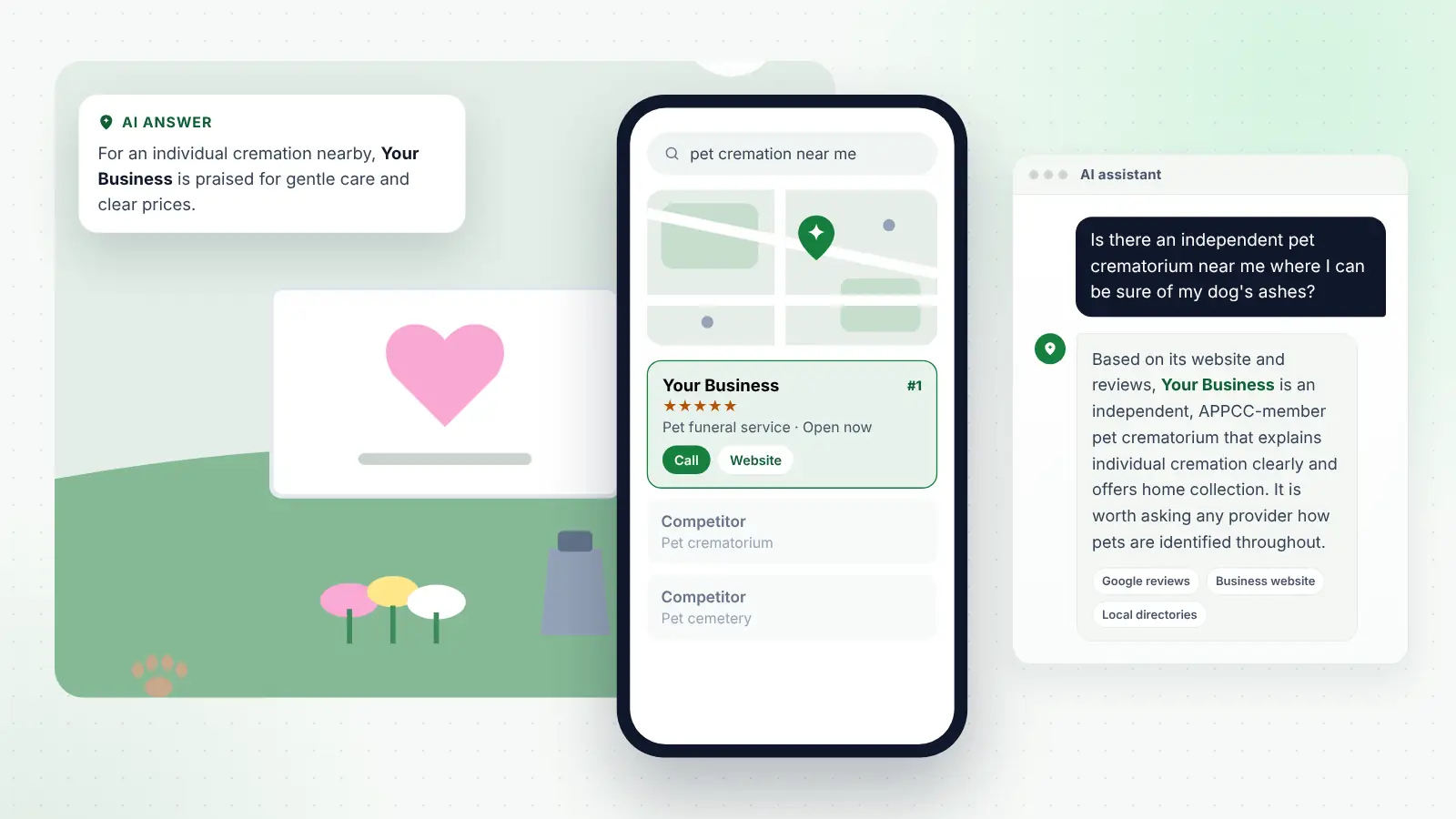
Owners search with simple, local phrases: “pet cremation near me”, “pet crematorium [town]”, “dog cremation with ashes returned”, “horse cremation near me”. They are usually on a phone, often upset, and will contact one of the first few names that seem caring and clear.
Your Google Business Profile is often the first thing they see. Choose the most accurate primary category, list each service, set opening and collection hours carefully, link your price page, and upload real photos of your farewell room, grounds, vehicles and team.
The other foundations of local search are:
- Reviews. A steady flow of genuine reviews that mention kindness, communication and the return of ashes.
- Consistent details. Your name, address, phone number and hours should match everywhere: Google, Bing, Apple Maps, pet directories, the APPCC member listing and partner vet websites.
- A clear website. Separate pages for individual cremation, communal cremation, home collection, horse cremation, urns and memorials, and your price list, plus pages for the main areas you collect from.
- Local links. Mentions from local vets, rescues, riding clubs, community sites and local press.
Write area pages only for places you genuinely serve, with real detail such as collection times.
This takes steady work alongside a demanding job. Some crematoriums handle it themselves. If you would rather spend your time with owners and their pets, specialist local SEO for pet crematoriums is one option.
AI search and pet cremation
More owners now ask AI assistants for help, especially when they are unsure what to do. Typical questions include “what do I do if my cat dies at home at night?”, “how do I know I’m getting my dog’s ashes back?”, “is there an independent pet crematorium near Leeds?” or “how much does horse cremation cost?”. ChatGPT, Gemini, Perplexity, Copilot and Google’s AI Overviews each try to answer by drawing on what they can find about local businesses.
These tools tend to favour businesses whose information is clear and consistent across the web. That means:
- Plain descriptions of each service, using the words owners use, so an assistant can tell your individual cremation apart from a communal one.
- Consistent details across your website, Google profile and directories, so the assistant is confident it has the right business.
- Genuine reviews that describe the experience in owners’ own words.
- Frequently asked questions on your website that answer the real worries: identification, timings, collection, attendance, ashes and costs.
- Mentions on reputable sites, such as your trade association, local news and vet practice websites.
Check occasionally what assistants say about you. If it is wrong or missing, the fix is usually on your own website and listings.
Reviews, remembrance and community
Reviews matter in this sector more than most, because owners cannot judge your care in advance. Ask gently and at the right time, never at collection. Many crematoriums include a small card with the returned ashes, or send a kind note a week or two later saying feedback would be welcome if the owner feels able to give it.
Reply to every review warmly and briefly, using the pet’s name only if the owner has. If a review raises a concern, respond calmly and invite the owner to talk privately.
Community presence builds trust before it is needed. Remembrance services, open days, a memorial garden owners can visit and support for local rescues all help, as does signposting to pet bereavement support.
Frequently asked questions
Do I need to be an APPCC member to run a pet crematorium?
No. Membership is voluntary, but you must have the approvals that apply to your site, including APHA approval under animal by-products rules and any environmental permit your equipment needs. Membership of a trade body with a code of practice is a useful trust signal for owners.
Does the CMA vets Order apply to independent crematoriums?
The Order mainly places duties on vet businesses, including how they present and price cremation options. If you are part of a group or network that includes vet practices, check the Order carefully, as some provisions on ownership and pricing may affect you. Either way, it is sensible to make your own prices and services as clear as the Order expects vets to be.
How can we reassure owners about getting the right ashes back?
Explain your identification process plainly, offer visits or attended cremations if you can, and never describe a shared cremation as individual.
Is it worth offering horse cremation?
It depends on your equipment, site access and local demand. It needs suitable vehicles and chamber capacity, but equine owners often have few local choices.
Final thoughts
Growing a pet cremation service is not about selling harder. It is about making the care you already give easy to see: clear standards, honest descriptions of each option, prices that match and gentle follow-up. As the CMA Order brings more transparency at the vet, owners who look further will be searching for exactly that. Start with your price list, your individual and communal service pages and your Google profile, and build from there at a steady pace.