Event catering is one of the most rewarding ways to make a living from food. You are part of people’s biggest days — weddings, milestone birthdays, christenings, retirements and wakes — as well as the everyday rhythm of office lunches, conferences and staff parties. There is no restaurant to fill every night, and your costs are tied to booked events rather than hoping customers walk through the door.
It is also a business with very little room for error. You are cooking at scale, often away from your own kitchen, to a fixed time, for guests with allergies and dietary needs you may only learn about a week before. Hosts know this, which is why they choose caterers on trust: reviews, recommendations, photos of real events and confidence that you will turn up organised.
This guide covers what you need to start a catering business in the UK: choosing your niche, registering with your council, food safety management, hygiene ratings, allergen rules, serving alcohol at events, insurance, startup costs, pricing and how local SEO and AI search help hosts find you. It is written for event caterers rather than restaurants or cafés.
Key points
- Register your catering business with your local council at least 28 days before you start trading; registration is free.
- You need a written food safety management system based on HACCP principles, such as Safer Food, Better Business in England and Wales.
- Your base kitchen will receive a food hygiene rating, which must be displayed in Wales and Northern Ireland and is voluntary but valuable in England.
- You must be able to give accurate information about the 14 allergens for everything you serve, and some packaged items need full labels under Natasha’s Law.
- Selling alcohol at events in England and Wales usually needs a Temporary Event Notice or a premises licence, unless the venue’s own bar handles it.
- Local SEO and AI search matter because most hosts hire a caterer rarely and build their shortlist from search results and recommendations.
In this guide
- Is catering right for you?
- Choosing your catering niche
- Registering your food business
- Food safety management and hygiene ratings
- Handling the 14 allergens and special diets
- Alcohol at events
- Insurance and other safety essentials
- Kitchen kit, vans and other start-up spending
- Pricing your catering
- Winning your first bookings
- Local SEO: getting in front of party and wedding hosts
- Getting suggested when hosts ask AI for a caterer
- Frequently asked questions
- Next steps
Is catering right for you?
Catering suits people who enjoy cooking for a crowd and are genuinely organised. The cooking is only part of the job. You will spend as much time on quotes, menu planning, ordering, staff rotas, loading vans, setting up in unfamiliar venues and clearing down at midnight as you do at the stove.
The hours are uneven. Weekends from May to September can be relentless, with Friday prep, a Saturday wedding and a Sunday party, while January to March is often quiet. Physical stamina matters: lifting chafing dishes, crates and urns, standing for long shifts and driving home late.
If you have not worked in event catering before, spend a season working for an established caterer as a chef or front-of-house team member. You will see how large orders are planned, how food travels safely and how experienced teams cope when a venue’s oven fails or a wedding runs an hour late.
Choosing your catering niche
Catering covers very different businesses. Choosing a clear focus makes your menus, equipment, pricing and marketing much simpler.
| Type | Typical work | Things to consider |
|---|---|---|
| Wedding catering | Wedding breakfasts, canapés, evening food | Long booking lead times, tastings, high expectations |
| Private party and buffet | Birthdays, christenings, anniversaries, wakes | Shorter notice, price-sensitive, often drop-off |
| Corporate catering | Office lunches, meetings, conferences | Repeat orders, invoicing, delivery reliability |
| Street food and BBQ | Food trucks, hog roasts, pizza ovens, festivals | Equipment-heavy, weather, gas safety, pitch fees |
| Fine dining and private chef | Dinner parties, small high-end events | Small numbers, high skill, premium pricing |
Many caterers start with one niche and add others. A buffet caterer might move into funeral teas and office lunches; a street-food trader might move into relaxed weddings. The key is to be known for something specific rather than “we cater for everything”.
Registering your food business
Every catering business must register with its local council as a food business at least 28 days before trading starts. Registration is free, the council cannot refuse it, and you register with the council for the area where your kitchen is based — or, for a food truck, usually where the vehicle is normally kept. You can register online through the Food Standards Agency’s registration service, which directs you to the right council.
Registration applies whether you work from a commercial unit, a hired kitchen or your own home. After you register, an environmental health officer will usually arrange an inspection, though the timing varies between councils.
Working from home
Many caterers start in their home kitchen, and it is allowed provided the kitchen can meet food hygiene requirements for the volume you produce. In practice that means suitable surfaces, enough fridge capacity, a separate hand-washing facility if possible, good pest control and a way to keep pets out of food areas. Speak to your council’s food team early about what they expect.
Also check whether you need planning permission if the business will significantly change how your home is used, and tell your mortgage lender or landlord and your home insurer. As you grow, a commercial kitchen, a shared kitchen or a hired unit will give you more space and a more professional base for tastings.
Other set-up basics
- Register with HMRC as a sole trader or set up a limited company.
- Keep records of income and costs from the first booking.
- Register for VAT if your turnover passes the threshold, and price corporate work with VAT in mind.
- Check your vehicle insurance covers business use and carrying equipment.
Food safety management and hygiene ratings
A food safety management system
The law requires food businesses to have food safety procedures based on HACCP principles: identifying what could go wrong at each stage and how you control it. For most small caterers the simplest way to do this is with a ready-made pack from the Food Standards Agency or Food Standards Scotland.
- England and Wales: Safer Food, Better Business, which has a version for caterers.
- Scotland: CookSafe, from Food Standards Scotland.
- Northern Ireland: Safe Catering, the HACCP-based system used there.
Event catering adds risks a restaurant does not face, so your system should cover food transport, hot and cold holding at the venue, cooking in unfamiliar kitchens and what happens to leftovers. In England, Wales and Northern Ireland, chilled food should generally be kept at 8°C or below and hot food held at 63°C or above. Insulated boxes, cool boxes with ice packs, a calibrated probe thermometer and written temperature records are essential.
Training
Food handlers must be supervised and instructed or trained in food hygiene to a level that suits their work. There is no single legally required certificate, but many caterers and venues expect at least a Level 2 food hygiene qualification for kitchen staff, with a Level 3 for whoever supervises. Allergen awareness training is also sensible for everyone who prepares or serves food.
Your food hygiene rating
After inspection, your business receives a rating. In England, Wales and Northern Ireland this is under the Food Hygiene Rating Scheme, scored from 0 to 5. In Scotland it is the Food Hygiene Information Scheme, which gives a Pass or Improvement Required result.
Displaying your rating at your premises is a legal requirement in Wales and Northern Ireland. In England it is voluntary, although many customers and most venues will look you up. Event caterers are rated at their base kitchen, so the rating follows you to every event. A 5 is one of the strongest trust signals you can have, so prepare for your first inspection properly: clean, organised, well-documented and with your safety records up to date.
Tip
Ask your council’s food team if they offer advice visits or guidance for new businesses before your first inspection. Getting your records and cleaning routines right from day one is far easier than recovering from a low first rating.
Handling the 14 allergens and special diets
Allergens are one of the biggest responsibilities a caterer carries. You must be able to tell customers whether any of the 14 regulated allergens are in the food you serve: celery, cereals containing gluten, crustaceans, eggs, fish, lupin, milk, molluscs, mustard, tree nuts, peanuts, sesame, soya, and sulphur dioxide and sulphites.
For most event catering — plated meals, buffets and food served loose — this information can be given in writing or verbally, but it must be accurate and available. In practice that means:
- Keeping a matrix showing which allergens are in each dish, updated whenever a recipe or supplier changes.
- Asking for dietary and allergy information at booking, then confirming it in writing before the event.
- Labelling buffet dishes or providing a clear allergen list beside them.
- Preparing and labelling special-diet meals separately, with the guest’s name where appropriate.
- Briefing every member of staff so they know who to ask and never guess.
Natasha’s Law and packaged food
Since 1 October 2021, food that is prepacked for direct sale (PPDS) must carry a full label with the name of the food and a full ingredients list with allergens emphasised. This is often called Natasha’s Law. For caterers, it can apply to items you package before guests choose them, such as wrapped sandwiches, boxed lunches set out for people to pick from, pots of salad or lidded drinks.
Food ordered in advance by a business for an event is generally treated differently from PPDS, and shared platters and open buffet dishes are not PPDS. Because the line depends on how food is packaged and sold, read the Food Standards Agency’s guidance for event caterers or ask your council if you are unsure. Corporate lunch boxes are the area where caterers most often need to check.
Tip
Never describe a dish as “allergen-free” or “nut-free” unless you can guarantee it. If your kitchen handles nuts, say so clearly and explain how you reduce the risk. Honest wording protects your guests and your business.
Alcohol at events
Many hosts want a bar, a drinks package or a glass of fizz on arrival. Whether you need a licence depends on who is selling the alcohol and where.
If the venue has its own premises licence and runs the bar, you usually do not need to do anything. If you sell alcohol yourself in England or Wales at a venue without a suitable licence, you will typically need a Temporary Event Notice (TEN) from the local council. As it stands in October 2026, a TEN:
- covers events with fewer than 500 people at any one time, including staff
- can last up to 168 hours
- costs £21
- must be given at least 10 working days before the event, or between 5 and 9 working days for a late TEN
There are annual limits on how many TENs one person can give. Without a personal licence the limit is five a year; personal licence holders can give up to 50. If you plan to run bars regularly, a personal licence is worth considering, and some caterers partner with a mobile bar company instead.
Scotland has a different system, where occasional licences are issued by local licensing boards, and Northern Ireland has its own licensing law. If you cater there, check the rules with the local licensing authority before agreeing to supply alcohol.
Insurance and other safety essentials
Insurance is one of the first things venues and corporate clients ask about. Most caterers need:
- Public liability insurance, covering injury or damage to third parties at events. Many venues set a minimum level of cover.
- Product liability insurance, covering illness or harm caused by your food.
- Employers’ liability insurance, which is a legal requirement once you employ staff, including casual event staff in most cases.
- Equipment and stock cover, for the kit you carry between events.
- Business vehicle insurance, for vans and food trucks.
If you use LPG for barbecues, hog roasts, pizza ovens or food trucks, keep your gas equipment properly installed and serviced, and expect venues and event organisers to ask for safety certificates. Keep a written risk assessment for each event, especially outdoor ones, and a fire extinguisher and fire blanket with your kit.
Kitchen kit, vans and other start-up spending
Costs vary widely depending on whether you start from home with drop-off buffets or launch a food truck. The figures below are rough guides only and vary by area and supplier.
| Item | Typical cost | Notes |
|---|---|---|
| Kitchen equipment and extra fridges | £1,000–£10,000 | Depends on home vs commercial kitchen |
| Hot-holding and transport kit | £500–£3,000 | Chafing dishes, insulated boxes, probes |
| Crockery, cutlery and linen | £500–£5,000 | Many caterers hire this at first |
| Used van | £8,000–£20,000 | Refrigerated vans cost more |
| Food truck or trailer | £10,000–£50,000+ | Wide range, new or converted |
| Insurance | Several hundred pounds a year upwards | Varies by turnover and cover |
| Training and certificates | Under £100 per person for basic courses | Level 3 courses cost more |
| Website and branding | £500–£3,000 | Photos of real events matter most |
Hire before you buy where you can. Crockery, glassware, marquee kitchens and large equipment can all be hired per event, which keeps early costs down and lets you learn what you actually use.
Pricing your catering
Most event caterers quote per head, with a minimum number of guests. To price well you need to know your true costs for every menu.
- Food cost per head, including garnishes, bread, sauces and a sensible allowance for waste.
- Staff costs, including prep time, travel, service and clearing down, not just the hours at the event.
- Equipment and hire, including crockery, linen and any items you hire in.
- Travel and fuel, with a clear charge or radius for distant venues.
- Overheads, such as insurance, kitchen rent, software and marketing.
- Profit, so the business can grow and cope with quiet months.
Be clear in every quote about what is included: staff, crockery, travel, set-up, clearing, VAT and how final numbers and dietary requirements are confirmed. Take a deposit to secure the date, with the balance due before the event, and set out your cancellation terms in writing.
Avoid competing on price alone. Hosts who choose the cheapest quote are often the hardest to please, and the caterers who last tend to be known for food quality and a calm, well-run service rather than the lowest price per head.
Winning your first bookings
Your first year is about building proof that you deliver. Useful ways to win early work include:
- Venue supplier lists. Approach venues without an in-house kitchen and ask how to become a recommended caterer. Offer to cater a showcase or open day.
- Wedding suppliers. Photographers, planners, florists and marquee companies often recommend caterers they trust.
- Funeral directors. Wakes and funeral teas are booked at short notice and many families welcome a recommendation.
- Local businesses. Office lunches and meeting platters can become weekly repeat orders.
- Tastings. A well-organised tasting turns many wedding enquiries into bookings.
After every event, ask for a review and permission to use photos. Real images of your food at real events are far more convincing than stock photography.
Local SEO: getting in front of party and wedding hosts
Most people hire a caterer only a handful of times in their lives, so they rarely have one in mind. They search “caterers near me”, “wedding caterers in [town]”, “buffet catering for 50 people” or “hog roast hire near me”, look at the map results and reviews, and send enquiries to a shortlist. Office managers do the same with “corporate catering near me” or “office lunch delivery”.
Being visible in those local results, with strong reviews and clear information, is often the difference between an enquiry and silence. If you would rather have specialists handle it, our page on local SEO for caterers and event catering companies explains how we approach it.
Setting up a caterer’s Google profile
Choose the most accurate primary category, such as “Caterer”, and add secondary categories where they genuinely fit. Because you travel to events, set a service area for the towns you cover rather than relying only on your kitchen address, and hide the address if customers do not visit you. Add your event types, menus, photos of real set-ups, opening hours for enquiries and a link to your enquiry form. Post updates about seasonal menus, wedding fairs and open dates.
Reviews
Reviews matter enormously for caterers because hosts cannot taste your food before they enquire. Ask after every event, by email or message with a direct link, while the day is still fresh. Reviews that mention the food, the staff, how dietary needs were handled and how smoothly the day ran are especially useful. Reply to every review, briefly and professionally, including the occasional critical one.
One set of details on every supplier list
Make sure your business name, phone number, website and service area match across your Google profile, website, social media, wedding directories, local business directories and venue supplier lists. If a venue’s supplier page shows an old number, hosts give up and search engines start to doubt which details are right.
A clear website
Your website should have a page for each main service — weddings, private parties, corporate catering, street food — with sample menus, guide prices per head, the areas and venues you cover, how you handle allergens, your hygiene rating and plenty of photos. Pages for the towns or venues you work at most often can help you appear for searches there, as long as they contain genuinely useful local information.
Local links
Links from relevant local websites help your visibility. Good sources include venue supplier pages, wedding blogs that feature real weddings you catered, local event listings, business networks and charity events you support.
Getting suggested when hosts ask AI for a caterer
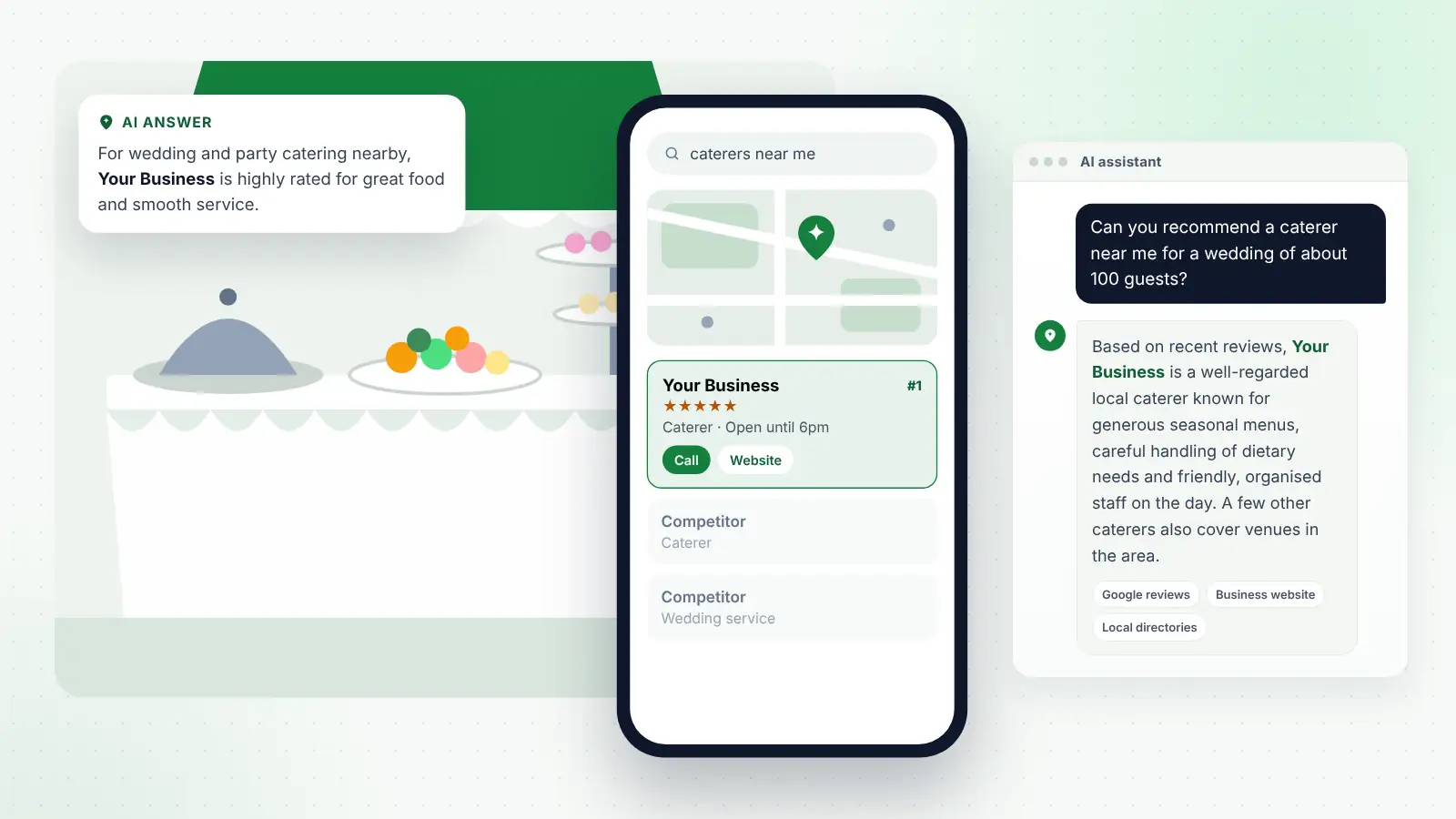
People increasingly ask AI assistants such as ChatGPT, Gemini, Perplexity, Copilot and Google’s AI Overviews to help plan events. Instead of typing a short search, they ask full questions: “Can you recommend a caterer near me for a wedding of about 100 guests?”, “Who does good vegan buffet catering in Leeds?” or “Which caterers near me do hog roasts for a 60th birthday party?”
AI assistants assemble their caterer suggestions from facts they can find and verify across several websites. For caterers, that means:
- Consistent information about your business, services and area on your website, Google profile and directories.
- Reviews that describe the events you cater, the food and the service.
- Clear service descriptions that say exactly what you do — “wedding breakfasts for 50 to 200 guests”, “drop-off buffets for offices” — rather than vague claims.
- FAQs that answer real questions about prices per head, minimum numbers, dietary needs, tastings, staff and travel.
- Mentions on reputable sites, such as venue supplier lists, wedding features, local news and event organisers’ websites.
A short, well-written FAQ section on each service page is one of the most practical things you can do. It helps hosts decide, and it gives AI tools clear, accurate answers to draw on when someone asks a specific question.
Frequently asked questions
Do I need a licence to start a catering business?
There is no general catering licence, but you must register with your local council as a food business at least 28 days before you start trading. You may also need a licence or a Temporary Event Notice to sell alcohol, and street-food traders may need a street trading licence or pitch permission from the council or event organiser.
Can I run a catering business from my home kitchen?
Yes, many caterers start that way. Your kitchen must meet food hygiene requirements for the amount of food you produce, and it will be inspected and rated like any other food business. Check with your council’s food team, your insurer and your mortgage lender or landlord before you start.
Is a food hygiene certificate a legal must for caterers?
The law requires food handlers to be supervised and trained in food hygiene appropriate to their work, rather than to hold one specific certificate. In practice, most caterers complete a Level 2 food hygiene course, and many venues and corporate clients expect to see evidence of training.
How far in advance do weddings book caterers?
Wedding catering is often booked many months ahead, and popular summer dates can go a year or more in advance. That is why building your online visibility during autumn and winter helps fill the following season.
How do I handle guests with severe allergies?
Collect allergy information at booking and confirm it in writing before the event. Prepare and label those meals separately, brief your staff, and be honest if you cannot guarantee a dish is free from an allergen. If a request is beyond what your kitchen can safely provide, say so early.
Next steps
Starting a catering business takes careful planning: register with your council, put a food safety management system in place, sort your insurance, build a reliable allergen process and decide on your niche and pricing. Then focus on doing every event well, collecting reviews and photos, and building relationships with venues and suppliers.
Alongside that, make it easy for hosts to find you. A complete Google profile, consistent listings, a clear website and honest, helpful information about your menus and service will help both search engines and AI assistants point people towards you — and that visibility builds steadily over the months that follow.