People rarely think about a watchmaker until they need one. A watch stops the week before a wedding, a crystal cracks, a grandfather’s automatic turns up in a drawer, or a longcase clock that has stood in the hall for decades falls silent. At that moment they want someone skilled, honest and careful, and most have no idea where to find that person.
That gap is the opportunity for an independent repairer. Battery kiosks pick up quick jobs and some brands steer owners towards their own service networks, but there is steady demand for watchmakers and clock restorers who explain what a piece needs, give a clear estimate and stand behind their work. The businesses that grow make that trust visible before a customer walks in or posts a parcel.
This guide covers your service mix, BHI accreditation, parts, estimates and guarantees, consumer rights, water resistance, insurance, postal repairs, clock collection, and appearing in local search and AI recommendations.
Key points
- Combine quick jobs such as batteries and straps with servicing, restoration and clock work that carry real margin.
- BHI accredited membership (MBHI or FBHI) and its code of practice give customers an independent reason to trust you.
- Written estimates, recorded consent and a clear guarantee prevent most disputes before they start.
- Under the Consumer Rights Act 2015, repairs must be carried out with reasonable care and skill, and what you tell customers can be binding.
- Insurance for customers’ items and a careful postal process let you win work from far beyond your town.
- A complete Google profile, detailed reviews and clear service pages help both Google Maps and AI assistants recommend you.
In this guide
- Balance servicing, battery work and restoration
- Qualifications and the British Horological Institute
- Parts access and manufacturer accounts
- Estimates, consent and guarantees
- Consumer rights for repair services
- Water resistance testing
- Insurance for customers’ items
- Postal repair services and secure shipping
- Clock repairs and home collection
- Local SEO for watch and clock repairers
- AI search: how owners ask who to trust with a watch
- Frequently asked questions
- Next steps
Balance servicing, battery work and restoration
Most successful workshops combine quick jobs that bring new people in, skilled work that pays the bills and specialist work that builds a reputation.
| Service type | Examples | Why it matters |
|---|---|---|
| Quick jobs | Batteries, straps, bracelet sizing, crystals | First visits and a reason to return |
| Watch servicing | Mechanical and automatic watches | Core skilled work and best margin per hour |
| Vintage restoration | Inherited and collectors’ pieces | Fewer competitors and strong word of mouth |
| Clock repairs | Longcase, carriage, mantel and bracket clocks | Higher value, often with home collection |
| Trade work | Jewellers, antique dealers, auction houses | Steady volume outside retail peaks |
Quick jobs are worth doing well even though they earn little. A customer whose battery is fitted carefully, with the seal checked, is far more likely to return for a full service or bring in a family clock. Be honest about what you do not do, and keep a short list of trusted specialists to refer people to.
Qualifications and the British Horological Institute
No licence is needed to repair watches or clocks in the UK, so customers rely on other signals to judge skill. The most widely recognised is the British Horological Institute (BHI).
BHI membership starts at Associate level, open to anyone. Accredited membership, as Member (MBHI) or Fellow (FBHI), is granted to people who have passed the BHI examinations or shown advanced ability at the bench. The BHI also runs distance learning courses, from a Technician Grade in practical servicing to intermediate and final grades on clock or watch pathways, with examinations accredited by Ofqual.
Accredited repairers agree to the BHI code of practice, covering receipts, recording condition, consent before chargeable work, written estimates, care of customers’ property and respect for historic pieces. BHI also keeps a register of accredited repairers.
Show your status clearly on your website, Google profile and paperwork. If you are working towards accreditation, say so honestly, and never imply a qualification or authorised status you do not hold. Training, brand courses and years at the bench are worth explaining too.
Parts access and manufacturer accounts
Parts supply varies a great deal between brands. Some sell to independent repairers who open an account, some only supply watchmakers who meet their training, equipment or workshop standards, and some restrict many parts to their own service centres or authorised partners. Plan around it:
- Know where you stand with each major brand. Keep a list of which makes you can get genuine parts for, from which source, and typical lead times.
- Explain limits before you take a watch in. If a repair may need to go back to the manufacturer, say what that could mean for cost and time.
- Be careful with non-genuine parts. The BHI code asks for genuine, exact parts on high-value modern watches where possible, with approval and a note on the invoice if not.
- Build trade relationships. Good material suppliers, case refinishers and dial restorers help with work you cannot source or do yourself.
“We service this brand independently using genuine parts where available, and we’ll tell you before ordering anything” is a far better message than a promise you may not keep.
Estimates, consent and guarantees
Most disputes come from unclear expectations. A consistent intake process prevents nearly all of them.
- Give a written receipt for every item. Record make, model, serial number where visible, and anything left with it, such as a pendulum, weights or key.
- Note condition at the counter. Record scratches, dents, worn plating or a cracked crystal, ideally with photographs.
- Explain inspection charges. Say whether you charge for an estimate and whether it is deducted if the customer goes ahead.
- Give a written estimate or quotation. State whether it is fixed, what it includes, whether VAT is included and the likely timescale.
- Get consent before work starts. Record approval, and ask again before anything that adds cost or delay.
- Return old parts with a detailed invoice. Customers value seeing what was replaced and why.
Many watchmakers guarantee the work on a full service, with exclusions such as accidental damage or the case being opened elsewhere. Whatever you offer, write down what it covers and for how long, and honour it.
Tip
Email customers a short summary when they approve an estimate: price, work agreed, expected return date and guarantee. It answers most of the questions people would otherwise phone to ask.
Consumer rights for repair services
When you repair a watch or clock for a consumer, the work is covered by the Consumer Rights Act 2015. The main points are:
- Reasonable care and skill. The work must meet the standard of a competent repairer. This is a standard of workmanship, not a promise an old movement will never fail, unless you promised a particular result.
- What you say can be binding. A quoted price or promised return date the customer relies on can become part of the contract.
- Reasonable price and time. If none was agreed, the price must be reasonable and the work done within a reasonable time.
- Remedies. If the work falls short, the customer can usually ask you to put it right at no cost, and if that is not possible or not done in reasonable time, may be entitled to a price reduction of up to the full price.
Deal with complaints promptly and keep good records of what was agreed. The government-backed Business Companion website has plain-English guidance on supplying services.
Every workshop has items that are never collected. In England and Wales, the Torts (Interference with Goods) Act 1977 sets out how a repairer can eventually sell or dispose of uncollected goods, but only after proper notice and a reasonable period. Wording on your tickets and a clear notice, followed by written contact with proof of delivery before any sale, is the usual approach. Rules differ in Scotland, so take advice before disposing of anything valuable.
Water resistance testing
Explaining water resistance well builds trust. A depth rating on a dial is a test pressure, not a safe swimming depth, and water resistance is not permanent: gaskets harden with age, crowns wear, and opening a case back can disturb the seal.
ISO 22810 covers water-resistant watches in general, and ISO 6425 sets stricter requirements for divers’ watches. Most workshops use a dry (air) pressure tester, a wet tester or both. Good practice includes:
- Offering a pressure test after battery changes and services on water-resistant watches.
- Replacing gaskets during a full service, and with battery changes where needed.
- Recording the result on the invoice, with any limits, such as a vintage case that cannot be sealed to its original rating.
People often search “watch water resistance test near me” before a holiday, so a clear page and a Google profile service listing can bring steady work.
Insurance for customers’ items
When you hold someone’s watch or clock, you must take reasonable care of it. Standard shop insurance may not cover customers’ property, so check with your broker that you have cover for goods in your custody at a level that reflects what you usually hold. Ask about:
- The maximum value per item and in total, including overnight in the safe.
- Cover in transit and while items are with another specialist.
- Security requirements, such as safe rating and alarm.
- Cover for clocks collected from, or worked on in, customers’ homes.
- Public liability, and employers’ liability if you employ staff, which is a legal requirement for most employers.
The BHI code suggests that if your insurance does not cover items left for repair, you tell the customer and record that they understand. Explaining your cover clearly is a selling point, as owners of valuable watches often ask.
Postal repair services and secure shipping
A postal service lets you win vintage, specialist and clock work from across the country. Because customers cannot see your workshop, the process needs to be clear.
| Step | What to set up | Why it matters |
|---|---|---|
| Booking | Online form with make, model, fault and value | Decline unsuitable work before it arrives |
| Packing | Guidance on packing and what not to send | Fewer items damaged in transit |
| Sending | Recommended tracked, signed-for service | Customers understand risk and cover |
| Arrival | Email confirmation with photographs | Reassurance and a record of condition |
| Estimate | Written estimate and approval | Avoids disputes at a distance |
| Return | Insured, tracked return, cost stated upfront | No surprises on the invoice |
Carriers set their own compensation limits, which can be far below the value of a good watch. Royal Mail, for example, recommends Special Delivery for valuable items, but customers should check the compensation limit and whether extra cover is available. Your insurer may also require particular return methods, so agree your process with them first. Put all of this on a “how to send us your watch” page.
Clock repairs and home collection
Longcase clocks are heavy and fragile, so owners usually need someone who will visit, remove the movement and reinstall it after repair. Many clock repairers also offer servicing visits and setting up clocks after a house move.
- Say what you work on. Longcase, carriage, mantel, bracket, wall and skeleton clocks, and whether you handle cases and dials.
- Explain home visits. Areas covered, any collection charge and typical repair times.
- Set expectations on antiques. Explain how you respect original parts and when you would advise conservation over full restoration.
Clock owners often live well outside your town, so state your coverage area clearly. Collection days in nearby towns can help you serve a wider area efficiently.
Local SEO for watch and clock repairers
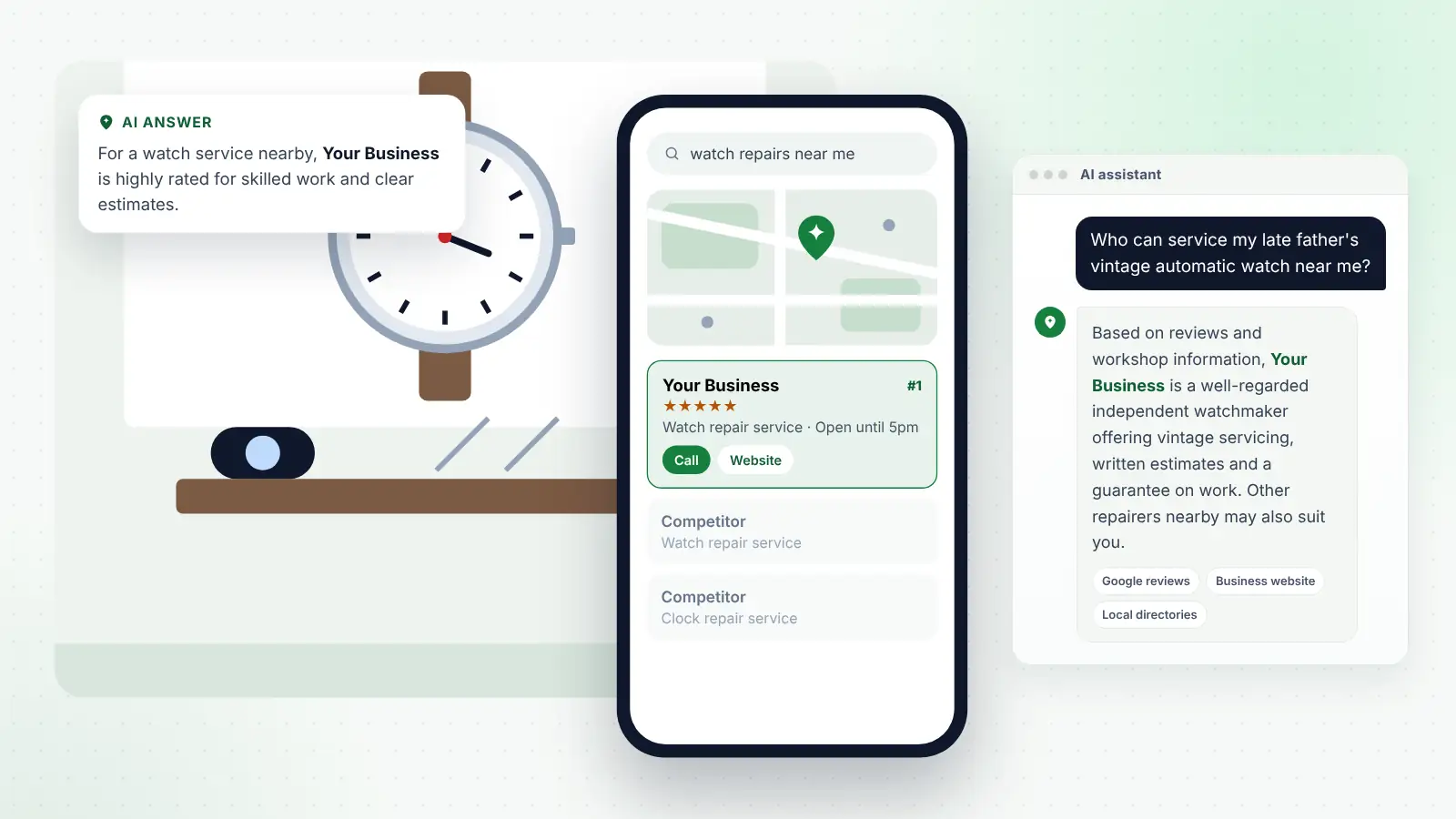
When someone searches “watch repairs near me”, “watch battery replacement”, “watch service [town]” or “grandfather clock repair near me”, Google shows a map with a few businesses. Many people choose from those results within minutes, so your map position affects how many new customers you see each week.
The essentials are:
- A complete Google Business Profile. Choose the most accurate primary category, such as Watch repair service, add genuine secondary categories such as Clock repair service, and fill in hours, services and collection area.
- Real photographs, added regularly. Your bench, movements mid-service and restored pieces, with owners’ permission.
- Steady, detailed reviews. Ask at collection, especially after a service or restoration. Reviews that mention the make, the problem and your communication are more useful than “great service”. Reply to every one.
- Consistent details everywhere. Name, address, phone and hours should match across your website, Google, Apple Maps, Bing, the BHI register and directories.
- A page for each service. Servicing, batteries and straps, water resistance testing, restoration, clock repairs, collection and postal repairs, each with “from” prices and turnaround.
- Local and relevant links. Mentions from local news, antique centres, jewellers you work with and horology clubs.
If you would rather stay at the bench, our local SEO for watch and clock repairs covers your Google profile, listings, service content and links on a rolling monthly plan.
Tip
Add your common jobs as services on your Google profile, each with a short description and “from” price. People searching for a battery change want to know at a glance that you can help.
AI search: how owners ask who to trust with a watch
More people now ask ChatGPT, Gemini, Perplexity, Copilot and Google’s AI Overviews for recommendations in full sentences: “who can service a vintage Omega near me?”, “is there a clock repairer near me who will collect a grandfather clock?” or “where can I send my watch for repair by post in the UK?”
These tools favour businesses whose details they can cross-check across the web. For a watch or clock repairer, that means:
- Clear service descriptions. What you repair, your specialisms and what you do not take on.
- Credentials stated plainly. BHI accreditation and experience, described consistently everywhere.
- Helpful FAQs. Service intervals, water resistance, estimates, guarantees and postal repairs.
- Guide prices and turnaround. AI assistants can only repeat what they can find.
- Current information. Old hours or an outdated price list can be repeated back to customers.
- Mentions on reputable sites. Local directories, the BHI register, local news and collector websites.
The questions people ask AI assistants are often the ones they ask at your counter. Answering them clearly on your website helps both.
Frequently asked questions
Do I need a licence to run a watch repair business?
No specific licence is needed. You still need to register for tax, hold appropriate insurance and follow consumer law. Many customers look for BHI accreditation as evidence of skill.
Should I charge for estimates?
Many watchmakers charge an inspection fee for services and restorations, often deducted if the customer goes ahead. Whatever you choose, state it before you take the item in.
How long should a guarantee on a watch service last?
There is no fixed rule. Choose a period you are confident you can honour, write down what it covers and explain it at the counter and online.
Is a postal repair service worth offering?
For specialist, vintage or clock work, often yes. It works best with packing guidance, insured shipping, photographs on arrival and written estimates before any work.
Can I say I service a brand if I am not an authorised service centre?
You can describe your work honestly, for example as an independent watchmaker servicing that brand. Avoid wording or logos that suggest official status you do not hold.
Next steps
Start with the basics that build trust: a clear intake process, written estimates and guarantees, insurance you can explain and a postal process customers can follow. Then make sure people can find you, with a complete Google profile, accurate service pages and a steady flow of detailed reviews. Skilled repairers are rarer than they used to be, and those who make their skill and care easy to see online are well placed to keep their benches full.