Most people do not wake up wanting a water softener. They get there gradually: a kettle that furs up within weeks, a shower screen that never looks clean, a boiler engineer who mentions limescale, or a move from a soft water area into a house where the taps are crusted white. By the time they search, they have usually been thinking about it for a while, and they want someone who will explain the options honestly rather than push the most expensive unit.
That puts a well-run local water treatment company in a strong position. National brands spend heavily on advertising, but many homeowners have also sat through a long, high-pressure sales visit and would rather deal with a local installer who fits the equipment properly, services it every year and delivers salt on time.
This guide covers the regulations customers and water suppliers expect you to follow, the claims you should avoid, how to build recurring income from servicing and salt, how to sell in the home without pressure, and how to be found on Google and in AI assistants. It focuses on England and Wales; Scotland and Northern Ireland have their own equivalent rules.
Key points
- Softeners and filters must comply with the Water Supply (Water Fittings) Regulations 1999 in England and Wales, and WRAS-approved products are the usual way to show that.
- Always leave an unsoftened drinking water tap, and tell customers the NHS advises against using artificially softened water to make up baby formula.
- Fit the right backflow protection and check whether the water supplier needs notice before installation.
- The ASA has ruled against unsupported softener claims about skin, hair and health, so keep savings and benefit claims measured and evidenced.
- Servicing plans and salt delivery turn one-off installs into steady recurring income.
- Local SEO and AI search matter because homeowners in hard water areas compare local installers on reviews, clear information and trust.
In this guide
- Know your market and where the work comes from
- Get the regulations right and say so
- Drinking water taps and baby feeds
- Backflow protection and good installation practice
- Make honest claims and stay on the right side of the ASA
- Build recurring income from servicing and salt
- Sell in the home without pressure
- Win trade referrals and partnerships
- Local SEO for water softener companies
- AI search and water treatment recommendations
- Frequently asked questions
- Final thoughts
Know your market and where the work comes from
Water hardness varies a great deal across the UK. Broadly, much of southern and eastern England has hard water, while large parts of Scotland, Wales, Northern Ireland and north-west England have softer water. Water companies publish hardness information by postcode, and it is worth checking the figures for every town you cover so your marketing focuses on the areas where customers actually need you.
Most water treatment businesses draw work from a handful of sources:
- Homeowners in hard water areas who want a softener for limescale, appliance care or easier cleaning.
- People moving house who inherit a softener they do not understand, or who arrive from a soft water area and are surprised by the difference.
- Existing softener owners whose unit needs servicing, repair or replacement, often because the original installer has stopped trading.
- Customers wanting better-tasting or filtered drinking water, who may want an under-sink filter, a filter tap or a whole-house filter rather than a softener.
- Trade referrals from plumbers, heating engineers and kitchen fitters.
Each group searches differently. A first-time buyer wants to know what a softener does and costs to run; an inherited-softener owner wants someone who services that brand.
Get the regulations right and say so
The Water Supply (Water Fittings) Regulations 1999
In England and Wales, any fitting connected to the public water supply must meet the Water Supply (Water Fittings) Regulations 1999. Regulation 4 requires fittings to be of an appropriate quality and standard and to be installed correctly. Scotland has its own Scottish Water byelaws, and Northern Ireland has the Water Supply (Water Fittings) Regulations (Northern Ireland) 2009.
The regulations also require certain installations to be notified to the water supplier before work starts. The notification list includes reverse osmosis units and water treatment units that produce a waste water discharge or use water for regeneration or cleaning, which covers most salt-based softeners. The supplier then has ten working days to respond. Check the current requirements with each water company you work with, as practice can vary.
WRAS approval
WRAS approval is the best-known way to show that a product meets the regulations, and the WRAS directory lets installers and customers check approved products. It is not the only route, as other certification schemes can also demonstrate compliance, but it is the one most customers recognise. Name the approvals your equipment holds on your website and in quotes rather than writing “fully approved” with no detail.
Approved contractor schemes
Membership of an approved contractor scheme, with the associated listing on the WaterSafe register, shows that you understand the water fittings rules and can certify certain work. Check which scheme suits the type of work you do and display the membership wherever customers look.
Tip
Add a short “how we install” page to your website. List the approved products you use, the backflow protection you fit, the bypass valve, the drinking water tap and how you handle notification. It answers questions before they are asked and gives AI tools clear facts to draw on.
Drinking water taps and baby feeds
Softening by ion exchange swaps calcium and magnesium for sodium, which raises the sodium content of the water. For that reason the standard practice, reinforced by water company guidance, is to leave at least one unsoftened supply for drinking and cooking, usually at the kitchen sink. Many installers fit a separate drinking water tap or a three-way tap.
Customers with babies need particular care. The NHS advice on making up baby formula says not to use artificially softened water. Tell customers this plainly at the survey, in your handover pack and on your website.
People on low-sodium diets, or with health concerns about sodium, should also be pointed towards the unsoftened tap and advised to check with their GP. Avoid making medical statements of your own.
Backflow protection and good installation practice
Water company guidance classes a domestic softener that regenerates with common salt as a fluid category 2 risk, normally protected with a single check valve. Commercial softeners of the same type are usually treated as a higher risk category and need more protection. Getting this right, and recording it, protects the public supply and the customer’s drinking water.
Other details that separate a careful installer from a careless one:
- Fit a bypass valve so the customer can isolate the softener without losing water.
- Run the drain and overflow correctly, with an appropriate air gap, so waste water cannot be drawn back.
- Check the incoming pressure and flow before recommending a unit.
- Set the unit for the measured hardness rather than a guess.
- Explain the controls, the salt top-up and what to do if something goes wrong.
- Leave written records of the installation, the settings and the servicing schedule.
Make honest claims and stay on the right side of the ASA
Softener advertising has a long history of overstatement, and the Advertising Standards Authority has ruled against several of these claims. The ASA’s advice on water treatment devices warns marketers to be wary of claiming that softened water benefits specific skin conditions or health in general. In one 2020 ruling, a leaflet promising glossier hair and softer skin was found misleading because the evidence was not good enough.
The same principle applies to savings claims. Statements about lower energy bills, less detergent or longer appliance life must be backed by evidence relevant to your product and to typical homes, and qualified where results vary. Water conditioners, such as magnetic or electronic devices, should never be described as softeners.
| Claim type | Risky wording | Safer approach |
|---|---|---|
| Health and skin | “Cures eczema” or “kinder to sensitive skin” | Avoid health claims entirely |
| Hair and beauty | “Glossier hair guaranteed” | Describe softened water without promising cosmetic results |
| Savings | “Halve your energy bills” | Only cite savings you can evidence, with clear qualifications |
| Limescale | “Eliminates all limescale” | Explain that softening removes hardness minerals that cause scale |
| Conditioners | “Softens water without salt” | Describe what the device does and does not do |
Honest claims also suit cautious customers who have been oversold before.
Build recurring income from servicing and salt
An installation is a single sale. A servicing plan and salt delivery can turn it into a relationship that lasts as long as the unit.
Servicing plans
Most softeners benefit from regular servicing: cleaning, checking the resin and valve, testing hardness and adjusting settings. Offer a clear plan at the point of sale and explain what each visit includes. Some companies offer annual visits only; others bundle salt, breakdown cover and parts. Whatever you offer, be clear about what is and is not covered, how renewals work and how the customer can cancel.
Salt delivery
Regular salt delivery is predictable income and keeps you in touch between services. Make ordering easy, offer scheduled deliveries and keep your delivery area clear.
Servicing other brands
Many softener owners cannot find their original installer. If you service common brands, say so on your website and Google profile; a good first service can lead to a replacement sale later.
Tip
Send a reminder a few weeks before each service is due, and include the customer’s last hardness reading. It reminds them why the visit matters and keeps the booking with you.
Sell in the home without pressure
Most softener sales are agreed in the customer’s home, which normally makes them off-premises contracts under the Consumer Contracts Regulations. The customer usually has 14 days to cancel, and you must give clear cancellation information and a cancellation form before the contract is made. Trading Standards’ Business Companion guidance on off-premises sales explains that failing to provide this information can extend the cancellation period by up to 12 months and can be a criminal offence.
If a customer wants you to fit within the 14 days, get their express request in writing and explain what they would owe if they cancelled. Have your contract and service plan terms reviewed by a solicitor.
Treat these rights as reassurance rather than small print. A survey that tests the water, explains the options and leaves a written quote with a sensible validity period stands out against a long visit ending in a “today only” discount.
Win trade referrals and partnerships
Plumbers and heating engineers deal with limescale every week, and many would rather pass softener work to a specialist than handle the servicing commitment themselves. Introduce yourself, explain how you work and make referrals easy. Return the favour by recommending them for plumbing work you do not do.
Kitchen and bathroom showrooms, letting agents, estate agents in hard water towns and new-build site managers can also introduce customers. A short, factual leaflet gives partners something to pass on.
Local SEO for water softener companies
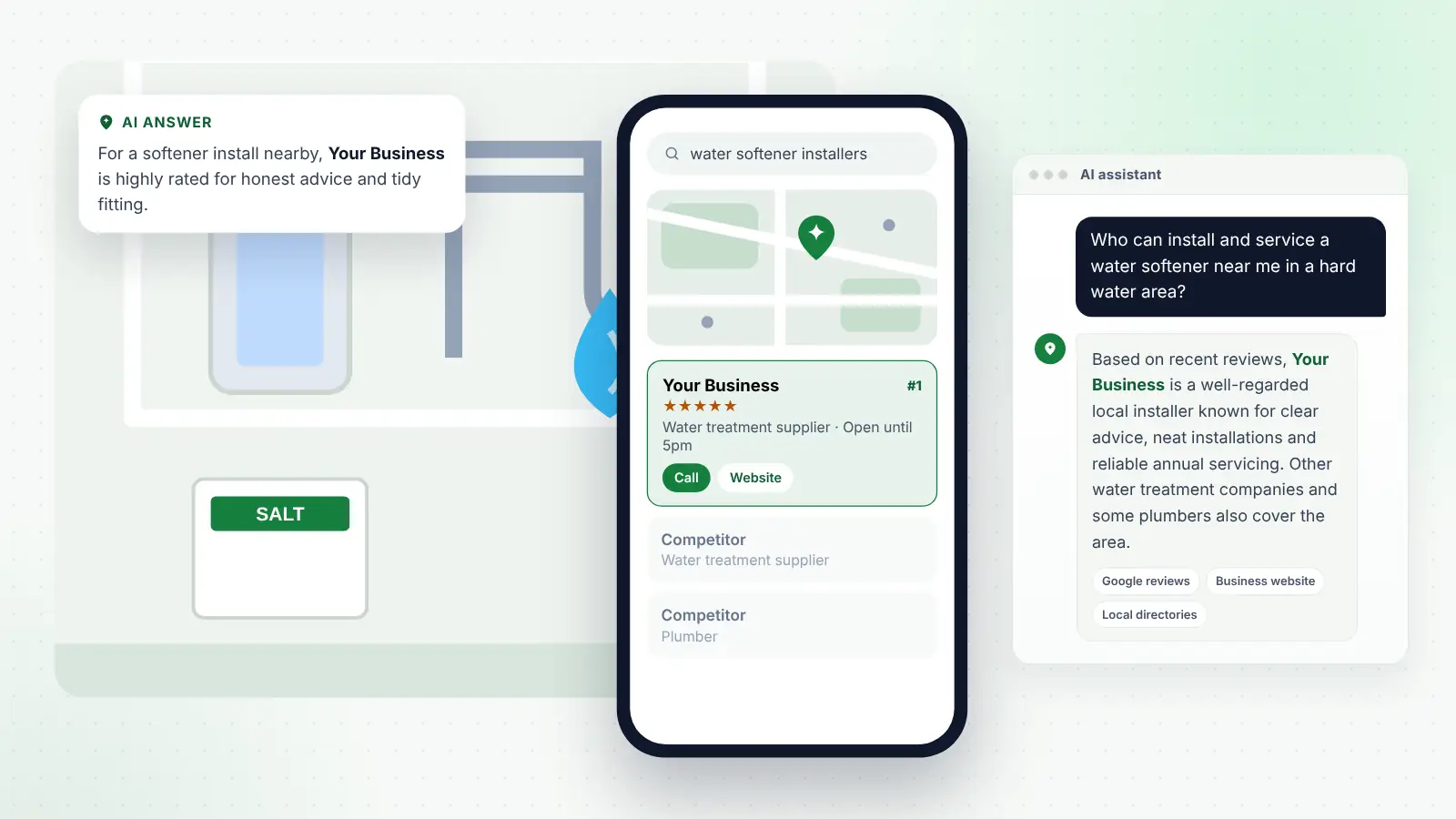
When someone in a hard water town decides they want a softener, their first move is usually a search such as “water softener installers near me”, “water softener service” or “whole house water filter fitted”. Google Maps results and the first few websites they see shape the shortlist. If your business is not there, a national brand or a competitor two towns away often gets the enquiry instead.
Local SEO is the work of making your business the clear, trustworthy choice in those results.
Google Business Profile
Pick the primary category that best describes water treatment work, then add secondary categories that genuinely apply. List every service you offer, from softener installation and servicing to salt delivery, filters and drinking water taps. Set your service area to the towns you genuinely cover, add real photos of installations and vans, and keep opening hours and contact details accurate.
Reviews
For a softener company, reviews shape where you appear and whether a wary homeowner rings you. Ask every installation and servicing customer, and make it easy with a direct link. Reviews that mention the service, such as “fitted our softener and a drinking tap” or “annual service, very thorough”, help you appear for those specific searches. Thank each reviewer, and answer any complaint about an install or service visit courteously.
Consistent details
Your business name, address, phone number and website should match exactly across your website, Google, Bing, Apple Maps, trade directories and any scheme listings.
Pages for each softener service and hard water town
Create a page for each main service: installation, servicing, salt delivery, filtration and drinking water taps. Add area pages for the towns you cover, with genuine local detail such as typical hardness levels and the water company that supplies the area. Include guide prices where you can, clear calls to action and answers to common questions.
Local links
Links and mentions from local websites, trade partners, community groups and home improvement sites strengthen your authority.
Keeping all this up to date alongside installs and service rounds is a lot of work, so some companies use specialist local SEO for water softener installers and filtration companies to manage the profile, listings, content and links each month. Either way, expect results to build over three to six months.
AI search and water treatment recommendations
More homeowners now ask AI assistants such as ChatGPT, Gemini, Perplexity, Copilot and Google AI Overviews for recommendations. Typical questions include “who can install a water softener near me?”, “is it worth getting a water softener in a hard water area?”, “who can service my old water softener locally?” and “what’s the best way to get filtered drinking water at home?”
These tools build answers from information they find across the web. To be recommended, your business needs:
- Consistent information about your name, location, services and coverage on every platform.
- Reviews that describe real work, such as installs, servicing and salt deliveries, on Google and other review sites.
- Clear service descriptions that say exactly what you do, which brands you service and where you work.
- Helpful FAQs covering drinking water taps, baby feeds, servicing, running costs and what softeners do and do not do.
- Mentions on reputable local and industry sites, including scheme listings, trade partners and local news.
Measured content matters here too: an installer whose website explains the limits of softening honestly is a more credible source than one making bold claims.
Tip
Ask an AI assistant who installs water softeners in your town and see what it says. If you are missing or described inaccurately, check that your website, Google profile and listings tell the same clear story.
Frequently asked questions
Do I need to tell the water company before installing a softener?
In England and Wales, the regulations require notice for water treatment units that discharge waste water or use water for regeneration, which includes most salt-based softeners. The water supplier has ten working days to respond. Check each supplier’s process. Approved contractors can skip advance notice for some other types of work, but water treatment units are not among them.
Is WRAS approval a legal requirement?
The legal requirement is that fittings comply with the water fittings regulations. WRAS approval is the most widely recognised way to show compliance, but other certification schemes can also demonstrate it. Customers recognise WRAS, so it is worth naming.
Why must I leave an unsoftened drinking water tap?
Softened water contains more sodium than the original supply, so standard practice and water company guidance is to keep at least one unsoftened tap for drinking and cooking. The NHS also advises against using artificially softened water to make up baby formula.
Can I say a softener helps with eczema or dry skin?
You should avoid it. The ASA has ruled against softener ads making skin and hair claims without adequate evidence, and its advice warns against claiming that softened water benefits specific skin conditions or health in general.
How long does local SEO take for a water treatment business?
Profile and listing improvements can make a difference within weeks, but stronger map rankings and AI visibility usually build over three to six months of consistent work.
Final thoughts
Growing a water softener and filtration business comes down to trust. Customers want an installer who fits approved equipment correctly, leaves a drinking water tap, explains the baby formula advice, makes honest claims and keeps servicing the unit for years. Build servicing and salt into every sale, cultivate trade referrals, and make all of it visible online so homeowners in hard water areas, and the AI tools they ask, find you first.