Anyone can book a cheap week in the sun online in a few minutes. But when the trip is a first cruise, a honeymoon, a three-week tailor-made journey, a family celebration for twenty people or a holiday for someone who uses a wheelchair, many people still want an expert. They want someone who has been there, knows which cabin to avoid, can spot a tight connection and will pick up the phone if a flight is cancelled.
That is the opportunity for independent travel agents and homeworking travel consultants. You can offer knowledge and personal service that booking sites cannot. The challenge is that customers have to find you, trust you with thousands of pounds and then actually book with you rather than taking your ideas elsewhere.
This guide covers growing an independent travel business in the UK as things stand in October 2026: financial protection, including the package travel changes coming in 2027, host agencies, specialisms, reviews, events, and how Google and AI assistants influence which agent a customer contacts.
Key points
- Customers choose an independent agent for expertise and support, so make your specialisms, experience and financial protection easy to see.
- Package holidays that include flights sold in the UK generally need ATOL protection, either under your own ATOL or as an agent for an ATOL holder such as your host agency.
- Amendments to the Package Travel Regulations have been made and, according to ABTA, apply to bookings made after 6 April 2027, removing linked travel arrangements and widening what counts as a package.
- Homeworkers can usually have a Google Business Profile as a service-area business with the home address hidden, provided they meet customers in person.
- A clear specialism, detailed reviews and regular local events give people and AI assistants a reason to recommend you.
In this guide
- Why customers still choose an independent travel agent
- Financial protection: ATOL, ABTA and package travel rules
- Host agencies, consortia and franchises
- Choosing a specialism
- Valuing your expertise and avoiding wasted quotes
- Local SEO for travel agents
- AI search and travel recommendations
- Events and travel evenings
- Seasonality, repeat business and referrals
- Frequently asked questions
- Final thoughts
Why customers still choose an independent travel agent
Most customers who contact an independent agent are not looking for the cheapest price. They are looking for some combination of:
- Expertise. Knowledge of destinations, ships, resorts and suppliers that saves them hours of research and avoids mistakes.
- Reassurance. Someone to call when plans change, and confidence that their money is protected.
- A personal relationship. Many clients book with the same agent for years, and recommend them to friends.
- Complexity handled well. Multi-centre trips, group bookings, special occasions and accessibility needs are hard to arrange alone.
Everything you publish should show these strengths, not imitate a booking site.
Financial protection: ATOL, ABTA and package travel rules
Financial protection is one of the strongest reasons to book through an agent, and one of the easiest areas to get wrong. Treat this section as an overview and check your own position with your host, consortium, bonding provider or the regulator.
ATOL
ATOL is the UK’s financial protection scheme for package holidays and some other bookings that include flights, run by the Civil Aviation Authority. If you sell flight-inclusive packages, you either hold your own ATOL or sell as an agent for an ATOL holder. The CAA’s guidance says a homeworker without their own ATOL must act as an agent for an ATOL holder or fall within an exempt category. Many homeworkers sell under their host agency’s ATOL in this way.
When you act as an agent for an ATOL holder, there must be a written agency agreement in place, and the customer should receive an ATOL Certificate as soon as any payment is taken. The CAA’s guidance for the travel trade on selling through agents also explains that receipts should show which part of a payment is protected and list any booking fee separately.
The Package Travel Regulations and the 2027 changes
The Package Travel and Linked Travel Arrangements Regulations 2018 set out what counts as a package, the information customers must receive, who is responsible for the holiday being delivered and the need for insolvency protection. They apply to packages with or without flights.
The Government consulted on updating the framework in 2025 and published its response in December 2025. Amending regulations have since been made, and ABTA says the revised rules apply to bookings made after 6 April 2027. The main changes are:
- Linked travel arrangements are being removed. One type is folded into the definition of a package, and the other, where a further service is booked within 24 hours of a first purchase, no longer needs protection or the related information.
- The package definition widens. Where you help a customer select and pay separately for travel services from different providers during a single visit or contact, that will count as a package.
- Organisers gain stronger rights against suppliers, including a 14-day refund requirement when a supplier cancels or fails to provide a service.
If you regularly put together trips from separate suppliers, check now how these changes affect your bookings, your protection and the paperwork you issue. Your host, consortium or trade body should be able to explain the practical impact. The Government response to the package travel consultation sets out the reasoning.
ABTA membership
ABTA members agree to follow ABTA’s Code of Conduct, which covers areas such as accurate information at the point of sale, handling complaints and access to dispute resolution. Customers are encouraged to look for the logo, so membership is a visible trust signal. Some agents hold their own membership, while many homeworkers trade under their host’s.
Getting the wording right
Common mistakes in protection wording:
- Implying everything is protected. A hotel-only booking or a flight booked on its own may be covered differently from a package. Say which bookings are protected and how.
- Using a logo or number you are not entitled to. If you sell under a host’s ATOL or ABTA membership, follow their rules on how to display it.
- Unclear contracting party. Customers should be able to see who their contract is with.
- Out-of-date pages. When the 2027 changes take effect, review every page that mentions linked travel arrangements.
Tip
Write one clear, plain-English page called something like “How your money is protected” and link to it from every booking-related page. It is one of the most useful pages you can have, for customers and for AI assistants.
Host agencies, consortia and franchises
Many homeworking travel consultants work with a host agency or franchise, which typically provides licensing and protection, booking systems, supplier agreements, training and back-office support in exchange for fees and a share of commission. Independent agencies with their own licences often join a consortium for buying power, marketing support and supplier relationships.
When comparing options, ask practical questions:
| Question | Why it matters |
|---|---|
| Whose ATOL and ABTA membership will I sell under? | Determines how you describe protection and display logos |
| What are the fees and commission split? | Shapes how many bookings you need to make a living |
| Can I use my own business name and website? | Affects your ability to build your own brand and search visibility |
| What marketing support is included? | Templates and campaigns save time but may look like everyone else’s |
| Who owns the client relationship if I leave? | Your client list is the most valuable thing you build |
| What training and supplier access is offered? | Specialist knowledge is what customers pay for |
Pay attention to branding. A page on a host’s site rather than your own domain is simpler, but limits the visibility you can build in your own name.
Choosing a specialism
General agents compete with every booking site in the country. Specialists have a reason to be recommended, and a clear focus makes marketing easier.
Specialisms that suit independent agents include:
- Cruise. Ocean, river and expedition cruising, where cabin choice, itineraries and onboard differences are confusing for first-timers and loyalty is high.
- Ski and snow. Families and groups need advice on resorts, ski school, childcare and transfers, and often book the same week each year.
- Accessible travel. Customers with mobility, sensory or medical needs want someone who checks accessible rooms, transfers, assistance at airports and shore excursions properly. Only describe what you have genuinely checked.
- Honeymoons and special occasions. Higher-value, carefully planned trips where personal service matters.
- Group travel. Clubs, choirs, family celebrations and special-interest groups need someone to coordinate.
Choose based on your own experience and interest. Many agents still serve existing clients for anything while promoting one or two specialisms publicly.
Valuing your expertise and avoiding wasted quotes
Every agent knows the customer who asks for a detailed itinerary, then books it themselves. Some ways to reduce this:
- Qualify early with a short conversation about budget, dates and priorities.
- Consider a planning fee for complex tailor-made trips, refunded or deducted when they book. Explain it clearly and early.
- Share outlines, not every detail, until a deposit is paid.
- Show the value of booking with you, such as protection, support while away and help if things change.
Be careful with prices in your marketing. Holiday prices change constantly, so any example should be clearly dated, say what is included and make clear that a personal quote confirms the final price. Avoid promising that you can always beat online prices.
Local SEO for travel agents
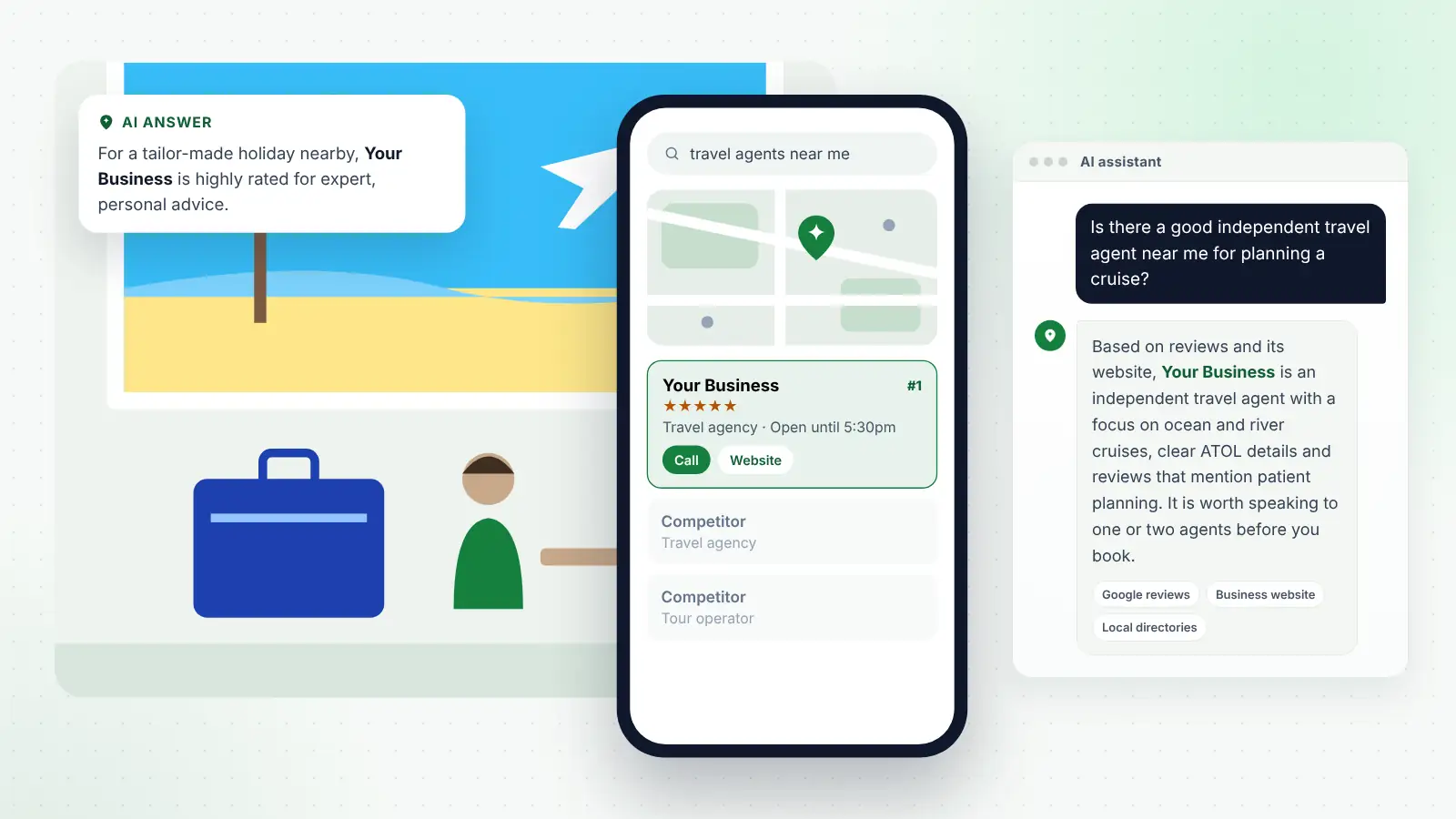
When people look for a travel agent, they often start with a search such as “travel agents near me”, “independent travel agent Harrogate”, “cruise specialist near me” or “honeymoon travel agent”. The agents shown on the Google map and in the top results are the ones that make the shortlist, and a homeworker with a well-built online presence can appear alongside high-street agencies.
Google Business Profile for homeworkers
Google’s guidelines allow a Business Profile for businesses that either have a location customers can visit or travel to customers. If customers visit your home office during set hours, you can show the address. If you meet clients at their homes, in local cafes or at events, you should set up a service-area business and hide your home address. A business that only ever deals with customers online or by phone does not meet the guidelines, and fake or virtual office addresses can lead to suspension. Google explains this in its Business Profile guidelines.
Once your profile is set up correctly:
- Choose accurate categories, such as Travel agency, and add specialist services like cruises or honeymoons.
- Set realistic service areas, covering the towns where you genuinely meet clients.
- Use your real business name, without adding keywords.
- Add real photos, including you, events you have run and places you have visited.
- Post regularly about travel evenings, new itineraries and seasonal advice.
- Answer questions in your description and services about protection, specialisms and how appointments work.
Reviews
Reviews are one of the strongest signals for both customers and search engines. Ask soon after clients return, while the trip is fresh. A personal message with a direct link works better than a generic email. Reviews that mention specific details, such as “she found us a cabin with step-free access” or “they sorted everything when our flight was cancelled”, are far more persuasive than a star rating.
Reply to every review calmly, without sharing booking details.
Consistent details, website and local links
Make sure your name, phone number, website and service area match everywhere, including Apple Maps, Bing, directories and your host’s agent finder. Your website should have a page for each specialism, a clear protection page, an about page with your story and experience, and pages for the main towns you serve if you genuinely work there.
Local links help too: a write-up in a community magazine, sponsoring a local club, a mention from a venue that hosts your travel evenings or a guest article on a local lifestyle site. If you would rather have specialists handle this, our local SEO for independent travel agents service covers profiles, listings, content and links.
Tip
If you sell under a host agency, make sure the details on its agent-finder page match your Google profile and website exactly. Inconsistent names and phone numbers are a common reason homeworkers are harder to find.
AI search and travel recommendations
More people now ask AI assistants for travel help. ChatGPT, Gemini, Perplexity, Copilot and Google’s AI Overviews are asked questions such as “Is there a good independent travel agent near me for cruises?”, “Who can help plan an accessible holiday to Spain?” or “Should I use a travel agent for my honeymoon?”. The answers often name specific businesses.
These tools build their answers from what they can find and trust across the web. For travel agents, that usually means:
- Consistent information about your business on your website, Google profile, host listing and directories.
- Reviews that describe your specialisms and service in detail.
- Clear service descriptions, so it is obvious that you specialise in cruises, ski or accessible travel.
- FAQ content that answers real questions in plain language, such as how protection works, what a planning fee covers or how far ahead to book a river cruise.
- Mentions on reputable sites, such as local news, community organisations, supplier partner pages and travel publications.
Pages that answer one question clearly, in plain language, are easier for AI tools to understand and quote. Check periodically by asking AI assistants the questions your customers ask and seeing what they say about you and your competitors.
Events and travel evenings
Events let people meet you before they book, which matters even more for homeworkers without a shopfront. Ideas that work:
- Cruise or destination evenings with a supplier representative, held in a local hotel, community venue or library.
- Small, focused sessions, such as “first-time river cruising” or “planning a family ski trip”.
- Talks for local clubs and groups.
- Wedding fairs if you specialise in honeymoons.
To get the most from each event:
- List it on your Google profile, website and local event listings.
- Collect contact details with clear consent.
- Follow up within a few days with a useful summary.
Seasonality, repeat business and referrals
Many people research and book big trips in the new year, while autumn can be quieter. Use quieter months to build content, run events and contact past clients about next year’s plans.
Repeat clients and referrals are the foundation of a strong agency:
- Make a welcome-home call to hear how the trip went and ask for a review.
- Send a short, useful newsletter rather than constant offers.
Tip
Keep a simple list of when each past client usually books. A personal message a few weeks before that time is often more effective than any advert.
Frequently asked questions
Do I need my own ATOL to sell package holidays from home?
Not necessarily. Many homeworkers sell as an agent for an ATOL holder, usually their host agency, under a written agency agreement. The customer must still receive an ATOL Certificate when they pay. If you want to organise packages under your own name, check the CAA’s requirements directly.
What are the package travel changes in 2027?
Amending regulations remove linked travel arrangements and widen the definition of a package. According to ABTA, they apply to bookings made after 6 April 2027, so check with your host or trade body how your bookings are affected.
Can I have a Google Business Profile if I work from home?
Yes, if you meet customers in person, either at your home office during stated hours or by travelling to them. If customers do not visit you, set up a service-area business with your address hidden. A business that only deals with customers online or by phone does not meet Google’s guidelines.
How long does local SEO take for a travel agent?
Getting your profile and travel listings in order can pay off within weeks. Stronger map rankings and AI visibility usually build over three to six months, so starting in the autumn helps you be visible for the new-year booking peak.
Final thoughts
Independent travel agents win on expertise, reassurance and personal service. The agents who grow are usually the ones who make those strengths visible: clear protection information, a genuine specialism, detailed reviews, regular local events and accurate information wherever customers and AI tools look.
Start with the basics: check your protection wording ahead of the 2027 changes, set up your Google profile correctly and ask your next few returning clients for a review.