Event styling is one of the most visible small businesses you can run. Every balloon garland, flower wall and dressed function room is photographed, shared and tagged, and a good set-up can bring in several new enquiries from a single party. It is also a business where the work behind the photos decides whether you last: venue rules, early load-ins, fire safety paperwork, deposits, storage and the logistics of getting fragile décor across town on a Saturday morning.
This guide covers choosing your services, the costs of setting up, the paperwork venues ask for, responsible balloon practice, pricing and terms for date-specific bookings, and how to get found by people searching for styling near them.
Key points
- Choose a lead service, such as balloon garlands, wedding styling or backdrop hire, and build your portfolio around it before adding more.
- Never offer or encourage balloon releases, weight every balloon securely and plan for helium supply problems with air-filled designs.
- Keep public liability insurance and flame-retardant certificates for drapes, backdrops and artificial flowers ready to send to venues.
- Use written terms with a booking fee, a clear balance date and cancellation charges that are fair and linked to your genuine loss.
- Venue supplier lists, Instagram and Pinterest bring much of the work, but a clear website and Google profile turn interest into bookings.
- Local SEO and AI search help you appear when people search for a specific service in a specific town or venue.
In this guide
- Decide what kind of styling business you are
- Set-up costs, kit and storage
- Balloons, helium and the environment
- Fire safety, insurance and venue paperwork
- Venue rules and load-in times
- Pricing, deposits and cancellation terms
- Instagram, Pinterest and venue supplier lists
- Local SEO: being found by people searching near them
- AI search: being recommended by assistants
- Frequently asked questions
- Next steps
Decide what kind of styling business you are
“Event styling” covers a wide range of work, and clients search for each part of it separately. It helps to decide early what you lead with, because that shapes your equipment, your vehicle, your pricing and the venues you work with.
Common service lines include:
- Balloon décor: organic garlands, arches, columns, balloon walls, bouquets and shop-front displays.
- Wedding styling: ceremony backdrops, aisle décor, table centrepieces, signage, chair covers and sashes, and full room dressing.
- Backdrop and prop hire: flower walls, sequin walls, neon signs, plinths, hoops and lounge furniture.
- Corporate styling: product launches, awards dinners, conferences, office celebrations and branded balloon work.
- Children’s party styling: themed set-ups, picnic-style tables, soft play add-ons and party décor packages.
A focused business is easier to recommend. “Balloon garlands and backdrops for parties across Leeds” tells people and search engines far more than “we do all events”.
Think about who you are selling to. Parents book parties a few weeks ahead, couples book wedding styling months ahead, and corporate clients care about invoices, timings and branding.
Set-up costs, kit and storage
You can start small, especially with balloons, but stock and transport costs grow quickly once you add hire items. The figures below are rough guides and vary by supplier, area and how much you buy second-hand.
| Item | Typical cost | Notes |
|---|---|---|
| Balloons, pumps and tools | £200–£1,000 | Electric inflators, sizers, glue dots, garland strip |
| Helium | Varies widely | Cylinder rental plus gas; supply can be disrupted |
| Backdrop frames and stands | £150–£800 | Hoops, mesh walls, panels and plinths |
| Flower wall or sequin wall | £300–£2,000 each | Must have flame-retardant evidence for venues |
| Chair covers and linens | £300–£1,500 | Depends on quantity; cleaning adds ongoing cost |
| Van or large estate car | £5,000–£20,000 | Used is common; high roof helps with tall items |
| Storage | £50–£300 a month | Many start at home, then rent a unit |
| Insurance | Varies | Public liability, equipment cover and business vehicle use |
| Website and branding | £300–£2,500 | A clear site with service pages matters more than design flourishes |
Buy one well-made flower wall before three cheap ones, and track how often each hire item is booked.
Tip
Before buying any fabric backdrop, artificial flower wall or drape, ask the supplier for a flame-retardant certificate and keep a copy. Venues increasingly refuse décor without one, and getting evidence after the event is booked can be difficult.
Balloons, helium and the environment
Never offer balloon releases
Released balloons come down as litter on land and at sea, where they can harm wildlife and livestock. Many councils have banned or discouraged balloon and sky lantern releases on their land and at events they control, and some venues ban them outright. Do not offer them, do not photograph them and politely decline if a client asks. Suggest alternatives such as bubbles, ribbon wands, a planted tree or a donation.
Latex and foil balloons
Latex balloons are made from natural rubber and are often described as biodegradable, but they can take a long time to break down and still cause harm if they escape. Foil balloons are made from a metallised film that does not biodegrade, and because the coating conducts electricity, escaped foil balloons can cause power cuts and fires if they touch overhead lines.
Good practice includes:
- Weight every helium balloon individually and securely, especially outdoors.
- Avoid metallic ribbon on foil balloons.
- Check outdoor displays for wind exposure and nearby power lines.
- Collect displays after events where you can, then deflate them and dispose of them properly.
- Tell clients how to deflate and dispose of balloons they keep.
If a balloon becomes caught in a power line, do not try to retrieve it. In Great Britain, report it to the local network operator by calling 105 (in Northern Ireland, contact NIE Networks), and call 999 if there is sparking or fire.
Helium supply
Helium is a finite resource with competing uses in medicine and industry, and party balloon gas tends to be low in the supply queue when there are shortages. In 2026, conflict in the Middle East disrupted shipments from Qatar, a major producer, and UK balloon suppliers warned of tighter supply. Check availability with your gas supplier before confirming large helium orders, and build air-filled designs, such as garlands, arches and columns on frames, into your packages. Many of the most popular styles never needed helium in the first place.
Follow your gas supplier’s guidance on storing and transporting cylinders safely.
Fire safety, insurance and venue paperwork
Venues have a legal duty to manage fire risk. In England and Wales, the Regulatory Reform (Fire Safety) Order 2005 places that duty on the “responsible person” for the premises, and official guidance for places of assembly recommends that drapes, curtains, display materials and artificial foliage are fire-retardant or treated. That is why venues ask you for evidence. Scotland and Northern Ireland have their own fire safety laws with similar principles. The government’s fire safety guidance for small and medium places of assembly gives a useful sense of what venues are thinking about.
What venues typically ask stylists for:
- Flame-retardant certificates for drapes, backdrops, flower walls, artificial foliage and fabric décor. Fabrics are often tested to a British Standard, such as BS 5867 for curtains and drapes, or treated with a recognised fire-retardant product. Some treatments need repeating after washing, so keep track of dates.
- Public liability insurance certificates, often with a minimum level of cover specified by the venue.
- Electrical safety records for LED signs, fairy lights and anything plugged in.
- Risk assessments and method statements for larger set-ups, especially tall structures or rigging.
Public liability insurance is not a general legal requirement, but most venues will not let you work without it, and it protects you if a guest trips over a weighted base or a structure falls. If you employ staff, you will normally need employers’ liability insurance by law. Consider cover for your hire stock while it is in storage, in transit and at venues.
Keep everything in one folder you can send the moment a venue asks.
Venue rules and load-in times
Venue rules decide a lot of how you work. Before every new venue, ask about:
- Access and load-in times, including whether you can set up the day before and when you must clear the room.
- Parking and unloading, lifts, stairs and distance from the van to the room.
- Fixings, such as whether tape, hooks, pins or freestanding frames only are allowed.
- Helium, candles, confetti and glitter, which many venues restrict.
- Collection, including late-night breakdowns and next-morning pick-ups, and who is responsible for hire items overnight.
Price for the realities: many stylists charge separately for early or late access, extra travel and overnight collection.
Pricing, deposits and cancellation terms
Event styling is date-specific. Once you accept a booking for a Saturday in June, you are usually turning other clients away, so your terms need to reflect that.
Building your prices
Work out the full cost of each package, including materials, helium, stock wear, cleaning, travel, set-up, breakdown and admin, then add a margin. Publish starting prices for popular packages so the right people enquire.
Deposits and cancellations
A common structure is a booking fee to secure the date, with the balance due a few weeks before the event. Write your terms clearly and explain them before the client pays.
Consumer law requires terms with consumers to be fair and transparent. A deposit or cancellation charge that is far more than your likely loss, or hidden in small print, may not be enforceable. Link charges to your genuine costs, such as materials already bought or a date you can no longer rebook, and reduce them where you can rebook.
Contracts agreed online or by phone normally give consumers a 14-day right to cancel under the Consumer Contracts Regulations 2013, with some exceptions, including certain leisure-related services provided on a specific date. Whether your services fall within an exception depends on what you provide, and hire of goods may be treated differently from styling services. Take advice from a solicitor or trade association when you draft your terms.
Tip
Include a simple clause on what happens if a venue changes its rules or access times after booking, such as banning helium or moving your load-in. Agreeing this in advance avoids awkward conversations close to the date.
Instagram, Pinterest and venue supplier lists
Styling is visual, and much of your marketing will be photos. Use them well.
- Instagram: post finished set-ups with the venue and town tagged, short reels of the build, and before-and-after shots of a plain room. Reply to enquiries quickly and link to a page with clear packages.
- Pinterest: pin your best work to boards organised by event type, colour and venue. Pinterest is used for planning, often months ahead, and each pin can link back to your website.
- Venue supplier lists: getting onto a venue’s recommended list is one of the strongest sources of wedding and corporate work. Ask for a meeting, offer to style a showround or open day, and follow house rules perfectly once you are booked.
- Other suppliers: florists, wedding planners, photographers, cake makers and marquee hire firms can all refer work. Many stylists complement florists rather than compete with them, for example by providing backdrops and props while the florist handles fresh flowers.
Ask permission before posting photos of clients, guests or children.
Local SEO: being found by people searching near them
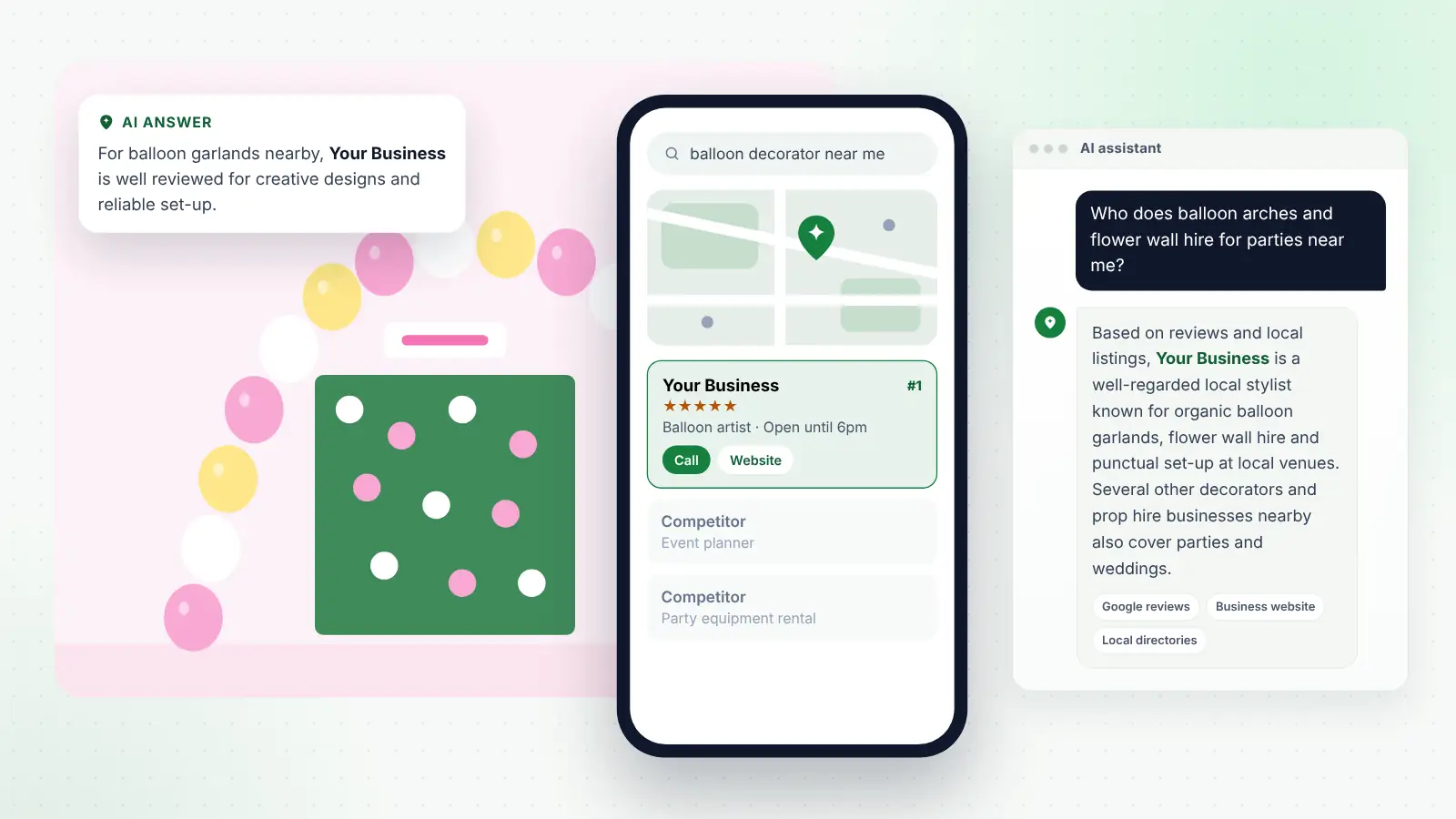
Most styling enquiries start with someone searching for a specific service near them: “balloon arch near me”, “flower wall hire Manchester”, “wedding chair covers Essex” or “kids party decorations near me”. The businesses that appear in Google’s map results and top listings for those searches get a large share of the enquiries, and those people are usually planning a real event with a date.
Everything local starts with your Google Business Profile. If you work from home, set it up as a service-area business and hide your address, listing the towns you cover. Choose the most accurate primary category, such as balloon artist or event planner, and add secondary categories that genuinely reflect your work. Fill in your services with clear descriptions, upload photos from real events regularly, and keep your hours and contact details up to date.
Reviews matter more than almost anything else. Ask every happy client for a review shortly after the event, while the photos are fresh. Reviews that mention the event type, venue and town, such as “beautiful garland for our daughter’s christening at the village hall”, help both people and search engines understand what you do. Reply to every review, including the occasional critical one, calmly and professionally.
Consistent details build trust: keep your name, phone number and website identical across your Google profile, social profiles, directories and venue supplier pages.
Your website should have a page for each main service, such as balloon garlands, wedding styling, flower wall hire and corporate events, with real photos, what is included, starting prices and answers to common questions. Add pages for the main towns or venues you work at where you have genuine work to show. A gallery of photos alone gives search engines little to understand, so add short descriptions of each event.
Local links from venues, suppliers, wedding blogs and community groups help Google trust your site. Ask venues whose supplier list you are on to link to you.
Local SEO takes consistent effort over several months. Some stylists handle it themselves; others prefer specialists. If you would rather focus on styling, our local SEO for event stylists and balloon decorators service covers your profile, listings, content and links.
AI search: being recommended by assistants
More people now ask AI assistants such as ChatGPT, Gemini, Perplexity and Copilot for recommendations, and Google often shows an AI Overview at the top of results. The questions are detailed: “Who does organic balloon garlands for baby showers near me?”, “Can you recommend a wedding stylist who works at barn venues in Kent?” or “Where can I hire a flower wall for a 40th birthday in Bristol?”.
These tools tend to draw on information they can find and check across the web. To give yourself the best chance of being recommended:
- Describe your services clearly on your website, using the words clients use, such as “balloon garland”, “flower wall hire” and “chair covers”.
- Name the areas and venues you work at, but only where it is true.
- Collect detailed reviews on Google and wedding directories that mention event types and venues.
- Keep details consistent across your website, Google profile, directories and social profiles.
- Add FAQs to your service pages, covering set-up times, venue paperwork, helium, what is included and how far you travel.
- Earn mentions on reputable local and wedding websites, such as venue supplier pages, local news and wedding features.
None of this guarantees a recommendation, but the same steps also help Google and the clients who visit your site.
Frequently asked questions
Do I need a licence to run an event styling business?
There is no specific licence to work as an event stylist or balloon decorator in the UK. You will need to register for tax, follow consumer law, and meet the requirements venues set, such as insurance and flame-retardant evidence. If you plan to run events yourself, such as styled open days in a public space, check with your local council whether any permissions are needed.
Are balloon releases illegal?
Rules vary by area. Many councils have banned or discouraged releases on land and at events they control, and venues often ban them too. Regardless of local rules, releases cause litter and harm to wildlife, so professional stylists should not offer them.
What flame-retardant certificates will venues ask for?
Usually certificates for any fabric or artificial décor, such as drapes, backdrops, flower walls and artificial foliage. These show the material has been tested or treated to resist fire. Ask your suppliers for certificates when you buy, and keep records of any re-treatment.
Should I specialise in balloons or offer full event styling?
Starting with one strong service builds a clear portfolio and reputation quickly. Many stylists start with balloons and add backdrops, props and wedding styling once they have stock, storage and venue contacts.
Next steps
Start by choosing your lead service and building a portfolio of real set-ups. Get your insurance and flame-retardant paperwork in order, write clear terms, and make sure your balloon practice is responsible. Then make yourself easy to find: a complete Google Business Profile, a website with a page for each service, steady reviews and good relationships with local venues.
Styling businesses that last are the ones venues trust and clients recommend.