Very few people buy a sofa, a bed or a mattress on impulse. They expect to live with it for years, it costs a meaningful amount, and comfort is personal in a way a photo cannot capture. That is the independent furniture shop’s great advantage: a showroom where people can sit, lie down, feel the fabric and talk to someone who knows how the frame is built.
The challenge is that most of those shoppers begin online. They browse online mattress brands and read reviews before deciding which showrooms to visit on a Saturday. If your shop does not appear, or your website does not answer their questions about lead times, delivery and taking the old sofa away, you will not make the shortlist.
This guide is for established independent furniture, sofa, bed and mattress retailers who want to grow. It covers positioning, delivery, fire safety and consumer law, finance, showroom events, and appearing in local search and AI recommendations.
Key points
- Decide what your showroom is known for, such as made-to-order sofas, a big mattress range or solid wood furniture, and make it obvious everywhere customers look.
- Lead times, delivery areas and old-furniture removal are deciding factors, so publish them clearly instead of leaving them to a conversation in store.
- Since 30 October 2025 the swing display label is no longer required, but upholstered furniture must still meet the fire safety rules and carry its permanent label.
- Made-to-order deposits and terms must be fair and explained before the customer orders, and introducing customers to regulated finance generally needs FCA authorisation.
- Your Google Business Profile, reviews and range pages feed both Google Maps and the AI assistants that people now ask for showroom recommendations.
In this guide
- Decide what your showroom is known for
- Understand how people search for sofas, beds and mattresses
- Make lead times, delivery and removal clear
- Get the fire safety rules right
- Handle made-to-order orders, deposits and consumer rights
- Offer finance properly
- Run showroom events that bring people through the door
- Local SEO for furniture and bed shops
- AI search and AEO for furniture retailers
- Frequently asked questions
- Final thoughts
Decide what your showroom is known for
Most independent furniture shops sell a broad mix, and that suits the customers who walk in. For marketing, though, a clear specialism gives people a reason to drive past the retail park to reach you. Pick two or three things you genuinely do better than anyone nearby.
Positions that work well for independents include:
- The made-to-order sofa specialist. A large fabric library, a choice of sizes and arm styles, and frames from makers you can name.
- The bed and mattress centre. A wide range of mattresses on the floor, knowledgeable comfort advice, divans, bed frames and adjustable beds.
- The solid wood and cabinet furniture shop. Dining sets, sideboards and bedroom furniture, often from British or European workshops.
- The comfort and mobility showroom. Riser recliner chairs and adjustable beds, with patient advice for older customers and their families.
Whatever you choose, list the brands you stock. Being the local stockist for a make people already like is one of the strongest reasons to visit.
Tip
Write one sentence that describes your shop as a happy customer would, such as “the family-run showroom with over fifty mattresses to try and its own delivery team”. Use it as the starting point for your homepage and your Google Business Profile description.
Understand how people search for sofas, beds and mattresses
Furniture searches tend to fall into a few groups, and it helps to know which ones you want to win.
| Search type | Typical examples | What the shopper wants |
|---|---|---|
| Showroom searches | “sofa shops near me”, “bed shops in [town]” | A place to visit this weekend |
| Product searches | “corner sofa bed”, “pocket sprung mattress king size” | A specific item, often with a budget in mind |
| Brand searches | “[brand] stockist near me” | A local shop selling a make they already like |
| Try-before-you-buy | “where can I try mattresses”, “sofa showroom open Sunday” | Reassurance before spending |
| Practical needs | “sofa delivered this week”, “furniture shop that takes old sofa away” | Speed, convenience or a problem solved |
Showroom searches are where Google Maps matters most. Product and brand searches are where your website and Google’s product listings help. Practical searches are often the most valuable, because the person is close to buying.
Make lead times, delivery and removal clear
The questions that decide many furniture sales are not about style at all. They are about when it will arrive, whether it will fit and what happens to the old one.
Be honest about lead times
Made-to-order sofas commonly take several weeks, and timings vary by manufacturer and season. Give a realistic timescale for each range on your website and in store, and say clearly when a piece is in stock and available sooner. A shopper who knows the wait can plan around it; one who is surprised by it is likely to complain. Keep customers updated if a date moves.
Spell out where you deliver and what it costs
Set out the towns you cover, what delivery costs in each zone, whether you offer room-of-choice delivery and assembly, and how you handle stairs and flats. A simple guide to measuring doorways and stair turns saves awkward delivery days.
Offer old-furniture removal, and do it properly
Taking away the old sofa or mattress is a strong selling point, but it comes with obligations. A business transporting other people’s waste must register as a waste carrier, and the government’s waste carrier registration page explains the tiers and fees for England, with separate arrangements in Scotland, Wales and Northern Ireland.
Upholstered domestic seating such as sofas, armchairs and sofa beds may contain persistent organic pollutants (POPs) in its foam and fabric. The Environment Agency requires waste seating of this kind to be kept separate and destroyed by incineration rather than landfilled. Mattresses and beds are not covered by those seating rules. Check that your waste contractor can handle each type of item correctly, and explain any removal charge on your website.
Tip
Add a “Delivery and removal” page with your areas, charges, lead times, access guidance and removal options. It answers the questions that stop people buying, and it is exactly the kind of clear information Google and AI assistants use.
Get the fire safety rules right
The Furniture and Furnishings (Fire) (Safety) Regulations 1988 apply to upholstered furniture supplied in the UK, including sofas, armchairs, sofa beds, futons, upholstered headboards, divans, bed bases, mattresses, pillows and cushions, along with their fillings and covers. They apply to second-hand upholstered furniture sold by a business as well as new.
The rules were updated by an amendment that came into force on 30 October 2025. The main changes for retailers are:
- The display (swing) label is no longer required at the point of sale, for new or second-hand furniture.
- The permanent label is still required on upholstered furniture, securely attached, and it carries the compliance information. Mattresses, divans and bed bases do not need this permanent label under the regulations, and are instead tested to the relevant British Standard.
- Many baby and children’s products, such as prams, pushchairs, cots, small children’s mattresses and baby walkers, are no longer within scope.
- Trading Standards now have up to 12 months to bring proceedings for non-compliance.
As a retailer you are not usually responsible for testing unless you are also the importer, but you must sell safe, compliant products. Buy from reputable manufacturers, check permanent labels are present and secure, keep supplier records so items can be traced, and ask your local Trading Standards service if you are unsure about a product.
Handle made-to-order orders, deposits and consumer rights
Made-to-order furniture is good business for independents, but the terms need to be clear and fair.
Cancellation rights depend on where the sale happens
The 14-day cancellation right under the Consumer Contracts Regulations applies to distance sales (online, phone or email) and off-premises sales, not to sales made in your showroom. There is an exception for goods made to the customer’s specification or clearly personalised, which generally have no cancellation right even when sold online. A sofa built in a chosen fabric and size is likely to fall within it; a standard model in a stock colour may not, so take advice if your ranges sit in between. For in-store sales, say clearly what your own policy is.
Deposits and balances
Explain the deposit amount, when the balance is due, and what happens to the deposit if the customer cancels before production starts. Terms that let you keep a large deposit regardless of your actual costs risk being unfair under the Consumer Rights Act 2015.
Faulty goods
Whatever your returns policy, customers have statutory rights if goods are faulty, not as described or not fit for purpose. A clear, calm process for dealing with problems protects your reputation. Membership of an alternative dispute resolution scheme such as the Furniture and Home Improvement Ombudsman is something many furniture retailers display as a trust signal.
Clear pricing
Show prices clearly, including any charges customers cannot avoid, and make compulsory delivery costs obvious before the customer commits.
Offer finance properly
Interest-free finance is common in furniture retail and helps customers buy the quality they want. The rules depend on the type of finance.
- Regulated credit through a lender. If you introduce customers to a finance provider so they can pay for your goods, you generally need FCA authorisation for credit broking, often under limited permission. The FCA’s guidance for consumer credit brokers explains the permissions involved.
- Buy now, pay later. Third-party deferred payment credit became regulated on 15 July 2026, with the lender rather than the merchant taking on the regulatory responsibilities. Most retailers offering a third-party option at checkout do not need their own authorisation for it, but your promotions of it generally need to be approved, usually by the lender, so use the lender’s approved wording and check the provider is authorised.
- Your own credit. Offering your own payment plans can bring you into lending regulation, so take advice first.
Whatever you offer, finance promotions must be clear, fair and not misleading. Avoid suggesting finance is guaranteed, and use the approved wording your finance partner provides for your website, tickets and signage.
Run showroom events that bring people through the door
Events give shoppers a reason to visit now rather than “some weekend”, and they create content for your website, social media and Google profile.
- New range previews. An evening for past customers when a new collection arrives, with the maker’s representative on hand.
- Mattress comfort clinics. Appointment slots for unhurried advice on support, firmness and sleeping position.
- Fabric and colour days. Help choosing fabrics with swatches to take home, perhaps with a local interior designer.
- Sale and clearance weekends. Ex-display and discontinued pieces, promoted to your mailing list first.
Add each event to your Google Business Profile as a post or event, publish it on your website and invite your mailing list.
Local SEO for furniture and bed shops
Showroom searches are local by nature, and the shops at the top of the Google map get far more calls, direction requests and visits than those further down. Local SEO is the work of making your shop the clearest, most trusted choice for those searches, and furniture shops start with useful advantages: photogenic showrooms and named brands.
Google Business Profile
Choose the most accurate primary category, such as “Furniture store”, “Mattress store” or “Bedding store”, and add relevant secondary categories. Then fill in everything:
- Opening hours, including Sundays, bank holidays and late evenings, kept up to date.
- Products for your main ranges, with photos and “from” prices.
- Regular photos of the showroom, new arrivals, room sets and your delivery team.
- A description that names your specialisms, key brands and the towns you deliver to.
- Posts for new ranges, events and seasonal offers.
Reviews
Ask every customer for a review after delivery, not at the till, when they have the furniture in their home and know how the experience went. A short message with a direct link works well. Reviews that mention comfort advice, fabric choice, the delivery team and how problems were handled carry the most weight with shoppers. Reply to every review calmly and constructively.
Matching showroom details on every directory
Your shop name, address and phone number should match exactly across your website, Google, Apple Maps, Bing, Facebook, UK directories and, importantly, the stockist lists on your brands’ websites. Ask each brand you sell to list you correctly and link to your site.
A website with range and area pages
Create a page for each main range and service, such as made-to-order sofas, mattresses, adjustable beds and dining furniture, with real photos, brands, lead times and price guides. Add a delivery page and, where you genuinely deliver regularly, pages for the main towns you cover. Avoid thin copies with only the town name changed.
Google’s free local product listings
If you keep stock in the showroom, Google Merchant Center lets you show in-store products in Google’s shopping results through free local listings, with paid local inventory ads as an option. You add your store by linking your Business Profile, then share which products are available in store, either from your website or through a local inventory feed.
Local links
Links from local news sites, community organisations, interior designers, letting agents and the brands you stock all help.
If you would rather have specialists handle the profile, listings, content and links, our guide to local SEO for furniture and bed shops explains how we approach it.
AI search and AEO for furniture retailers
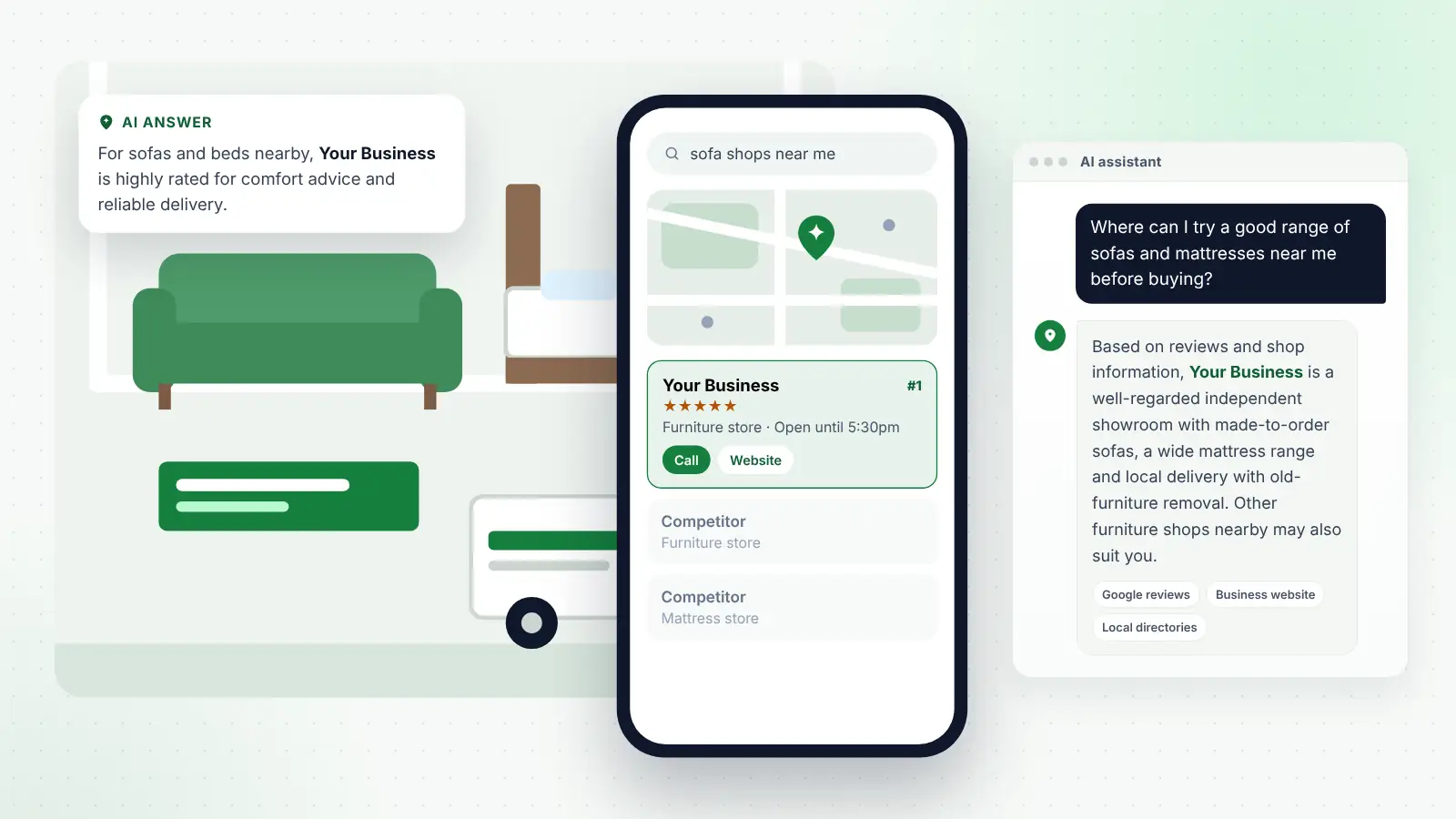
More shoppers now ask AI assistants such as ChatGPT, Gemini, Perplexity, Copilot and Google’s AI Overviews for help before they visit a shop. Answer engine optimisation (AEO) means making your business easy for those tools to understand, trust and recommend.
Typical questions include:
- “Where can I try mattresses near me before buying?”
- “Which independent sofa shops near me do made-to-order sofas?”
- “Who stocks [brand] beds near [town]?”
- “Is there a furniture shop that delivers to [village] and takes the old sofa away?”
AI tools build their answers from what they can find and cross-check. They tend to rely on:
- Consistent information across your website, Google profile, directories and brand stockist lists.
- Reviews that describe real experiences, such as comfort advice, careful delivery and good after-sales care.
- Clear range descriptions that say what you sell, which brands you stock and what makes your showroom different.
- FAQs that answer practical questions about lead times, delivery charges, removal, finance and returns.
- Mentions on reputable sites, such as local news, community websites and the brands you stock.
The practical steps are much the same as good local SEO. A website that states “we deliver to these twelve towns and can remove your old sofa for a set fee” is far easier for an AI assistant to recommend than one that says “nationwide delivery available, ask in store”.
Tip
Ask an AI assistant the questions your customers ask, such as “where can I try mattresses in [town]?”. Note what it says about you and your competitors, then fix any gaps or inaccuracies in your own information.
Frequently asked questions
Do I still need display labels on new sofas?
No. Since 30 October 2025 the display or swing label is no longer required under the fire safety regulations. Upholstered furniture still needs to comply with the regulations and carry its permanent label, so check new stock on arrival.
Do I need FCA authorisation to offer interest-free credit?
If you introduce customers to a lender for regulated credit, you generally need FCA authorisation for credit broking. Third-party buy now, pay later works differently, as the lender is the regulated party. Speak to your finance provider and check the FCA’s guidance before you start.
How long does local SEO take for a furniture shop?
Profile and listing fixes can bring extra showroom visits within weeks, while higher map positions and AI recommendations tend to take three to six months, so begin well ahead of your big sale weekends.
Final thoughts
An independent furniture shop wins on things that the internet cannot easily copy: comfort you can feel, advice from people who know the products, and a delivery team that treats a customer’s home with care. The job now is to make those strengths visible before the shopper leaves the house: clear information about ranges, lead times, delivery and finance, compliant products and terms, and a steady stream of reviews. Do that consistently and both Google and the AI assistants will have good reasons to send shoppers your way.