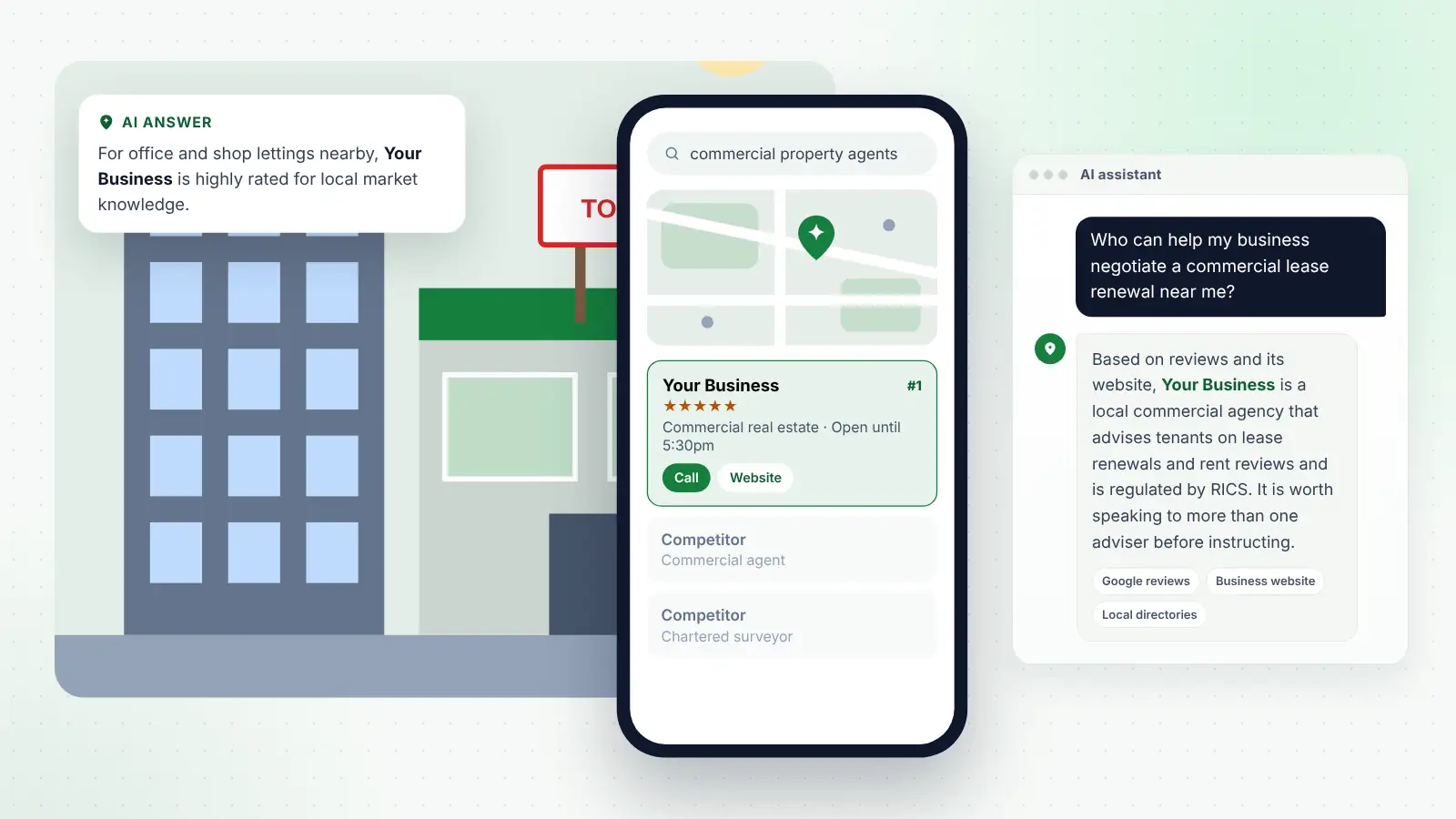
Commercial property agency has always been a relationship business. The landlord who instructs you on a vacant warehouse probably knew one of your partners, and the café owner taking a high street unit may have been introduced by their accountant. Those relationships still matter, but they no longer explain where all the work comes from. A growing share of first contact now starts with a search on Google, a look at a firm’s website or a question put to an AI assistant.
That shift matters most for independent and regional firms, because a small business owner who needs a workshop, a landlord with an empty shop or a tenant facing a rent review usually wants someone local who knows the rents, the landlords and the stock. Many of them do not have an agent in mind, so they search for one.
This guide is for commercial agents and surveyors handling office, retail and industrial lettings and sales, lease renewals and rent reviews, acquisitions for occupiers, business rates and investment work. It covers regulation, the 2026 changes to leases and rates, portals, and how to be found on Google and in AI search.
Key points
- Agency instructions follow the market, so advisory work such as lease renewals, rent reviews and rates challenges helps smooth out fee income.
- RICS members and regulated firms must follow the mandatory parts of the Code for Leasing Business Premises, including written heads of terms, in England and Wales.
- The Estate Agents Act 1979 covers commercial sales work, commercial estate agencies must register with HMRC for anti-money laundering supervision, but compulsory redress applies only to residential work.
- The 2026 business rates revaluation, energy efficiency rules and the coming ban on upwards-only rent reviews all give occupiers and landlords reasons to seek advice.
- Portals market the property; your Google profile, website and reviews market the firm.
- Local search and AI assistants increasingly decide which agent a business owner calls first.
In this guide
- Know where your instructions come from
- Build a mix of agency and advisory work
- RICS regulation and the Code for Leasing Business Premises
- The Estate Agents Act, redress and money laundering
- Business rates after the 2026 revaluation
- Energy efficiency rules for commercial lettings
- Rent reviews and the ban on upwards-only clauses
- Portals, boards and your own website
- Local SEO for commercial property agents
- AI search: how occupiers and landlords ask for advice
- Referrals, lease events and staying in touch
- Frequently asked questions
- Final thoughts
Know where your instructions come from
Before spending money on marketing, look at the last two years of instructions and sort them by source: existing landlord clients, referrals from solicitors and accountants, board enquiries, portal leads, direct searches, repeat occupiers and pitches. Then sort them by fee, not just by number. Knowing which channels bring the clients you want tells you where to focus.
Build a mix of agency and advisory work
Lettings and sales income rises and falls with the market. Advisory work is steadier, because leases expire, rent reviews fall due and rates bills change whatever the economy is doing.
| Service | Typical client | What triggers the search | Why it matters |
|---|---|---|---|
| Lettings and sales | Landlords and owner-occupiers | A vacancy, a sale or a relocation | Core agency fees and board visibility |
| Lease renewals | Tenants and landlords | A lease nearing expiry | Recurring, predictable work |
| Rent reviews | Tenants and landlords | A review date in the lease | Often success-based fees |
| Acquisitions for occupiers | Growing or relocating businesses | Expansion, a new site or a break clause | Long-term client relationships |
| Business rates | Occupiers and landlords | A new rateable value or bill | Strong demand after a revaluation |
| Investment | Private investors and funds | Buying or selling let property | Higher-value instructions |
Each of these is searched for separately, by people who describe it in their own words. A tenant does not search for “lease advisory”; they search for “help with commercial lease renewal” or “is my new rent too high”. Your website and marketing need to meet them there.
RICS regulation and the Code for Leasing Business Premises
Clients choosing a commercial adviser increasingly ask whether a firm is regulated by RICS. Firms that are registered for regulation can use the “Regulated by RICS” designation, and individual members can describe themselves as chartered surveyors where they hold that status. Use these terms accurately and only where they apply.
The RICS professional statement Code for leasing business premises came into effect on 1 September 2020 for lettings of business premises in England and Wales. Its mandatory provisions apply to RICS members and regulated firms, and it excludes some lettings, such as lettings of six months or less, premises intended to be wholly sublet and premises used only for plant, equipment or advertising. In practice, the Code requires agents to:
- Negotiate leases in a constructive and collaborative way, aiming for a fair balance of the parties’ interests.
- Tell any party who is not represented by a property professional about the Code and its supplemental guide, and advise them to take professional advice.
- Put written heads of terms in place, marked “subject to contract”, before the first draft lease is circulated, with some flexibility for renewals on the existing lease terms.
- Cover the key terms in those heads of terms, including the premises, the length of term, whether the Landlord and Tenant Act 1954 security of tenure applies, break rights, rent and incentives, rent review, any guarantor or deposit, service charges, insurance, repairs, alterations, use, assignment and subletting, and any conditions of the letting.
The Code is also a marketing point. Explaining in plain English how you follow it shows unrepresented first-time tenants that you treat both sides properly.
The Estate Agents Act, redress and money laundering
Some consumer-style property rules reach commercial agents and some do not.
Estate Agents Act 1979
The Estate Agents Act 1979 covers estate agency work on commercial and agricultural property as well as homes. That includes the requirements to give clients clear information about fees and services before they instruct you and to declare any personal interest. Arranging lettings and property management are outside the Act’s definition of estate agency work. The National Trading Standards Estate Agency Team is the lead enforcement authority.
Redress schemes
The legal requirement to belong to an approved redress scheme, such as The Property Ombudsman or the Property Redress Scheme, applies to estate agency work on residential property. A firm that only handles commercial work is not required to join, although schemes accept commercial members voluntarily, and RICS-regulated firms must have their own complaints handling arrangements. If you take on any residential sales or lettings, check your position carefully.
Anti-money laundering
Commercial estate agencies must register with HMRC for anti-money laundering supervision; HMRC’s registration guide for estate agency businesses lists commercial agencies among the businesses that need to register. Letting agency businesses must also register where they handle lettings with a rent of 10,000 euros or more a month, and those rules cover commercial lettings too. Registered firms need a written risk assessment, customer due diligence on clients and, for sales, on the other party, staff training and good records.
Tip
Write a short “How we work” page that sets out your regulation, complaints procedure, professional indemnity cover and money laundering checks. Landlords and occupiers find it reassuring, and it gives search engines and AI tools a clear, factual picture of your firm.
Business rates after the 2026 revaluation
New rateable values in England and Wales took effect on 1 April 2026, based on rental values at 1 April 2024. In England the system has also changed: from 2026/27 there are separate, lower multipliers for qualifying retail, hospitality and leisure properties with rateable values under £500,000, and a higher multiplier for properties valued at £500,000 or more. A redesigned transitional relief scheme limits how quickly bills can rise for properties whose values went up.
For occupiers, that combination is confusing. Many will see a new figure, not know whether it is right and not know who to ask. That is a strong opening for rating surveyors and general practice firms:
- Publish a plain-English page explaining what changed in April 2026 and how to check a rateable value on GOV.UK.
- Explain the Valuation Office Agency’s check and challenge process and when an appeal to the tribunal may follow.
- Be clear about how you charge, whether a fixed fee, a success fee or a mix, and avoid any suggestion that a reduction is guaranteed.
A business you help with its rateable value may well instruct you when its lease comes up for renewal.
Energy efficiency rules for commercial lettings
The Minimum Energy Efficiency Standards make it unlawful to let non-domestic property in England and Wales with an EPC rating below E, unless a valid exemption is registered. Since April 2023 that has applied to existing lettings as well as new ones.
The longer-term picture has been uncertain for years. In June 2026 the government published an interim response proposing that privately rented non-domestic buildings over 1,000 square metres should reach EPC B from 2031 where improvements are cost-effective, with smaller buildings staying at E for now and a previously proposed interim step to EPC C dropped. That is a stated direction, not yet law: the regulations still need to be amended and a fuller response is expected. Word anything you publish carefully and keep it under review.
Landlords need to know whether a building can be let, what works might be needed and how ratings affect value, and occupiers want to know whether works will appear in service charges. Firms that explain this clearly are easier to instruct.
Rent reviews and the ban on upwards-only clauses
The English Devolution and Community Empowerment Act 2026, which received Royal Assent in April 2026, includes a ban on upwards-only rent review clauses in new and renewal business leases. The ban does not take effect until commencement regulations are made, and at the time of writing a date has not been confirmed. Existing leases are generally unaffected, although renewal leases granted under options or agreements entered into from 17 March 2026 onwards could be caught.
This will change how reviews are negotiated and gives both sides a reason to take advice now. Useful content includes:
- What the ban means for leases being agreed today.
- How stepped, index-linked and open market reviews compare.
- What tenants with existing upwards-only clauses should expect at their next review.
Keep this content clearly dated and update it as the position becomes clearer.
Portals, boards and your own website
Specialist portals remain the main way to market available stock. Rightmove has a commercial search, and CoStar’s LoopNet, formerly known in the UK as Realla, is widely used alongside CoStar’s research and deal data. Many occupiers also find space through local agents’ own listings and boards.
Portals sell the property, not the firm. A landlord choosing an agent, or a tenant choosing an adviser, will look at your website, reviews and deal history. So:
- Keep your own website’s availability list current and link each listing to the relevant sector page.
- Publish a regularly updated deals page showing lettings, sales and advisory successes, with client permission.
- Add a short market commentary for each town or business park you cover.
Local SEO for commercial property agents
When someone searches for “commercial property agents near me”, “industrial units to let in [town]” or “rent review surveyor”, Google usually shows a map with three businesses before the ordinary results. Many landlords and business owners contact one of those firms without scrolling further, particularly when they want someone who knows the area.
The essentials for a commercial agency are:
- A complete Google Business Profile for each office. Choose the most accurate primary category, add secondary categories only where they apply, list your services, describe the sectors and areas you cover and keep opening hours correct.
- Real photographs and updates. Schemes you have let, completed deals, your team on site and local market updates. Post new instructions and market reports as updates.
- Steady, genuine reviews. Ask landlords, occupiers and advisory clients to review you when a deal completes. Reviews that mention a specific service, such as a renewal or a rates challenge, are especially useful.
- Consistent details everywhere. Your name, address and phone number should match across your website, Google, Apple Maps, Bing, portals, RICS listings and local business directories.
- A page for each service and sector. Offices, retail, industrial, lease renewals, rent reviews, acquisitions, business rates and investment each deserve a clear page explaining who it is for, how you work and how fees are structured.
- Area pages that say something. Real local insight, availability and recent deals for each town or business park you cover.
- Local and industry links. Coverage in local business news, chamber of commerce membership, sponsorship of business events and mentions on property sites help Google trust that you are established.
If you would rather have specialists handle it, our local SEO for commercial property agents covers your profiles, listings, service content and links on a rolling monthly plan.
Tip
Ask for a review at the moment a deal completes or a rent review is settled, with a direct link to your Google review form. Clients are most willing to write a detailed review when the outcome is fresh.
AI search: how occupiers and landlords ask for advice
Many business owners now ask AI assistants such as ChatGPT, Gemini, Perplexity, Copilot and Google’s AI Overviews for help with unfamiliar property decisions. Their questions are long and specific: “my lease ends next year, who can help me negotiate a renewal near me?”, “how do I challenge my business rates after the revaluation?” or “which commercial agents in [town] let industrial units?”
These tools rely on information they can find and cross-check. For a commercial firm, that means:
- Clear service descriptions. Say plainly that you act for tenants on lease renewals, that you handle rent reviews for landlords and tenants, or that you cover particular sectors and towns.
- Answers to common questions. FAQs on heads of terms, the Landlord and Tenant Act 1954, rates challenges, energy ratings and rent review clauses give assistants accurate material to draw on.
- Consistent firm information. The same name, address, services and regulation status on your website, Google, portals and directories.
- Mentions on reputable sites. Local business news, property press, professional directories and chamber of commerce listings help AI tools recognise you as an established firm.
Nobody can guarantee an AI recommendation, but the same work that helps a business owner choose you is what these tools rely on. Ask a few typical questions yourself every few months, note what comes back and correct any outdated information at its source.
Referrals, lease events and staying in touch
Search brings new clients, but relationships keep them:
- Track lease events. Keep a record of lease expiries, break dates and review dates in your area, and contact occupiers well before them.
- Work with other professionals. Commercial solicitors, accountants, business bankers, developers and fit-out firms all meet businesses at the moment they need property advice. Be useful to them, with quick answers and clear referrals back.
- Report on the market. A short quarterly update on rents and recent deals keeps your name in front of landlords and doubles as website content.
Frequently asked questions
Do commercial-only agents need to join a redress scheme?
No legal requirement applies to firms that only handle commercial work, because compulsory redress covers estate agency work on residential property. You can still join a scheme voluntarily, and RICS-regulated firms must have their own complaints procedure.
Is the RICS Code for Leasing Business Premises compulsory?
Its mandatory provisions apply to RICS members and regulated firms for lettings of business premises in England and Wales, with some exclusions.
Has the ban on upwards-only rent reviews started?
The ban is in the English Devolution and Community Empowerment Act 2026, but it only takes effect once commencement regulations are made. Check the current position before advising on any new lease or renewal.
What is the current minimum EPC rating for commercial lettings?
In England and Wales, non-domestic property generally cannot be let with an EPC rating below E unless an exemption is registered. The government has proposed EPC B from 2031 for larger buildings, but that still needs legislation.
How long does local SEO take to work for a commercial agency?
A sharper Google profile and accurate listings can start helping within weeks. Climbing the map and being named by AI assistants usually takes three to six months, depending on how crowded your local commercial market is.
Final thoughts
The commercial firms that grow are the ones landlords and occupiers find easily, trust quickly and recommend afterwards. Build a balance of agency and advisory work, keep your regulation and compliance in order, explain the changes to rates, energy rules and rent reviews clearly, and make sure all of that is visible on Google Maps, on your own website and in the AI tools business owners increasingly ask.