Opening a tattoo studio is a big step for any artist. It gives you control over the work you take on, the artists you work alongside and the standards your clients experience, and a studio with a strong reputation can keep its books full for months ahead. It also brings responsibilities that go well beyond tattooing: council registration, infection control, record keeping, staffing, rent and marketing.
Most studio owners start as resident or self-employed artists in someone else’s shop, building a portfolio and a client base before going it alone. The studios that do well after opening usually share a few traits. They are spotless and clearly compliant, they have a recognisable style or a well-chosen team, they make the consultation and booking process easy, and they are easy for new clients to find and trust.
This guide covers the practical steps for opening a tattoo studio in the UK, including the licensing differences between England, London, Wales and Scotland, the legal age limit, infection control and the business decisions that shape a profitable studio. Where the rules depend on your area, it says so, so you know when to check with your council.
Key points
- Outside London, councils in England register both tattoo premises and each individual artist under the Local Government (Miscellaneous Provisions) Act 1982, and you must follow the council’s byelaws.
- In most London boroughs you need a special treatment licence, in Wales tattooists fall under the national special procedures licensing scheme, and in Scotland a skin piercing and tattooing licence is required.
- Tattooing anyone under 18 is a criminal offence under the Tattooing of Minors Act 1969, even with a parent’s consent, so check photo ID every time.
- Infection control is central to your registration, your reputation and your insurance, and national guidance recommends hepatitis B vaccination for artists.
- Clients search by style as well as by location, so local SEO and AI search visibility should be built around your artists and the work they do best.
In this guide
- Decide what kind of studio you want to open
- Licensing and registration
- The legal age limit and consent
- Infection control and hygiene
- Insurance
- Premises, fit-out and startup costs
- Artists, staffing and chair rental
- Pricing, deposits and booking
- Local SEO: getting found by nearby clients
- AI search: when people ask an assistant for a tattoo artist
- Frequently asked questions
- Final thoughts
Decide what kind of studio you want to open
Your studio’s identity affects everything from the premises you choose to the clients you attract. Before you look at units or talk to artists, decide how you want the studio to work.
Common models include:
- A custom, appointment-only studio, focused on bespoke pieces and larger projects, often with long waiting lists.
- A street shop, open to walk-ins as well as appointments, with a broad range of styles and a busy front desk.
- A specialist studio known for one or two styles, such as realism, Japanese, blackwork or fine line.
- A private studio, often a single artist or a small team working by appointment in a quieter location.
- A tattoo and piercing studio, adding piercing for regular footfall and a broader client base.
Think honestly about your own work and reputation. A studio built around artists with distinct, complementary styles gives clients a clear reason to choose you, and makes your marketing far easier than trying to be all things to everyone.
Licensing and registration
Tattooing is regulated in every part of Great Britain, but the system depends on where your studio is. Contact your council’s licensing or environmental health team early, ideally before you sign a lease, because they may want to inspect the premises before you open.
England outside London
Most councils in England regulate tattooing under the Local Government (Miscellaneous Provisions) Act 1982. Both the premises and each person who tattoos there must be registered with the council, and registration usually involves an inspection by an environmental health or licensing officer. Councils adopt byelaws covering hygiene, cleanliness and the cleansing and sterilising of equipment, and you must display your registration certificate and a copy of the byelaws. Working without registration or breaching the byelaws is an offence and can lead to fines and the loss of your registration.
Registration is often a one-off rather than an annual licence, but every new artist who joins the studio, including guest artists, will usually need to be registered too. Check your council’s process for guest spots before you book them.
London
Most London boroughs regulate tattooing through special treatment licensing under the London Local Authorities Act 1991. Premises licences are typically renewed every year, and boroughs set their own conditions on hygiene, records and the artists working there. Requirements vary between boroughs, so check your own council’s conditions carefully.
Wales
Wales has a national licensing scheme for special procedures under the Public Health (Wales) Act 2017, covering tattooing (including semi-permanent make-up and microblading), body piercing, electrolysis and acupuncture. Each practitioner needs a special procedure licence, and the premises or vehicle used needs an approval certificate. The Welsh Government’s guidance on the special procedures licensing scheme explains who needs what, and your local authority handles applications.
Scotland
In Scotland, tattooing and skin piercing businesses need a licence from their council under the Civic Government (Scotland) Act 1982, as extended by a 2006 order covering skin piercing and tattooing. Councils usually inspect premises through environmental health before granting a licence, and licence conditions cover hygiene, records and age checks. If you plan to tattoo at events or from a vehicle, ask your council how its licensing applies.
Other council checks
- Planning. Check that your premises can be used as a tattoo studio, especially if the unit was previously used for something else.
- Business rates. Ask about the rateable value and any small business rate relief.
- Signage. A large or lit shopfront sign for the studio may need advertisement consent.
- Music. Playing music for clients usually requires TheMusicLicence from PPL PRS.
- Waste. You will need a licensed contractor to collect sharps and any hazardous waste.
Tip
Ask the council for a copy of its byelaws or licence conditions before you design your fit-out. Building the studio around them from the start is much cheaper than altering it after an inspection.
The legal age limit and consent
The Tattooing of Minors Act 1969 makes it a criminal offence to tattoo anyone under the age of 18, except where the tattoo is carried out for medical reasons by a qualified medical practitioner or someone working under their direction. A parent’s or guardian’s consent makes no difference, and nor does the client’s own consent. The only defence is that you had good reason to believe the person was 18 or over, which is why checking photo ID is standard practice.
Good consent and record-keeping habits protect both you and your clients:
- Check photo ID for anyone who might be under 25, and record that you have done so.
- Use a written consent form covering medical history, allergies, medication, skin conditions and anything that could affect healing.
- Explain the process — what will happen, how long it will take, the risks and how healing works — so consent is properly informed.
- Refuse when appropriate, for example if a client is under the influence of alcohol or drugs, or if a medical condition means they should speak to their doctor first.
- Keep records securely and for as long as your council or insurer requires, in line with data protection law.
Piercing has its own age considerations, and the rules differ between the nations of the UK. In Wales, it is an offence under the Public Health (Wales) Act 2017 to perform an intimate piercing on anyone under 18. In Scotland, licence conditions generally require a parent or guardian to give consent and be present when anyone under 16 is pierced. England has no specific statutory minimum age for most piercings, but many studios set their own minimum ages, particularly for intimate piercings. Check the rules for your nation and your council’s conditions before adding piercing to your services.
Infection control and hygiene
Infection control is at the heart of tattooing. It is what your council inspects, what your insurer expects and what clients increasingly look for before they book. National guidance for tattooing and body piercing, produced with public health and environmental health bodies, sets out the standards most councils expect.
Core practices
- Use sterile, single-use needles, and check them before use.
- Decontaminate reusable equipment properly. If you use an autoclave for reusable items, it must be suitable for the job, maintained and tested, with records kept of each cycle. Many studios now use single-use grips and tubes to reduce the risk.
- Keep the workstation clean, with surfaces that can be easily disinfected, barrier film on equipment and fresh disposable coverings for each client.
- Hand hygiene. Provide a dedicated hand-washing basin with hot and cold water, liquid soap and paper towels, and use fresh disposable gloves for each client.
- Inks and products. Use single-use portions of ink for each client and never return unused ink to the bottle.
- Sharps and waste. Dispose of needles immediately in an approved sharps container, and arrange collection by a licensed waste contractor.
Hepatitis B vaccination
Tattoo artists are at risk of exposure to blood-borne viruses through needlestick injuries and splashes. National tattooing and body piercing guidance recommends that anyone at risk of exposure to blood or body fluids has a full course of hepatitis B vaccination, with a follow-up blood test to check it has worked. Where artists are employees, employers are expected to pay for protective measures such as vaccination. Keep a record of each artist’s vaccination status, and have a clear procedure for what to do after a needlestick injury.
Many councils also expect, or encourage, artists to complete an infection control course. Even where it is not required, it is a sensible investment and something you can show clients.
Insurance
Most tattoo studios need:
- Public liability insurance, covering injury to clients or visitors on your premises.
- Treatment or professional liability insurance, covering tattooing and any other services such as piercing or laser removal.
- Employer’s liability insurance, required by law in most cases if you take on employees such as a studio manager or apprentice on the payroll.
- Buildings, contents and equipment cover, including machines and power supplies.
- Business interruption cover, if you rely on the studio for most of your income.
If artists work in your studio on a self-employed basis, make sure each holds their own treatment insurance, and keep copies of their certificates alongside their council registration.
Premises, fit-out and startup costs
Look for premises that suit the kind of studio you want. A street shop benefits from visibility and footfall, while a custom studio can work well on a quieter street or first floor where rent is lower. You will need separate, easily cleaned working areas, a dedicated hand-washing basin, a toilet, good lighting, a waiting area away from the workstations and secure storage for clean equipment and waste.
The figures below are rough guides only. Costs vary widely by area, size and the condition of the premises.
| Cost | Typical range | Notes |
|---|---|---|
| Lease deposit and legal fees | Often several months’ rent | Have a solicitor review the lease |
| Fit-out, flooring, plumbing and lighting | A few thousand to tens of thousands of pounds | Surfaces must be easy to clean |
| Workstations, chairs and beds | Varies by quality and number | Adjustable, wipe-clean furniture |
| Machines, power supplies and tools | Varies widely | Many artists bring their own |
| Autoclave or single-use supplies | Varies by approach | Factor in ongoing consumable costs |
| Sharps and waste collection | Regular contract fee | Required from the day you open |
| Council registration or licence | Varies by council | London licences usually renew annually |
| Insurance | Annual premium | Depends on services and staff |
| Booking and deposit system | Monthly subscription | Look for consent forms and reminders |
Set aside enough to keep the studio running for several months before the books are full. Fit-outs, landlord consents and council inspections often take longer than expected.
Artists, staffing and chair rental
Most studios combine some of the following arrangements:
| Model | How it works | Things to consider |
|---|---|---|
| Employed artists | You pay a wage and set hours and policies | PAYE, holiday pay and pensions apply |
| Commission split | Self-employed artists share each job’s income with the studio | Agree splits, deposits and supplies in writing |
| Chair or desk rental | Artists pay a fixed fee to work from your studio | Must genuinely reflect self-employment |
| Guest artists | Visiting artists work for a set period | Check council registration for each guest |
Self-employed arrangements must reflect reality. HMRC looks at factors such as who controls the work, prices and hours, and its Check Employment Status for Tax tool can help you test an arrangement. Take advice from an accountant and put agreements in writing, covering commission or rent, supplies, deposits, client ownership and what happens when an artist leaves.
A front-of-house or studio manager can make a big difference as you grow. Handling enquiries, deposits, consent forms and the diary frees artists to focus on design and tattooing.
Pricing, deposits and booking
Tattoo pricing varies by style, size, placement and the artist’s experience, so most studios combine a few approaches: a minimum charge for small pieces, an hourly rate, day rates for large sessions and quotes for custom work. Publishing guide prices and a minimum charge helps clients plan and filters out enquiries that are unlikely to go ahead.
Deposits are standard and protect artists’ time, especially for custom designs. Make your policy clear wherever people book: how much the deposit is, whether it covers design time, how it is deducted from the final price, how much notice you need to move an appointment and when deposits are forfeited. Clear policies reduce disputes and make clients more comfortable committing.
Advertising for tattoo studios is covered by the CAP Code, which the Advertising Standards Authority enforces across websites and social media. Keep claims accurate, use genuine photos of your own work, and if you offer laser tattoo removal, be careful not to overstate how many sessions it takes or promise complete removal. Since you cannot tattoo under-18s, avoid aiming promotions at younger audiences.
Local SEO: getting found by nearby clients
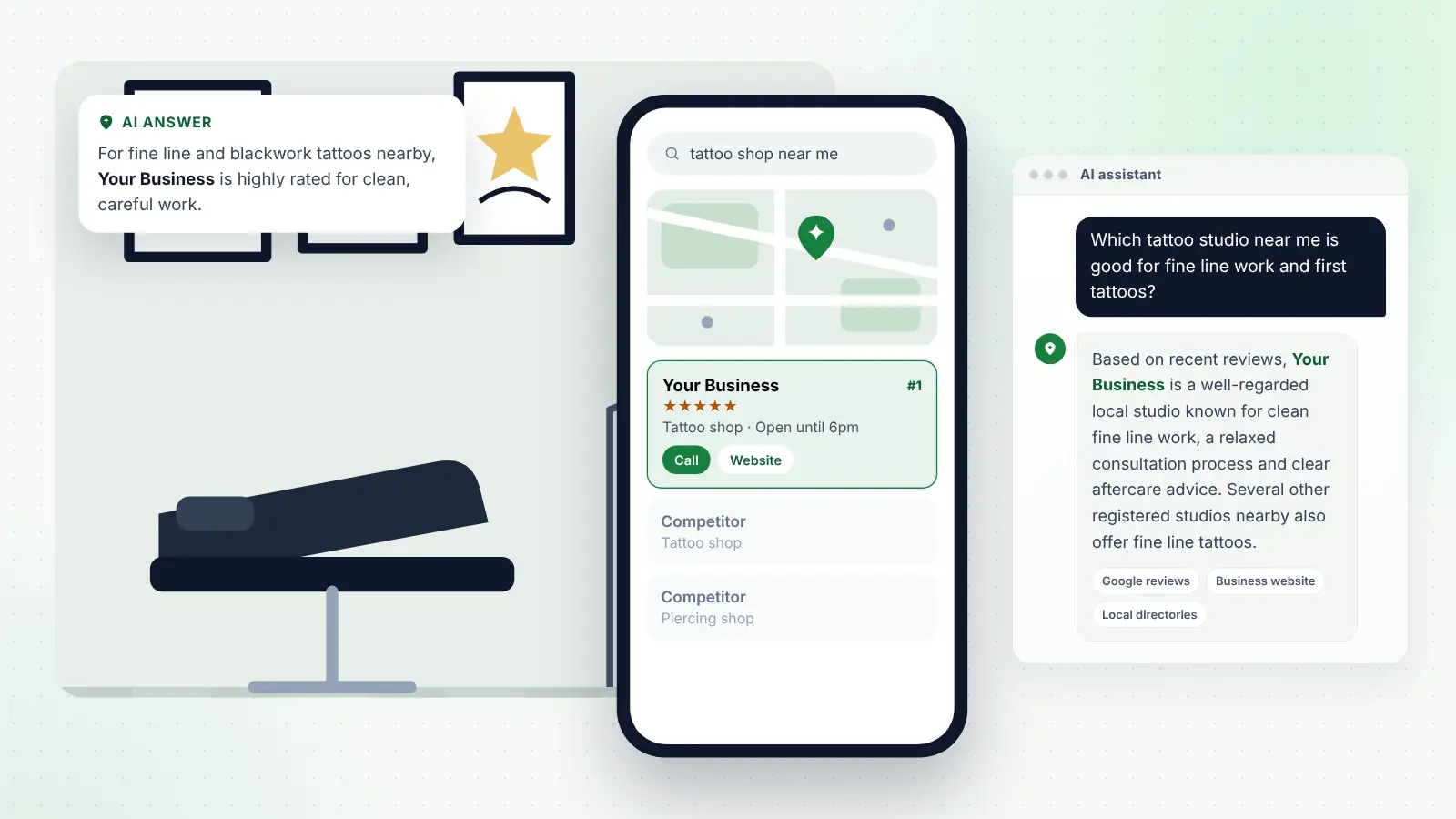
Most people get tattooed within travelling distance of home, and many start with a search. Some search broadly — “tattoo shop near me”, “tattoo studio [town]”, “walk in tattoo today” — but many search for the style or type of work they want: “fine line tattoo near me”, “cover up tattoo artist”, “realism tattoo [city]”, “small tattoo walk in”, “ear piercing near me”. Local SEO is about making sure your studio appears for those searches and looks like a trustworthy, skilled choice.
Social media is where many artists show their work, but it rarely helps you appear when someone types a search into Google or Maps. The map results, with their star ratings and photos, are often the first thing people see.
Fill your Google profile with healed work and artist bios
Choose “Tattoo shop” as your primary category, and add secondary categories such as “Body piercing shop” only if they genuinely apply. Describe your styles, your artists and how booking and deposits work, keep opening hours accurate and say whether you accept walk-ins. Post photos regularly, including healed work, the clean studio and the team. Healed photos show clients how your work looks long after the session.
Collect reviews at the session and after healing
Reviews influence where you appear and whether people enquire. Ask clients when they are delighted with their new piece, and again when you check in after healing. Reviews that mention the artist, the style, the experience and how well the tattoo healed help you appear for those specific searches. Answer each one in a measured, friendly way, even a complaint about a touch-up.
Keep the studio’s name, address and hours identical everywhere
Your studio name, address, phone number and website should be identical on Google, Apple Maps, Bing, Facebook, Instagram, tattoo directories and local listings. If you move, update everything.
Give each artist and style a page
Your website should have a page for each artist, showing their portfolio, styles, availability and how to book with them, plus pages for key styles and services such as cover-ups, fine line or piercing. Add an aftercare page and an FAQ page covering pain, healing, pricing, deposits, ID and what to expect at a consultation. Show your council registration or licence clearly. This content helps clients decide and gives search engines something specific to match.
Get featured by conventions, local press and tattoo blogs
Links from local websites — a feature in a local magazine, a listing on a convention or event site, a charity flash day covered by local news or a collaboration with a local business — show search engines that your studio is established and well regarded in the area.
A new studio usually needs three to six months before local search visibility improves in a clearly noticeable way. If you would rather spend your time drawing and tattooing, specialist local SEO for tattoo studios and independent artists can look after your profile, listings, artist content and links for you.
AI search: when people ask an assistant for a tattoo artist
More people now ask AI assistants for advice before getting tattooed. Someone might ask ChatGPT “Which tattoo studio near me is good for fine line work and first tattoos?”, ask Gemini for “a tattoo artist in [city] who specialises in Japanese style”, or ask Perplexity or Copilot which studios nearby are good at cover-ups. Google’s AI Overviews also summarise local options for many searches.
These tools aim to give a confident answer, so they draw on information they can find and cross-check. For a tattoo studio, that usually means:
- Consistent details across your Google profile, website, directories and social profiles.
- Reviews that describe the artist, style, experience and healing in clients’ own words.
- Clear descriptions of your artists and styles, so the tools can match the right studio to a specific request.
- FAQs that answer real questions, such as how much a small tattoo costs, whether you take walk-ins, how long healing takes or whether you do cover-ups.
- Mentions on reputable sites, such as local news, convention listings, tattoo publications and awards.
The industry term for this is answer engine optimisation, or AEO. The practical work overlaps with local SEO, but specificity matters even more. A studio whose website clearly explains that one artist specialises in colour realism and another in fine line, backed by reviews mentioning those styles, is far easier for an AI assistant to recommend than one with a single gallery page. Keep information accurate and up to date, including which artists are currently resident, because outdated details lead to wrong recommendations.
Tip
Update your website and Google profile whenever an artist joins or leaves. Clients and AI tools both rely on knowing who works at your studio now.
Frequently asked questions
Do I need a licence to open a tattoo studio?
Yes, in some form. In most of England outside London, both the premises and each artist must be registered with the council under the Local Government (Miscellaneous Provisions) Act 1982. Most London boroughs use special treatment licences, Wales has a national special procedures licensing scheme, and Scotland requires a skin piercing and tattooing licence. Contact your council before you open.
Can I tattoo someone under 18 if their parent agrees?
No. Under the Tattooing of Minors Act 1969, it is an offence to tattoo anyone under 18, regardless of parental consent, except for medical reasons by or under the direction of a qualified medical practitioner. Check photo ID and record that you have done so.
Do tattoo artists need to be vaccinated against hepatitis B?
National tattooing and body piercing guidance recommends that anyone at risk of exposure to blood or body fluids is vaccinated against hepatitis B. Your council or insurer may also ask about it. Keep a record of each artist’s vaccination status.
Do guest artists need to be registered?
In most areas, yes. Anyone tattooing at your premises usually needs to be registered or licensed with the local council, even for a short guest spot. Check your council’s process well before the guest arrives.
How long does it take for a new studio to get busy?
Artists who bring an existing client base usually fill their books faster, but most studios take several months to build steady enquiries from new clients. Setting up your Google profile, artist pages and reviews before you open can shorten that period.
Final thoughts
Opening a tattoo studio combines artistic reputation with careful business management. Get your council registration or licence in place early, build the studio around strong infection control, check ID every time and choose working arrangements with your artists that are clear and fair. Clear pricing, deposits and consultation processes then make it easy for clients to commit.
Finally, make your studio easy to find and trust. A complete Google profile, a steady stream of reviews, clear artist and style pages and consistent information across the web will help both search engines and AI assistants recommend your studio to the right clients.