A memorial is one of the few things a family buys that is meant to last for generations. Most people choose one only once or twice in a lifetime, often several months after a funeral, when the first rush of arrangements has passed and grief has settled into something quieter. They want to get it right, they want to be treated gently, and they rarely know where to start.
Independent memorial masons are usually very good at guiding families through this in person. Many have worked in the same area for decades and know every local churchyard and cemetery, its rules and its staff. But more families now form their first impression before they visit a showroom: through a search on their phone, a funeral director’s recommendation they look up online, a few reviews or an AI assistant’s summary. Growing a memorial business today means making that patience and knowledge visible before the first conversation.
This guide is for established masons who want to grow steadily and respectfully, from credentials and cemetery rules to pricing, partnerships and being found online.
Key points
- Families choose a mason they trust to be patient, knowledgeable about local rules and clear about costs, and there is no need to rush them.
- NAMM membership, BRAMM registration and fixing to BS 8415 are the credentials that matter most, and many burial authorities now expect them.
- Church of England churchyards follow diocesan churchyard regulations, while council and private cemeteries set their own rules and permit fees, so explaining the difference saves families disappointment.
- Most memorials cannot be fixed straight away, because the ground needs time to settle, and families appreciate an honest timeline.
- Renovation, additional inscriptions and cremation memorials are a steady part of the work and often begin a long relationship with a family.
- Local search and AI assistants increasingly shape first impressions, so consistent details, real photos and plain guidance matter.
In this guide
- How families choose a memorial mason
- Credentials that reassure families
- Explaining churchyard and cemetery rules
- Timing: when a memorial can be placed
- Clear, transparent pricing
- Additional inscriptions, renovation and cremation memorials
- Working with funeral directors and local partners
- Reviews and reputation
- Local SEO: being found by families nearby
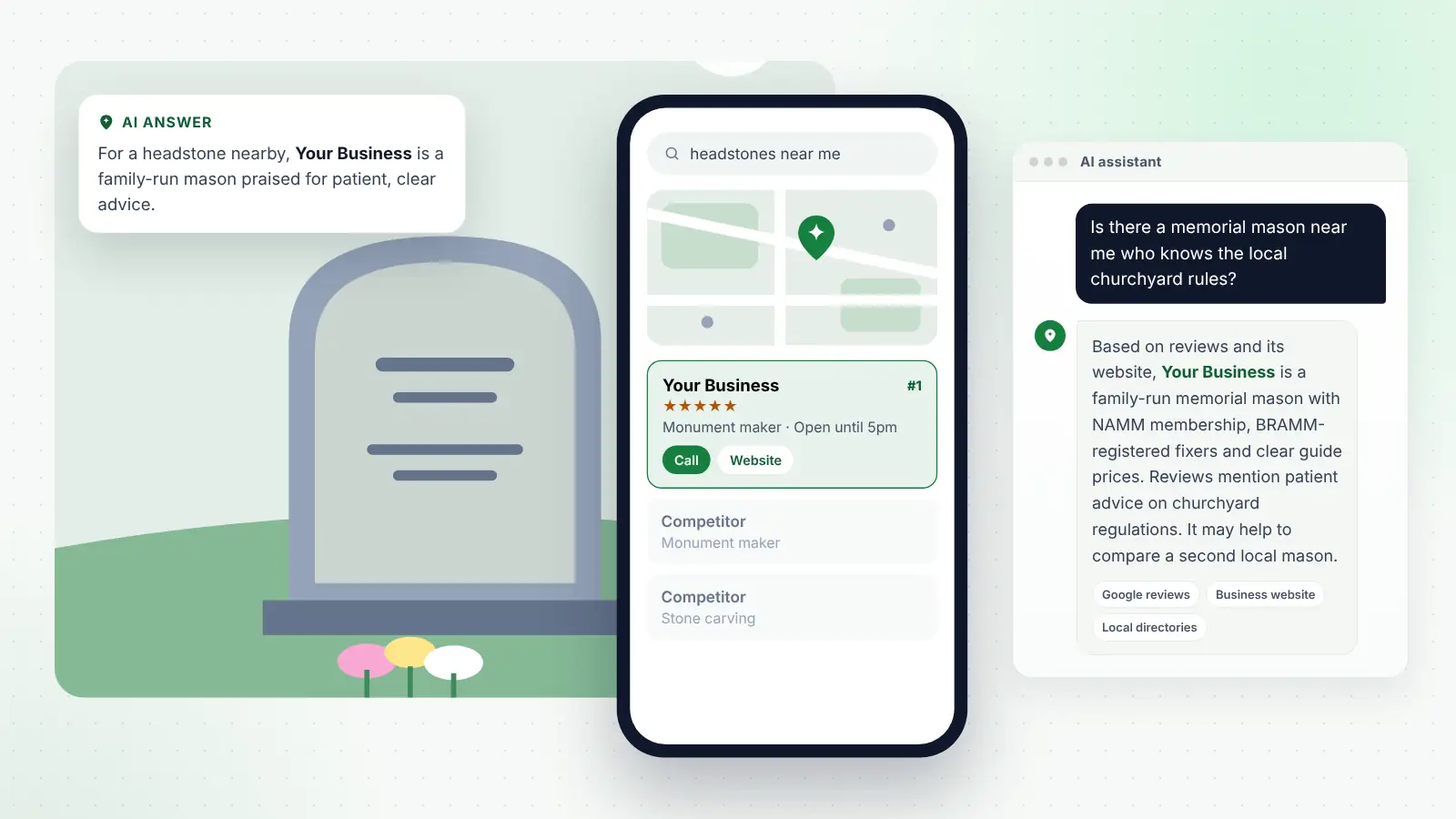
- AI search: what assistants tell families
- Frequently asked questions
- Final thoughts
How families choose a memorial mason
Very few families know the difference between granite and sandstone, or what a ground anchor is. What they notice is simpler:
- Whether they felt rushed. Families often visit several times before deciding.
- Whether the mason understood the cemetery. Hearing early what is allowed prevents heartache later.
- Whether the prices made sense before they committed time to a visit.
- Whether the lettering looked right, judged from real examples of your work.
- Whether the memorial was fixed safely, and whether someone kept them informed during the wait.
Almost everything in this guide comes back to making those things clear, in your showroom and online.
Credentials that reassure families
Memorial masonry is not licensed by law, but families and burial authorities recognise a few well-established standards and bodies. Showing them clearly, and explaining what they mean, is one of the simplest ways to build trust.
The National Association of Memorial Masons
The National Association of Memorial Masons (NAMM) is the long-standing trade association for the industry. It publishes a Code of Working Practice, runs training and qualifications in memorial fixing, and oversees the independent testing and approval of ground anchors and fixing systems, keeping a list of approved fixings. Membership tells families that you belong to a recognised professional body and work to its guidance.
The British Register of Accredited Memorial Masons
The British Register of Accredited Memorial Masons (BRAMM) is a national registration scheme set up in 2004, with burial authorities represented on its management board. Registered businesses must be accredited, insured and hold current health and safety documentation, and they guarantee the stability of their memorials. Each fixer must hold a BRAMM fixer licence, which requires a recognised qualification in safe memorial fixing and ongoing training.
Many burial authorities now allow only BRAMM-registered masons, or an equivalent scheme, to work in their cemeteries. If you are registered, say so prominently.
BS 8415 and fixing systems
BS 8415, Monuments within burial grounds and memorial sites – Specification, is the British Standard for memorials, currently in its 2018 edition. It covers how memorials are designed and installed to stay stable, including how ground anchors and fixing systems are tested. Many cemetery and churchyard regulations now require new memorials to comply with it.
For families, the reassurance matters more than the detail: that you fix every memorial to the British Standard, using tested stainless steel anchors or an approved foundation suited to the ground. Many have seen older headstones laid flat after council safety testing and are glad to know theirs will be fixed properly.
Tip
Write one plain page called “How we fix your memorial safely”. Explain BS 8415, your anchors or foundations and your credentials in everyday words. Families read it, funeral directors notice it, and AI assistants can quote it accurately.
Explaining churchyard and cemetery rules
Few things upset a family more than choosing a design, only to be told it is not permitted. Explaining the rules early, and kindly, is one of the most valuable things a mason does.
Churchyards
In the Church of England, memorials in churchyards are governed by regulations set by each diocese, usually issued by the diocesan chancellor. A memorial that falls within those regulations can normally be approved by the incumbent, or the priest in charge if there is no incumbent. Anything outside them, such as an unusual size, material or finish, needs a faculty, a formal permission from the diocese that can take longer. Regulations often limit size, stone type and finish, kerbs, photographs and some inscriptions, and they vary between dioceses. Other denominations and the Church in Wales have their own arrangements.
Council and private cemeteries
Council and private cemeteries set their own regulations. These usually require a permit for each new memorial and additional inscription, signed by the grave owner, with a fee set by the burial authority. Many also specify approved masons, fixing standards, sizes and working hours.
| Church of England churchyard | Council or private cemetery | |
|---|---|---|
| Who sets the rules | The diocese, through its churchyard regulations | The burial authority or owner |
| Who approves | The incumbent, or a faculty for anything outside the regulations | The cemetery office, through a permit or application |
| Typical restrictions | Height, stone type, polished finishes, kerbs, photographs, wording | Sizes, section rules, approved masons, fixing method |
| Fees | Churchyard fees set nationally, plus any faculty costs | Permit and inscription fees set locally |
| Mason’s role | Advise on what is allowed and prepare the application | Submit the application and meet registration rules |
Keep notes on every churchyard and cemetery you regularly work in, and share what is usually allowed before a family chooses. Never promise an approval you cannot guarantee.
Timing: when a memorial can be placed
Many families assume a headstone can go up within weeks of the funeral. In practice, most memorials on a new earth grave cannot be fixed for several months, because the ground needs time to settle before a memorial can be installed safely. Some cemeteries set a minimum period of a few months for lawn memorials and longer for kerb sets. Some churchyard regulations ask for around six months between the burial and approval, partly so that families have time to choose an inscription without pressure. Where a memorial sits on a concrete foundation already in place, or marks cremated remains, it can sometimes be fixed sooner.
Design, permits, stone supply and lettering add further time. Explaining this honestly helps:
- It removes worry. Families who know why there is a wait are less likely to feel forgotten.
- It takes away pressure. There is rarely any reason to decide quickly, and saying so builds trust.
- It gives you a reason to stay in touch. A brief update when the permit is approved or the stone arrives is always appreciated.
Clear, transparent pricing
Families often hesitate to contact a mason because they have no idea what a memorial costs. Guide prices on your website, explained warmly, make that first enquiry much easier. Show starting prices for common designs, what is included (letters, fixing, foundation), what is separate (burial authority fees, extra letters, motifs, vases), whether VAT is included and your deposit terms.
| Service | What families want to know | What helps |
|---|---|---|
| New headstone | What does a simple memorial cost? | Starting prices with photos of real examples |
| Additional inscription | Can the new letters match the old? | Examples of matched lettering and a typical price range |
| Cleaning and renovation | Will cleaning damage the stone? | A note on gentle methods suited to each stone |
| Re-fixing | Is a leaning headstone safe? | Plain advice on inspection and safe re-fixing |
| Cremation memorial | What is allowed on an ashes plot? | Examples and notes on common cemetery limits |
Prices vary by area, stone and design, so present them as guides. A written, itemised quotation after a visit gives families confidence and protects you both.
Additional inscriptions, renovation and cremation memorials
Much of a mason’s steady, year-round work comes from memorials that already exist.
Additional inscriptions
When another family member dies, adding their name to an existing memorial is often the first thing the family thinks of, and they care deeply that the new lettering matches the old. Explain how you match lettering, whether the stone comes back to the workshop, and that a permit is usually needed. Families who have a good experience often remember you for generations.
Renovation and cleaning
Older memorials weather, lean and lose their lettering. Many families want a grandparent’s headstone cleaned, re-lettered or safely re-fixed, sometimes after a council safety test. Explain your methods plainly and avoid harsh cleaning that could damage softer stone. Before and after photos, shared with permission, show your care well.
Cremation memorials
Many families who choose cremation still want a place to visit. Tablets and plaques on ashes plots, vases and garden of remembrance memorials are often subject to stricter rules than full graves, so explain the options for each local crematorium and cemetery.
Working with funeral directors and local partners
Funeral directors are often the first people a family asks about a memorial. A good relationship rests on reliability, not on any arrangement that puts the family second.
- Be dependable. Funeral directors recommend masons who are courteous, keep families informed and fix memorials safely.
- Share clear information. A short printed guide to timing, rules and guide prices is easy for them to hand on.
- Be open about any commission, so the family’s choice is a free one.
- Know the local burial staff. Cemetery offices and churchwardens appreciate tidy applications.
- Support local remembrance, such as hospice memorial events and churchyard restoration days.
Reviews and reputation
Reviews matter, but timing and tone need care. Ask only once the memorial is in place and the family has had time to visit it, with a short, optional line such as “If you feel able to share your experience, it may help other families”. Reply briefly and warmly, without naming the person remembered unless the family has done so publicly, and handle any concern privately, offering to visit and put things right.
Never write, buy or incentivise reviews. It is unfair to families, breaks review platform rules, and fake or undisclosed incentivised reviews are banned under consumer law.
Local SEO: being found by families nearby
Memorial searches are local and considered. Families type “headstones near me”, “memorial masons [town]”, “headstone prices [area]”, “add name to headstone” or “headstone cleaning near me”, and often compare two or three masons on the map before deciding who to visit. Local search is where your years of work in the area become visible to someone who has never met you.
Setting up your showroom’s Google profile
Choose “Monument maker” as your primary category if it fits. Show accurate opening hours, including whether showroom visits are by appointment, and list each service separately. Add real photos of your showroom, workshop, lettering and finished memorials, and mention NAMM membership and BRAMM registration in your description.
Family reviews and matching details everywhere
Alongside gentle reviews, keep your name, address, phone number and website identical on Google, Apple Maps, Bing, NAMM’s member listing, memorial directories and local sites. One outdated listing can quietly cost enquiries.
Service, cemetery and area pages
Give each service its own page, add pages for the towns you serve and, where helpful, for the churchyards and cemeteries you work in most, with what is usually allowed and typical waiting times. These answer the exact questions families search for.
Local links and mentions
Mentions on parish, hospice, community, local history and local news websites, and in NAMM’s directory, show search engines that you are an established local business.
Expect gains to come slowly, over roughly three to six months, and be wary of anyone who promises a set position. If you would rather spend your time in the workshop and with families, specialist local SEO for memorial masons and headstone makers can look after your profile, listings, content and links for you.
AI search: what assistants tell families
More families now ask AI assistants for help when they start thinking about a memorial. Someone might ask ChatGPT “How long after a burial can a headstone go up?”, ask Gemini “Is there a memorial mason near me who knows the local churchyard rules?”, ask Copilot “How much does a headstone cost in [town]?” or ask Perplexity “Can I add my mum’s name to my dad’s headstone?”. Many of the same questions now bring up an AI Overview at the top of Google too.
AI tools try to give careful answers to sensitive questions, so they rely on clear, consistent information from several sources. For a memorial mason, that typically means:
- Plain guidance on timing and regulations that an assistant can explain accurately.
- Consistent business details across your website, Google, NAMM and BRAMM listings and directories.
- Clear credentials, such as NAMM membership, BRAMM registration and fixing to BS 8415.
- Guide prices and genuine reviews describing patience, workmanship and clear advice.
- FAQs answering real questions, such as whether a churchyard allows polished granite.
- Mentions on reputable local sites, such as parish, hospice and local news pages.
People call this answer engine optimisation (AEO), and for a memorial mason the principle is simple: be clear, consistent and accurate. A mason whose credentials, rules, timings and prices are explained plainly is far easier for an AI assistant to describe correctly than one with a gallery and little else.
Tip
Ask an AI assistant “who are the memorial masons in [your town]?” and “how long after a burial can a headstone be fixed in [your area]?”. If your business is missing or described wrongly, check your Google profile, NAMM listing and guidance pages first.
Frequently asked questions
Do memorial masons need to be registered?
There is no general legal licence, but many burial authorities only allow BRAMM-registered businesses and licensed fixers, or an equivalent scheme, to work in their cemeteries, and many regulations require fixing to BS 8415. Check the rules for every burial ground you work in.
What is the difference between churchyard and cemetery rules?
Church of England churchyards follow diocesan regulations, with the incumbent approving memorials within them and a faculty needed for anything outside them. Council and private cemeteries set their own regulations, permits and fees.
How long should families expect to wait for a headstone?
Usually several months, because the ground on a new grave needs time to settle, and some burial grounds set minimum periods. Design, permits and lettering add further time.
Should a memorial mason list headstone prices online?
Yes, as guide prices, making clear what is included and that churchyard or cemetery fees are usually separate. Follow a visit with an itemised quotation.
How should we ask for reviews?
Only once the memorial is in place, with a gentle, optional invitation, and never share personal details in a reply.
Final thoughts
Families remember the mason who was patient, explained the rules early, was honest about cost and timing, and fixed the memorial so it would last. Most independent masons already work this way.
The task now is to make that care visible before the first visit. Clear credentials, plain guidance on local burial grounds, honest guide prices and gentle, genuine reviews help families find you when they are ready, and help AI assistants describe you accurately.