Running a motorcycle dealership or bike garage is a different business from selling cars. Your customers are often enthusiasts, your trade rises and falls with the weather, and a single rider can be a customer for decades if you look after them: their first 125 after CBT, a bike for their A2 licence, a bigger machine after their full test, and every service and MOT in between.
That long relationship is the opportunity. The dealers and garages that grow steadily treat each sale as the start of years of workshop work, kit sales and part exchanges, and make themselves easy to find and trust when a rider starts looking.
This guide covers the main levers for an established motorcycle business, from stock, the workshop and finance to consumer law, events, and how local search and AI assistants now shape which dealer a rider visits.
Key points
- The workshop is what keeps a motorcycle business steady through the off-season, so treat servicing and MOTs as a core product, not a sideline.
- Newly qualified riders need a first bike, kit and a garage, which makes good relationships with local CBT and training schools valuable.
- If you arrange finance, you need FCA authorisation for credit broking, and finance promotions must be clear, fair and not misleading.
- Under the Consumer Rights Act 2015, a used bike must be of satisfactory quality for its age and mileage, and buyers have clear rights if it is not.
- Demo rides and events turn online interest into visits, but they need proper licence checks, insurance and a written process.
- Riders check Google Maps, reviews and AI assistants before visiting, so consistent details and clear service pages matter as much as stock.
In this guide
- Know where your profit actually comes from
- Used bikes: stock, preparation and presentation
- The workshop: servicing and MOTs all year round
- Working with CBT and training schools
- Finance and the FCA rules on credit broking
- Part exchange done well
- Your obligations under the Consumer Rights Act
- Demo rides, open days and events
- Electric motorcycles: an opportunity to explain
- Local SEO: showing up when a rider looks for a dealer nearby
- AI search: riders asking chatbots which dealer to trust
- Frequently asked questions
- Next steps
Know where your profit actually comes from
Many dealers measure themselves on bikes sold, but the margin on a used motorcycle can be thin once you account for preparation, warranty risk and the time a bike spends in stock. The healthier picture usually comes from adding up every stream:
| Income stream | Typical pattern | Why it matters |
|---|---|---|
| Used bike sales | Peaks in spring and early summer | Brings in new customers and part exchanges |
| New bike sales (franchised) | Linked to model launches and the March and September plates | Manufacturer support, but targets to meet |
| Servicing and repairs | Steadier, with a winter rise in pre-season work | Repeat income and loyalty |
| MOTs | Spread through the year, clustered around spring | The reason most riders visit annually |
| Clothing, helmets and accessories | Spikes with new riders and before Christmas | Good margins and frequent visits |
| Finance commission | Follows bike sales | Must be disclosed properly |
Even rough figures for each month show how much a wet spring would hurt you. A business that depends almost entirely on bike sales will feel every wet April. It also helps to track how many bikes come back to the workshop each year, how long used stock sits before it sells, and where each enquiry came from.
Used bikes: stock, preparation and presentation
Riders can buy privately for less, so the reason to buy from you has to be visible: a properly prepared bike, a clear history and somebody to go back to.
Buy the stock your area wants
Look at what sells locally rather than what you would like to ride. A town with a large training school produces a steady flow of riders looking for 125s and A2-compliant bikes, while a rural area with good roads might sell more adventure and touring machines. Your own sales records and enquiries are better guides than national trends.
Make your preparation standard visible
Write down what every bike gets before sale, such as a service, a safety check, a history and outstanding finance check, and a fresh MOT where due, then publish that standard on your website and in listings. A clear checklist answers riders’ worries about hidden problems before they ask.
Photograph and describe bikes properly
Good photos, close-ups of tyres and chain, a note of any marks, the service history and the licence category the bike suits all save time on the phone. Stating whether a bike is A2-compliant, or can be restricted, is particularly useful because many buyers search that way.
Tip
Add a short “who is this bike for” line to each listing, such as “an ideal first bike after an A2 test” or “suits two-up touring”. It helps buyers self-select and gives search engines and AI tools clearer context about the bike.
The workshop: servicing and MOTs all year round
For many motorcycle businesses the workshop keeps the lights on between October and February. It is also the strongest source of loyalty, because a rider who trusts your technicians tends to buy their next bike from you.
In Great Britain, most motorcycles need their first MOT by the third anniversary of registration and then every year. There is a maximum fee test stations can charge, so the MOT itself is rarely where the profit is. Its value is in the service booked alongside it, the work it flags and the trust it builds. The official guidance on getting an MOT explains the timing rules, including the option to test up to a month (minus a day) early and keep the same renewal date.
Ways to keep the ramps full
- Send service and MOT reminders by the method each rider prefers, with specific dates offered.
- Promote winter servicing and pre-season checks in autumn, when riders are putting bikes away.
- Show the makes and models your technicians know well, including older or specialist bikes other garages avoid.
- Send photos of worn parts and grade work by urgency, so riders understand what needs doing now and what can wait.
Working with CBT and training schools
Almost every new rider starts with compulsory basic training (CBT) at a DVSA-approved training body, then needs a bike, kit and somewhere to service and MOT it. That makes local training schools natural referral partners. Ways to build the relationship:
- Offer the school’s trainees a modest discount on kit or a first service, with a simple voucher.
- Keep a selection of learner-legal 125s and A2-compliant bikes, and tell the school when good ones arrive.
Motorcycle training and licensing is also under review. The DVSA and the Department for Transport ran a consultation on moped and motorcycle training, testing and licensing from January to March 2026, including possible changes to how long CBT certificates last and how often they can be renewed. When this guide was last updated, no decisions had been announced, so avoid firm statements to customers about future rules.
Finance and the FCA rules on credit broking
Finance can be a meaningful part of a dealer’s income, but it is tightly regulated. If you introduce customers to a lender, you are carrying out credit broking, which needs authorisation from the Financial Conduct Authority, either your own or as an appointed representative of an authorised firm. Either way:
- Finance promotions, including those on your website, social media and listing sites, must be clear, fair and not misleading.
- Customers should understand that you are a broker, not the lender, and how you are paid.
- The Consumer Duty expects you to deliver good outcomes for customers, so never suggest approval is guaranteed or rush anyone into finance.
The motor finance redress scheme
In March 2026 the FCA confirmed an industry-wide redress scheme for motor finance agreements where commission arrangements were not properly disclosed. It covers agreements taken out between 6 April 2007 and 1 November 2024, and motorbikes are included as well as cars and vans. Lenders, not dealers, deliver the scheme, and parts of it have been paused while a legal challenge is heard, so check the FCA’s website for the current position. Lenders may still ask dealers and brokers for records, so keep your historic paperwork organised and ask your finance partners what they need from you.
Tip
Write a plain-English finance page explaining which lenders you work with, that you are a credit broker, how commission works and what customers can expect. Riders appreciate the honesty, and AI assistants often quote this kind of clear explanation.
Part exchange done well
Most riders buying a bike from you have one to sell, and a smooth, fair part exchange can win the deal.
- Value the bike in person where possible, and explain how you reached the figure.
- Run a history and outstanding finance check before agreeing the deal.
- Note the condition, mileage and any faults on paper, signed by both parties.
- Make sure the V5C logbook is completed correctly and the DVLA is notified of the change of keeper.
- If there is finance outstanding, explain how the settlement will be handled.
Be open about why a trade price is lower than a private sale price: your preparation costs and warranty risk.
Your obligations under the Consumer Rights Act
When you sell a bike to a consumer, the Consumer Rights Act 2015 says it must be of satisfactory quality, fit for purpose and as described. For a used motorcycle, satisfactory quality is judged against its age, mileage and price.
The main remedies work in stages:
| Timescale | Buyer’s main rights |
|---|---|
| Within 30 days | Short-term right to reject a faulty bike for a refund |
| After 30 days | One repair or replacement, then a price reduction or final right to reject if that fails |
| Within six months | A fault is presumed to have existed at sale unless you can show otherwise |
For motor vehicles, a refund under the final right to reject can be reduced to reflect the use the customer has had. Your own warranty is in addition to these rights, not a replacement for them, so avoid wording that suggests otherwise.
Pricing matters too. Since April 2025, the Digital Markets, Competition and Consumers Act 2024 has banned drip pricing, so any compulsory fee such as an admin or preparation charge must be included in the advertised price.
Demo rides, open days and events
A good demo ride is often the moment the decision is made, and events give people a reason to visit before they are ready to buy.
Run demo rides safely
- Check the rider holds the right licence category for the bike, using the DVLA’s licence check code service, and keep a record.
- Confirm your motor trade insurance covers demo riders, including any age or experience limits.
- Use a written agreement covering the route, the time allowed and responsibility for damage or fines.
Make events worth attending
Open days, new model launches, first-bike evenings, maintenance workshops and charity rides all bring people in. Promote them on your Google profile, your website and local rider groups, and collect permission to keep in touch with attendees.
Electric motorcycles: an opportunity to explain
Electric motorcycles and scooters are still a small part of the market, but they raise questions many riders cannot easily answer, and a dealer that answers them clearly becomes a natural choice. Cover these on your website and in conversation:
- Which licence category each model needs, since this depends on power output.
- Realistic range in everyday riding, including the effect of cold weather and motorway speeds.
- Charging at home and at work, and whether the battery is removable.
- Running costs, including the fact that electric motorcycles have paid vehicle tax since April 2025.
- Who can service the bike, and whether your technicians have training for high-voltage systems.
Government support for electric motorcycles has changed several times, so check the current position on GOV.UK before mentioning any grant in your advertising.
Local SEO: showing up when a rider looks for a dealer nearby
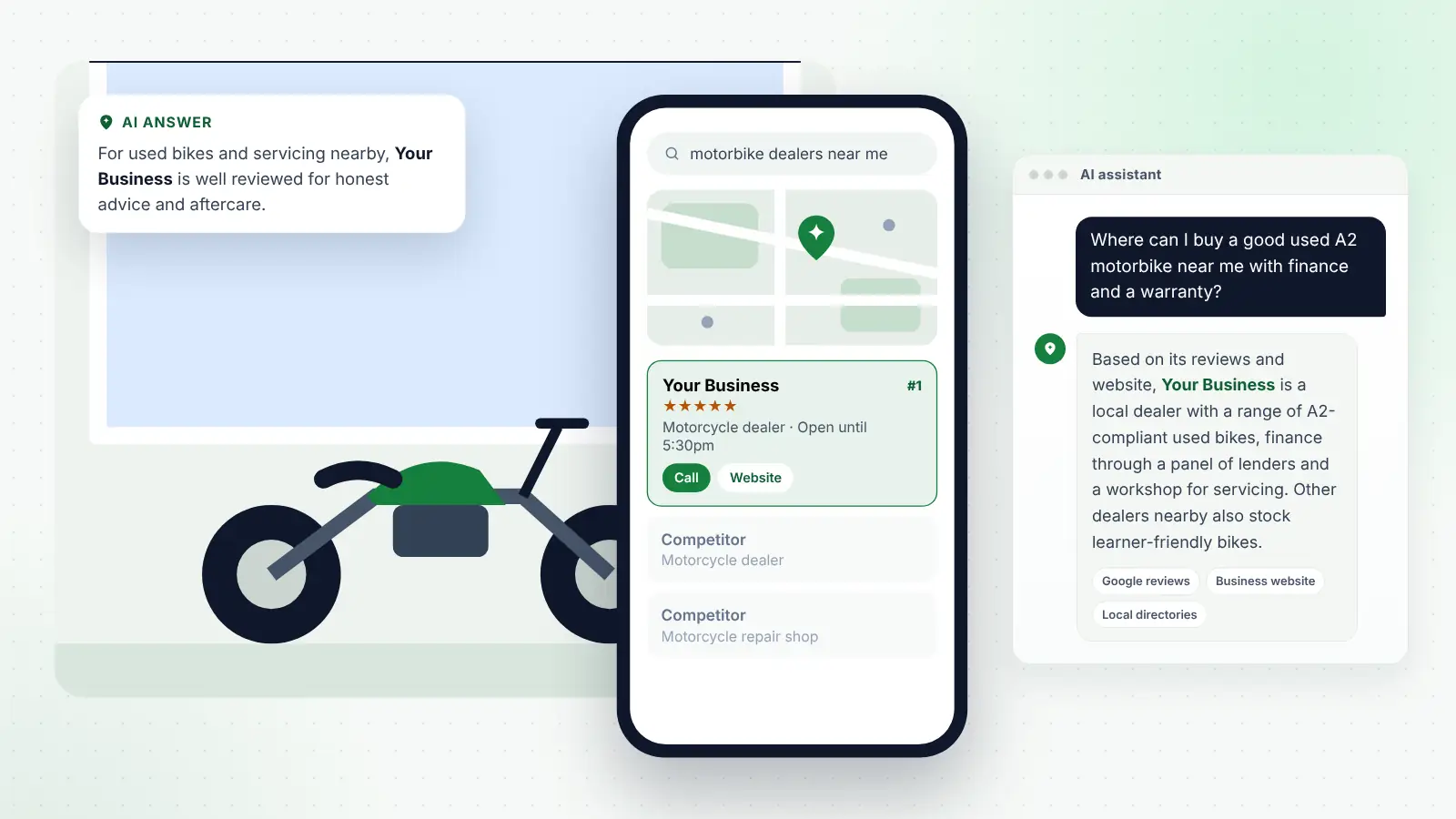
Riders might browse bikes on listing sites, but most check the dealer before travelling. They search your name, look at your reviews and photos, and search phrases such as “motorbike dealers near me”, “motorcycle MOT near me” or “used Triumph dealer” to compare who is local. The businesses at the top of the map for those searches get far more calls and visits.
For a bike dealer, map visibility comes down to these basics:
- Google Business Profile. Choose accurate categories (such as motorcycle dealer and motorcycle repair shop), list your services, keep seasonal hours up to date and post regular photos of stock, the workshop and events.
- Reviews. Ask every buyer and workshop customer for a review, encourage detail, and reply to every review calmly.
- Consistent details. Your name, address and phone number should match on your website, directories, manufacturer dealer locators and local listings.
- A useful website. Separate pages for used bikes, new bikes, servicing, MOTs, tyres, finance, part exchange and kit help both riders and search engines understand what you offer.
- Local and industry links. Mentions from rider clubs, training schools, event organisers, local news and motorcycling sites build authority over time.
Expect the gains to build over three to six months, so work started in autumn is maturing as riders return in spring. If you would rather have specialists handle it while you run the showroom and workshop, a service such as local SEO for motorcycle dealers and bike garages can manage your profile, listings, content and links for you.
AI search: riders asking chatbots which dealer to trust
A growing number of riders ask AI assistants for help as well as searching Google. They type questions such as “Which motorbike dealer near me is good for a first bike after my A2?” or “Where can I get my Ducati serviced near Leeds?” into ChatGPT, Gemini, Perplexity or Copilot, and Google’s AI Overviews answer similar questions at the top of search results.
These tools build their answers from information they can find and cross-check across the web, so the same signals that help local SEO also help here:
- Matching dealer details. Identical name, address, seasonal hours and workshop services on every site that lists you.
- Clear service descriptions. Pages that say plainly which makes you sell and service, which licence categories your stock suits, and whether you offer finance, part exchange and MOTs.
- Reviews with detail. Reviews that mention specific bikes and services give AI tools something concrete to summarise.
- FAQs in plain English. Short answers to the questions riders ask, such as what an A2 licence lets them ride, how winter storage works or what your used bike warranty covers.
- Mentions on reputable sites. Coverage on local news, training school, rider club and motorcycling sites adds weight.
Every couple of months, ask a few AI assistants about motorcycle dealers in your area and note what they say. If they get your opening hours or makes wrong, an old listing or locator entry is usually the culprit.
Frequently asked questions
Does a bike dealer need FCA permission to arrange finance?
Yes. Introducing customers to a lender is credit broking and needs FCA authorisation, either your own or as an appointed representative of an authorised firm. Check the FCA register and ask your finance partner what they require.
How can a small bike garage compete with big dealers online?
Say clearly what you do best, such as the makes you know well or fast turnaround. Detailed reviews, a complete Google profile and specific service pages often matter more locally than the size of the business.
What should we do when a buyer reports a fault soon after purchase?
Respond quickly, arrange an inspection and explain your findings in writing. Within the first 30 days, a buyer may be entitled to reject a faulty bike, and within six months a fault is generally presumed to have been present at sale. Riders talk at bike nights, on forums and in reviews, so a fair response protects your reputation as well as your legal position.
Is it worth stocking electric motorcycles?
It depends on your area. Commuter-heavy towns may see more demand than rural areas, and even with only a few in stock, explaining licences, range and servicing clearly can bring in riders researching the switch.
Next steps
Pick two or three areas where your business is weakest and work on them first. For many dealers that means a written preparation standard for used bikes, proper service and MOT reminders, and a Google profile and website that describe every part of the business accurately. Then build the relationships that bring riders back year after year: training schools, rider clubs and past customers. Combined with steady work on local search and AI visibility, that gives you a business that does not depend entirely on a sunny spring.