A holiday park is rarely one business. Depending on how your site has grown, you might be selling touring pitches to caravanners and motorhomers, hiring out static caravans and lodges by the week, renting glamping pods or yurts by the night, collecting pitch fees from holiday home owners and selling new and used holiday homes on top. Each of those has its own customers, its own margins, its own legal framework and its own busy season.
The parks that do well tend to be run by owners who understand how those parts fit together, keep on top of the licence and safety obligations that come with having people sleep on their land, and make it easy for guests to see exactly what they are booking. This guide covers the practical side of running a park in the UK as it stands in October 2026, from site licences and the pop-up campsite rules to selling holiday homes fairly, pricing, tax and getting found online.
It is written for owners and managers of small to medium parks, farm campsites and glamping sites. If you run bed and breakfast rooms or a small hotel alongside your site, the separate guides on B&Bs and direct hotel bookings cover those in more detail.
Key points
- Most caravan sites need both planning permission and a site licence from the council under the Caravan Sites and Control of Development Act 1960, and the licence conditions are enforceable.
- In England, land can be used as a temporary campsite for tents and motorhomes for up to 60 days a year under permitted development, but only with advance notice to the council and within strict limits.
- Fire safety duties apply to parks and campsites, and a written fire risk assessment sits alongside your licence conditions on spacing, fire points and equipment.
- Selling holiday homes is covered by general consumer law, so sales materials, pitch fee terms and licence agreements must be clear, fair and not misleading.
- Compulsory charges belong in the headline price, and the furnished holiday lettings tax regime ended in April 2025, so review how you price and how you are taxed.
- Guests search by place and type of stay, so a detailed Google profile, clear accommodation pages and steady reviews matter as much as your facilities.
In this guide
- Understand which business you are really running
- Planning permission and the site licence
- Pop-up campsites: the 28-day and 60-day rules
- Fire safety and site safety
- Selling holiday homes fairly
- Pricing, fees and showing the full price
- Tax and business rates
- Filling the shoulder seasons
- Trust signals and reviews
- Local SEO: being the park guests find first
- AI search: what assistants say when a guest asks where to stay
- Frequently asked questions
- Next steps
Understand which business you are really running
Before you think about marketing, be clear about where your income comes from and which parts deserve your time. A park that earns most of its money from holiday home pitch fees has very different priorities from a farm campsite that sells tent pitches for ten weekends a year.
| Income stream | Typical customer | Main considerations |
|---|---|---|
| Touring and tent pitches | Caravanners, motorhomers, campers | Pitch sizes, hook-ups, facilities blocks, seasonal demand |
| Seasonal pitches | Touring owners who leave their van on site | Clear agreements, storage, fair annual price rises |
| Hire fleet (statics, lodges) | Families and couples on self-catering breaks | Cleaning turnarounds, gas and electrical safety, refurbishment |
| Glamping units | Couples, small groups, special occasions | Higher nightly rates, stoves and hot tubs, planning status |
| Holiday home ownership | Buyers wanting a second home on the park | Consumer law, licence agreements, pitch fees, resale |
| Ancillary income | All guests | Shop, café, bar, entertainment, storage, dog wash |
Work out the margin of each line once a year. It is common to find that a busy part of the park, such as tent camping in August, takes a lot of staff time for modest profit, while a quieter part, such as seasonal pitches or a few well-run lodges, does far more of the work.
Planning permission and the site licence
The two permissions most parks need
In England and Wales, the Caravan Sites and Control of Development Act 1960 makes it an offence to use land as a caravan site without a site licence from the local council, unless an exemption applies. The council can only issue a licence once the land has planning permission for that use, so the order is almost always planning first, licence second. Site licensing under the same Act also applies in Scotland, though the planning system and guidance there differ, and Northern Ireland has separate legislation.
The licence comes with conditions, usually based on government model standards, covering things like the number of units, spacing between them, roads, lighting, drainage, sanitation, electrical installations and fire precautions. Councils can enforce those conditions, and breaching them is an offence. Keep a copy of your current licence and conditions where staff can find them and display them on site if your licence requires it, as many do.
Planning conditions that shape your business
Your planning permission will often say more about your business than you might expect. Common conditions include:
- the number and type of units allowed, for example touring pitches only, or a set number of statics or lodges
- a season during which the site can be occupied, or a closed period each year
- a holiday occupancy condition, meaning units cannot be used as anyone’s main or permanent residence
- limits on landscaping, lighting or noise, especially in a National Park or protected landscape
Before you add glamping pods, swap tents for lodges or extend your season, check whether your planning permission and site licence allow it. A pod with a bathroom, a hot tub and a fixed base can look very different to a planning officer than a bell tent in a field.
Tents, certificated sites and exemptions
Tent-only sites are not caravan sites, but they can still need a licence from the council under separate public health legislation if tents are used for long enough periods. There are also exemptions under the 1960 Act, including small sites run under certificates issued through the large caravanning clubs. The exemptions are detailed, so speak to your council’s licensing team before relying on one.
Tip
Keep a single folder with your planning decisions, site licence, conditions plans and any variations. When you sell, refinance, extend or face a complaint, being able to show exactly what you are allowed to do saves weeks.
Pop-up campsites: the 28-day and 60-day rules
Many farm and estate campsites start as a pop-up site in a field for the summer holidays. In England, the rules on this changed in July 2023.
The general temporary use right in the planning rules allows land to be used for other purposes for up to 28 days a year, but it does not cover camping except in connection with a festival. Since 26 July 2023, a separate permitted development right, known as Class BC, allows land to be used as a recreational campsite for up to 60 days in a calendar year. As of October 2026 it remains in force with no end date. The main limits are:
- no more than 50 pitches
- tents, motorhomes and campervans only, not towed caravans
- on-site toilet and waste disposal facilities must be provided
- you must notify the council in writing before you start each calendar year, with a site plan and your dates
- in flood zones 2 and 3, you need the council’s prior approval each year, with a site-specific flood risk assessment and any required fee
- it does not apply on scheduled monuments, sites of special scientific interest, the site of a listed building and certain safety and military areas
If toilets, showers or other structures will stay on the land between camping periods, check with your council how it will count the days. The full wording is in Part 4 of the permitted development order. These rights apply in England only; Wales and Scotland have their own rules. A camping licence may also be needed if tents stay up for long periods, so check with your council even if planning permission is not required.
Fire safety and site safety
Your fire risk assessment
Fire safety law applies to holiday parks, caravan sites, campsites and holiday chalets. The person responsible for the site must carry out a fire risk assessment, act on it and keep it under review, and in most cases record it in writing. The government’s guide to fire safety risk assessment for sleeping accommodation specifically covers caravan and holiday parks, camping and holiday chalets, though not privately owned individual units. Your local fire and rescue service enforces it, and council inspectors will usually expect to see it.
What licence conditions usually cover
Site licence conditions often set out fire precautions in detail, and your risk assessment should check that they are in place or that equally effective measures are. Typical conditions include:
- minimum spacing between caravans and lodges, commonly around five to six metres depending on construction, with tighter rules for awnings and porches
- fire points within a set distance of every unit, with extinguishers or hose reels, a way of raising the alarm and a clear fire notice
- regular servicing of fire equipment by a competent person, with a log
- safe storage of LPG tanks and cylinders
- regular inspection of the site’s electrical installation, with the certificate kept on file
Gas, electrics, water and glamping risks
Hire fleet caravans and lodges with gas appliances need regular safety checks by a Gas Safe registered engineer, and smoke and carbon monoxide alarms should be fitted and tested between stays. Electric hook-up points need inspection and safe cabling. If your site has a private water supply, such as a borehole or spring, your council will have a role in testing it.
Glamping brings its own risks. Wood-burning stoves in tents, yurts and pods, hot tubs, fire pits and barbecues all need clear guidance for guests and regular checks. Put the rules in your booking confirmation as well as on site, so guests know them before they arrive.
Selling holiday homes fairly
For many parks, holiday home sales and pitch fees are the most valuable part of the business. They are also the part that attracts the most complaints, and the area where getting the legal side wrong is most expensive.
What protection holiday home owners have
Holiday home owners do not have the statutory protections that residents of residential park homes have. Their relationship with you is governed by the contract you agree, usually a licence agreement, and by general consumer law. That means the Consumer Rights Act 2015, which requires contract terms to be fair and transparent, and the unfair commercial practices rules, which since April 2025 sit in the Digital Markets, Competition and Consumers Act 2024. The Competition and Markets Authority (CMA) and Trading Standards enforce these rules, and the CMA can now fine businesses directly for consumer law breaches.
The Office of Fair Trading’s old guidance on unfair terms in holiday caravan agreements was withdrawn in 2017, and the CMA’s general guidance on unfair contract terms now applies. Pitch fee increases, resale restrictions and age limits on units have been the subject of complaints, petitions and legal challenges in recent years, so it is worth reviewing your terms with a solicitor who knows the sector.
Good practice in holiday home sales
- Use a clear, written licence agreement. The British Holiday & Home Parks Association (BH&HPA) provides members with a standard licence agreement, and many parks use it as their starting point.
- Explain pitch fees honestly. Say what the fee covers, how and when it will be reviewed, and what other charges owners pay, such as utilities, rates, insurance or service charges.
- Be open about depreciation and resale. Holiday homes usually lose value over time. Do not imply otherwise, and explain any rules on selling privately, commission on sales and the age at which units may need replacing.
- Make the occupancy rules clear. If planning or your licence means owners cannot live there permanently, say so before they buy.
- Avoid pressure selling. Give buyers time and written information to take away, and do not use deadlines or offers that are not genuine.
Tip
Write a plain English ownership guide that sets out the season, pitch fee, typical running costs, resale process and site rules on a few pages. Buyers trust parks that put this in writing, and it is useful content for your website too.
Pricing, fees and showing the full price
Pricing for pitches has traditionally been built up from parts: a pitch fee, a per-person charge, an electric hook-up, a dog, an awning and perhaps a booking fee. That is fine, as long as guests can see the full price clearly.
Since 6 April 2025, the Digital Markets, Competition and Consumers Act 2024 has expressly banned drip pricing, where a headline price is shown and unavoidable charges are added later. For a park, that means:
- a compulsory booking or admin fee should be included in the price guests first see
- charges that depend on the guest’s choices, such as extra people, dogs or hook-ups, should be clear from the start and easy to calculate
- optional extras such as late checkout, hot tubs or firewood should be genuinely optional, not pre-selected
- “pitches from” prices in adverts should be realistically available, not limited to a handful of dates
Check your booking system, website and confirmation emails against these points. It is also worth showing what is included, such as showers, Wi-Fi, use of the pool or entertainment, because guests compare those when they choose between parks.
Tax and business rates
The furnished holiday lettings tax regime was abolished from April 2025. Before then, qualifying holiday lets, including some caravans and lodges let to guests, had tax advantages over ordinary property lettings. Owners who relied on those rules, particularly smaller operators letting a few units, should review how their income is now taxed and whether the way the business is structured still makes sense.
Larger parks that provide significant services may be treated as a trading business rather than a property letting business, which affects how they are taxed. VAT on pitches, holiday accommodation, seasonal pitches and caravan sales also has its own rules. These are areas where an accountant who works with holiday parks is worth the fee. Business rates on parks are assessed by the Valuation Office Agency in England and Wales, Visitor levies are also arriving: Scottish councils now have the power to charge one and some have already started, and Welsh councils can introduce a levy from 2027 alongside a national register of visitor accommodation providers. Check with your council whether and how these apply to your type of accommodation.
Filling the shoulder seasons
Many parks sell out in August and struggle in March. Filling the weeks in between is often where the extra profit lies.
- Find your slow dates. Look at last year’s bookings week by week, by accommodation type, to see exactly where the gaps are.
- Match each gap to a guest. Retired caravanners and couples often travel midweek in spring and autumn. Walkers, cyclists and anglers have their own seasons. Families book half-terms.
- Create a reason to come. Local food festivals, dark sky events, walking festivals and Christmas markets give guests a reason to book a specific weekend.
- Welcome rallies and groups. Caravan and motorhome club rallies, walking groups and family reunions can fill a field on a quiet weekend.
- Offer longer stays where allowed. Seasonal pitches, winter storage and extended stays can bring steady income, within your planning and licence conditions.
- Publish a page for each. A dedicated page for spring breaks or dog-friendly autumn stays will be found by people searching for exactly that.
Trust signals and reviews
Guests are trusting you with their holiday and, for families, their children’s safety. Show them why they can.
- Reviews everywhere guests look. Google, camping and glamping platforms and travel review sites all matter. Ask every guest at the end of their stay, and reply to reviews thoughtfully.
- Memberships and gradings. BH&HPA membership, quality gradings from national tourism organisations or the AA, and environmental or conservation awards are worth showing.
- Honest photos. Show real pitches, facilities blocks and the inside of every accommodation type, in different seasons, not just the best view on the best day.
- Clear rules. Dog policies, quiet hours, group bookings, arrival times and what happens in bad weather all reduce disappointed guests and poor reviews.
Local SEO: being the park guests find first
Most guests do not search for a park by name. They search for a place and a type of stay: “campsites near me”, “static caravan holidays in north Wales”, “glamping with hot tub Yorkshire”, “touring caravan site near Whitby” or “dog-friendly holiday park Cornwall”. The parks that appear prominently on Google Maps and in the local results for those searches get a large share of the enquiries.
Search results for holiday parks are crowded with booking platforms and large park operators, so your own listing needs to be complete, accurate and active to compete.
Google Business Profile
Your Google Business Profile is often the first thing guests see. Choose your primary category carefully, as it affects both where you appear and how Google treats your listing. According to Google’s guidance on lodging categories, holiday parks in European countries can appear in Google’s hotel results, cottages, cabins and chalets can be listed as holiday rentals if they meet Google’s requirements, and campgrounds and RV parks are classed as outdoor lodging that is not eligible for those results. If your site mixes pitches, lodges and glamping, think about which category describes it best and whether your booking system can connect to Google’s free booking links.
Then fill in everything: your season dates and reception hours, facilities and amenities, accessibility, dog policy, booking link and a good set of photos of every accommodation type. Post updates for events, late availability and next season’s opening, and answer guests’ questions.
Guest reviews and matching park listings
Reviews that mention specifics, such as “spotless shower block”, “huge pitches” or “great for young children”, help both guests and search engines understand what you are good at. Make sure your park’s name, address, phone number and website are identical across Google, Apple Maps, Bing, tourism sites and camping directories, because inconsistencies make your details less trustworthy.
A website that does the selling
Your website should have a separate page for each accommodation type, with sizes, what each unit sleeps, hook-ups, hard standings, accessibility, prices and photos. Add pages for the things guests search for, such as dog-friendly stays, things to do nearby and seasonal breaks, and a holiday homes for sale section if you sell. A clear FAQ page covering arrival times, rules and what to bring helps guests and AI tools alike. If you would rather have specialists handle this, our local SEO for holiday parks and glamping sites service covers profiles, listings, content and links.
Local links
Links from local tourism organisations, attractions you partner with, walking and cycling groups, local news coverage and outdoor and family travel sites all help show search engines that your park is a genuine, well-regarded part of the area.
AI search: what assistants say when a guest asks where to stay
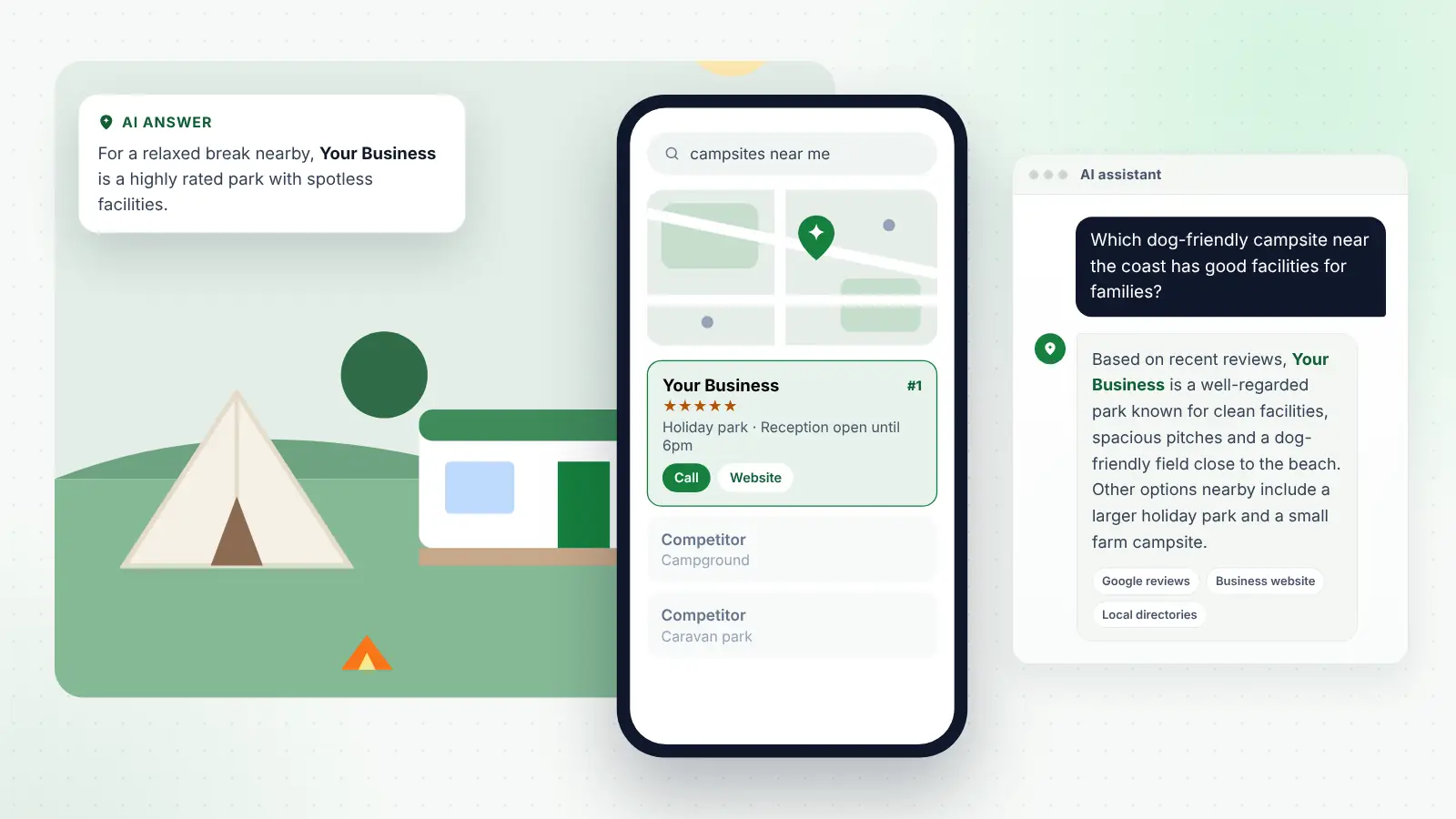
More holidaymakers now ask ChatGPT, Gemini, Perplexity, Copilot or Google’s AI Overviews to help them plan. Instead of typing “campsites Norfolk”, they ask a full question, such as “Which campsite near Wells-next-the-Sea is good for families with a dog?” or “Can you recommend a quiet glamping site in the Peak District with a hot tub?”
AI assistants piece together their park suggestions from what campsite directories, tourism sites and reviews say about you. To be recommended, your park needs to be clearly and consistently described in the places they look:
- Consistent details. Your name, location, accommodation types and season should match across your website, Google profile and directories.
- Specific descriptions. Say clearly what you offer: adults-only or family, pitch types, facilities, dog rules, distances to the beach or town. Vague wording such as “a beautiful site” gives AI tools nothing to work with.
- Reviews. AI tools often summarise review themes, so steady, recent reviews that mention your strengths matter.
- FAQs. Clear answers to common questions on your website are easy for AI tools to use.
- Mentions on reputable sites. Coverage on tourism websites, travel guides, outdoor publications and local news helps AI tools treat your park as a trusted option.
Test this yourself. Ask a few AI assistants the questions your guests would ask and see whether your park appears, and whether what they say about you is accurate. If it is not, the fix is usually clearer, more consistent information about your park across the web.
Frequently asked questions
Do I need planning permission to start a campsite?
Usually, yes, for a permanent site. In England, you may be able to run a temporary campsite for tents and motorhomes for up to 60 days a year without planning permission, as long as you notify the council in advance and meet the conditions. Caravan sites generally need planning permission and a site licence.
Can I add glamping pods to my existing campsite?
Possibly, but check first. Your planning permission and site licence may limit the type and number of units, and a pod with a fixed base, plumbing or a hot tub may need permission even if tents do not. Speak to your council’s planning team before you buy.
Do holiday home owners have the same rights as park home residents?
No. Holiday home owners rely on their licence agreement and general consumer law rather than the specific protections for residential park homes. That makes clear, fair terms and honest sales information particularly important.
How should I show pitch prices with extras?
Show the full price as early as possible. Compulsory fees should be included in the headline price, and charges that depend on the guest’s choices, such as dogs or hook-ups, should be clear from the start.
Do I need a fire risk assessment for a small campsite?
In most cases, yes. Fire safety law applies to campsites and caravan parks as well as larger holiday parks, and your site licence may set specific fire precautions too. The government’s guide for sleeping accommodation is a good starting point.
Next steps
Running a successful holiday park or glamping site is a balance between looking after guests, keeping on top of licences, safety and consumer law, and making sure people can find and choose you when they plan a trip. Start by checking your planning and licence conditions, reviewing your fire risk assessment and making sure your prices are shown in full.
Then look at how your park appears online. Ask a few AI assistants about parks in your area, check your Google profile and accommodation pages, and see whether a guest would understand exactly what you offer. Small improvements, made steadily before each season, tend to add up to more direct bookings over time.