A stairlift, a mobility scooter or a walk-in shower can be the difference between someone staying safely in their own home and having to move. People rarely buy this kind of equipment on a whim. They buy it after a fall, a diagnosis, a hospital stay or a slow realisation that the stairs have become a worry, and very often a son, daughter or carer is helping with the decision.
That makes mobility one of the most rewarding local trades to run, and one with real responsibility. Your customers are often older or disabled, sometimes unwell, and sometimes buying under time pressure. The sector also has a history of complaints about high-pressure doorstep selling, so the businesses that do well over the long term are the ones that sell fairly, explain clearly and look after people for years after the sale.
This guide works through the main decisions in a sensible order: the type of business, sourcing and insurance, fair selling and consumer law, the BHTA code, VAT relief, grants, safety and servicing, costs, pricing, and how families now find mobility companies through Google and AI assistants. It is general information rather than legal or tax advice, so check the details with your accountant, solicitor and the official guidance before you rely on them.
Key points
- Choose a clear focus, such as stairlift installation, a mobility showroom or bathroom adaptations, because it shapes your stock, training, vehicles and premises.
- Fair selling is the foundation: home sales carry cancellation rights, and aggressive practices towards people in vulnerable positions are an enforcement priority for the CMA.
- Membership of the BHTA, whose code is approved under the Chartered Trading Standards Institute’s Approved Code Scheme, is a strong trust signal for families.
- VAT relief for chronically sick or disabled customers depends on genuine eligibility, and suppliers are expected to take reasonable steps to check it, usually with a written declaration.
- Many customers start with a search such as “stairlifts near me”, so an accurate Google profile, genuine reviews and clear prices belong in your launch plan.
In this guide
- Decide what kind of mobility business you want to run
- Set up the business, suppliers and insurance
- Sell fairly: consumer law and home visits
- Join the BHTA and show your standards
- Understand VAT relief for disabled and older customers
- Help customers with grants and funding
- Plan safety, installation standards and servicing
- Rough start-up costs
- Price clearly and honestly
- Local SEO: helping local families find you
- Getting mobility products named in AI answers
- Build referrals and long-term relationships
- Frequently asked questions
- Final thoughts
Decide what kind of mobility business you want to run
“Mobility” covers several quite different businesses. Each has its own skills, stock, margins and customer journey, so decide early where you want to focus.
- Stairlift installation. Straight, curved and outdoor stairlifts, new and reconditioned, often with rental and buy-back options. Mostly sold through home surveys, with servicing and breakdown cover providing recurring income.
- Through-floor and home lifts. Higher-value projects that involve structural work, building control and careful planning with the customer and sometimes the council.
- Mobility showroom or shop. Mobility scooters, powerchairs, wheelchairs, riser recliners, profiling beds and daily living aids, with demonstrations, servicing and repairs.
- Bathroom adaptations. Walk-in showers, wet rooms, level-access trays, grab rails and walk-in baths, often linked to council grant work.
- Servicing, repairs and hire. Scooter and wheelchair repairs, battery replacement, short-term hire for holidays or recovery, and stairlift servicing for other brands.
Many businesses start with one area, such as reconditioned stairlifts or scooter repairs, and add others once they have a reputation. Look closely at your local market first. Note which national brands advertise heavily in your area, which independents exist, what their reviews say and where the gaps are. Common gaps include no local showroom where people can try a scooter, slow repairs, or no one offering reconditioned or rental stairlifts at fair prices.
Set up the business, suppliers and insurance
Decide whether to trade as a sole trader or a limited company, register with HMRC and open a business bank account. Your accountant can help with the structure and with VAT registration, which matters in this sector because so many supplies can be zero-rated for eligible customers.
Suppliers and training
Most stairlift installers work with one or more manufacturers, either as an approved dealer or by buying units and parts through distributors. Manufacturer training on surveying, installation and servicing is essential, and many will want to see that your engineers are trained before they supply curved rails or give you warranty support. For scooters and powerchairs, look for distributors who offer dealer training, parts availability and reliable warranty handling, because your reputation will depend on how quickly you can fix things.
Insurance
Talk to a broker who understands mobility and installation work. Typical cover includes:
- Public liability, for work in customers’ homes.
- Product liability, for equipment you sell, recondition or hire out.
- Employers’ liability, which is a legal requirement once you employ staff.
- Professional indemnity, if you give assessment or product advice that people rely on.
- Vehicle and goods-in-transit cover, for vans carrying rails, chairs and scooters.
Plan for disclosure and safeguarding checks for staff who visit homes. Customers and their families will want to know who is coming, and many will ask.
Sell fairly: consumer law and home visits
Much mobility equipment is sold in the customer’s home, and the law gives those customers extra protection. Fair selling is not just good ethics. It is a legal requirement, and it is the main thing families judge you on.
Cancellation rights for home sales
A contract agreed in the customer’s home is usually an off-premises contract under the Consumer Contracts Regulations. In most cases the customer has 14 days to cancel. You must give them the required information, including cancellation information and a cancellation form, on paper or another durable medium before the contract is made. Failing to provide cancellation information is a criminal offence, and if you do not provide it the cancellation period can be extended by up to 12 months.
There are exceptions, such as goods made to the customer’s specification. A curved stairlift rail made to fit one staircase may fall into this category, but standard stock, reconditioned straight units and items assembled from stock parts generally do not. Take legal advice on how the rules apply to your products, explain the position in plain words before the customer commits, and never use the exception as a way to rush people. If you start installation during the cancellation period, you need the customer’s express request in writing.
Avoid pressure selling
The mobility sector has a history of concerns about doorstep selling. The Office of Fair Trading’s market study of mobility aids in 2011 led to enforcement action against some traders over unfair practices. Today, unfair commercial practices are covered by the Digital Markets, Competition and Consumers Act 2024, and since April 2025 the Competition and Markets Authority has been able to enforce consumer law directly and impose fines of up to 10% of global turnover. Its early priorities included aggressive sales practices that prey on consumers in vulnerable positions. Local Trading Standards services also deal with doorstep selling complaints.
In practice, a fair home visit looks like this:
- Book the visit openly. Say how long it will take and encourage the customer to have a family member or carer present.
- Survey and listen first. Understand their condition, their home and what they actually need before talking about products.
- Offer genuine options. New, reconditioned, rental or a simpler aid such as a second banister rail, where that would do the job.
- Give a written quote and leave it. No “today only” discounts, no claims that a price will rise tomorrow and no staying until someone signs.
- Explain cancellation rights clearly. Make sure the customer understands them, not just that the paperwork has been handed over.
- Refer on when it is not right. If someone needs an occupational therapist assessment or may be eligible for a council grant, say so.
Tip
Write your fair selling promise on your website and quotes. A short statement such as “We never ask you to sign on the day” reassures families before they even pick up the phone.
Join the BHTA and show your standards
The British Healthcare Trades Association (BHTA) is the main trade body for the sector. Its code of practice is approved under the Chartered Trading Standards Institute’s Approved Code Scheme, and covers sectors including mobility, stairlifts and access, and independent living. The code sets standards on treating customers fairly, advertising, staff conduct, off-premises sales, cancellation rights, deposits and consumer vulnerability. Members must offer access to independent alternative dispute resolution.
Membership involves vetting and compliance checks, so it takes some preparation, but it gives families an independent reason to trust you. Display it on your website, quotes, van and Google profile, and explain in plain words what it means for the customer.
Understand VAT relief for disabled and older customers
VAT is one of the most confusing parts of buying mobility equipment, and one of the easiest places for a business to get things wrong. HMRC’s guidance is set out in VAT Notice 701/7, and it is worth reading in full.
Zero-rating for chronically sick or disabled people
Many goods and services can be zero-rated when supplied to a chronically sick or disabled person for their personal or domestic use. The relief is not means-tested and does not depend on benefits or being registered as disabled. Older people who are not disabled, and people with a temporary condition such as a broken leg, do not qualify. Depending on the item and the circumstances, eligible supplies can include stairlifts and their installation, lifts installed in a private home to move between floors, qualifying mobility scooters, riser-recliner chairs with a lift or tilt facility, specialist adjustable beds, ramps, widened doorways, and certain bathroom, washroom and lavatory adaptations. The detailed conditions matter, so check each product line against the notice.
Eligibility declarations
As the supplier, you are responsible for making sure the conditions are met. HMRC expects you to take reasonable steps to check eligibility, and recommends obtaining a written declaration from the customer, kept separate from the order or invoice. Where the disabled person cannot sign, a parent, guardian, doctor or other responsible person may sign for them. HMRC treats systems where one signature covers both the order and the eligibility claim as a warning sign. Do not zero-rate if you believe a declaration is untrue.
The reduced rate for people aged 60 or over
Separately, the reduced rate of VAT (5%) can apply when certain mobility aids, such as grab rails, ramps, stairlifts, bath lifts, built-in shower seats and walk-in baths with sealable doors, are supplied and installed in the home of someone aged 60 or over who is not eligible for zero-rating. You must both supply and install the item, and the customer must give a written declaration.
Tip
Train every member of staff to explain VAT relief the same way. Never suggest someone qualifies just because of their age, and never fill in or sign a declaration on a customer’s behalf.
Help customers with grants and funding
Some customers will be eligible for help with the cost of adaptations. In England, Disabled Facilities Grants are available from local councils for changes such as stairlifts, ramps, level-access showers and wider doors. The grant can be up to £30,000 per applicant, councils may top this up under local policies, and for most adult applicants the amount awarded depends on a means test of household income and savings. The council usually arranges an assessment by an occupational therapist or trusted assessor and must be satisfied that the work is necessary and appropriate. Rules and limits differ in Wales, Scotland and Northern Ireland.
Grant work moves at the council’s pace, and customers should check with the council before any work starts. Your role is to explain the option honestly, point people to their council, and quote clearly if the council or the customer asks you to. Some businesses also tender for council, housing association and home improvement agency frameworks, which can bring steady volume at agreed prices.
Plan safety, installation standards and servicing
Stairlifts, lifts and LOLER
The Lifting Operations and Lifting Equipment Regulations 1998 (LOLER) apply to lifting equipment used at work. The Health and Safety Executive says that equipment such as stairlifts installed in private homes is not normally subject to LOLER, because it is not used by people at work. That changes where a stairlift is provided as work equipment for employees, for example in a care home or other workplace, where LOLER applies and thorough examinations by a competent person are required. Even where LOLER does not apply, businesses that provide such equipment still have general health and safety duties. If you install in those settings, check HSE’s guidance and agree with the client who arranges examinations.
In private homes, regular servicing in line with the manufacturer’s instructions is what keeps equipment safe and reliable. Offer a clear service plan, keep records for every installation and make your breakdown response times realistic. Through-floor lifts usually involve structural changes, so plan for building control, electrical work and a careful survey.
Mobility scooters and powerchairs
Under the rules for mobility scooters and powered wheelchairs, class 2 vehicles have a maximum speed of 4mph and are for pavement use, while class 3 vehicles can travel at up to 8mph and can also be used on the road. Class 3 vehicles must be registered and taxed with the DVLA (the owner applies on form V55/MV), so be ready to help customers with the paperwork. Insurance is not legally required for class 3 but is recommended. The Department for Transport ran a consultation on reviewing the law for powered mobility devices between January and April 2026, covering the terms used for these devices, where they can be used and the size, speed and age rules. At the time of writing it is analysing the responses and has not yet published its decision, so keep an eye on any changes.
Help each customer choose the right class for how they will use it, show them how to use it safely, and be honest when a smaller or slower model would suit them better.
Rough start-up costs
Costs vary widely by area, premises and whether you start with a showroom or as a home-based installer. The figures below are rough guides only.
| Item | Typical cost | Notes |
|---|---|---|
| Van, racking and tools | £10,000–£30,000 | Used is fine to start |
| Opening stock and demonstrators | £5,000–£40,000 | Scooters, chairs and reconditioned stairlifts |
| Showroom fit-out | £5,000–£25,000 | Level access, parking and a test area help |
| Manufacturer and engineer training | £500–£3,000 | Sometimes included in dealer agreements |
| Insurance | £1,000–£4,000 per year | Depends on turnover, staff and products |
| Software for quotes, jobs and servicing | £30–£200 per month | Service reminders are essential |
| BHTA membership and compliance | Varies | Check current fees with the BHTA |
Keep enough working capital for stock and parts. Many suppliers want payment before you are paid, and grant-funded jobs can take time to settle.
Price clearly and honestly
Families often worry that they cannot find out the price of a stairlift without letting a salesperson into the house. Clear pricing is one of the strongest ways for an independent business to stand out.
- Publish guide prices for straight, curved and reconditioned stairlifts, and for rental or buy-back options.
- Say what is included, such as survey, fitting, warranty, the first service and removal of old equipment.
- Explain the VAT position for each guide price, so customers know whether a figure assumes VAT relief.
- Price servicing and repairs separately and clearly, including call-out charges.
- Offer genuine alternatives, such as reconditioned units for people who may only need a stairlift for a short time.
Local SEO: helping local families find you
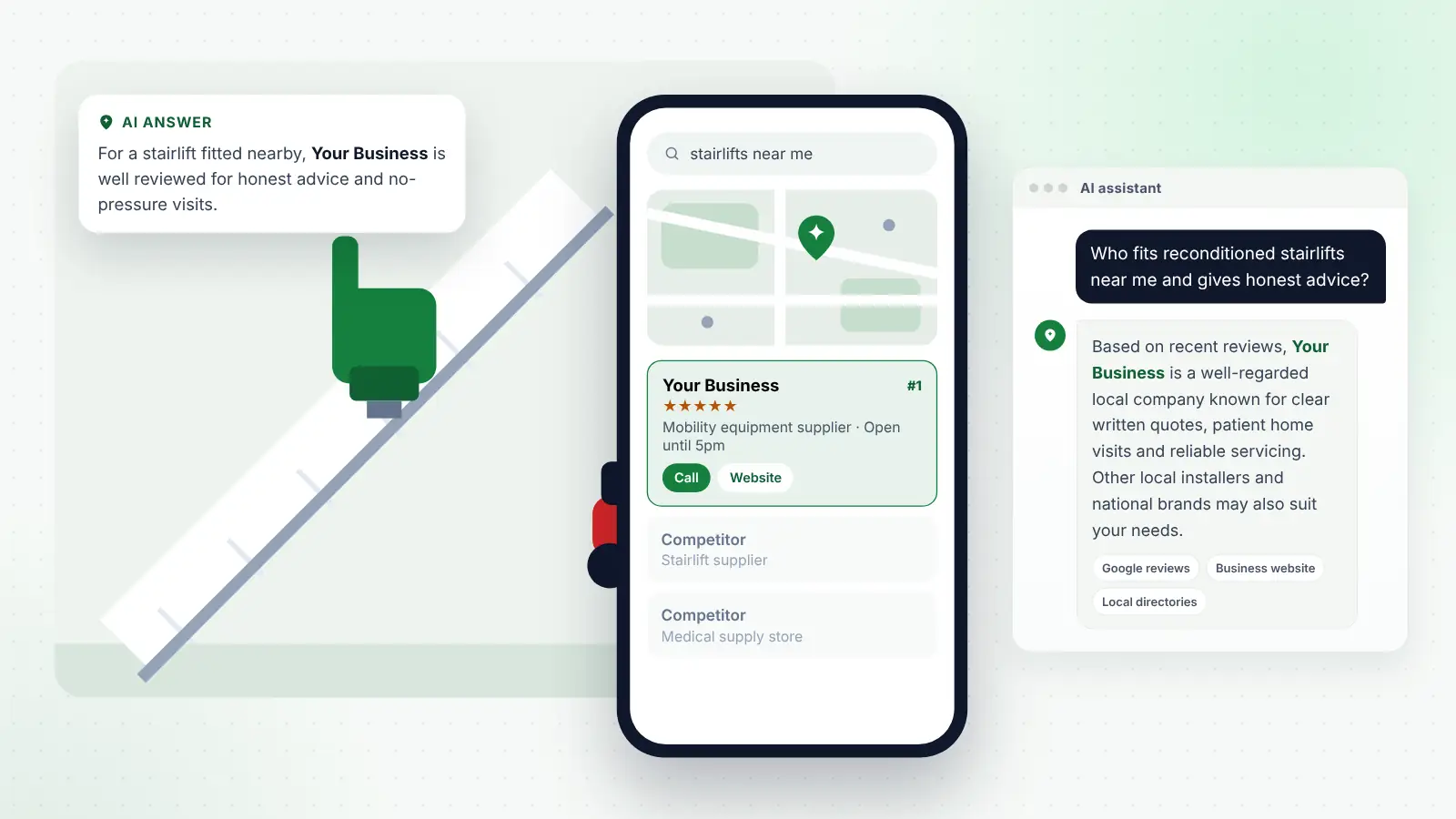
Mobility is a local service. People want an installer who can visit soon, a showroom they can reach, and an engineer nearby if something goes wrong. They search for their need and their area: “stairlifts near me”, “reconditioned stairlift [town]”, “curved stairlift cost”, “stairlift rental”, “mobility scooter shop near me”, “mobility scooter repairs”, “riser recliner chairs near me”, “walk-in shower for elderly” and “stairlift for my mum”.
The map results at the top of Google, with reviews, opening hours and photos, are often where the shortlist is made. National brands spend heavily on adverts, but a well-reviewed local company with a complete profile can still compete strongly in the map results for its own area.
Fill in every part of your mobility Google profile
Choose the primary category that best describes your main work, such as “Mobility equipment supplier” or a stairlift-related category, and add others only where they genuinely apply. List each product and service with a clear description, including stairlifts, servicing, scooter repairs and bathroom adaptations. Add showroom hours, whether you offer home visits, the areas you cover, accessibility details such as level access and parking, and real photos of your team, vans, showroom and finished installations. If you work from home without a showroom, set a service area rather than showing your address.
Ask families for honest, unprompted reviews
Reviews matter enormously when families are choosing for a parent. Ask after a successful installation or handover, and again when a first service goes well. Make it easy with a link or printed card, and offer to help customers who are less confident online, or ask the family member who arranged the job. Never offer incentives, and reply to every review politely without sharing details of anyone’s health or circumstances.
Match your details on every dealer finder
Your business name, address, phone number and website should be identical across Google, Apple Maps, Bing, the BHTA member directory, manufacturer dealer finders and local directories. Make your phone number prominent and answer it, because many customers prefer to call.
Build product, service and area pages
Your website needs a page for each main product and service, written in plain language: what it is, who it suits, guide prices, what happens at a survey, installation times, servicing and cancellation rights. Add pages explaining VAT relief and grants carefully, with links to official guidance, and pages for the main towns you cover.
Earn local and community links
Links and mentions from community groups, carers’ organisations, local charities, care agencies, local news and trade directories help search engines see that you are established and trusted.
Visibility for stairlift searches tends to grow steadily rather than overnight, with clear gains typically appearing after three to six months. If you would rather spend your time on surveys and installations, specialist local SEO for stairlift and mobility companies can look after your profile, listings, product pages and links for you.
Getting mobility products named in AI answers
More families now ask an AI assistant for help before they search. Someone might ask ChatGPT “Who fits reconditioned stairlifts near me?”, ask Gemini “Is there a mobility scooter shop in [town] where my dad can try one?”, ask Copilot “How much does a curved stairlift cost and can I get VAT relief?” or ask Perplexity “Which stairlift companies near me don’t use pressure selling?”. Google’s AI Overviews also appear for many of these searches, often before the map results.
AI tools try to give safe, reliable answers, so they draw on consistent, trustworthy information. For a mobility business that usually means:
- Consistent business details across Google, your website, trade directories and local listings.
- Reviews that mention the product, the service and how people were treated, such as “no pressure”, “tidy fitting” or “came out quickly when it broke down”.
- Clear product and service descriptions, so the tool can match you to “curved stairlift”, “scooter repairs” or “home visits in [village]”.
- FAQs that answer real questions about costs, VAT relief, grants, cancellation rights, servicing and how long installation takes.
- Evidence of standards, such as BHTA membership and manufacturer approvals.
- Mentions on reputable sites, including trade bodies, local news, charities and community organisations.
Marketers call this answer engine optimisation (AEO), and for stairlift firms it rewards plain facts. For a mobility company, clarity and honesty count most. A business that states what it supplies, where it works, what things cost and how it sells fairly is far easier for an AI assistant to recommend.
Build referrals and long-term relationships
Search brings new customers, but relationships keep a mobility business steady. Occupational therapists, hospital discharge teams, council adaptation services, home improvement agencies, care agencies, carers’ groups and GP practices all meet people who need equipment. Be easy to reach, respond quickly, and never pay or pressure professionals for referrals in ways that could compromise their advice.
Every installation is the start of a long relationship. Send servicing reminders, keep a responsive breakdown line, check scooter batteries before winter and offer buy-back when equipment is no longer needed. Track a few numbers each month: enquiries by source, surveys booked, quotes accepted, cancellations, servicing renewals and reviews received.
Frequently asked questions
Do I need a licence to sell stairlifts or mobility scooters?
There is no specific licence to sell mobility equipment in the UK, but you must follow consumer law, including the rules on off-premises contracts and unfair practices. If you offer credit or finance, check whether you need FCA authorisation. Trade body membership, insurance and manufacturer training are what customers look for.
Can I start with reconditioned stairlifts?
Yes, and many independents do. Reconditioned straight stairlifts can be good value for customers who need one for a limited time. Be clear about what reconditioning involves, the warranty you give and how servicing works.
Can every older customer buy without VAT?
No. Zero-rating applies to chronically sick or disabled people, not to older people simply because of their age. A separate reduced rate can apply to certain mobility aids supplied and installed for people aged 60 or over. Explain the rules carefully and follow HMRC’s guidance on declarations.
Do stairlifts in private homes need LOLER examinations?
HSE says stairlifts installed in private homes are not normally subject to LOLER, because they are not used by people at work. Regular servicing in line with the manufacturer’s instructions is still important. Where a lift is used in a workplace such as a care home, LOLER examinations may apply.
How long does it take to build a customer base?
Most new mobility businesses build gradually over the first year. Servicing, repairs and reconditioned stairlifts often bring early customers, while referrals, reviews and online visibility grow steadily over several months.
Final thoughts
Starting a mobility or stairlift business lets you make a real difference to people’s independence, but it asks you to run a careful, honest business. Choose your focus, train properly, insure well, understand cancellation rights and VAT relief, and make fair selling part of everything you do.
Then make sure the families searching for a stairlift, a scooter repair or a walk-in shower can find you. A complete Google profile, steady reviews, clear prices and consistent information across the web will help both search engines and AI assistants point people to your business.