A security guarding company can be built from very little equipment. There is no workshop to fit out and no stock to buy, and many successful firms began with a director who had worked the doors or run sites for someone else. What you are really selling is reliability: licensed, vetted people who turn up on time, do the job properly and are covered when something goes wrong.
That simplicity is also the challenge. The industry is tightly regulated, margins on hourly guarding are thin, and the biggest costs are people and compliance. Clients are trusting you with their buildings, their stock, their customers and sometimes their keys. Get licensing, vetting, pay or insurance wrong and the consequences can include criminal offences, unpaid wage claims and lost contracts.
This guide walks through the main steps to starting a security guarding company in the UK as things stand in October 2026, from SIA licensing and approved contractor status to British Standards, Martyn’s Law, pay, insurance, pricing and getting found by local buyers.
Key points
- Under the Private Security Industry Act 2001, people carrying out licensable security activities under a contract need an SIA licence, and directors and managers of companies that supply them need one too.
- The SIA Approved Contractor Scheme (ACS) is voluntary, but many buyers expect it; you need at least 12 months of trading before you can apply.
- BS 7858 is the standard for screening security staff, and services are commonly delivered to codes of practice such as BS 7499 for static guarding and BS 7984 for key holding, response and mobile security.
- Martyn’s Law is now law, with the SIA as regulator and active regulation expected from spring 2027; it may create demand from larger venues and events.
- Paying at least the National Minimum Wage for every hour worked, and calculating holiday pay correctly, matters as much as winning the contract.
In this guide
- Decide what kind of security company you want to run
- SIA licensing under the Private Security Industry Act 2001
- The SIA Approved Contractor Scheme
- Vetting and British Standards
- Martyn’s Law and what it means for security firms
- Pay, holiday pay and working time
- Setting up the business
- Pricing and winning your first contracts
- Local SEO: getting found by local buyers
- AI search: being named when buyers ask for security cover
- Referrals from contractors, agents and licensees
- Frequently asked questions
- Final thoughts
Decide what kind of security company you want to run
Security guarding covers several quite different businesses. Choosing where to focus first shapes the licences your staff need, the clients you approach and how you schedule your people.
- Static and manned guarding. Officers based at offices, retail units, warehouses, hospitals, empty buildings and corporate sites, often on long-running contracts.
- Mobile patrols. Scheduled or random visits to several sites a night, checking perimeters, doors and alarms, usually from a liveried vehicle.
- Key holding and alarm response. Holding clients’ keys and attending when an alarm activates, plus opening and locking-up services for shops and offices.
- Door supervision. Licensed door staff for pubs, bars, clubs and late-night venues.
- Event security. Searching, stewarding, crowd management support and backstage protection for festivals, concerts, sporting fixtures and private events.
- Construction and void property security. Guards, patrols and protection for building sites and empty buildings, sometimes alongside monitored CCTV towers supplied by others.
Many new firms start with one or two of these, often key holding and mobile patrols because they produce monthly recurring income, or door supervision because the founder already knows local licensees. Static guarding contracts can follow once you have a track record and enough reliable officers to cover shifts.
Skills and experience
Running a security company needs more than frontline experience. You will be recruiting, vetting, rostering, invoicing, handling incidents and dealing with clients at all hours. Time spent as a supervisor or account manager for an established firm is valuable, because it shows you how rotas, assignment instructions, incident reports and contract reviews work in practice.
SIA licensing under the Private Security Industry Act 2001
The Private Security Industry Act 2001 created the Security Industry Authority (SIA) and the licensing regime that applies across the UK. According to the SIA’s guidance on whether you need an SIA licence, licensing applies when security work is supplied to another organisation under a contract for services. Staff working in-house usually do not need a licence, with door supervision at licensed premises being a notable exception.
The licensable activities most relevant to a guarding company are:
| Licence | What it covers | Typical work |
|---|---|---|
| Security guarding | Guarding premises or property against damage, theft, unauthorised access or disorderly behaviour | Static guarding, mobile patrols, construction sites, retail |
| Door supervision | Guarding licensed premises against damage, theft, unauthorised access or disorderly behaviour | Pubs, bars, clubs, many events |
| Public space surveillance (CCTV) | Using CCTV to guard premises or people | Control rooms, monitoring stations |
| Key holding | Keeping or controlling access to keys or devices used to operate locks | Key holding and alarm response |
| Close protection | Guarding people against assault or injury | Personal protection |
A door supervisor licence also covers security guarding work, which is one reason many officers hold it. A front line licence is needed by anyone who personally carries out licensable work, whatever their job title. Directors, partners, managers and supervisors of a company that supplies licensed operatives under contract also need a licence, which can be a non-front line licence if they do not do the work themselves.
Getting a front line licence involves completing the relevant licence-linked qualification with an approved training provider, passing identity and criminal record checks and paying the licence fee. From 1 April 2026 the fee is £204 for new applications and renewals, after a temporary rebate ended. Most licences last three years.
Using unlicensed staff for licensable work, or working without a licence, is a criminal offence. Build licence checks into recruitment and keep a record of every officer’s licence number, type and expiry date, with reminders well before renewal.
Tip
Check each officer’s licence on the SIA’s online register before every new deployment, not just at recruitment. Licences can be suspended or revoked, and you are responsible for who you put on site.
The SIA Approved Contractor Scheme
The Approved Contractor Scheme (ACS) is voluntary, but it is one of the strongest signals a guarding company can show. Many public sector buyers, larger clients and facilities management firms only work with approved contractors, and the register is public, so buyers can check it.
To apply, the SIA’s guidance on applying for ACS approval says you must:
- Supply at least one licensable activity under contract in the UK.
- Have been providing those services for at least 12 months.
- Supply at least two licensable operatives in each activity you want approval for.
- Show that your directors hold valid SIA licences and that the people controlling the business are fit and proper.
- Complete the ACS self-assessment workbook and report, then be assessed by an approved assessing body such as NSI, SSAIB or the British Assessment Bureau.
There is an application fee based on the number of licensable staff, the assessing body charges for its visits, and approved companies pay an annual registration fee for each licensable person deployed. The SIA updated that annual fee in 2026, so check the current figures on its website before you budget.
Because of the 12-month rule, plan for ACS from the start. Keep proper records of recruitment, screening, training, assignment instructions, incidents, complaints and client reviews from your first contract, and the assessment becomes far more straightforward.
Vetting and British Standards
BS 7858 security screening
BS 7858 is the British Standard for screening individuals employed in a security environment. In broad terms it involves verifying identity and the right to work, checking a continuous employment and education history over a set period with references, confirming any gaps and carrying out an appropriate criminal record check. Assessing bodies and many clients expect it, and the ACS assessment looks at how you screen staff.
Screening takes time, and that is often the bottleneck for a growing firm. Some companies use specialist screening providers to speed it up. Either way, keep a complete file for every officer, because you may be asked to show it.
Codes of practice for services
Certification bodies assess guarding companies against service standards. The main ones to know are:
- BS 7499 for the provision of static guarding security services.
- BS 7984 for key holding, response and mobile security services.
- BS 7960 for door supervision.
- BS 7958 for CCTV management and operation.
- BS 10800 for the provision of security services more generally.
These codes cover things such as assignment instructions, supervision, training, control room arrangements, record keeping, key control and complaints. Even before you seek certification, using them as a checklist for how you run contracts is good practice, and it gives you something concrete to show buyers.
Martyn’s Law and what it means for security firms
The Terrorism (Protection of Premises) Act 2025, known as Martyn’s Law after Martyn Hett, who was killed in the Manchester Arena attack in 2017, received Royal Assent on 3 April 2025. It was followed by an implementation period of at least two years. The Home Office published its final statutory guidance in April 2026, the SIA consulted on its own guidance until June 2026, and active regulation by the SIA is expected to begin in spring 2027.
The Act sets two tiers for qualifying premises and events that the public can access:
| Tier | Capacity | Main requirements |
|---|---|---|
| Standard tier | 200 to 799 people | Public protection procedures such as evacuation, invacuation, lockdown and communication, and notifying the SIA |
| Enhanced tier | 800 or more people, plus qualifying events | The standard duties plus measures covering monitoring, movement, physical security and information security, documented compliance and, where the responsible person is an organisation, a designated senior individual |
For a security company, the main opportunity is with enhanced tier venues and events, which may need trained staff for searching, monitoring and controlling movement, and practical help preparing plans. Standard tier premises mostly need procedures and staff awareness rather than guards, so be careful not to suggest that every venue must hire security. Clear, accurate guidance on your website will be more persuasive to buyers than alarmist claims, and it is the kind of content AI tools are likely to trust.
The SIA has also been reviewing licence-linked qualifications, so watch for changes to training requirements and update your recruitment and training plans when they are confirmed.
Pay, holiday pay and working time
Labour is your biggest cost, and pay compliance is where security firms most often get into trouble. From 1 April 2026 the National Living Wage for workers aged 21 and over is £12.71 an hour, with lower rates for younger workers and apprentices.
Common mistakes in the sector include:
- Unpaid working time. Briefings, handovers, site checks before a shift and time spent waiting for a relief can count as working time.
- Uniform and equipment costs. Deductions for uniforms or requiring staff to buy specific clothing can take pay below the minimum wage for that period.
- Training and licence costs. Deducting or recharging training or licence fees can have the same effect, so take advice before agreeing any repayment arrangement.
- Travel between sites. Time mobile patrol officers spend travelling between assignments during a shift is generally working time.
- Long shifts. Twelve-hour shifts make it easy for unpaid extras to push average pay below the legal minimum.
Holiday pay needs care too. Officers working irregular hours or only part of the year can, for leave years starting on or after 1 April 2024, have holiday pay calculated as 12.07% of hours worked and paid as rolled-up holiday pay, provided it is shown separately on payslips. Regular overtime may also need to be reflected in holiday pay. Working time rules on rest breaks, daily and weekly rest and night work apply as well.
Pricing should start from these costs, not from a competitor’s rate. If a contract only works by cutting corners on pay, it is not worth winning.
Setting up the business
Structure, registration and paperwork
Most guarding companies trade as limited companies, partly because larger clients and frameworks expect it. Register with Companies House and HMRC, set up payroll as an employer, and decide early how you will handle VAT once you pass the threshold. Be cautious about treating officers as self-employed: employment status depends on how the work is really done, and getting it wrong creates tax and employment rights risks. The SIA’s ACS eligibility criteria also expect the people you deploy on regulated activity to be employees or employees for tax purposes.
Insurance
Insurance is essential and clients will ask to see it. Typical cover for a security company includes:
- Employers’ liability, which the law requires as soon as your first officer goes on the payroll.
- Public liability, often at a level set by the client’s contract.
- Professional indemnity, if you provide advice, risk assessments or security plans.
- Loss of keys cover if you offer key holding.
- Wrongful arrest and related cover, for situations where officers detain someone.
- Motor insurance for business use of patrol vehicles.
Specialist brokers who understand the security sector can help match cover to the contracts you plan to bid for.
Startup costs
| Item | Rough guide | Notes |
|---|---|---|
| Company formation and legal | Modest | Contracts and terms of business are worth getting right |
| SIA licences for directors | £204 each from April 2026 | Plus licence-linked training if needed |
| Screening | Varies by provider | Per officer, ongoing as you recruit |
| Uniform and equipment | Varies by number of officers | Radios, body-worn cameras, torches, first aid kits |
| Patrol vehicle | Varies widely | Used and liveried vehicles keep costs down |
| Insurance | Varies by cover and turnover | Use a specialist broker |
| Software | Typically a monthly subscription | Rostering, guard tour, incident reporting, payroll |
| Control room or out-of-hours cover | Varies | In-house or outsourced, essential for key holding |
| Working capital | Several weeks of payroll | Clients may pay 30 days or more after month end |
All figures vary by area and scale. Cash flow is the hidden risk: you pay officers weekly or monthly, while clients often pay a month or more later, so arrange enough working capital or invoice finance before taking on a large contract.
Pricing and winning your first contracts
Buyers often compare hourly rates, so make it easy for them to see what is included.
- Build rates from cost. Start with pay at or above the legal minimum, holiday pay, employer National Insurance and pension contributions, supervision, uniforms, insurance, training and overheads, then add a margin.
- Show the difference. Explain your vetting, licensing, supervision, reporting, out-of-hours support and how quickly you cover sickness.
- Set clear terms. Minimum shift lengths, notice periods, enhanced rates for bank holidays and late cancellations should be in writing.
- Start with recurring services. Key holding, alarm response and patrol contracts can be priced monthly and build a steady base.
- Be realistic about tenders. Large contracts and frameworks often ask for years of trading, ACS approval and references, so build up to them.
Your first clients are often people you already know: licensees, site managers, local businesses, letting agents and event organisers. Do excellent work for them and ask for a reference and a review.
Tip
Write a clear assignment instruction for every site, even small ones, and share it with the client. It shows professionalism from day one and will form part of the evidence you need for ACS.
Local SEO: getting found by local buyers
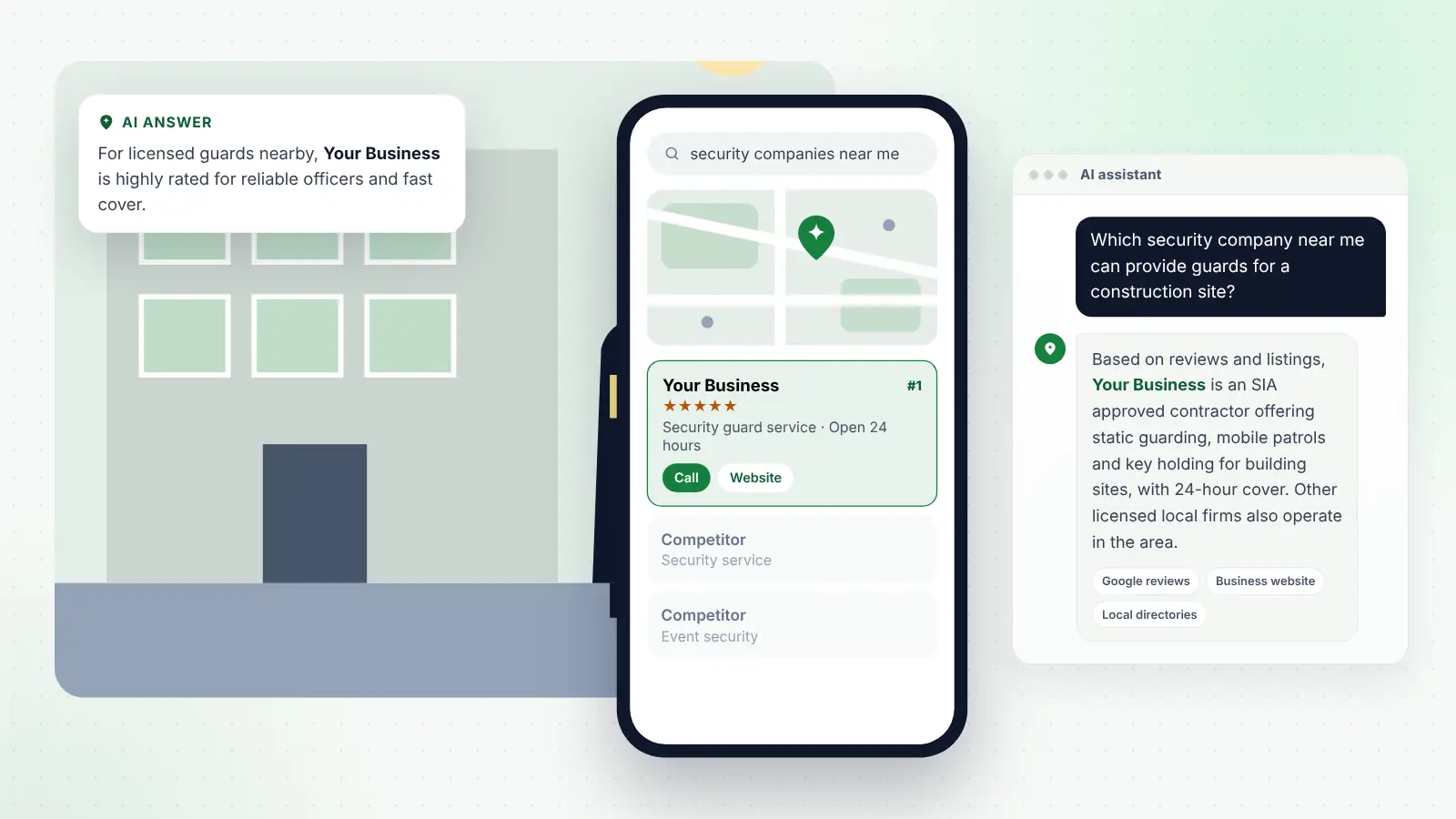
Many security purchases start with a search. A site manager needs overnight cover from Monday, a shop has been broken into, a landlord has an empty building, or a pub has lost its door team. Searches such as “security companies near me”, “security guards [town]”, “construction site security”, “key holding and alarm response” and “door staff for hire” are local and often urgent, and the companies shown on the Google map get many of those calls.
Buyers also search more specifically: “SIA approved contractor [county]”, “mobile security patrols for industrial estate”, “event security company for festival” or “void property security”. Being visible for these searches helps you win better contracts.
Google Business Profile
Your Google Business Profile is often the first thing a buyer sees. Make it complete and accurate:
- Choose the most accurate primary category, such as security guard service, and add relevant secondary categories.
- Set it up as a service-area business if you do not have a public office, listing the areas you genuinely cover.
- Add each service separately: static guarding, mobile patrols, key holding, door supervision, event security and construction site security.
- Mention SIA licensing, ACS approval if you have it, and insurance in your description.
- Show accurate hours, and make clear if you answer the phone 24 hours a day.
- Upload real photos of your team, uniforms and patrol vehicles, avoiding anything that reveals a client’s site layout or security arrangements.
Reviews
Clients care about reliability and communication. Ask every client for a review once a contract is running well, ideally with a direct link. Reviews that mention punctual officers, quick cover, clear reports and responsive managers are especially persuasive. Reply to every review politely, and respond to any criticism calmly and professionally.
Matching company details on the SIA register and directories
Your company name, address and phone number should be identical across your website, Google profile, Bing Places, Apple Business, UK business directories, trade association listings and your entry on the SIA’s approved contractor register. Inconsistencies confuse both buyers and search engines.
Pages for each guarding service and patrol area
Give each main service its own page, explaining what is included, which licences your officers hold, how reporting works and what clients should expect. Area pages for the main towns and industrial areas you cover help, provided each has genuinely useful local information rather than copied text. Explain licensing, vetting, key holding and Martyn’s Law in plain English, and give clients an easy way to request a quote or call out of hours.
Local links and mentions
Links and mentions from local business groups, chambers of commerce, Pubwatch schemes, Business Improvement Districts, construction and property partners and local news help show search engines that you are an established local company. Sponsoring a community event you also secure is a natural way to earn one.
If you would rather focus on running contracts while specialists handle your visibility, local SEO for security guard companies is one option to consider. Whichever you pick, expect your visibility to grow over three to six months rather than within the first few shifts.
AI search: being named when buyers ask for security cover
More buyers now ask AI assistants such as ChatGPT, Gemini, Perplexity, Copilot and Google’s AI Overviews for help. A facilities manager might ask “Which security companies near me are SIA approved contractors?”. A builder might ask “Who can provide overnight guards for a construction site in Leeds?”. A venue manager might ask “What does Martyn’s Law mean for my 900-capacity venue?” or “Which local firms provide licensed door staff at short notice?”.
These tools try to give a measured answer, so they lean on information they can confirm across the web. To be recommended, help them understand what you do and why you can be trusted:
- Consistent information everywhere. Matching details on your website, Google profile, directories and the approved contractor register.
- Reviews. A steady flow of genuine reviews describing the service you provided.
- Clear service descriptions. Plain explanations of the services you offer, the licences your officers hold, the areas you cover and the types of site you protect.
- Helpful FAQs. Answers to real questions about licensing, vetting, key holding, response times, construction site security and Martyn’s Law.
- Mentions on reputable sites. Trade bodies, local business organisations, partners and local news coverage.
AI search is still developing, and no one can guarantee a recommendation. The work that helps you appear in AI answers is the same work that builds trust with buyers, so it is never wasted.
Tip
Keep a list of the questions prospective clients ask on site surveys and calls, and answer them on your website. They are exactly the questions people now type into AI assistants.
Referrals from contractors, agents and licensees
Search brings new enquiries, but relationships bring much of the steadiest work. Consider partnerships with:
- Main contractors and developers, who need site security from groundworks to handover.
- Facilities management companies and commercial property agents, who manage many buildings.
- Alarm and CCTV installers, who are often asked who can provide key holding and response.
- Insurance brokers, who may need to recommend security for empty or high-risk premises.
- Licensees, Pubwatch schemes and event organisers, who need door supervisors and event teams.
Keep in touch with past clients too. A developer who was happy with your guards on one site is likely to call again for the next.
Frequently asked questions
Do I need an SIA licence to run a security company?
If your company supplies licensed security operatives under contract, directors, partners, managers and supervisors generally need an SIA licence. That can be a non-front line licence if you do not personally carry out security work, but anyone who does needs a front line licence for that activity.
Can I apply for ACS approval straight away?
No. You need to have been supplying the relevant licensable services for at least 12 months and deploy at least two licensable operatives in each activity before you can apply. Use the first year to build the records and procedures the assessment will look at.
Do my officers need to be screened to BS 7858?
It is not a legal requirement in itself, but it is the recognised standard for screening security staff, ACS assessments look at how you vet people, and many clients expect it. In practice, most professional guarding companies screen to BS 7858.
Does Martyn’s Law mean every venue needs security guards?
No. Standard tier premises with a capacity of 200 to 799 mainly need procedures for evacuation, invacuation, lockdown and communication. Enhanced tier premises and events with 800 or more people face further requirements, which may include measures where trained security staff can help. Active regulation is expected from spring 2027.
Can I pay officers as self-employed contractors?
Employment status depends on how the work is actually done, not on what a contract says. Most guarding work, with set shifts, uniforms and supervision, points towards employment or worker status, which brings minimum wage and holiday pay rights. Take advice before using self-employed arrangements.
Final thoughts
Starting a security guarding company takes careful groundwork: the right SIA licences, thorough BS 7858 screening, a plan for ACS approval, compliant pay and holiday pay, proper insurance and an understanding of what Martyn’s Law will and will not ask of your clients. Get those foundations right and reliability does much of your marketing for you.
Alongside that, make sure buyers can find you when they need cover quickly. A complete Google profile, consistent details, genuine reviews and a website that answers real questions will help you appear both in local search and in the AI tools people increasingly use to choose a security company they can trust.