Upholstery has quietly come back into fashion. People are keeping good furniture for longer, rescuing well-made frames from auctions and asking whether the sofa they already own could feel new again. Pubs, restaurants, hotels and offices need seating repaired and re-covered on a regular cycle. For a skilled upholsterer, that means steady demand from homes and businesses.
It is also a trade with real responsibilities. Upholstered furniture is a known fire risk, and every time you rebuild a chair you are choosing the foam, fillings and fabric that go into someone’s living room or a busy bar. Customers rarely ask about this, but trading standards officers do.
This guide covers choosing your niche, training, fire safety rules for domestic and contract work, the 2025 labelling change, quoting, collection and delivery, portfolios, trade work, and getting found on Google and in AI assistants.
Key points
- Domestic re-upholstery is generally covered by the Furniture and Furnishings (Fire) (Safety) Regulations 1988, which set fire resistance requirements for fillings and covers.
- Since 30 October 2025 the display label requirement has been removed, but the permanent label requirement remains.
- Contract seating for pubs, restaurants, hotels and offices is usually specified to BS 7176, which uses BS 5852 ignition sources such as crib 5 for medium hazard premises.
- The Association of Master Upholsterers and Soft Furnishers (AMUSF) runs a recognised qualification programme, alongside college courses and apprenticeships.
- Clear quoting, especially for customer’s own fabric, and before-and-after photos turn enquiries into jobs.
- Local SEO and AI search visibility matter because most customers have never hired an upholsterer before and search for one when they need it.
In this guide
- Decide what kind of upholstery business you want to run
- Training, skills and qualifications
- Fire safety rules for domestic re-upholstery
- Contract seating: BS 7176 and BS 5852
- Setting up your workshop, equipment and costs
- Quoting, fabric quantities and pricing
- Collection, delivery and customer care
- Building a portfolio and winning trade work
- Local SEO for upholsterers
- How AI assistants recommend upholsterers
- Frequently asked questions
- Next steps
Decide what kind of upholstery business you want to run
Upholstery covers several different kinds of work, and your choice shapes your training, equipment and customers.
- Traditional upholstery. Springs, webbing, horsehair or fibre stuffings and hand-stitched edges, suited to antique and period pieces. Slower work, priced accordingly.
- Modern upholstery. Foam, serpentine springs, staples and machine-sewn covers. Most domestic sofas and contract seating are built this way.
- Restoration and repairs. Frame repairs, re-springing and re-webbing, often with a French polisher as partner.
- Foam and cushion replacement. Quick, regular work, and a satisfied customer often returns for a full re-cover.
- Commercial and contract seating. Banquettes, booths, dining chairs and bar stools for hospitality, plus office seating. Tighter deadlines and stricter fire specifications.
- Marine and caravan upholstery. Boat cushions and caravan or motorhome interiors, needing outdoor fabrics, careful templating and often on-site work.
Many workshops combine domestic work with a few commercial clients to smooth out quieter months.
Training, skills and qualifications
You do not need a licence to work as an upholsterer, but customers are handing you furniture they value, and good training shortens the time it takes to work quickly and confidently.
The main routes into the trade are:
- AMUSF qualifications. The Association of Master Upholsterers and Soft Furnishers runs a professional qualification programme delivered through accredited centres, progressing in stages from a craft certificate through an intermediate craft certificate to a diploma.
- College courses. Many further education colleges offer upholstery courses and qualifications at different levels, covering modern and traditional methods and often part-time.
- Apprenticeships. Where available, furniture manufacturing apprenticeships with an upholstery focus combine paid work in a workshop with structured off-the-job learning.
- Working for an established upholsterer. Learning at the bench is still how many build speed and judgement before going independent.
You need to be confident assessing frames, springing, cutting foam, cutting fabric economically, machining covers and piping, and finishing neatly. Short courses in skills such as deep buttoning are worth adding as you go.
The Association of Master Upholsterers and Soft Furnishers
AMUSF was founded in 1947 to represent upholsterers, small furniture makers and soft furnishers. It acts as the trade’s voice, offers advice to members and is closely involved in training. Membership is not compulsory, but it is a recognisable sign that you take your craft seriously.
Fire safety rules for domestic re-upholstery
The Furniture and Furnishings (Fire) (Safety) Regulations 1988 set fire resistance requirements for upholstered furniture intended for use in the home. According to trading standards guidance on new upholstered furniture fire safety, the regulations cover items such as chairs, sofas, sofa-beds, headboards, cushions and seat pads, and they apply to businesses offering re-upholstery and re-covering services as well as to manufacturers and retailers.
What the rules mean in practice
In broad terms:
- Foam fillings must meet ignition resistance requirements, which in practice means buying combustion-modified foam from reputable suppliers.
- Non-foam fillings such as fibre have their own requirements.
- Cover fabrics must pass a match test as part of the finished composite, or be used over a suitable fire-resistant interliner where the regulations allow it.
- The whole composite of cover and filling must pass a cigarette test.
- Labelling. New furniture must carry a permanent label setting out its compliance information. Check with trading standards what labelling applies to a re-upholstered piece.
There are exceptions. The regulations do not apply to furniture made before 1 January 1950, or to materials used to re-upholster such furniture. Caravan upholstery is within scope, while furniture in vehicles and boats is not, though boat owners and marine businesses may have their own specifications to meet.
The 2025 change to labelling
The Furniture and Furnishings (Fire) (Safety) (Amendment) Regulations 2025 came into force on 30 October 2025. The change most visible to the trade is that the display label, the swing ticket previously required at the point of sale, is no longer needed. The permanent label requirement is unaffected. The amendment also removed certain baby products from scope and extended the time limit for bringing legal proceedings from six to twelve months.
Ask your local trading standards team if you are unsure how labelling applies to a particular job.
Customer’s own fabric and interliners
Customers often supply their own fabric, sometimes a natural fibre that will not pass the match test alone. Depending on the fabric, it may be used over a suitable interliner or treated by a specialist. Explain this before they buy, include the cost in your quote and record what you used. Never quietly leave out the interliner to save time.
Tip
Keep a simple job file for every piece: the foam and fabric used, supplier certificates, any interliner or treatment, and photos at each stage. If a question is ever raised about a piece you worked on, you can answer it quickly.
Contract seating: BS 7176 and BS 5852
Seating for non-domestic premises follows a different approach. The key reference is BS 7176, which classifies furniture by hazard level and specifies the tests the cover and filling must pass, using ignition sources defined in BS 5852.
| Hazard level | Typical premises | Additional test |
|---|---|---|
| Low | Offices, schools, museums, day centres | Cigarette and match tests only |
| Medium | Pubs, restaurants, hotel bedrooms, public halls, entertainment venues | BS 5852 crib 5 |
| High | Certain hospital wards and hostels, offshore installations | BS 5852 crib 7 |
| Very high | Prison cells | Specified by the client |
Most hospitality work falls into the medium hazard category, which is why “crib 5” is the phrase you will hear most from pub and restaurant clients.
In England and Wales, responsibility for fire safety in non-domestic premises sits with the “responsible person”, usually the operator, through their fire risk assessment, and Scotland and Northern Ireland have similar duties. They will often ask you to confirm that your foam, fabric and any interliners meet the specified hazard level. Buy contract-grade foam and fabrics with clear certificates, keep those certificates on file and give the client written confirmation of what was used.
Contract fabrics also need to be durable, so check the Martindale rub count and choose heavier-duty fabrics for busy dining areas.
Setting up your workshop, equipment and costs
Many upholsterers start from a garage or garden workshop and move to a unit as work grows. You need space to strip and rebuild furniture, a clean cutting area, storage for customers’ pieces and ventilation if you use spray adhesives.
The figures below are rough guides only, and vary by area and whether you buy new or used.
| Item | Typical cost | Notes |
|---|---|---|
| Hand tools | £300–£1,000 | Ripping chisel, mallet, tack lifters, shears, needles, regulators |
| Industrial sewing machine | £800–£2,500 | Walking-foot machines suit heavy fabrics and piping |
| Staple guns and compressor | £300–£1,200 | Pneumatic tools speed up modern work considerably |
| Foam cutting equipment | £200–£1,500 | Electric foam saw, or buy foam cut to size at first |
| Workshop unit | Varies widely | Rent, business rates, utilities and fit-out |
| Van | £5,000–£18,000 | Needs space for a three-seater sofa and blankets |
| Insurance | Varies | Public liability, plus cover for customers’ goods |
| Website and branding | £1,000–£4,000 | Logo, website, van livery, quote templates |
Decide whether to trade as a sole trader or limited company, register with HMRC, open a business bank account and keep records from the start. Customers’ furniture may be with you for weeks, so check your insurance covers it in the workshop and in transit. Employers’ liability insurance is generally a legal requirement once you take on staff.
Quoting, fabric quantities and pricing
Underquote and you work for nothing; overquote without explanation and the customer buys a new sofa instead. A clear written quote should cover:
- The work to be done, such as strip back, re-web, re-spring, new foam, re-cover and any frame repairs.
- The fabric, either supplied by you with the price per metre, or customer’s own fabric with the exact quantity needed.
- Fire safety materials, including compliant foam and any interliner or fabric treatment.
- Extras such as piping, buttons, skirts, new castors or legs, and scatter cushions.
- Collection and delivery charges.
- Lead time, deposit and payment terms.
Hidden problems such as broken springs may only show once a piece is stripped, so agree up front that you will call with a revised price before doing extra work.
Getting fabric quantities right
Fabric mistakes are expensive. Allow extra for pattern repeat, matching stripes or florals across cushions, piping and the pile direction on velvets. When customers buy their own fabric, give a written quantity, ask them to order from one batch and check it before you cut.
Price for the time a job genuinely takes, plus materials, overheads and a fair margin, and explain the value of a rebuilt piece when customers compare it with a new sofa.
Tip
Ask customers to send photos of the front, back, sides and underside of a piece, along with rough measurements, when they enquire. You can give a guide price quickly and only visit or collect when the job is likely to go ahead.
Collection, delivery and customer care
Most customers cannot get a sofa to your workshop, so collection and delivery are part of the service. Set your area and charges, protect pieces with blankets and photograph each item on collection to record its condition.
Give realistic lead times and send a progress photo mid-job; customers often mention it in reviews. Under the Consumer Rights Act 2015, a service for a consumer must be carried out with reasonable care and skill, so put what you have agreed in writing. If you agree jobs in customers’ homes, be aware that consumer law on off-premises contracts, including cancellation rights, may apply, and take advice on your terms and deposit policy.
Building a portfolio and winning trade work
Before-and-after photos
Photograph every piece before, during and after, in good natural light. The transformation answers every customer’s question: is my piece worth saving? Ask to photograph finished pieces in customers’ homes too.
Trade work from interior designers and others
Good trade sources include:
- Interior designers, for bespoke pieces, headboards and re-covering clients’ furniture.
- Furniture shops and antique dealers, with pieces that need restoring.
- Curtain makers and soft furnishers, who share clients and refer work.
- Hospitality fit-out companies and pub groups, for contract seating.
- Caravan dealers, holiday parks and marinas, for interiors.
Designers value consistency, honest lead times and clear trade pricing. Agree terms in writing, including payment, who supplies fabric and who pays for measurement mistakes.
Local SEO for upholsterers
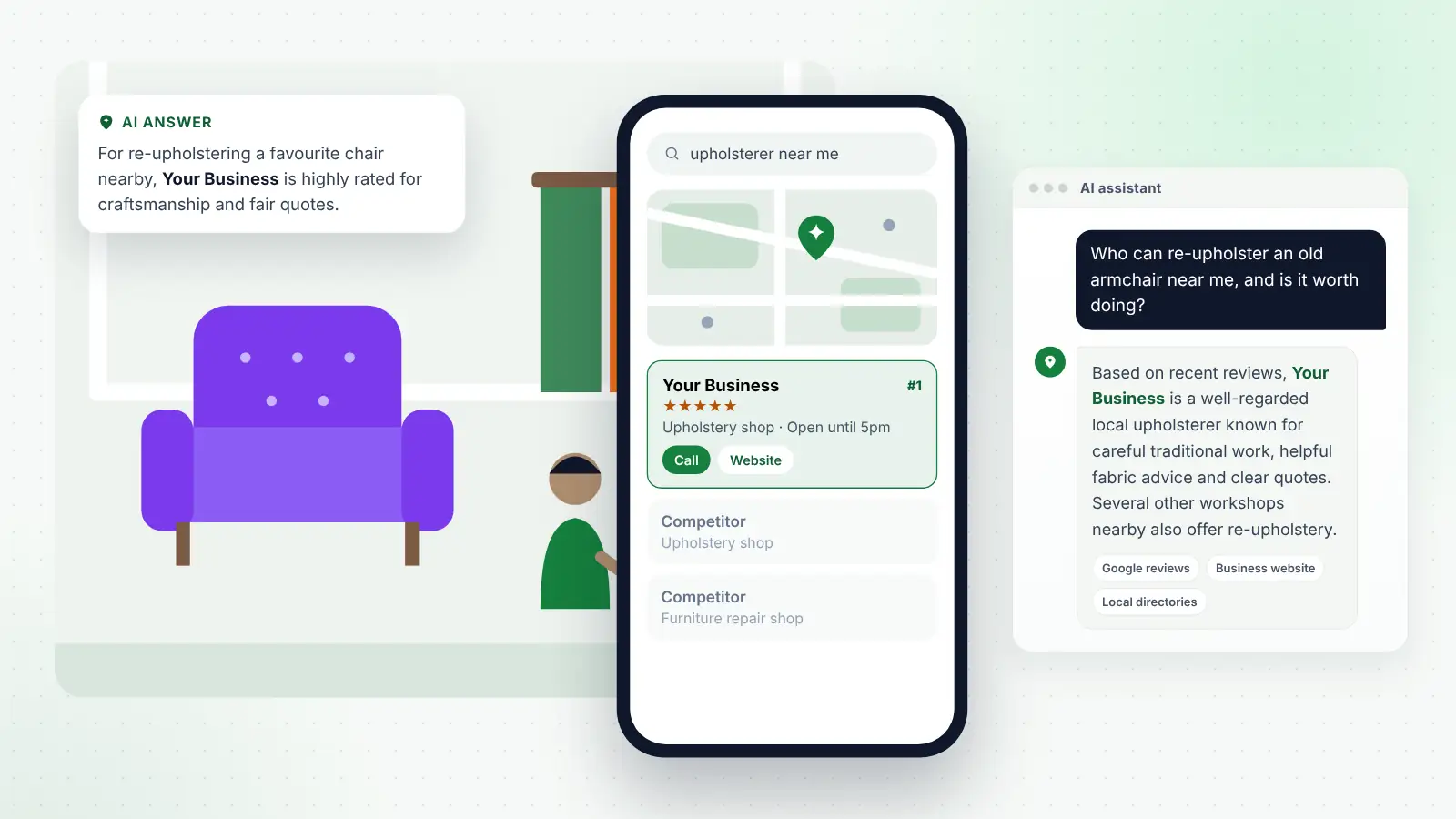
When a sofa or armchair needs attention, people search Google for “upholsterer near me”, “sofa re-upholstery [town]” or “replacement cushion foam”. Pub and restaurant owners search for “restaurant seating re-upholstery” or “banquette repairs”. The map results show three local businesses with reviews and photos, and being one of them is one of the most effective ways for a small workshop to win work. Local search favours businesses that are relevant, nearby and well regarded, so a skilled independent has a fair chance.
Google Business Profile
Choose the most accurate primary category, such as upholstery shop, and add secondary categories only if they genuinely apply. If customers cannot visit your workshop, set up as a service-area business rather than showing a home address. Describe your services, list your collection area and add before-and-after photos regularly.
Reviews
Ask every customer for a review after delivery, using a direct link. Reviews that mention the finish, fabric advice and meeting the agreed date are far more persuasive than a star rating alone. Reply to every review calmly.
Keeping your workshop details identical everywhere
Your name, address and phone number should match exactly on your website, Google, Bing, Apple Maps, directories and trade association listings.
Pages for each upholstery service and the areas you collect from
A page for each main service, such as sofa re-upholstery, traditional upholstery, foam replacement, commercial seating and boat or caravan work, helps Google understand what you do. Add pages for the main towns you collect from, plus guide prices, lead times, your fire safety approach and a photo enquiry form.
Local and industry links
Good sources include trade association listings, local business groups, designers you work with, vintage fairs and local press features about restorations.
This takes time alongside bench work, which is why some workshops choose specialist help with local SEO for upholsterers so they can concentrate on the craft. Whichever route you take, expect visibility to grow over three to six months, not in a matter of days.
How AI assistants recommend upholsterers
Plenty of people weighing up a tired sofa now ask an AI assistant first. Someone might ask ChatGPT “Is it worth re-upholstering my sofa?”, ask Gemini “Who can restore an antique chair near me?”, ask Copilot “What does crib 5 mean for restaurant seating?” or see a Google AI Overview for “re-upholstery cost in [town]”. Perplexity works the same way.
These tools build answers from information already published, so the groundwork for local SEO also helps AI visibility. They rely on:
- Consistent information. Matching details across your website, Google profile and directories make AI tools more confident about mentioning you.
- Reviews. Detailed reviews help assistants describe what you are known for, such as traditional craftsmanship.
- Clear service descriptions. Plain explanations of what you do and where make it easy to match you to a question.
- FAQs. Answers on turnaround times, fabric quantities, customer’s own fabric and fire safety are exactly what these tools summarise.
- Mentions on reputable sites. Local news, interiors blogs and trade association listings strengthen the picture.
Many customers are unsure whether their piece is worth saving. A workshop that answers that clearly, and is described consistently elsewhere, is better placed to be mentioned.
Frequently asked questions
Do the fire safety regulations apply to re-upholstery?
Generally yes. Trading standards guidance says re-upholstery and re-covering services are within the regulations. Furniture made before 1 January 1950, and materials for re-upholstering it, are excluded, though some upholsterers choose compliant materials anyway.
Is a display label still required?
No. Since 30 October 2025 the display label requirement has been removed. The permanent label requirement still applies to new furniture, so check with trading standards what labelling each job needs.
What does crib 5 mean?
Crib 5 is an ignition source defined in BS 5852, a small wooden crib used to test how a cover and filling combination resists fire. BS 7176 uses it for medium hazard premises such as pubs, restaurants and hotel bedrooms.
Should I join the AMUSF?
It is not compulsory, but membership is well recognised by customers and trade clients.
Next steps
An upholstery business rewards good hands and patience, but success also depends on foundations customers rarely see: compliant materials, the right approach for contract seating, careful records and accurate quotes.
Then focus on being easy to find and trust. A complete Google profile, before-and-after photos, genuine reviews and consistent information will help homeowners, businesses and AI tools recognise you as a skilled, dependable local upholsterer.