Most planning consultancies are good at the work and less consistent at finding it. A busy architect sends three instructions in a month, then none for a quarter. Meanwhile, the people who most need advice, such as a homeowner holding an enforcement letter or a shop owner who wants to convert the floor above, often have no idea what a planning consultant does or how to find a good one.
The consultancies that grow steadily tend to do a few things well. They are clear about the clients and problems they want, they describe their credentials and track record accurately, they explain planning changes in plain English, and they make themselves easy to find when someone searches for help with a specific problem in a specific council area.
This guide covers each of those, with particular attention to how you talk about RTPI membership and outcomes, how to use the 2025 and 2026 reforms in England as a reason to talk to clients, how the systems in Scotland and Wales differ, and the local SEO and AI search work that brings enquiries to you directly.
Key points
- Decide which clients and problems you want most, because a householder appeal, a change of use and a small housing site are found and won in different ways.
- Use “Chartered Town Planner” and MRTPI only for people who hold them, and be clear about who in the team is chartered.
- Avoid headline success rates; specific, verifiable case studies are more honest and more persuasive.
- The Planning and Infrastructure Act 2025, the revised NPPF and the new national scheme of delegation give you timely, useful things to explain to clients in England.
- Local SEO and AI search help clients find you at the moment they need help, and results usually build over three to six months.
In this guide
- Decide which clients you actually want
- Describe your RTPI credentials accurately
- Talk about outcomes honestly
- Use planning reform as a reason to talk to clients
- Build service pages around the problems clients have
- Make appeals work easy to find and understand
- Be clear about Scotland and Wales
- Build referral partners who send steady work
- Local SEO for planning consultants
- AI search and how clients ask for recommendations
- Set fees and terms that reduce disputes
- Frequently asked questions
- Next steps
Decide which clients you actually want
“Planning consultant” covers a wide range of work, and each kind of client arrives in a different way. Before changing your marketing, look at the last year of instructions and note where each came from, how much it was worth and whether the client came back.
| Client | Typical trigger | How they usually find you | What they need to hear |
|---|---|---|---|
| Homeowners | A refused extension, a neighbour dispute, an enforcement letter | Search, architects, builders | What their options are, what it costs, how long it takes |
| Local businesses | A change of use, new signage, an extension to premises | Search, accountants, commercial agents | Whether permission is needed and the likely route |
| Small developers | A site to appraise, a scheme of a few homes, a refusal | Land agents, architects, repeat work | Your judgement on risk, policy and viability |
| Landowners and farmers | Barn conversions, diversification, prior approval | Land agents, search, word of mouth | Whether permitted development applies and what it involves |
| Property owners with a problem | An unauthorised change or works without consent | Search, solicitors | Calm, realistic advice on enforcement and certificates |
Most consultancies find that one or two of these groups are the most profitable. Focus your content, referrals and search visibility there.
Describe your RTPI credentials accurately
Chartered membership of the Royal Town Planning Institute is the main professional credential clients and referrers look for. The RTPI’s guidance on designations sets out who may use what: Chartered Members may use MRTPI and the title “Chartered Town Planner”, Fellows use FRTPI (and may also use the title), Associates use AssocRTPI and Legal Associates use LARTPI. Affiliate, student and licentiate members cannot use post-nominals but can describe their membership class.
A few practical points for your website, proposals and Google profile:
- Be specific about who is chartered. “Led by a Chartered Town Planner” is accurate for a sole MRTPI with junior staff. “A team of chartered planners” is not, unless it is true.
- Check the logo rules. RTPI guidance limits use of its logo, and a practice with a single chartered member needs to make clear that the membership belongs to that person.
- Mention your insurance. RTPI members offering planning services to the public must hold professional indemnity insurance, and saying so reassures clients.
The RTPI’s guidance on offering planning services to the public also covers terms of engagement, fee clarity and advertising that is accurate, truthful and not misleading. It is worth rereading before you rewrite your website.
Tip
Add each chartered planner’s membership class and specialisms to their team profile, and link those profiles from your service pages. Clients, referrers and AI tools all look for named, qualified people behind the advice.
Talk about outcomes honestly
Clients want to know whether you can get them permission, and it is tempting to answer with a percentage. Success rates are hard to state fairly. They depend on which cases you take, how you define success and over what period. A consultancy that turns down weak appeals will look better than one that takes on difficult cases, which says little about the quality of advice. A claim like “98% success rate” also needs evidence behind it, and most firms cannot produce that in a form a client could check.
More honest and usually more persuasive alternatives include:
- Case studies with context. The site, the problem, the policy issues, what you did and what was decided, including any conditions.
- Specific experience. “We have handled householder appeals in most of the councils across the county” is checkable and meaningful.
- Candid advice about prospects. Saying “we will tell you if we do not think an appeal is worth pursuing” builds more trust than any statistic.
- Reviews that describe the experience. A client explaining that you set out the risks clearly is evidence of good advice even when the outcome was a refusal.
Never imply that permission is guaranteed. Decisions rest with the council or the appeal decision-maker, and clients who were promised an outcome are the ones who complain.
Use planning reform as a reason to talk to clients
Planning in England has changed a great deal over the past two years, and most of your clients will not have followed it. Clear, dated explanations of what has changed are useful to readers, to referrers and to AI tools.
The Planning and Infrastructure Act 2025
The Planning and Infrastructure Act 2025 received Royal Assent on 18 December 2025. Its provisions are being brought into force in stages through commencement regulations, so when you write about it, say what is in force and what is still to come rather than treating the whole Act as live. Topics clients ask about include:
- Planning committees. Under regulations made in 2026, a national scheme of delegation takes effect in England on 31 October 2026. Householder, minor and prior approval applications are among those that must be decided by officers, while larger schemes can only go to committee in defined circumstances.
- Planning fees. The Act gives councils powers to set their own fees, but those powers depend on further regulations and are being brought in gradually. National fees have also risen significantly since 2025, including for householder applications, so always check the current figure on the Planning Portal or your council’s website before quoting it.
The revised NPPF
A revised National Planning Policy Framework was published on 17 August 2026, including national decision-making policies that apply straight away. It changes how the presumption in favour of sustainable development works, with a stronger focus on settlement boundaries, and encourages more homes on small and medium sites. For small developers in particular, a short, accurate explainer on what the new framework means for the sort of sites they buy is a strong reason to get in touch.
Tip
Put a “last reviewed” date on every article about reform and update it when rules change. Out-of-date planning guidance damages trust quickly, and dated content helps readers and AI tools judge whether it is still current.
Build service pages around the problems clients have
Clients rarely search for “planning consultant” in the abstract. They search for the problem in front of them, so give each common problem its own clear page.
Permitted development and prior approval
Many homeowners and landowners have heard they “do not need planning” without understanding permitted development limits, conditions or Article 4 directions. Explain the main routes you handle, such as larger rear extensions, commercial to residential conversions under Class MA and agricultural building conversions under Class Q, and make clear that prior approval is a formal process with its own requirements and deadlines.
Lawful development certificates
Explain the difference between a certificate for proposed use or works and one for an existing use or works, and why buyers’ solicitors often ask for one. In England, the time limit for enforcement against most breaches is now ten years, following changes that took effect in April 2024, with transitional arrangements for older breaches. That change is a common source of confusion and a good subject for a clear article.
Enforcement
People who receive a planning contravention notice or enforcement notice are often anxious and searching late at night. Calm, practical content on what the letter means, the deadlines involved and the options, such as a retrospective application, an appeal or a certificate, can bring high-value instructions.
Make appeals work easy to find and understand
Appeal enquiries are among the most urgent you will receive. In England, appeals are made to the Planning Inspectorate. A householder appeal must usually be made within 12 weeks of the decision, most other planning appeals within six months, and an enforcement appeal must reach the Inspectorate before the notice takes effect. Only the applicant can appeal a refusal; objectors have no right of appeal.
Your appeals page should explain the procedures, likely timescales and costs in general terms and, most importantly, your honest view on when an appeal is worthwhile. Encourage people to contact you as soon as they are refused, so there is time to review the decision notice and officer report before the deadline.
Be clear about Scotland and Wales
If you work outside England, or your content could be read by people elsewhere, make the jurisdiction obvious. Planning is devolved, and the systems differ in important ways:
- Scotland has its own legislation and National Planning Framework 4. Delegated decisions on local developments are usually reviewed by the council’s local review body, while other appeals go to the Scottish Government’s Planning and Environmental Appeals Division (DPEA).
- Wales has Planning Policy Wales and its own national plan. Appeals are handled by Planning and Environment Decisions Wales (PEDW), and Wales sets its own fees and permitted development rules.
The revised NPPF and the national scheme of delegation apply only in England. A page labelled “planning permission guide” that mixes the systems will confuse clients and AI tools. Label pages by nation, or state at the top which system they cover.
Build referral partners who send steady work
Referrals remain a dependable source of planning work. Each partner type refers for different reasons:
- Architects and architectural technologists want a planning specialist for difficult sites, heritage issues and appeals, without losing the client.
- Builders meet homeowners whose plans need permission or have been refused.
- Estate agents and land agents see sites and properties with planning potential or problems.
- Property solicitors handle transactions where a missing permission or certificate is holding up a sale.
Earn referrals by making the referrer look good: respond quickly, keep them informed and hand the client back where appropriate. A short briefing on recent reform is often a better introduction than a sales call, and RTPI guidance asks members to avoid repeated or persistent approaches when canvassing.
Local SEO for planning consultants
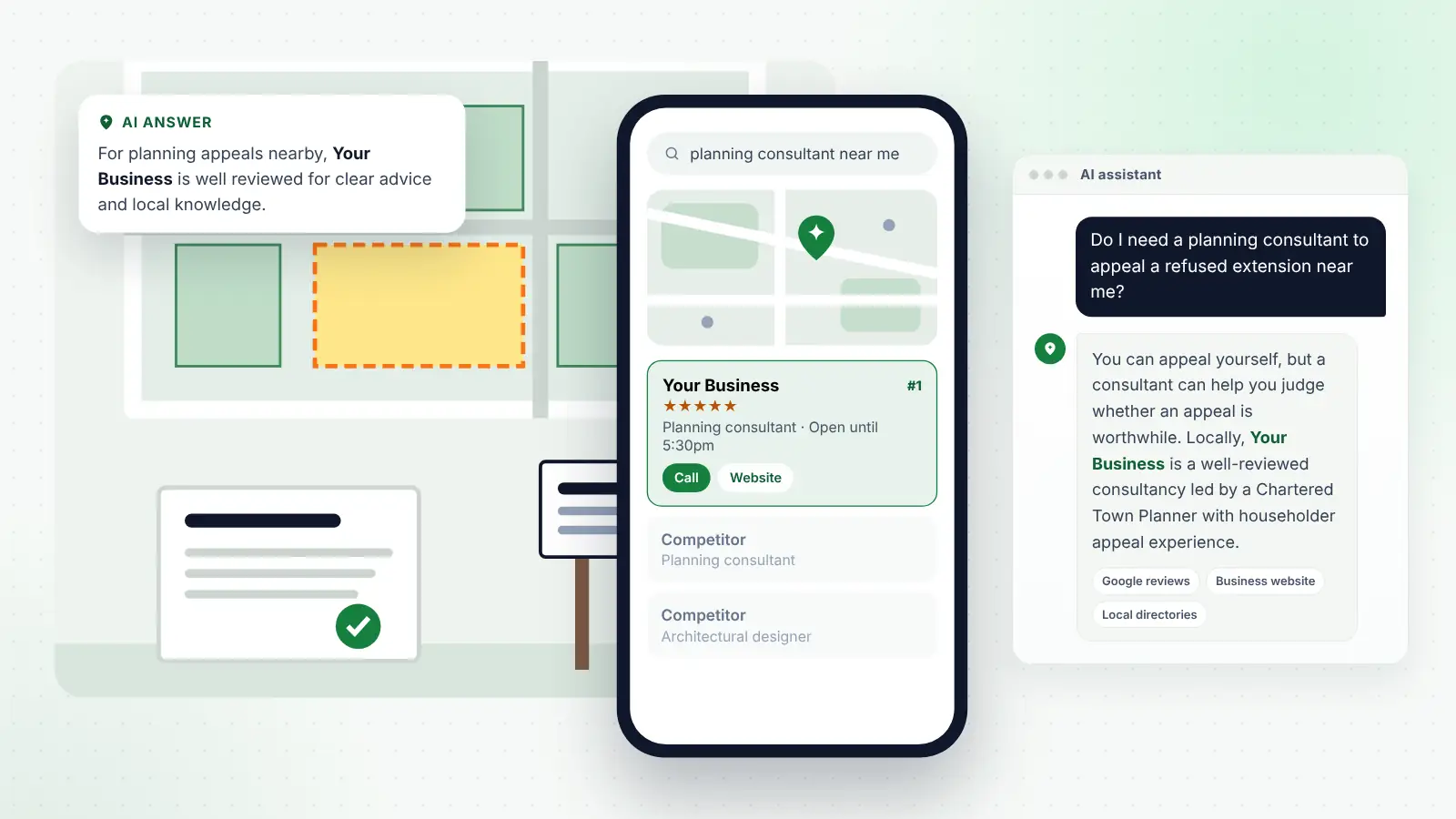
Local search matters because clients want a consultant who knows their council. Someone refused an extension in one borough is unlikely to choose a firm with no visible experience there, and searches such as “planning consultant near me”, “planning appeal consultant Leeds” and “help with planning refusal” carry a strong local element.
The essentials are:
- Google Business Profile. Choose the most accurate primary category, list your services, set your service area honestly, add photos of your team and office, and use posts to share planning updates. If you work from home or meet clients on site, follow Google’s rules on hiding your address.
- Reviews. Ask clients after the outcome, whatever it was, and suggest they mention the type of work and the area. Reply to every review professionally and without disclosing confidential details.
- Consistent details. Keep your name, address, phone number and website identical across directories, professional listings and social profiles.
- Service and area pages. Give each main service its own page, and write genuine area pages for the councils you know well, with real local experience rather than swapped place names.
- Local and industry links. Mentions from local business groups, property publications, partner websites and talks you have given all build authority.
If you would rather concentrate on fee-earning work, specialist help with SEO for planning consultants and planning consultancies can take care of the profile, listings, content and links while you focus on clients.
AI search and how clients ask for recommendations
A growing number of people ask ChatGPT, Gemini, Perplexity, Copilot or Google’s AI Overviews about planning before they ever contact a consultant. Their questions are often long and specific: “Do I need planning permission to turn my garage into an office?”, “Is it worth appealing a refused rear extension?” or “Which planning consultants near Bristol handle change of use to flats?”
An assistant asked about planning help draws on sources it can find and check against each other. To give your consultancy a better chance of being named:
- Keep your details consistent everywhere your firm appears, including your RTPI credentials and the areas you cover.
- Answer real questions on your website, in plain English, with a clear statement of which nation and which rules the answer applies to.
- Describe services specifically. “Householder appeals, Class MA prior approvals and lawful development certificates across three named councils” is easier to match than “planning services”.
- Earn reviews and mentions on reputable local, property and professional sites, which act as independent evidence.
AI recommendations are not a ranking you can buy or guarantee, but clear, consistent, well-evidenced information makes your firm easier to recommend accurately.
Set fees and terms that reduce disputes
Unclear fees are a common source of complaints. Set out the brief, fees, extra work arrangements and payment terms in writing before you start, as the RTPI expects. On your website, give guide fees or ranges for common work and explain clearly that council application fees, appeal costs and specialist reports such as ecology, heritage or highways are separate. Clients who understand the full likely cost early are less likely to drop out halfway through.
Frequently asked questions
Can someone who is not chartered call themselves a planning consultant?
“Planning consultant” is not a protected title, so anyone can use it. “Chartered Town Planner” and the RTPI post-nominals are restricted to members who hold them, which is why showing your membership clearly helps clients tell the difference.
Should we publish our appeal success rate?
It is usually better not to lead with one. Rates depend heavily on which cases you take and how success is defined, and any figure you publish should be accurate and evidenced. Specific case studies and honest advice on prospects tend to be more persuasive.
How do we write about reforms without giving advice that dates quickly?
Date every article, state which nation it covers, distinguish between what is in force and what is proposed, and review your key pages whenever rules change. Avoid quoting fees or thresholds unless you check them regularly.
How long does local SEO take for a planning consultancy?
A sharper profile and corrected listings can start to make a difference within a few weeks. Expect firmer map positions and AI visibility to take three to six months, depending on how many planning consultants compete for your councils.
Next steps
Start with the work you want more of. Make your team’s credentials clear and accurate, replace headline success claims with honest case studies, and publish dated, plain-English explanations of the reforms clients ask about. Then make sure your Google profile, listings and service pages match the problems people actually search for. That combination of accuracy, clarity and visibility is what turns a referral-dependent practice into one with a steady flow of the right instructions.