Most business owners know reviews matter in a vague way. Fewer can say exactly why, which makes it hard to decide how much time they deserve next to everything else on the to-do list. A plumber with forty reviews might wonder whether forty more would change anything. A dental practice with a 4.6 rating might worry about one recent complaint more than it needs to, while ignoring the fact that its newest review is eight months old.
Reviews do three separate jobs for a local business. They help Google decide whether to show you. They help a customer decide whether to choose you once they have seen you. And, increasingly, they give AI assistants the raw material to describe you when someone asks for a recommendation. Each job depends on slightly different things: the number of reviews, the rating, how recent they are and what they actually say.
This guide explains each of those jobs in practical terms, what a healthy review profile looks like for different kinds of business, and what quietly goes wrong when reviews are left to look after themselves. If you want the hands-on side, such as how to ask or how to reply to criticism, we cover those in our guides to getting more Google reviews and responding to negative reviews.
Key points
- Google says prominence is one of its three main local ranking factors, and that more reviews and positive ratings can help your local ranking.
- Customers judge reviews on four things at once: how many, the average rating, how recent they are and what they say.
- Detailed reviews that naturally mention services, situations and places help both people and search tools understand what you do.
- For higher-value work, such as roofing, legal services or aesthetics, customers read reviews more deeply and pay close attention to how you handle problems.
- AI assistants tend to repeat the themes that come up again and again in reviews, good or bad.
- Neglect rarely shows up as a sudden drop; it shows up as a slow loss of calls to competitors with fresher, fuller profiles.
In this guide
- The three jobs a review does
- How reviews affect Google local rankings
- From the map to the phone call: clicks and conversions
- Count, rating, recency and content
- Reviews and trust for higher-value services
- Reviews beyond Google
- How reviews feed AI assistants’ recommendations
- What a healthy review profile looks like by business type
- The cost of neglecting reviews
- A quick review health check
- Frequently asked questions
- Final thoughts
The three jobs a review does
It helps to separate the effects of reviews, because owners often mix them up and then measure the wrong thing.
- Being found. Reviews are one of the signals Google uses when deciding which businesses to show in the map results for a search like “electrician near me” or “physio in Harrogate”.
- Being chosen. Once someone sees three or four businesses side by side, reviews are usually the main way they compare them. This is where a stale or thin profile loses calls, even if you rank well.
- Being described. Google’s own review summaries, and assistants such as ChatGPT, Gemini, Perplexity and Copilot, increasingly describe a business by pulling together what reviewers say. The words in your reviews become the words used about you.
A business can do well at one and badly at another. A café in a busy high street might appear in the map pack simply because it is close to most searchers, then lose the customer because its last review mentions a dirty table and nobody replied. A specialist accountant with few reviews might rarely be shown at all, even though the reviews it does have are excellent.
How reviews affect Google local rankings
Google explains its local ranking in fairly plain terms on its Business Profile help page about improving your local ranking on Google. It describes three main factors. Relevance is how well a profile matches what someone searched for. Distance is how far the business is from the searcher, or from the location in the search. Prominence is how well known the business is.
Reviews sit within prominence. Google says prominence is based partly on information from across the web, such as links, and on how many reviews a business has, and states that more reviews and positive ratings can help a business’s local ranking. On replies, the same page says that responding to reviews shows you value customers’ feedback, and that positive reviews and helpful replies can help your business stand out.
That wording is worth reading carefully. Google does not say that reviews outrank everything else, publish a target number or explain how much weight each element carries. Distance and relevance still matter a great deal. A locksmith with three hundred reviews based twenty miles away will not usually beat a nearby locksmith with sixty for someone searching on their phone in an emergency. What reviews do is strengthen your position among the businesses that are already relevant and reasonably close.
There is also an indirect effect on relevance. Google reads the text of reviews, and local results sometimes show a snippet from a review that matches what the searcher typed. A garage whose customers mention “clutch replacement” or “MOT while I waited” gives Google more evidence about what it does than a profile full of “great service, thanks”. This is not something to engineer, and you must not ask customers to include particular words, but it is a good reason to encourage reviews that describe the actual job.
Reviews are one part of local visibility alongside a complete Business Profile, consistent details across directories, a website with clear service pages and links from local organisations. If you would rather have someone join those pieces up for you, our local SEO and AI search services for small businesses treat reviews as part of the wider plan rather than a separate task.
From the map to the phone call: clicks and conversions
Ranking gets you into the shortlist. Reviews largely decide what happens next. When someone looks at a map pack, the star rating and number of reviews appear right next to your name before they tap anything. Tap through, and the newest reviews, the photos and your replies are usually the next things they see.
There is good evidence that customers pay attention. The Competition and Markets Authority has said that as much as £23 billion of UK consumer spending is potentially influenced by online reviews each year, in its January 2025 announcement of changes Google agreed to make on fake reviews. BrightLocal’s 2026 Local Consumer Review Survey, based on around 1,000 consumers in the United States, found that 74% look for reviews written in the last three months, and that 31% would only use a business rated 4.5 stars or more. UK habits will not be identical, but the direction is consistent with what most local businesses see.
In practice, reviews affect conversion in a few specific ways:
- Whether people tap through at all. A noticeably lower rating or a much smaller review count than the neighbours can mean you are skipped without being looked at.
- Whether they call or book. Recent reviews describing the same kind of job reassure people that you still do it well.
- How much they compare. A strong, consistent profile often shortens the decision. A weak one sends people to check two or three more businesses.
- What they expect on price and process. Reviews that mention clear quotes, punctual arrival or a straightforward booking process set expectations before the first conversation.
You can see some of this in your own data. Business Profile performance figures show calls, website clicks and direction requests over time. If those fall while your map position holds steady, your reviews and photos are a sensible place to look first.
Count, rating, recency and content
Owners often focus on the average rating because it is the most visible number. Customers and search tools look at more than that, and each element tells a different story.
| Signal | What customers read into it | What it gives search and AI tools | Common weakness |
|---|---|---|---|
| Number of reviews | How established and busy you are | Evidence of prominence and real activity | Far fewer than nearby competitors |
| Average rating | Overall quality and risk | A quick comparison point | A perfect 5.0 from very few reviews can look thin |
| Recency | Whether the business is still good today | Signs the business is active | Newest review several months old |
| Content | Whether you do their kind of job well | Services, situations, places and qualities to match against questions | Short, vague reviews that say little |
| Your replies | How you treat people, especially when things go wrong | Extra context in your own words | Silence, or copy-and-paste replies |
Why recency matters more than owners expect
Recency is the signal most often neglected. A salon with 150 reviews, most from two years ago, looks less reassuring than one with 80 that has had several every week this month. Staff change, ownership changes, standards slip or improve, and customers know it. A steady flow of new reviews shows the business is active and that recent customers are still happy.
Why content matters
The content of reviews is where a lot of value sits, because it answers specific questions. Someone looking for a physiotherapist for a running injury wants to see other runners mentioned. Someone booking a function room wants to read about a fortieth birthday or a wake that went smoothly. A homeowner choosing a kitchen fitter looks for reviews that mention similar kitchens, sensible timescales and a clean finish.
Reviews like these happen naturally when you serve a range of customers well and ask all of them, and when your request invites people to say what you did for them, without telling them what to write. They also tend to mention places, such as a village, a street or a neighbouring town, which helps people in those areas recognise you as local.
Tip
Read your last twenty reviews and note which services they mention. If your most profitable service hardly appears, it is often a sign you are not asking those particular customers, rather than a sign they are unhappy.
Reviews and trust for higher-value services
The more a job costs, and the harder it is to undo, the more carefully people read reviews. Someone choosing a café for a quick coffee might glance at the rating. Someone choosing a roofer for a full replacement, a solicitor for a divorce, an aesthetics clinic for injectable treatment or a venue for a wedding will often read dozens of reviews, sometimes on more than one site, before making contact.
These customers are looking for different things:
- Evidence of similar jobs. “They replaced the whole roof on our 1930s semi” is worth far more to the next homeowner than “great job”.
- How problems were handled. People choosing expensive or sensitive services expect something to go wrong occasionally. They want to see that it was put right. A calm, helpful reply to a three-star review can be more persuasive than another five-star one.
- Process and communication. Clear written quotes, regular updates, staff who explained options and no pressure to commit.
- Longevity. Reviews spread over several years suggest a business that will still be around if there is a warranty claim or a follow-up appointment.
- Photos. For trades, venues and visible results, customer photos often do more than any description.
Higher-value businesses also tend to have fewer customers, which means fewer reviews. A kitchen installer might complete forty projects a year, while a barber sees forty clients a day. That is fine. Customers compare you with similar businesses, not with the barber. What matters is that a good share of your customers leave a review, that reviews keep arriving through the year and that they describe the work properly.
If you work in a regulated area, such as healthcare, law or financial advice, your regulator may have rules on how you use and reply to reviews, and on confidentiality. Check your own regulator’s guidance before you feature reviews in marketing or reply to them in detail.
Reviews beyond Google
Google is usually the most visible place for local reviews, but it is rarely the only one customers check. Which other sites matter depends on your sector:
- Trades and home services: Checkatrade, TrustATrader, Which? Trusted Traders and MyBuilder are widely used by homeowners, alongside Facebook recommendations.
- Hospitality: Tripadvisor remains important for restaurants, pubs, hotels and attractions, along with booking platforms that carry guest reviews.
- Salons and beauty: booking platforms such as Treatwell and Fresha show reviews from verified bookings.
- Healthcare and clinics: sites such as Doctify and iWantGreatCare are used by some patients.
- Professional services and online retail: Trustpilot and Feefo are common, as are industry directories and comparison sites.
Reviews on these platforms help in three ways. Customers who prefer a particular site see you there. Search engines and AI tools see a consistent picture from several independent sources. And if something goes wrong on one platform, you are not relying on it alone.
The practical advice is to focus. Keep Google as your main priority, pick one or two other platforms your customers actually use, and keep your business name, address, phone number and description consistent across all of them. Spreading requests across six sites usually means none of them looks healthy. If you display reviews on your own website, remember that you are publishing them, and you should present them fairly rather than picking only the glowing ones.
How reviews feed AI assistants’ recommendations
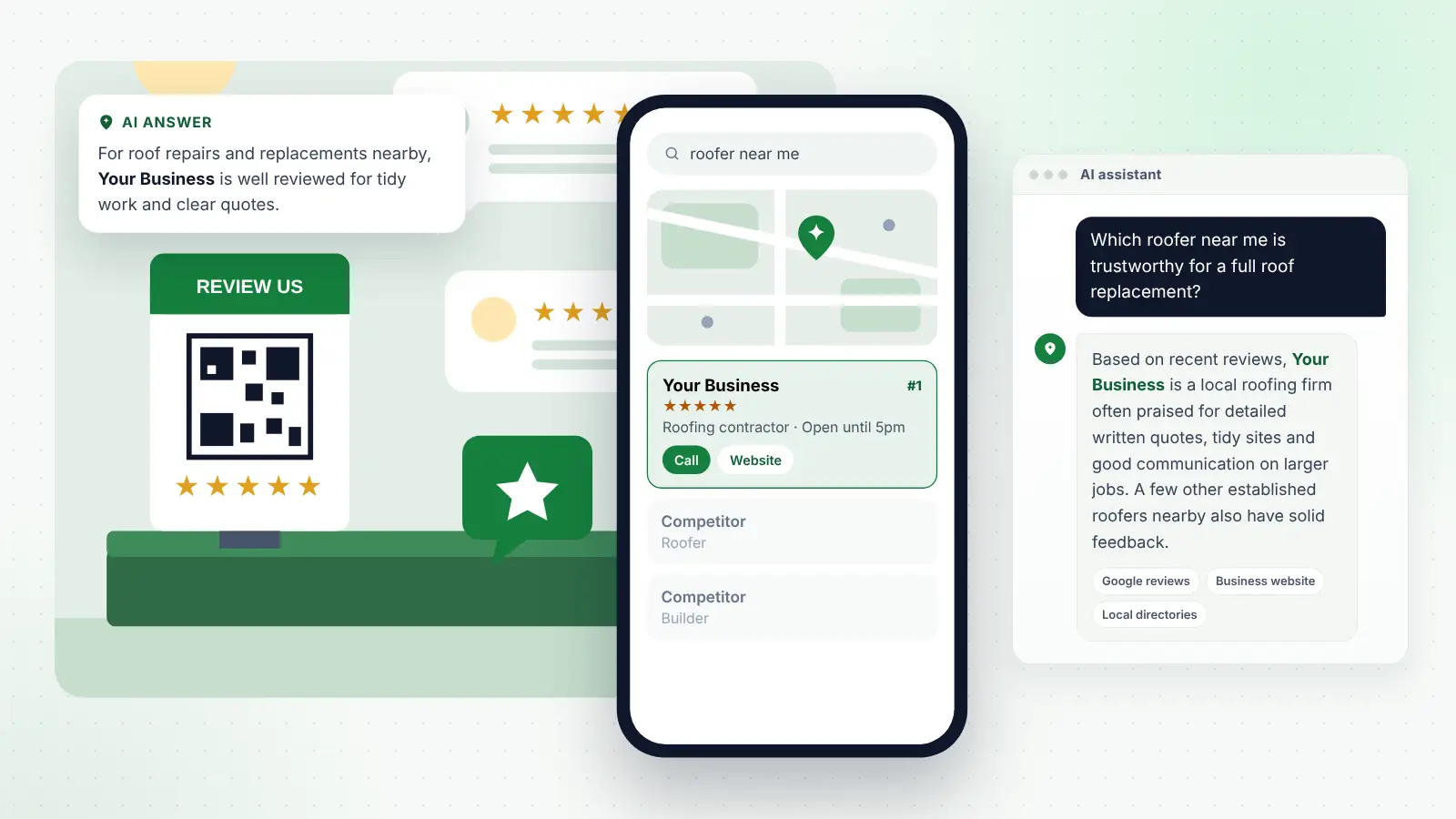
People now ask AI assistants for local recommendations in full sentences: “Which roofer near me is trustworthy for a full replacement?”, “Is there a dog groomer in Leicester that is good with nervous dogs?” or “Which accountant in Bristol is good with landlords?” Google is also adding AI-generated summaries of reviews and places to Maps and Search, with availability varying by country and device.
To answer those questions, AI tools draw on what they can find about local businesses: Business Profiles, directories, websites, local news and, prominently, reviews. They tend to summarise rather than quote, so what matters is the pattern across many reviews. If dozens of customers mention patience with nervous dogs, an assistant has something concrete to say. If reviews repeatedly mention late arrivals or poor communication, that theme can show up in an AI summary however high your average rating is.
A few practical consequences follow:
- Specific reviews give AI tools more to match. A detailed question can only be matched to a business if something, somewhere, says it does that thing well.
- Recurring problems need fixing, not hiding. The most effective way to change how you are described is to resolve the underlying issue so newer reviews tell a different story.
- Consistency across sites helps. When Google, a trade directory and your own website all describe the same services and area, tools can be more confident about what you do.
- Your replies are part of the record. Calm, specific replies add balance and context in your own words.
No one can control what an AI assistant says about a business, and anyone offering to guarantee AI recommendations should be treated with caution. What you can do is make sure there is plenty of accurate, genuine information for those tools to work with.
What a healthy review profile looks like by business type
There is no universal target number. A healthy profile is one that compares well with the businesses you actually compete with, keeps growing steadily and describes the work you want more of. The table below gives a rough picture of what that tends to look like in different sectors. Treat it as a guide, not a benchmark, and always compare yourself with your own local competitors.
| Business type | Typical pattern of new reviews | What good reviews tend to mention | Warning signs |
|---|---|---|---|
| Café, pub or restaurant | Frequent and short, often several a week when busy | Food, staff, atmosphere, occasions, accessibility | Long gaps, unanswered complaints about hygiene or service |
| Salon, barber or beauty clinic | Regular, linked to appointments | Named treatments, results, comfort, booking ease | Reviews all praise one stylist who has since left |
| Emergency trades (locksmith, plumber) | Steady, spikes after busy periods such as winter | Speed, honesty on price, area covered | Few reviews mention emergencies or pricing |
| Project trades (roofer, builder, kitchen fitter) | Fewer, longer, spread through the year | Job type, property type, tidiness, timescales, photos | Very short reviews, or none for big projects |
| Clinics (dental, physio, chiropractic) | Regular but often modest in number | Manner, explanations, results, nervous patients | Replies that discuss treatment details |
| Professional services (accountant, solicitor, adviser) | Slower, often after a milestone or completed matter | Clarity, responsiveness, fees explained, outcome | Profile with almost no reviews despite years trading |
| Hotel or B&B | Frequent in season, quieter in winter | Rooms, breakfast, location, host, value | Several platforms with very different ratings |
Two patterns look unhealthy in almost any sector. One is a long silence followed by a burst of reviews in a single week, which can look unnatural to customers and to Google. The other is a perfect rating from a small number of reviews that all read alike. A slightly lower average built from a large, varied set of genuine reviews usually inspires more confidence.
Tip
Once a quarter, note the review count, rating and date of the newest review for yourself and your three closest map competitors. The gap between you and them is more useful than any national average.
The cost of neglecting reviews
Neglect rarely causes a dramatic drop. It works quietly, which is why it is easy to underestimate.
- Your profile ages. If you stop asking, the newest review slowly becomes months old. Customers reading it in March see feedback from last summer and wonder whether anything has changed.
- Competitors pull ahead. A newer business that asks every customer can overtake an established firm’s review count within a year or two, and with it some of the map visibility and clicks.
- One complaint carries more weight. On a busy profile, a single unfair review is diluted by everything around it. On a thin profile, it sits near the top for months.
- Unanswered criticism looks like indifference. Prospective customers read silence as a sign that nobody is paying attention, even when the business is well run.
- AI tools work with what is there. If the most detailed recent reviews are about a problem from two years ago, that may be what gets summarised.
- You lose free feedback. Reviews tell you what customers value and what irritates them. Ignore them and you miss early warnings about a member of staff, a process or a pricing issue.
The opposite is also true. Businesses that ask consistently, reply thoughtfully and act on what reviews say usually see the benefits build gradually over several months, in visibility, in conversion and in the kind of customers who get in touch.
A quick review health check
If you want to know where you stand today, this takes about half an hour.
- Search for your main service and town on Google Maps from a phone, and note where you appear and who appears around you.
- Compare your review count, rating and newest review date with the top three businesses.
- Read your last twenty reviews and note which services, places and qualities they mention.
- Check whether every review from the last three months has a reply.
- Look at the one or two other platforms that matter in your sector and check that your details match Google.
- Ask an AI assistant a realistic question a customer might ask, and see how your business is described, if at all.
- Write down the two or three biggest gaps, such as recency, replies or reviews for your best service, and work on those first.
Frequently asked questions
Do reviews really affect where I appear on Google Maps?
Google says prominence is one of its main local ranking factors and that more reviews and positive ratings can help your local ranking. Reviews work alongside relevance and distance, so they are unlikely to put you ahead of much closer or more relevant businesses on their own, but they strengthen your position among those that are.
Is a 5.0 rating better than 4.7?
Not necessarily. A perfect score from a small number of reviews can look less convincing than a slightly lower score from many detailed, recent ones. Customers often expect the occasional mixed review and pay more attention to how you responded to it.
Should I worry about reviews on sites other than Google?
Focus on Google first, then on the one or two platforms your customers use most in your sector, such as Tripadvisor for hospitality or a trade directory for home services. Keep your details consistent everywhere so customers and search tools see the same business.
Can I ask customers to mention particular services in their review?
You should not tell customers what to write or ask them to include specific words, and Google’s policies say businesses should not request specific content. It is fine to say that it helps other people if they mention what you did for them, and then leave the rest to the customer.
How long does it take for reviews to make a difference?
Customers notice fresh reviews immediately. Effects on local visibility usually build over several months, alongside the other parts of local SEO. A steady monthly flow tends to matter more than any single burst.
Final thoughts
Reviews are not a vanity metric. They help Google decide whether to show you, help customers decide whether to choose you and increasingly shape how AI assistants describe you. Each of those depends on more than the star rating: a healthy number of reviews compared with your competitors, a steady flow of recent ones, detailed content that reflects the work you do and thoughtful replies. None of it can be bought or rushed safely. It comes from serving customers well, asking all of them consistently and paying attention to what they say, month after month.