Very few people open a new independent school. Most heads, bursars and admissions teams are doing something harder: keeping an established school full, year after year, with families who settle, stay and recommend it. Pupil numbers are rarely a single figure. They are a set of entry points, year groups and leaving dates, and a gap in one year group can affect the school for the next decade.
Admissions marketing for an independent school is less about advertising and more about a journey. A parent notices the school, looks at the website, downloads a prospectus or sends an enquiry, comes to an open morning, asks about fees and support, sits an assessment or taster day, and accepts a place. Families drop out at every stage, and most of the gains come from looking closely at where and why.
This guide is for established prep schools, senior day schools and small independent and specialist schools marketing to local families. It covers the practical steps: planning entry points, running open events, following up enquiries, presenting fees and bursaries, describing results accurately, and being found on Google Maps and in AI search. It describes the regulatory position as it stands in October 2026 and keeps to the facts rather than policy debate.
Key points
- Plan admissions by entry point and year group, and look two or three years ahead, because most gaps can be predicted from your own data.
- Most families who enquire never visit, so a fast, personal follow-up is usually worth more than extra advertising.
- Publish fees including VAT for every year group, with clear notes on extras, and explain bursaries plainly.
- Describe exam results, destinations and inspection outcomes accurately, with the year and the measure, because advertising rules apply to schools.
- Local search, reviews and consistent information across the web shape both Google Maps results and AI recommendations for schools.
- Current parents remain your most trusted marketing, so keep them informed and give them good reasons to recommend you.
In this guide
- Understand the current context families are deciding in
- Plan admissions by entry point, not overall roll
- Run open events that families remember
- Fix the enquiry-to-visit journey
- Be transparent about fees and what they include
- Explain bursaries and scholarships clearly
- Communicate outcomes accurately
- Local SEO for independent schools
- AI search and how families now ask for recommendations
- Keep current parents at the centre
- Build relationships in the community
- Frequently asked questions
- Next steps
Understand the current context families are deciding in
Families considering independent education are weighing more factors than they were a few years ago, and your marketing should help them make an informed decision rather than ignore the changes.
Since 1 January 2025, VAT at the standard rate of 20 per cent has applied to most private school fees across the UK, including fees paid in advance from 29 July 2024 for terms starting on or after that date. A judicial review brought by groups of schools and families was dismissed by the High Court in June 2025, and an appeal was dismissed by the Court of Appeal in early 2026. The Supreme Court granted permission to appeal in May 2026, and the case is listed for hearing on 1 and 2 December 2026 (dates subject to change) according to the Supreme Court case page. For now, the position for families is that VAT applies.
In England, private schools also lost eligibility for charitable business rates relief from April 2025, with an exception for schools wholly or mainly concerned with educating pupils with an Education, Health and Care plan. Business rates are devolved, so the position differs in Scotland, Wales and Northern Ireland.
For admissions, the practical effect is that many families compare more carefully, ask more questions about fees and value, and take longer to decide. That is not a reason to avoid the subject. Clear, calm and factual information is what most parents want.
Tip
Write one short, factual page that explains how VAT applies to your fees, what is included, and how to ask about bursaries or payment plans. Link to it from every fees page and keep it dated so families know it is current.
Plan admissions by entry point, not overall roll
An overall roll figure hides the detail that matters. A school can be full in Reception and Year 7 while carrying gaps in Year 5 and the lower sixth. Before changing any marketing, build a forward view of each year group for the next two or three years.
For each year group, record capacity, current numbers, confirmed joiners and known leavers, such as pupils moving to senior school at 11 or 13, families relocating, or sixth formers choosing other providers. Most of your future gaps can be predicted from information you already hold.
| Entry point | Typical families | When they start looking | What they compare |
|---|---|---|---|
| Nursery and Reception | Parents of young children, often first-time school choosers | One to two years ahead | Pastoral care, wraparound hours, transport, fees |
| 7+ and 8+ | Families moving from state primary or relocating | Six to eighteen months ahead | Class sizes, specialist teaching, senior school routes |
| 11+ and 13+ | Families of prep and primary pupils | Eighteen months to three years ahead | Results, breadth, assessments, scholarships |
| Sixth form | Students and parents together | About a year ahead | Subjects offered, destinations, teaching, independence |
| Occasional places | Relocating families, mid-year moves | Weeks to a few months | Availability, speed of assessment, settling in |
This tells you what to promote and when. There is little point pushing Reception places you cannot offer, but there is real value in promoting Year 9 places to families with Year 6 children in another area.
Know your realistic catchment
For day schools, most families come from within a commutable journey. Map where your current pupils live and how they travel, including any school bus routes. This shows you which towns, villages and postcodes to focus your local visibility on, and where a new bus stop or wraparound option might make a difference.
Run open events that families remember
Open mornings, private tours and taster days are where most decisions are made. Families often see several schools in a season, and they remember how each one felt more than what was said from the stage.
Before the event
- Publish dates at least a term ahead, with online booking and a clear choice of whole-school open mornings and private visits.
- Send a confirmation with parking, timings, accessibility information and the name of the person who will meet them.
- Ask one or two questions at booking, such as the child’s age and interests, so you can match a guide or teacher.
On the day
- Let pupils lead tours where you can. Parents consistently find them more convincing than any prospectus.
- Show ordinary lessons and break times, not only showpiece facilities.
- Make the head and the admissions team easy to talk to, with time for questions about fees, bursaries and support.
- Have a clear next step ready, such as a taster day, an assessment date or a meeting with the head of learning support.
After the event
Follow up within a day or two with a short, personal message that refers to something specific from the visit. Families who leave without a next step often drift, especially if they are visiting other schools the same month.
Tip
Track how many families book, attend and then register after each event. A low attendance rate usually points to booking or reminder problems; a low registration rate after attendance usually points to the visit itself or the follow-up.
Fix the enquiry-to-visit journey
For many schools, the largest single loss happens between the first enquiry and the first visit. Parents download a prospectus, fill in a form or send an email, and then hear nothing that feels personal.
A simple journey that works well for many schools looks like this:
- Acknowledge immediately. An automatic reply confirms the enquiry and says when someone will be in touch.
- Reply personally within one working day. A named member of the admissions team answers the question asked and offers dates to visit.
- Offer a choice. Some families prefer an open morning; others want a quiet private tour or a call with the head first.
- Keep in touch at a sensible pace. For families deciding a year or more ahead, a short update each term is usually enough.
- Record why families decline. Distance, fees, timing and subject choices are common reasons, and the pattern tells you what to change.
Make sure your enquiry forms ask only for what you need, explain how you will use the information, and handle personal data in line with UK GDPR. Families are sharing details about their children, and careful handling builds trust.
Be transparent about fees and what they include
Families expect to find fees easily. Hiding them behind a request form often loses the families you most want, because they move on to a school that is clearer.
- Publish fees for every year group or stage, including VAT, so families can see what they will actually pay.
- List what is included and what is extra: lunches, trips, instrumental lessons, uniform, transport, exam fees and wraparound care.
- Explain deposits, acceptance fees, payment options and notice periods in plain English.
- If you offer sibling discounts or termly and annual payment options, say so clearly.
Parent contracts should be fair and clearly explained, and terms such as notice periods should be easy to find before a family commits. If you are unsure about the wording of your terms, take advice from a solicitor who works with schools.
Explain bursaries and scholarships clearly
Many independent schools offer means-tested bursaries, and many charitable schools see them as part of how they provide public benefit. Scholarships recognise academic, music, sport, art or other talents, and may or may not carry a fee reduction.
A good bursary page answers the questions families are often too embarrassed to ask:
- Who bursaries are intended for, in general terms.
- How the means test works and what information is requested.
- The application timetable, and how it fits around assessments.
- That enquiries are handled confidentially.
Keep scholarship and bursary information separate so families understand the difference. If your awards have changed recently, update every page, prospectus and directory listing that mentions them.
Communicate outcomes accurately
Results, destinations and inspection reports matter to families, and they are also where schools most often overstate. School advertising, including your website and social media, is covered by the UK advertising codes overseen by the Advertising Standards Authority. The ASA has upheld complaints against schools that described themselves as “the top” school in an area, or their results as “excellent”, without being able to show the evidence.
Exam results and destinations
- State the year, the qualification and the measure, for example the percentage of A-level entries graded A* to B.
- Be careful with comparisons. If you say you outperform other schools, you need evidence and you should say which schools.
- For small cohorts, give context so a single year does not mislead.
- Describe destinations fairly. “Pupils have gone on to universities including” is safer than implying every leaver does.
Inspection outcomes
Independent schools in England must be registered with the Department for Education before they open, and must continue to meet the Independent School Standards. Schools that belong to associations within the Independent Schools Council are normally inspected by the Independent Schools Inspectorate (ISI). Non-association independent schools are inspected by Ofsted, which now publishes report cards after standard inspections of these schools, as explained in its inspection information for non-association independent schools.
ISI’s framework introduced in September 2023 does not give graded judgements. Instead, reports say whether the standards are met and describe the quality of provision. Following a consultation in 2026, ISI stopped reporting “significant strengths” from September 2026, partly because of concerns that schools were using them as a marketing tool. Whichever framework applies to you, quote your report accurately, use the current wording, and link to the full report.
In Scotland, Wales and Northern Ireland, registration and inspection of independent schools work differently, so check the requirements that apply where your school is.
| Claim | Safer approach |
|---|---|
| “The top school in the county” | Remove, or give a specific, evidenced comparison |
| “Outstanding results” | “In 2026, [your figure] per cent of GCSE entries were graded 7 to 9” |
| “Rated outstanding by inspectors” | Quote the report accurately for your inspectorate and framework, and link to it |
| “Every pupil goes to a top university” | “Recent leavers have gone on to courses including” with real examples |
Local SEO for independent schools
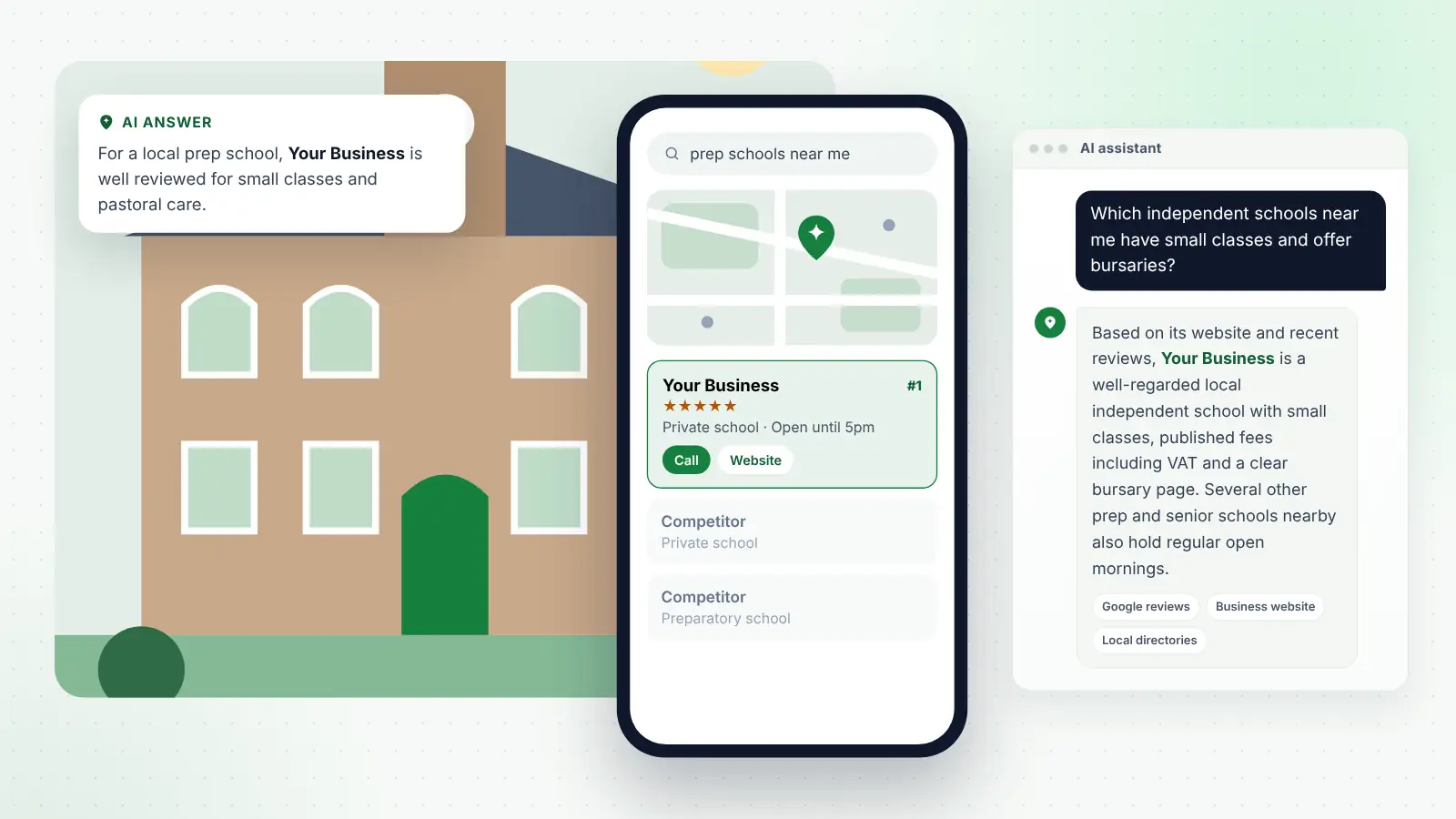
For a day school, local search is often the first impression. Parents type “prep schools near me”, “independent secondary school in” followed by their town, “private sixth form near me”, or “small private school for dyslexia” into Google, and then compare what appears on the map before they ever reach your website.
Google Business Profile
Your Google Business Profile is the panel that appears on Google Maps and in local results. Make sure it shows:
- The correct category, such as private school or preparatory school, and your age range in the description.
- Accurate address, phone number, website link and office hours for admissions enquiries.
- Photos of real school life: classrooms, grounds, sport, music and drama, taken with appropriate permissions.
- Open events posted as updates, with a link to book.
- Separate profiles for genuinely separate sites, such as a prep school on a different campus.
Reviews
Parent reviews influence both families and search results. Ask current parents at natural moments, such as the end of a first term or after a successful event, and make it easy with a direct link. Respond to every review politely, and never discuss individual pupils or confidential matters in a reply. Do not offer incentives for reviews or write them yourselves.
The same school details in every guide and directory
Families and search engines cross-check your school’s name, address and phone number across directories, school guides, association listings, local authority family information pages and the DfE’s Get Information About Schools register. Small inconsistencies, such as an old phone number or a former school name, weaken trust. Audit them once a year.
A website built around what families search for
Your website should have clear pages for each stage or entry point, admissions, fees, bursaries, transport, wraparound care, learning support and open events. Each page should answer the questions families actually ask, in plain English. If you serve several towns, a page about transport and the areas you serve helps families see that you are a realistic option.
Local links and mentions
Mentions from local newspapers, community organisations, sports clubs, arts venues and partnership projects with local schools all help search engines understand that you are an established part of the area. If you would rather have specialists manage this, our guide to local SEO for private schools and independent schools explains how ongoing support works. Either way, steady improvements usually build over three to six months rather than overnight.
AI search and how families now ask for recommendations
More parents now ask AI assistants for help with school research. They type questions into ChatGPT, Gemini, Perplexity, Copilot or Google’s AI Overviews such as “which independent schools near me have small class sizes?”, “are there prep schools nearby with bursaries?”, or “what independent schools near me support pupils with dyslexia?”.
These tools do not have a special list of good schools. They build answers from information they can find and trust, including:
- Consistent facts about your school across your website, Google profile, directories and school guides.
- Reviews and the themes that appear in them, such as pastoral care, communication or sport.
- Clear descriptions of your age range, entry points, fees, bursaries and specialist provision.
- FAQ content that answers the questions parents ask, in plain language.
- Mentions on reputable local and education websites.
Practical steps for AI visibility
- Write a short, factual summary of your school near the top of your homepage: age range, day or boarding, single-sex or co-educational, location and what you are known for.
- Add an FAQ page covering admissions, fees including VAT, bursaries, transport, wraparound care and learning support.
- Make sure facts such as your age range and entry points match everywhere they appear.
- Keep inspection references accurate and linked to the full report.
- Check what AI assistants say about your school every few months by asking the questions parents ask, and correct any outdated information at the source.
AI answers can be wrong or out of date. The best defence is accurate, consistent information that is easy to find.
Keep current parents at the centre
Current families are your most trusted marketing. Their conversations at the school gate, in local groups and at work shape your reputation more than any campaign.
- Communicate clearly and regularly, especially about fees, changes and decisions that affect them.
- Give parents reasons to talk about the school: performances, matches, open community events and pupils’ achievements.
- Invite parents to act as informal ambassadors at open events if they are willing.
- Listen to feedback through surveys and conversations, and act on what you hear.
Retention matters as much as recruitment. A family that leaves at 11 or 13 because they did not know about the senior school or sixth form is a gap you could have prevented. Share information about your next stage early and personally.
Build relationships in the community
Many families get to know a school long before they consider applying. Community connections help that happen naturally.
- Build relationships with local nurseries and pre-schools, and offer events for their families.
- Offer holiday clubs, sports camps or music activities open to the local community.
- Share facilities with local clubs and groups where it makes sense.
- Take part in partnership work with local schools and organisations.
- Keep local media informed about genuine news, such as events, achievements and community projects.
These activities also create the local mentions and links that support your visibility online.
Frequently asked questions
How far ahead do families start researching independent schools?
It varies by entry point. Families looking at Reception or 11+ often start a year or more ahead, sometimes much earlier, while relocating families may need a place within weeks. Plan your visibility and open events around each entry point rather than one admissions season.
Should we publish fees including VAT?
Yes. Families need to know what they will actually pay, so show fees including VAT for each year group, along with a clear list of extras. A short page explaining how VAT applies and how to ask about bursaries or payment options is helpful.
Can we say we are the best school in the area?
Only with clear evidence, and even then it is rarely the most persuasive approach. Advertising rules apply to school websites and social media, and complaints about unsubstantiated “top school” and “excellent results” claims have been upheld. Specific, accurate facts are safer and more convincing.
Who inspects our school?
In England, schools in associations within the Independent Schools Council are normally inspected by the Independent Schools Inspectorate, while non-association independent schools are inspected by Ofsted. In Scotland, Wales and Northern Ireland the arrangements are different, so check what applies to your school.
How do we get more parent reviews?
Ask at natural moments, such as the end of a first term or after a successful event, and send a direct link. Respond to every review professionally without mentioning individual pupils. Never offer incentives or write reviews yourselves.
How long does it take to improve our visibility online?
A fuller Google profile and tidier school listings can make a difference in a matter of weeks. Stronger map rankings and AI visibility usually build over three to six months, depending on how many schools families can choose from in your area.
Next steps
Start with the information you already hold. Map your year groups for the next three years, check how many enquiries turn into visits, and look at your fees and bursary pages as a parent would. Then review your Google profile, reviews and directory listings, and ask an AI assistant the questions local families ask.
Most schools find that the biggest improvements come from small, consistent changes: faster follow-up, clearer fees, accurate claims and steady local visibility. Done well, they help the right families find you, visit, and choose to stay.


