Interior design is one of the most personal services a business can offer. Clients let you into their homes, share how they live and trust you with large budgets and decisions they will see every day for years. For a designer with a strong eye and good organisation, that trust can be turned into a rewarding studio, whether you focus on whole-house residential projects, single rooms, commercial and hospitality spaces or online e-design packages.
Starting your own business, though, means much more than creating beautiful schemes. You need clear terms, sensible insurance, a fee structure clients understand, an honest approach to trade discounts, and an understanding of your responsibilities when building work is involved. Then you need a steady flow of the right enquiries, which for most small studios now comes from referrals, reputation and being easy to find online.
This guide walks through the main steps for independent interior designers in the UK. It is general information, not legal or financial advice, so check the latest official guidance and take professional advice on your own situation.
Key points
- “Interior designer” is not a protected title in the UK, so your experience, portfolio, insurance and memberships such as the BIID are how clients judge you.
- Choose a clear service mix early: full-service residential, room design, commercial and hospitality, or e-design each need different pricing and processes.
- Put written terms in place before work starts, and if you sign up consumers in their homes, follow the cancellation rules for off-premises contracts.
- Decide how you charge and how you handle trade discounts, and explain both clearly in writing.
- When your designs involve building work, understand how the CDM 2015 regulations apply to you and to domestic clients.
- Homeowners and businesses increasingly find designers through Google Maps, reviews and AI assistants, so an accurate online presence matters from the start.
In this guide
- Is running your own studio right for you?
- Credentials, the title and the BIID
- Choosing your services and niche
- Setting up the business
- Contracts and consumer rights
- How to price your services
- Trade discounts and transparency
- Working with trades and CDM 2015
- Winning work: portfolio, referrals and reputation
- Local SEO: how clients find a designer nearby
- When clients ask AI to suggest an interior designer
- Frequently asked questions
- Final thoughts
Is running your own studio right for you?
Many designers start their own business after years in a studio, a retailer’s design service or a related trade such as joinery, kitchens or property development. Others come from a different career entirely after training. Whatever your route, running a studio means you are responsible for winning work, writing proposals, managing suppliers and cash flow, keeping clients informed and resolving the problems that every project throws up.
Before you commit, think honestly about:
- The work you want. Whole-house projects are rewarding but long and complex. Single-room design offers faster turnaround. Commercial and hospitality work brings bigger budgets but needs a track record and confidence with programmes and contractors.
- Where your first clients will come from. Friends, former colleagues, builders and architects you know often provide early projects. Check any restrictions in your previous employment contract before approaching past clients.
- Your financial runway. Projects can stall while clients make decisions or wait for builders. Plan to cover several months of costs while your pipeline builds.
- How you feel about the business side. Procurement, invoicing, chasing deliveries and managing snagging take up a surprising share of a designer’s week.
- Your network of trades. Good decorators, joiners, upholsterers, curtain makers and electricians make or break a finished room.
Credentials, the title and the BIID
Unlike “architect”, the title “interior designer” is not protected in law in the UK, and there is no statutory regulator. Anyone can call themselves an interior designer, regardless of training or experience. That cuts both ways: it is easy to start, but clients have no register to check, so they look for other signs that you are competent and trustworthy.
The main professional body is the British Institute of Interior Design (BIID). It offers several membership grades, including Student, Affiliate, Provisional Associate, Associate, Registered Design Practice and the BIID Registered Interior Designer® grade. The registered grade is the most demanding: at the time of writing it asks for around six years of combined education and professional experience, an assessment in which you present a complete project, referees, and professional indemnity and public liability insurance. Check the BIID website for current criteria and fees, as they can change.
Members also agree to a code of conduct. Among other things, it expects members to set out the scope of work, services and how they will be paid in writing before taking on a project, to avoid conflicts of interest and payments that could compromise their impartiality, and to carry appropriate insurance.
You do not need to be a member to trade, but membership is a useful trust signal, especially for higher-value residential and commercial clients. Whatever credentials you hold, describe them accurately. Use the exact name of your membership grade and never imply a grade you do not have.
Tip
Make your credentials easy to verify. List your membership grade, qualifications and insurance on your website and Google profile, and keep the wording identical everywhere so clients and AI tools see the same facts.
Choosing your services and niche
Clients search for a problem or a project, not just a profession. Being clear about what you offer makes your marketing sharper and your pricing simpler.
Full-service residential design
You take a home from brief to installation: concept, space planning, lighting and electrical layouts, joinery design, sourcing, procurement, coordinating trades and final styling. This is the highest-value work but involves the most risk and responsibility, particularly when renovation is involved.
Room design and styling
A defined scope for one or two rooms, such as a living room, kitchen-diner, bedroom or home office. Fixed packages work well here, and these projects are often the way new clients test you before committing to more.
Commercial and hospitality interiors
Offices, restaurants, bars, cafés, hotels, salons and shops. The brief usually centres on brand, customer experience, durability and practical requirements such as fire safety and accessibility, which your scheme must work alongside. Commercial clients care about programme, budget control and how quickly the space can open.
E-design and consultations
Online packages, typically including a mood board, layout plan and shopping list that the client implements themselves, plus paid consultations by the hour. These have a lower price point, can be sold beyond your local area and suit clients who want guidance rather than a full service.
Many studios combine two or three of these. Just make sure each has a clear scope, so clients know what is included and what is not.
Setting up the business
Choosing a structure
Most designers start as a sole trader or a limited company. Sole trader status is simpler to set up and run. A limited company separates business and personal finances and can be more tax-efficient at higher profits, but brings more administration. Speak to an accountant about which suits you, and register with HMRC or Companies House as appropriate. If your turnover is likely to pass the VAT threshold, consider early how VAT will affect your fees and any goods you supply.
Insurance
Insurance is essential for a business that gives design advice and often handles clients’ money and goods:
- Professional indemnity insurance covers claims that your advice or design was negligent, for example a layout that does not fit, specifications that fail or a costly error in measurements.
- Public liability insurance covers injury or damage to third parties, which matters when you visit homes, sites and showrooms.
- Employers’ liability insurance becomes a legal must in most cases as soon as you take on a design assistant or any other employee.
- Contents, equipment and goods in transit cover protects samples, equipment and items you collect or store for clients.
Talk to a broker who understands design businesses, and check the limits clients or commercial contracts may ask for.
Equipment and software
You do not need a large studio to start. Many designers work from home and meet clients on site or in showrooms. Typical startup costs vary widely by area and ambition, but are often modest compared with other trades.
| Item | Typical cost | Notes |
|---|---|---|
| Laptop and large monitor | £1,000–£3,000 | Enough power for 3D and rendering software |
| Design and CAD software | £30–£300 a month | Many offer monthly subscriptions |
| Sample library | £0–£1,500 | Many suppliers provide free or low-cost samples |
| Website and branding | £1,000–£5,000 | A strong portfolio site is worth investing in |
| Insurance | Varies | Depends on cover limits and project types |
| Measuring tools and laser measure | £50–£300 | Accurate surveys prevent costly mistakes |
These are rough guides only and will vary depending on your suppliers and the work you take on.
Systems and paperwork
Set up project management, accounting and procurement tracking from the start. Interior projects involve hundreds of items, deposits, lead times and deliveries, and clear records protect you and your client when something arrives damaged or late.
Contracts and consumer rights
Every project should begin with a written agreement, often called a letter of appointment or terms of engagement. It should cover the scope of services, the fee structure, payment stages, how procurement works, who contracts with trades and suppliers, how changes are priced, what happens if the client wants to pause or end the project, and the limits of your responsibility.
When your clients are consumers, consumer protection law applies. One rule catches many designers out. If you agree a contract with a consumer away from your business premises, such as at the first consultation in their home, it is usually an off-premises contract under the Consumer Contracts Regulations 2013. The client normally has a 14-day cancellation period, and you must give them clear information about that right.
If the client wants you to start work within the cancellation period, they must expressly ask you to, and for off-premises contracts that request must be made on a durable medium, such as a signed form or an email. If they then cancel, they pay a proportionate amount for the work you have already done, as set out in regulation 36. If you fail to give the required information or start without a valid request, you may not be able to charge anything. Ask a solicitor or use a well-drafted template that reflects these rules.
Tip
Keep a simple start-early request form with your terms. When a client wants their design started straight away, they sign or confirm it by email, and you both know where you stand if plans change.
How to price your services
There is no single correct way to charge, and many studios mix approaches depending on the project. The common structures are:
| Fee structure | How it works | Works well for |
|---|---|---|
| Fixed fee | An agreed price for a defined scope, often paid in stages | Room design, e-design, well-defined projects |
| Hourly or daily rate | You charge for time spent, sometimes with an estimate or cap | Consultations, open-ended or advisory work |
| Percentage of budget | A percentage of the overall project or furnishing budget | Larger full-service projects |
| Design fee plus procurement | A design fee, with a separate charge or margin on goods supplied | Studios that buy furniture and materials for clients |
Whichever you choose, explain it clearly before the project starts and confirm it in writing. Clients are most likely to feel misled when they do not understand what is included, how changes are charged or how you earn money on purchases. Many studios publish a minimum project budget or starting prices for consultations and packages, which saves time on enquiries that are not a good fit.
Review your rates regularly. Track the hours each project really takes, including procurement and snagging, so you can see which services are profitable.
Trade discounts and transparency
Many suppliers offer trade accounts and discounts to interior designers. How you handle those discounts is one of the most important business decisions you make, because it affects your income, your client relationships and your reputation.
Common approaches include:
- Passing discounts on in full and charging a higher design or procurement fee.
- Sharing the discount, with an agreed split between you and the client.
- Charging the retail price and keeping the discount as part of your income.
- Adding a handling or procurement fee to goods you buy on the client’s behalf.
All of these can be legitimate, but the client should know which one you use before they agree to buy. Hidden margins and undisclosed commissions erode trust quickly and can lead to disputes, and professional codes such as the BIID’s expect members to avoid payments that compromise their impartiality. Set out your approach in your terms, show it clearly on quotes and keep records of what you paid.
Also decide who holds the contract with each supplier. If you buy goods in your own name and resell them, you take on more risk for faults, delays and returns, and you may need extra insurance and clear terms on deposits and ownership.
Working with trades and CDM 2015
If your designs involve construction work, such as removing walls, new joinery, rewiring, plumbing changes or a full refurbishment, the Construction (Design and Management) Regulations 2015 apply. Anyone who prepares or modifies designs for construction work, or arranges for others to do so, is a designer under CDM, and that includes interior designers specifying work as well as finishes. Designers must take account of health and safety risks in their designs and share the information others need.
Domestic clients, meaning people having work done on their own or a family member’s home outside any business, have client duties under CDM, but these normally pass to someone else. According to the HSE’s guidance for domestic clients, on a single-contractor project the contractor takes them on, and on a project with more than one contractor they pass to the principal contractor. A domestic client can instead agree in writing that their designer takes on the client duties, alongside acting as principal designer. If you manage and coordinate a multi-contractor home project, you may be treated as the principal designer, so be clear in your terms about the role you are taking on.
Commercial clients have their own CDM duties, and in England the building regulations also have separate dutyholder requirements. If you are unsure which roles you are taking on, get advice before you sign the appointment, and check your insurance covers the work.
Winning work: portfolio, referrals and reputation
Your portfolio is your most important sales tool. Commission professional photography of finished projects where you can, and write short case studies that cover the brief, the constraints and how the space now works for the client.
Referrals are the other pillar. Build relationships with:
- Architects and architectural designers, who often have clients needing interior input once the structure is agreed.
- Builders and renovation contractors, whose clients ask for help choosing finishes, kitchens and lighting.
- Kitchen, joinery and bathroom companies, who see clients at the start of big projects.
- Estate agents and property developers, for new homeowners and show homes.
- Commercial fit-out contractors and hospitality operators, for business work.
Ask your clients for reviews and permission to share their project, and stay in touch. Many clients who loved working with you on one room come back for the rest of the house, or recommend you when friends move.
Local SEO: how clients find a designer nearby
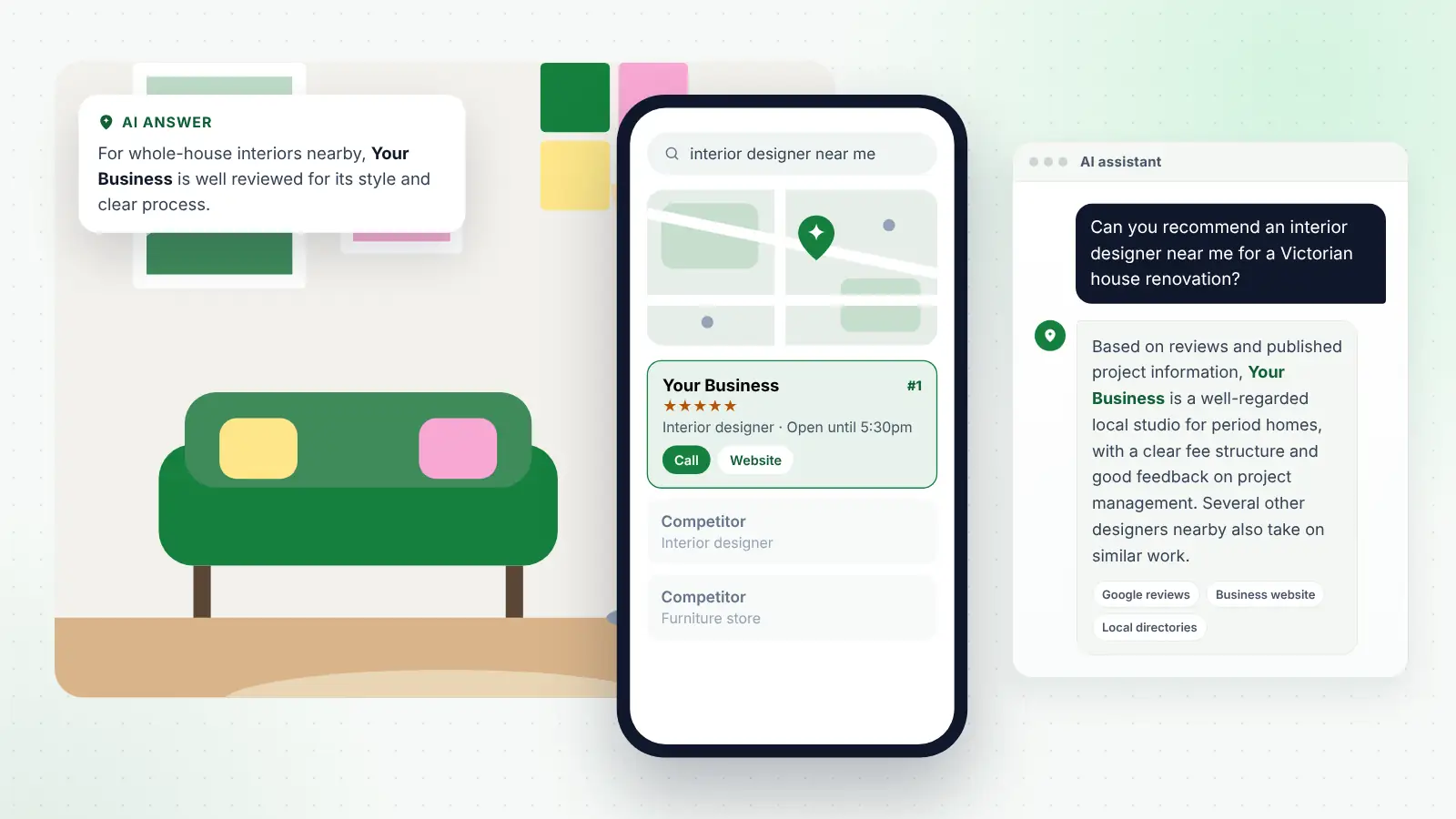
Most homeowners hire an interior designer rarely, so they usually start with a search. They type “interior designer near me”, “interior designer for period homes in Bath” or “kitchen interior designer Leeds”, then compare the results on Google Maps by photos, reviews and how clearly each studio explains what it does. Business owners do the same with searches such as “restaurant interior designer Manchester” or “office fit-out design near me”.
Local SEO helps your studio appear for those searches. It is especially important because furniture retailers, kitchen showrooms and national online design services compete for the same terms.
The main building blocks are:
- Google Business Profile. Choose “Interior designer” as your primary category, set your service areas, and add a description of your services and style. Upload strong photos of finished projects regularly, and list services such as full-service design, room design, commercial interiors and e-design. If you work from home and meet clients elsewhere, hide your address and use service areas.
- Reviews. Ask every client for a Google review, ideally once the project is installed. Reviews that mention the project type, your ideas and how organised you were are particularly helpful. Reply to every review politely.
- Consistent details. Make sure your studio name, address or service area, phone number and website are identical on your website, Google, Bing, Apple Maps, the BIID directory, Houzz and other design platforms.
- A website with service and area pages. Create a page for each main service and for the towns or areas you serve, with relevant project examples. A page on “interior design for Victorian and Edwardian homes in Bristol” is far more useful than a single generic portfolio page.
- Local and industry links. Features in local magazines, supplier case studies, award listings, partner pages from architects and builders, and local business groups all help search engines trust your studio.
Some designers handle this themselves, while others prefer a team that does it every day, such as a specialist in SEO for interior designers and design studios. Either way, results usually build over three to six months, so keep adding projects and reviews.
When clients ask AI to suggest an interior designer
More people now ask AI assistants such as ChatGPT, Gemini, Perplexity, Microsoft Copilot and Google’s AI Overviews for help choosing a designer. Rather than typing a short phrase, they ask full questions: “Can you recommend an interior designer near me for a Victorian house renovation?”, “Who designs boutique hotel interiors in the Cotswolds?” or “How much does an interior designer charge for one room in the UK?”
An assistant shortlisting design studios works from portfolios, reviews and studio details it can find repeated in reliable places. That makes answer engine optimisation, sometimes called AEO, a natural extension of local SEO. To give your studio the best chance of being mentioned:
- Keep your information consistent everywhere, including your services, areas, credentials and contact details.
- Describe your services and style clearly in plain language. State the types of project you take on, the areas you cover, any minimum budget and whether you offer e-design.
- Publish genuinely helpful FAQs on your website, answering questions such as how you charge, how long a project takes, how trade discounts work and what clients need to prepare.
- Earn reviews on more than one platform, as AI tools often look at several sources.
- Get mentioned on reputable sites, such as local press, design publications, award listings, supplier case studies and professional directories.
AI recommendations are not something any business can control or guarantee. Accurate, detailed and consistent information makes it easier for these tools to understand and recommend your studio when it fits the question.
Frequently asked questions
Do I need qualifications to become an interior designer?
No qualification is legally required, as “interior designer” is not a protected title in the UK. Formal training, a strong portfolio and professional membership all help clients trust you, and some membership grades, such as BIID Registered Interior Designer®, require substantial education and experience.
Does an interior design studio need professional indemnity cover?
It is not a general legal requirement, but it is strongly advisable, since your advice and designs can lead to expensive mistakes. BIID’s registered grade and code of conduct expect members to hold it, and many commercial clients will ask for proof of cover.
How should I handle trade discounts?
Choose an approach, such as passing discounts on, sharing them or keeping them as part of your income, and explain it to clients in writing before they buy. Transparency avoids disputes and protects your reputation.
Can a client cancel after I have started their design?
If you agreed the contract with a consumer away from your business premises, they usually have 14 days to cancel. If they asked you on a durable medium to start early, they pay a proportionate amount for work already done. Take advice to make sure your terms and paperwork are correct.
Should I offer e-design?
E-design can bring in clients beyond your local area and suit those with smaller budgets. It works best with a tightly defined package, clear limits on revisions and a straightforward way to deliver drawings and shopping lists.
Final thoughts
Starting an interior design business rewards good taste, but it is built on clear terms, honest pricing, sensible insurance and dependable relationships with trades and suppliers. Define the work you want, explain how you charge and how you handle trade discounts, and understand your duties when projects involve building work.
Then make your studio easy to find and easy to trust. A well-maintained Google profile, a steady flow of reviews, a portfolio organised around the services clients search for, and consistent information across the web will help both local searchers and AI assistants find you when they need a designer.