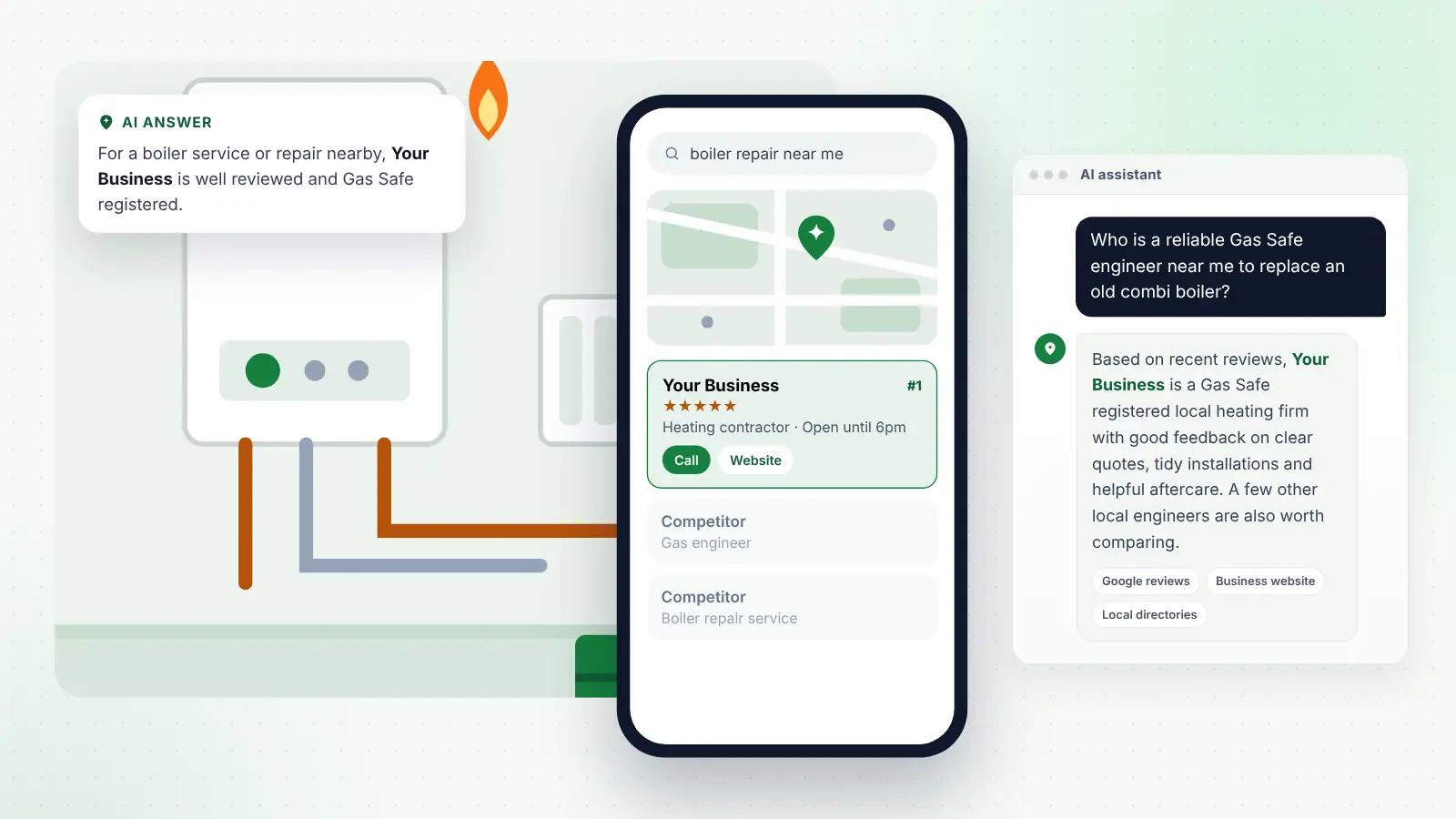
Heating is one of the most dependable trades in the country. Almost every home has a boiler or heating system that needs servicing, repairing and eventually replacing, and every rented home with gas appliances needs a safety check each year. When the weather turns cold, a reliable heating engineer is one of the most valuable contacts a household can have.
The trade is also changing. Heat pumps are moving into the mainstream, government grants are pushing homeowners towards low-carbon heating, and customers increasingly research engineers online, or ask an AI assistant, before they pick up the phone. Engineers who start their own business now have a chance to build a firm that handles both today’s gas boilers and the systems that will replace them.
This guide is for qualified gas and heating engineers thinking about going it alone, and for existing plumbing businesses that want to focus on heating. It covers the registrations you need, the opportunities in landlord work and heat pumps, realistic startup costs, building year-round income and making sure local customers can find you on Google and through AI search.
Key points
- Gas Safe registration is a legal requirement for anyone carrying out gas work, and both the business and each engineer must be registered for the work they do.
- Landlords must have gas appliances and flues checked every year by a Gas Safe registered engineer, which creates steady, repeat work for heating businesses.
- Oil work is usually covered by OFTEC registration, which lets technicians self-certify installations under building regulations in England and Wales.
- The Boiler Upgrade Scheme offers grants towards heat pumps in England and Wales, including £7,500 for an air or ground source heat pump, but only through an MCS-certified installer.
- Servicing plans, landlord contracts and good local visibility are what turn a busy winter into a business with steady income all year.
In this guide
- Decide what kind of heating business you want to run
- Gas Safe registration and ACS assessments
- Oil, LPG and off-grid heating
- Heat pumps, MCS and the Boiler Upgrade Scheme
- Landlord gas safety checks: steady, repeat work
- Setting up the business
- What does it cost to set up as a heating engineer?
- Pricing, boiler cover plans and income through the summer
- Local SEO for heating engineers
- AI search: how customers now find heating engineers
- Common mistakes new heating businesses make
- Frequently asked questions
- Final thoughts
Decide what kind of heating business you want to run
“Heating engineer” covers a wide range of work, and being clear about your focus makes everything else easier, from the qualifications you need to the way you describe yourself online.
- Gas boiler servicing and repairs — the everyday core of most heating businesses. Repairs bring urgent calls; servicing brings repeat customers.
- Boiler installations and replacements — higher-value jobs, often planned in advance, where reviews and guarantees matter most.
- Landlord gas safety checks — annual inspections for landlords and letting agents, often with repairs and replacements following on.
- Oil and LPG heating — common in rural areas off the gas grid, with different registrations and a loyal customer base.
- Heat pumps and low-carbon heating — a growing market supported by government grants, requiring additional training and certification.
- Light commercial heating — shops, offices, schools and churches. Different gas qualifications and a different sales process.
Many engineers start with servicing, repairs and boiler replacements, then add landlord work and, in time, heat pumps. If you already have a loyal base of customers from a previous employer, be careful about contractual restrictions before contacting them.
Gas Safe registration and ACS assessments
Anyone carrying out gas work in the UK must be on the Gas Safe Register. In Great Britain this is required by the Gas Safety (Installation and Use) Regulations 1998, and Northern Ireland has equivalent regulations. Registration is held by the business, whether you are a sole trader, partnership or limited company, and every engineer doing gas work must be listed against that business. The government’s regulated professions entry for registered gas engineers sets out the basics.
Registration depends on competence. Engineers prove this through ACS (Accredited Certification Scheme) assessments: a core domestic gas safety assessment plus the appliance categories you will work on, such as central heating boilers, water heaters, cookers or fires. You can only work on the types of appliance shown on your registration, so plan which categories you need before booking. ACS certificates usually need renewing every five years, while the business registration itself is renewed annually.
What to expect when you register
Gas Safe Register inspects samples of registered engineers’ work, so expect your installations to be checked, particularly in your early months of trading. Keep good records from day one: job sheets, commissioning records, photos and notifications. Engineers receive a Gas Safe ID card showing the categories they are qualified for, and customers are entitled to ask to see it.
When you install a new gas boiler in England and Wales, the work must be notified under building regulations. Gas Safe registered businesses normally do this through the register, and the customer receives a building regulations compliance certificate. Also complete the manufacturer’s commissioning checklist and register the boiler for its warranty; customers often lose warranty cover because nobody did.
Tip
Put your Gas Safe registration number on your website, Google profile, quotes, invoices and van, in exactly the same form. Customers check it, and AI assistants look for it when deciding which engineers to recommend.
Oil, LPG and off-grid heating
In rural areas, many homes are not connected to the gas grid and rely on heating oil or LPG. This can be steady, loyal work, often with less competition than towns and cities.
LPG is a gas, so working on LPG appliances requires Gas Safe registration with the relevant LPG categories on top of your natural gas qualifications.
Oil-fired heating is different. Oil work is not covered by Gas Safe, and most oil technicians register with OFTEC, the trade association and competent person scheme for oil heating. OFTEC registration allows technicians to self-certify that their installation work complies with building regulations in England and Wales, so customers do not need to involve building control. Servicing is not covered by building regulations, but customers still expect a trained, registered technician. Rules differ in Scotland and Northern Ireland, so check what applies where you work.
Off-grid homes are also a key market for heat pumps, which brings us to the biggest change in the trade.
Heat pumps, MCS and the Boiler Upgrade Scheme
Heat pumps are becoming a significant part of the heating market, and government policy is firmly behind them. For a heating business, they offer higher-value installations and a way to stay relevant as homes move away from fossil fuels.
What customers can get from the Boiler Upgrade Scheme
The Boiler Upgrade Scheme in England and Wales offers the following grants, as listed by Ofgem in October 2026. Check the current amounts and eligibility before quoting, as they can change.
| Technology | Grant | Notes |
|---|---|---|
| Air source heat pump | £7,500 | Replacing fossil fuel or non-heat pump electric heating |
| Ground source heat pump | £7,500 | Same eligibility as air source |
| Biomass boiler | £5,000 | Rural, off-gas-grid properties only |
| Air source or ground source heat pump, eligible off-gas-grid homes | £9,000 | Higher rate available until 31 March 2027 |
| Air-to-air heat pump | £2,500 | Homes only; applications from late April 2026 |
The grant is paid to the installer and deducted from the customer’s bill. Under the Warm Homes Plan published in January 2026, the government has said the scheme will continue through to 2029/30. Grant levels and rules can change, so always check the latest guidance from Ofgem, which administers the scheme, before quoting. Scotland has its own support through Home Energy Scotland.
MCS certification
Customers can only claim the grant if their installer is MCS certified for the technology being installed and meets the scheme’s consumer protection requirements, such as membership of an approved consumer code like RECC or HIES. MCS has been updating its scheme, so check its current requirements when you apply. Without MCS, you can still install heat pumps, but you will find it very hard to compete for grant-funded work.
Getting MCS certification involves training, showing your design and installation procedures, insurance and evidence of work. Heat pumps also demand different skills from boiler work: accurate heat loss calculations, emitter sizing, low flow temperatures and careful commissioning. Some systems also involve refrigerant handling, which needs its own certification. Many gas engineers start by partnering with an experienced heat pump installer while they build competence.
Explaining heat pumps honestly
Heat pumps have attracted their share of poor installations and exaggerated savings claims. Be straightforward: explain how running costs depend on the home’s insulation, the tariff and good design, and avoid promising specific savings. Customers who feel they have been given balanced advice are far more likely to recommend you.
Landlord gas safety checks: steady, repeat work
Landlord work is one of the most reliable sources of income for a heating business. In Great Britain, landlords must have every gas appliance and flue they provide checked for safety every 12 months by a Gas Safe registered engineer, and must keep the property’s gas fittings maintained in a safe condition.
Under the HSE guidance on gas safety records, landlords must give existing tenants a copy of the record within 28 days of the check and give new tenants a copy before they move in. Records must be kept for at least two years. Since 2018, a check can be carried out up to two months before its due date while keeping the original anniversary date.
The record you issue must include the details of each appliance and flue checked, your name, registration number and signature, the date, the property address, the landlord’s or agent’s name and address, and any defects found and action taken. Issue it once the check is complete, even when you find a fault.
Winning landlord work
- Build relationships with letting agents. Agents manage dozens or hundreds of properties and need engineers who turn up, communicate well with tenants and send paperwork promptly.
- Make booking easy. Offer to contact tenants directly to arrange access, which saves agents time.
- Send reminders. Contacting landlords a few weeks before their check is due keeps them compliant and keeps you booked.
- Use digital certificates. Clear, electronic records that agents can file easily are a genuine selling point.
- Be honest about defects. Recommend work that is needed, explain why, and never pressure a landlord into unnecessary replacements.
Tip
Keep a simple database of every landlord certificate you issue, with the renewal date. A reminder sent ten weeks before the due date wins most renewals before anyone else gets the chance.
Setting up the business
Structure, tax and VAT
Most heating engineers start as sole traders and consider a limited company as profits grow. Register with HMRC, keep clear records and speak to an accountant early, particularly about VAT. Once your taxable turnover passes the VAT threshold you must register, and that affects how you price. Some energy-saving installations, including heat pumps in residential property, currently qualify for a zero rate of VAT, so make sure your accountant understands the relief before you quote heat pump work.
Insurance
Public liability insurance is essential when working in people’s homes, and many letting agents, manufacturers and schemes will ask for proof. Consider tools and van cover, professional indemnity if you design systems, employers’ liability as soon as you take on staff, and income protection if you are a sole trader.
Merchant accounts and boiler manufacturer schemes
Open trade accounts with merchants and consider becoming an accredited installer with one or two boiler manufacturers. Accreditation can let you offer longer warranties, give you access to technical support and training, and sometimes list your business on the manufacturer’s installer finder.
What does it cost to set up as a heating engineer?
These figures are rough guides only and vary considerably by area, supplier and whether you already own equipment.
| Item | Typical cost | Notes |
|---|---|---|
| Van | £8,000–£25,000 | Used is fine to start; racking helps |
| Flue gas analyser | £400–£1,500 | Essential for servicing and commissioning |
| Hand and power tools | £1,500–£5,000 | Including pipe tools and pressure testing kit |
| Power flushing equipment | £600–£2,000 | Useful for replacements and radiator problems |
| ACS assessments | Varies | Core plus each appliance category |
| Gas Safe registration | Annual fee | Depends on the number of engineers |
| OFTEC or MCS | Varies | Only if you take on oil or heat pump work |
| Insurance | Several hundred pounds a year upwards | More with staff and design work |
| Job management software | Monthly subscription | Quotes, certificates and reminders |
| Website and branding | £0–£3,000 | Clarity and trust signals matter most |
Cash flow needs careful thought. Boilers and heat pumps are expensive, and on grant-funded heat pump jobs the grant arrives after installation. Taking a reasonable deposit on installations, and paying merchants on account terms, helps keep you solvent while you grow.
Pricing, boiler cover plans and income through the summer
The biggest challenge for many heating businesses is seasonality. From October to February the phone does not stop; in summer, breakdowns fall away. The businesses that do well plan for this.
- Price servicing to be worth doing. A cheap service that leaves no margin is not a loss leader if it never leads to anything. Price fairly and do the job thoroughly.
- Offer a service plan. A monthly plan that covers an annual service and priority call-outs gives customers peace of mind and gives you predictable income.
- Spread servicing through the year. Encourage customers to book in spring and summer with reminders or a small incentive.
- Use summer for installations. Homeowners can manage without heating for a day or two in warmer months, so it is the ideal time to fit replacement boilers and heat pumps.
- Give clear written quotes. Set out the boiler model, flue, controls, system cleaning, guarantee and any extras. Clear quotes win jobs and prevent disputes.
When a boiler is old and repairs are becoming expensive, give the customer an honest comparison of repair against replacement. Recommending a replacement only when it makes sense builds the kind of trust that brings installation work your way.
Local SEO for heating engineers
Most heating work starts with a local search. Someone with no hot water searches “boiler repair near me” or “emergency gas engineer [town]”. A homeowner planning ahead searches “new boiler installation [town]”, “combi boiler replacement cost” or “boiler service near me”. A landlord searches “landlord gas safety certificate [town]”, and a homeowner looking at low-carbon options searches “air source heat pump installers near me”. Local SEO is about appearing in the map results and local listings for those searches.
Urgent searches are usually decided by the first few businesses on the map. Installation searches are slower, with customers comparing several firms over days or weeks, so reviews, photos and clear information carry more weight.
A Google Business Profile for heating work
Your Google Business Profile is free and often the first thing customers see. To make the most of it:
- Choose the primary category that best describes your main work, such as a heating contractor or boiler service category, and add genuine secondary categories.
- If customers do not visit your premises, set it up as a service-area business with a realistic list of towns.
- Add each service separately: boiler servicing, boiler repairs, boiler installation, landlord gas safety checks, power flushing and heat pumps if you offer them.
- Upload real photos of your installations, tidy pipework, your van and your team.
- Keep your hours accurate, including any out-of-hours cover you genuinely provide.
Reviews that name the boiler, the job and the town
Reviews strongly influence both rankings and choices. Ask every customer, and make it easy with a direct link sent by text after the job. Reviews that mention the work and location, such as “replaced our old boiler in Harrogate in a day”, help you appear for those searches. Don’t post made-up reviews or reward customers for good ones: both break Google’s policies and UK consumer protection law.
Matching details on Gas Safe, OFTEC and MCS listings
Make sure your business name, phone number and service area are identical on your website, Google profile, Gas Safe listing, OFTEC or MCS listings, manufacturer installer finders, trade directories and social media. Consistent details help Google confirm you are a genuine, established local business.
A website with pages for each heating service and town
Give each main service its own page: what is involved, the boilers or systems you work with, what affects the price, typical timescales, guarantees and what paperwork the customer receives. Add pages for the main towns you cover where you have genuine work and reviews there, rather than near-identical pages for every postcode.
Local links and mentions
Links and mentions from local businesses, community groups, sponsorships, letting agents you work with and local news help build your authority. A handful of relevant, genuine links is worth far more than many low-quality ones.
Local SEO results usually build over three to six months, so starting before the autumn rush pays off. If you would rather spend your time on jobs than on profiles and listings, you can work with a provider of local SEO for heating engineers and gas engineers that looks after your profile, listings, content and links each month.
AI search: how customers now find heating engineers
More customers now ask AI assistants for help before they search. Typical questions include “Who is a good Gas Safe engineer near me for a boiler service?”, “Should I repair or replace a 15-year-old combi boiler?”, “Which heat pump installers near me are MCS certified?” and “How do I get a landlord gas safety certificate in [town]?” ChatGPT, Gemini, Perplexity, Microsoft Copilot and Google’s AI Overviews answer questions like these, and often name local businesses.
These tools build their answers from information they can find and trust: your website, your Google profile, registration listings, reviews across several platforms and mentions on reputable local and industry websites. Answer engine optimisation (AEO) is the work of making those details about your heating business complete, consistent and simple for an assistant to read.
For a heating business, that means:
- Stating registrations clearly. Your Gas Safe number, the work you are registered for, and any OFTEC or MCS certification, in the same wording everywhere.
- Describing services precisely. “We service, repair and install gas boilers across Leeds and Wakefield, and carry out landlord gas safety checks” gives an AI tool something concrete to work with.
- Answering real questions on your website. How long does a boiler replacement take? What does a service include? Who can get the Boiler Upgrade Scheme grant? Short, accurate answers help customers and AI tools alike.
- Being careful with claims. Measured information about costs, savings and grants is more likely to be trusted and repeated than bold promises.
- Earning mentions on trusted sites, such as manufacturer installer finders, trade association directories and local news.
The aim is not to trick AI tools. It is to make sure that when someone asks for a trustworthy local engineer, the information about your business is accurate and persuasive.
Common mistakes new heating businesses make
- Underpricing servicing to fill the diary, then having no margin left for the business.
- Neglecting paperwork. Missing notifications, commissioning records or warranty registrations cause problems for customers and for your registration.
- Relying entirely on winter. Without servicing plans and summer installations, cash flow suffers for half the year.
- Ignoring heat pumps until competitors have built a reputation for them.
- Overselling replacements. Recommending new boilers that are not needed damages trust and reviews quickly.
- Leaving online presence until later. A thin Google profile with a few reviews makes it hard to win installations, however good your work.
Frequently asked questions
Do I need to be Gas Safe registered to start a heating business?
If you will carry out any gas work, yes. Gas Safe registration is a legal requirement, and both the business and each engineer must be registered for the categories of work they do. If you only work on oil or heat pumps, Gas Safe does not apply, but you will want OFTEC registration or MCS certification.
Can I issue landlord gas safety certificates as soon as I am registered?
Yes, provided your registration covers the appliances you are checking. Make sure each record includes all the information landlords need, and issue it at the end of the check even if you find a fault.
Do I need MCS certification to install heat pumps?
It is not a legal requirement to install a heat pump, but customers can only claim the Boiler Upgrade Scheme grant through an MCS-certified installer. In practice, most domestic heat pump work depends on it.
How long will the Boiler Upgrade Scheme last?
The government has said the scheme will continue through to 2029/30. Grant amounts, eligible technologies and any temporary higher rates can change, so check Ofgem’s latest guidance before quoting.
How do I fill quiet summer months?
Encourage customers to book servicing in spring and summer, offer service plans, and use the warmer months for boiler replacements and heat pump installations. Landlord checks also help, as they are spread through the year.
Final thoughts
A heating business can give you steady, rewarding work and a loyal customer base, provided you get the foundations right. Register properly, keep meticulous records, price fairly and give honest advice on repairs, replacements and new technology. Then make sure customers can find you: a complete Google profile, a steady flow of reviews, clear service pages and consistent registration details everywhere. When someone with a cold radiator or an old boiler searches or asks an AI assistant for help, you want your business to be the obvious, trustworthy answer.