Most local businesses spend their marketing effort on strangers: people who have never heard of them and are comparing five options on Google. Yet the cheapest, most reliable work usually comes from people who already know you. A customer who has used you before needs no convincing, and a friend who has been told “use this one, they were great” arrives halfway to saying yes.
The trouble is that repeat and referral work tends to be left to chance. A heating engineer does a good boiler service and never contacts the customer again until the boiler breaks and they call someone else. A physiotherapy clinic treats a patient well but has no way of reminding them about the follow-up. A salon client loves her cut but nobody asks whether she has a friend who would like the same. None of these businesses did anything wrong. They simply did not have a system.
This guide explains how to build that system: when and how to ask for referrals, how to reward them without breaking any rules, how to use reminders and service intervals, what UK law says about marketing to your customer list, how to build referral relationships with other businesses and how to tell whether any of it is working.
Key points
- Repeat and referred customers usually cost far less to win than new ones, but they rarely appear without a deliberate routine.
- Ask for referrals at the moments customers are happiest, and make it easy for them to pass your details on.
- Referral rewards are fine, but never offer anything in return for a review, and keep the two requests completely separate.
- Reminders tied to genuine service intervals are one of the most useful things a local business can send.
- Marketing emails and texts need consent or the soft opt-in under PECR, and every message needs a simple way to opt out.
- Track where each new customer came from, or you will never know which efforts are worth keeping.
In this guide
- Why the second job matters more than the first
- Find out where your work already comes from
- Make the first experience worth repeating
- When to ask for a referral, and how
- Referral rewards: what works and what to avoid
- Reminders, service intervals and rebooking
- Building a customer list you are allowed to use
- Referrals from other businesses
- Referrals, reviews and Google Maps
- How loyal customers show up in AI answers
- Measuring referral and repeat business
- Frequently asked questions
- Next steps
Why the second job matters more than the first
For most local firms, the first job with a new customer is the expensive one. You may have paid for an advert, given time to a quote that might not convert or offered a new-client price. The second job costs almost nothing to win, and it is often more profitable because you already know the property, the car, the patient’s history or the client’s preferences.
Referrals carry a different advantage. A personal recommendation transfers trust. The person who rings because their neighbour told them to is less likely to haggle, less likely to get three other quotes and more likely to book quickly.
That does not mean you should stop looking for new customers. It means the customers you already win should be treated as the start of a relationship, not a single transaction. A café that recognises regulars, an accountant who checks in before the tax deadline and a window cleaner who keeps a reliable round are all doing the same thing: making the next job the obvious choice.
Find out where your work already comes from
Before changing anything, spend an hour looking at your last few months of customers. Most owners have a feeling about where work comes from, and the feeling is often wrong.
- Export or list every new customer from the last three to six months.
- Mark each one by source: Google search, Google Maps, social media, a directory or lead site, a referral from a customer, a referral from another business, a returning customer or unknown.
- Note the value of each job, roughly if necessary.
- Count how many of last year’s customers have come back this year.
If “unknown” is your biggest category, that is your first fix. Add a “How did you hear about us?” question to your enquiry form, booking system or phone script, and record the answer every time. If returning customers are a small share, look at what happens after a job finishes. Usually the answer is nothing.
Make the first experience worth repeating
No referral scheme will rescue a disappointing service. Customers recommend businesses that made something easy, solved a problem or exceeded a modest expectation. The small things are often what people mention when they talk to friends.
- Communication. Confirming the appointment, saying when you are running late and explaining what you did. A garage that sends a short text when the car is ready, with a note of anything to watch, is remembered.
- Tidiness and respect. Dust sheets, shoe covers and taking rubbish away matter more to homeowners than many trades realise.
- No surprises on price. If the quote changes, say so before the work is done, not on the invoice.
- A clear finish. A summary of what was done, any guarantee, and what happens next.
The last point is where repeat business starts. If you tell a customer “your next service is due in about a year and we will send you a reminder”, you have set up the second job before you leave.
When to ask for a referral, and how
Most people are happy to recommend a business they liked, but very few do it unprompted. The ask needs to be well timed, simple and low pressure.
The right moments
Ask when the customer has just experienced the result and is pleased with it:
- When a tradesperson hands over a finished job and the customer says it looks great.
- When a physiotherapy patient reports that they are back running or sleeping through the night.
- When a salon client looks in the mirror and smiles.
- When an accountant tells a client their return is filed and they have money coming back.
- When a restaurant guest thanks the team on the way out after a celebration meal.
Do not ask when a job is half finished, when something has gone wrong or when the customer is clearly in a hurry.
What to say
Keep it short and specific. Vague requests (“tell your friends about us”) are easy to agree to and forget. Something like this works better:
“I’m glad you’re happy with it. Most of our work comes from recommendations, so if you know anyone who needs a boiler looked at, I’d really appreciate you passing my number on.”
Then give them something to pass on: a business card, a small leaflet with a few spare cards, or a short message they can forward by text or WhatsApp with your name, number and website. For clinics and professional services, a brief follow-up email after the final appointment can include the same line.
Tip
Ask for a specific kind of referral. “If any of your neighbours have a similar extension in mind” or “if a colleague needs help with their self-assessment” is far easier to act on than a general request.
Referral rewards: what works and what to avoid
A reward is not essential, but it can turn a vague intention into an actual recommendation, and it is a pleasant way to say thank you.
Rewards that tend to work
- A thank-you to the referrer only after the new customer has booked or paid. For example, a credit off the referrer’s next service, a voucher for a local café or a small gift.
- A two-way offer. The new customer gets a modest welcome discount and the referrer gets a thank-you. This works well for salons, gyms and clinics where both people are likely to keep visiting.
- A donation option. Some customers feel awkward accepting a reward. Offering to donate to a local charity on their behalf gives them an alternative.
Keep the scheme simple enough to explain in a sentence, put the terms in writing on your website or the referral card, and record who referred whom so you can thank them promptly.
Check your sector’s rules
Some regulated professions restrict paying for or receiving referrals, or require referral arrangements to be disclosed to the client. If you are a solicitor, financial adviser, mortgage broker, healthcare professional or similar, check your regulator’s or professional body’s rules before offering any reward.
Keep referrals and reviews completely separate
This is the most important rule in this guide. A referral reward must never be linked to leaving a review, and you should never offer anything in return for a review of any kind.
Google’s policies prohibit offering incentives for reviews, and Google has been strengthening its rules on review requests, including against setting staff targets for reviews. In UK law, the Digital Markets, Competition and Consumers Act 2024 added fake reviews and concealed incentivised reviews to the list of commercial practices banned in all circumstances, from 6 April 2025. The Competition and Markets Authority can now enforce consumer law directly and impose substantial fines, and there is no exemption for small businesses. The CMA’s guidance on fake reviews sets out what is prohibited.
In practice:
- Do not say “refer a friend or leave us a review and get £10 off”. Run the two as separate requests.
- Do not give referral rewards only to customers who have reviewed you.
- Do not ask referred customers to review you as a condition of their welcome discount.
- Ask for reviews in the normal way, from every customer, with no reward attached.
Reminders, service intervals and rebooking
For many local businesses, the most valuable repeat work comes from things that need doing regularly. A reminder at the right time is a genuine service to the customer, not just marketing, because it saves them remembering.
| Business | What to remind about | Typical timing | Notes |
|---|---|---|---|
| Heating engineer | Boiler or heat pump service | Around 11 months after the last visit | Many manufacturers’ warranties expect regular servicing |
| Garage | MOT and service | A few weeks before the due date | The MOT due date is easy to check, so reminders are expected |
| Dental or physio clinic | Check-up or follow-up | As advised by the clinician | Base the interval on the individual’s care, not a fixed rule |
| Salon or barber | Next appointment | Rebook at checkout, then remind a few days before | Rebooking in the chair beats any reminder |
| Accountant | Year-end, tax return and payment deadlines | Several weeks before each deadline | Good reminders reduce last-minute panic for both sides |
| Window cleaner or gardener | Next round or seasonal visit | A day or two before | Regular rounds are repeat business by design |
A few principles make reminders work better:
- Agree the reminder at the end of the job. “Shall I put you down for a reminder next October?” gets a yes from most customers, and it makes the later message expected.
- Make booking easy. Include a link to book, or a number to call or reply to. A reminder that asks the customer to go and find your website loses people.
- Use the channel the customer prefers. Many people respond better to a text than an email for appointments.
- Keep reminders factual. A service reminder that turns into a sales flyer for unrelated products may stop being a service message and become marketing, which has different rules.
Tip
Store the due date, not just the job date. If your system records “next service due: 14 October”, reminders can be sent automatically and nothing depends on you remembering.
Building a customer list you are allowed to use
A list of past customers is valuable, but UK law controls how you use it for marketing. Two sets of rules matter: UK GDPR, which covers how you handle personal data in general, and the Privacy and Electronic Communications Regulations (PECR), which covers marketing by email, text and phone.
The basics under UK GDPR
Tell customers what you collect and why in a clear privacy notice, keep the data secure, keep only what you need and delete records you no longer have a reason to hold. Most businesses that process personal data also need to pay the data protection fee to the Information Commissioner’s Office (ICO), and the ICO’s self-assessment will tell you whether that applies to you.
Marketing emails and texts under PECR
In general, you need a person’s consent before sending them marketing by email or text. There is an exception commonly called the soft opt-in, which allows you to send marketing to existing customers if all of these apply:
- You got their contact details in the course of a sale, or negotiations for a sale, of your product or service.
- The marketing is about your own similar products or services.
- You gave them a clear, simple chance to refuse marketing when you collected their details.
- You give them a simple way to opt out in every message you send.
So a garage that collected a customer’s email when booking an MOT, and offered a tick box to opt out at the time, could normally email them about servicing offers. It could not pass the list to a car dealer, or market an unrelated business to them.
Service reminders that the customer has asked for are generally treated differently from marketing, but the line can blur if the message is mainly promotional. When in doubt, treat it as marketing and include an opt-out.
Business-to-business email has its own rules, and the rules for individuals generally also cover sole traders and some partnerships. Marketing phone calls have separate requirements, including screening numbers against the Telephone Preference Service (or the Corporate Telephone Preference Service for companies) unless the person has specifically agreed to calls from you. The Data (Use and Access) Act 2025 has also amended parts of PECR, with the main changes in force since February 2026, including much higher maximum fines, so check the ICO’s current guidance on direct marketing before you launch a campaign.
Keeping the list useful
- Record when and how each person gave consent or was given the chance to opt out.
- Act on unsubscribes promptly and keep a suppression list so they are not added back.
- Send fewer, more useful messages. A short seasonal email with one practical tip and one reason to book is more likely to be read than a weekly newsletter.
Referrals from other businesses
Some of the best referral sources are not customers at all but businesses that serve the same people at a different moment.
- Trades. A kitchen fitter needs a reliable electrician, plumber and plasterer, and gets asked for recommendations constantly. An electrician who turns up when promised becomes the name the fitter passes on.
- Property. Estate agents, letting agents and conveyancing solicitors are asked for removal firms, cleaners, gardeners and handymen.
- Health and wellbeing. A physiotherapist, a sports massage therapist, a personal trainer and a podiatrist often see the same clients and can refer between them where it is clinically appropriate.
- Professional services. Accountants, solicitors, mortgage brokers and independent financial advisers routinely refer clients to each other.
- Hospitality. A wedding venue’s recommended supplier list, a B&B that suggests a local restaurant, or a florist who works with particular venues.
To build these relationships:
- Pick three to five businesses whose customers overlap with yours and whose work you respect.
- Introduce yourself properly, ideally in person, and explain what kind of job you are a good fit for.
- Refer work to them first if you can. Reciprocity is the most reliable basis for these arrangements.
- Look after their customers exceptionally well. Your work reflects on the business that recommended you.
- Agree whether there is any referral fee, and if so, put it in writing and check it is allowed in both of your sectors. Many local arrangements work perfectly well with no money changing hands.
- Thank them every time, and let them know how the job went.
Referrals, reviews and Google Maps
Referral and repeat business is not separate from being found online. When someone is told “use this firm”, the first thing they usually do is search the name on Google. What they see on your Google Business Profile either confirms the recommendation or makes them hesitate.
A referred customer looking at your profile wants reassurance: a business name that matches what they were told, current opening hours, a working phone number, recent photos and reviews that mention the kind of job they need. A profile with a handful of old reviews and a disconnected phone number can lose work that a friend has already half won for you.
Your loyal customers are also your best source of reviews. Ask every customer for a review in the normal way, separately from any referral request, with a direct link and no incentive. Over time, reviews that mention specific services, places and staff help both people and Google understand what you do and where. If you would rather not manage the profile, reviews and website yourself, specialists in local SEO and AI search services for small businesses can take on that work while you concentrate on the customers.
A few practical links between the two:
- Use the exact same business name on your referral cards, invoices, van and Google profile, so a referred customer finds the right listing.
- Put your website address and a short “search us on Google” line on referral materials.
- Keep your services list on Google up to date, so a referral for a specific job matches what the profile shows.
How loyal customers show up in AI answers
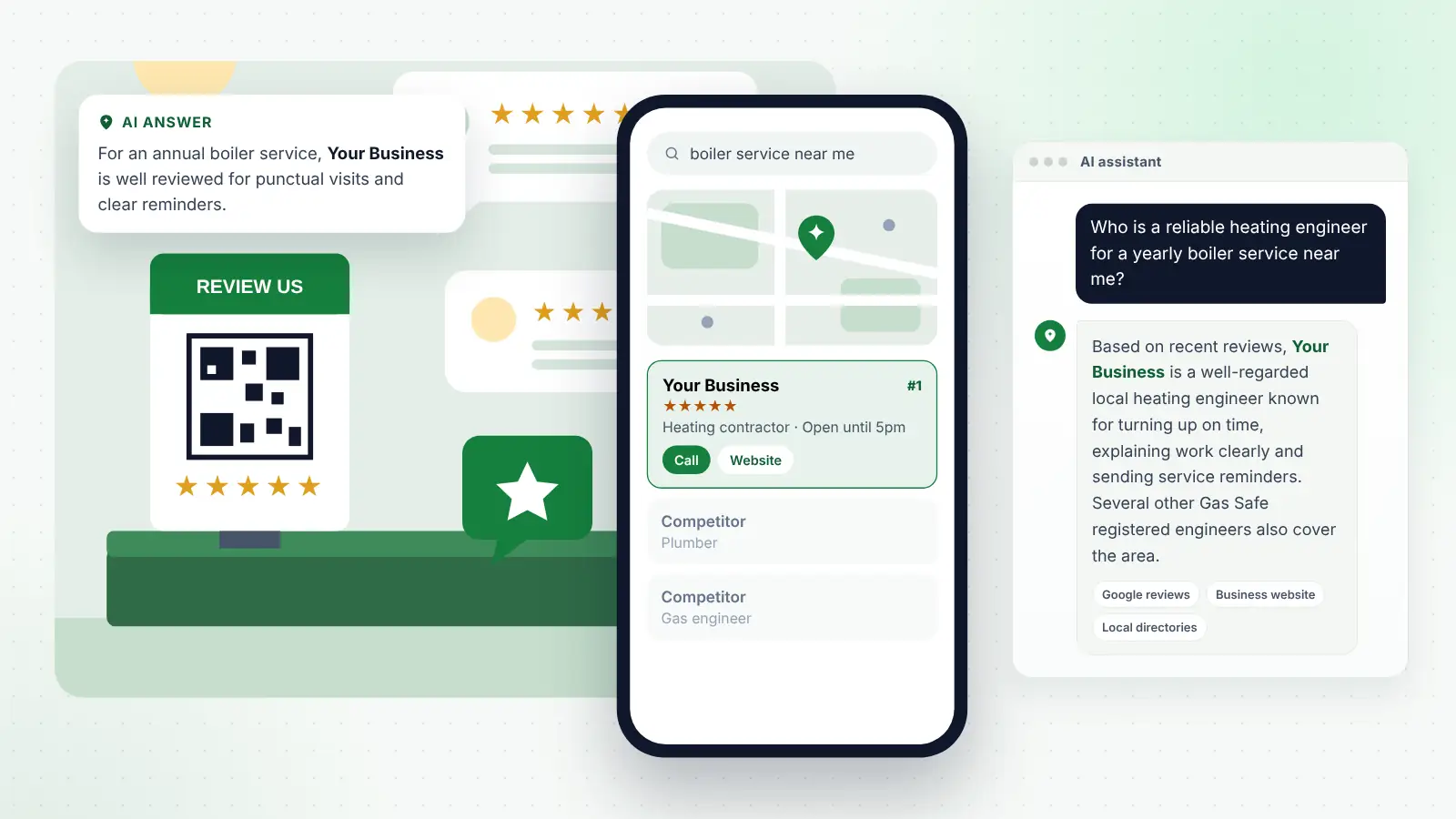
More people now ask AI assistants such as ChatGPT, Gemini, Perplexity and Copilot, as well as Google’s AI Overviews, for local recommendations: “Which garage in Leeds is honest about repairs?” or “Is there a good accountant for sole traders in Exeter?” These tools tend to draw on what is written about a business across the web, including reviews, directories, local news and the business’s own website.
Repeat and referred customers help here in ways that a one-off advert does not. Customers who keep coming back often write reviews that describe a long relationship, such as “we have used them for every service for five years”, and AI tools pick up recurring themes like reliability, honesty and good communication. Partner businesses that recommend you on their own websites, such as a kitchen showroom listing its preferred installers, create independent mentions that confirm you exist and do the work you claim.
To make that information easy to use:
- Describe your services, service area and any regular plans (such as annual servicing or maintenance contracts) clearly on your website.
- Answer common questions in plain language, for example how often a service is needed or how your referral thank-you works.
- Keep your name, address, phone number and opening hours consistent everywhere they appear.
- Ask partner businesses who recommend you to describe what you do accurately when they mention you.
No one can guarantee what an AI assistant will say, but a business with steady, genuine reviews and consistent information is in a far better position than one that relies on a single listing.
Measuring referral and repeat business
You do not need complicated software. A spreadsheet or the reporting in your booking or job management system is enough, as long as you record the source of every new customer.
| Measure | How to work it out | What it tells you |
|---|---|---|
| Share of work from referrals | Referred customers divided by all new customers, monthly | Whether your asks and partners are producing results |
| Repeat rate | Customers from last year who booked again this year | Whether reminders and service quality are working |
| Reminder response | Bookings made within a month of a reminder | Whether timing and wording need changing |
| Top referrers | Customers and partners who sent the most work | Who to thank and look after |
| Value by source | Average job value for each source | Which channels bring the most profitable work |
Review these figures every quarter. If referrals rise after you start asking at handover, keep doing it. If reminders are being ignored, try changing the timing, the channel or the wording before giving up on them.
Tip
Thank referrers quickly. A short message within a day or two of the referred customer booking matters more than the size of the reward, and it makes a second referral more likely.
Frequently asked questions
Can I offer a reward for referrals and reviews in the same scheme?
No. Keep them entirely separate. A referral reward is fine on its own, but offering anything in return for a review breaks Google’s policies, and under UK consumer law fake or concealed incentivised reviews are banned. Ask for reviews from everyone, with nothing offered in return.
Can I email all my past customers about a special offer?
Only if you have their consent or the soft opt-in applies. That generally means you collected their details during a sale, the offer relates to your own similar services, and they had a chance to opt out when you collected their details and in every message since. If you are unsure about part of your list, the ICO’s direct marketing guidance is the place to check.
How big should a referral reward be?
Big enough to feel like a genuine thank-you, but not so large that it eats the profit from the job. Many local businesses use a modest credit off the next visit or a small gift. The speed and sincerity of the thank-you usually matter more than the amount.
Are service reminders classed as marketing?
A reminder the customer has asked for, giving factual information about a due service, is generally different from a promotional message. If the reminder starts selling other products or offers, treat it as marketing and follow the PECR rules, including an opt-out.
Should I pay other businesses for referrals?
You can, where your sector allows it, but many local partnerships work without fees. If you agree a fee, put it in writing, check your trade body’s or regulator’s rules, and be open with customers where the rules require it.
Next steps
Start small. This week, add a “How did you hear about us?” question to every enquiry and record the answers. Next, choose one moment where you will ask for a referral, and write down the words you will use. Then set up reminders for the regular work you already do, with the due date stored for each customer, and check your marketing list has a clear consent or soft opt-in basis.
Within a few months you will know where your best customers come from, and you will have a routine that turns good work into the next job rather than leaving it to chance.