Fencing looks simple from the outside. A homeowner sees a row of panels and assumes anyone with a van and a post-hole spade can do it. Then the first winter storm arrives, and the difference between a fence that was set properly and one that was rushed becomes obvious along every street. The fences that stay up were installed by people who understood posts, ground conditions, timber treatment and wind load.
That gap is the opportunity for a new fencing business. Demand is steady, it spikes sharply after high winds, and customers increasingly want someone who can answer their questions about heights, boundaries and gates, not just fit panels. Fencing also spreads well into related work: driveway gates, commercial security fencing, agricultural and equestrian fencing and garden decking.
This guide covers the decisions and rules that matter most when you start: choosing your market, setting up properly, planning limits for fences and walls, boundary and neighbour questions, the Party Wall Act, timber treatment, automated gates, safety, costs, pricing and getting found on Google and in AI assistants.
Key points
- Choose your core market early, such as domestic garden fencing, gates, commercial security fencing or agricultural work, because tools, materials and customers differ.
- In England, a new fence, wall or gate usually needs planning permission if it is over 1 metre high next to a road used by vehicles, or over 2 metres elsewhere; Wales, Scotland and Northern Ireland set their own rules.
- Boundary lines and fence ownership are for the customer and their neighbour to settle, and Land Registry title plans usually show only general boundaries.
- The Party Wall Act can apply to garden walls on a boundary, but not to timber fences.
- Use timber treated to the right use class, with use class 4 for posts in the ground, and treat automated gates as a specialist safety job.
- Being visible in local search and AI answers before storm season matters more in fencing than in most trades.
In this guide
- Decide what kind of fencing business you will run
- Get your fencing business registered and insured
- Fence heights and planning permission
- Boundaries, ownership and neighbours
- Garden walls and the Party Wall Act
- Materials and timber treatment
- Gates and automated gates
- Health and safety on site
- Post drivers, vans and other start-up costs
- Pricing, quoting and seasonality
- Landing your first fencing jobs
- Local SEO for fencing contractors
- AEO and AI search: how customers research fencing now
- Frequently asked questions
- Final thoughts
Decide what kind of fencing business you will run
Fencing covers several quite different markets. Most new businesses start in one and add others as they gain experience and equipment.
- Domestic garden fencing. Closeboard, panels, picket, slatted and composite fencing for homeowners, plus repairs and storm damage. Fast-moving work with lots of small jobs and plenty of opportunities for reviews.
- Gates. Side gates, garden gates and timber or metal driveway gates. Higher job values, and a natural upsell on most domestic fencing jobs.
- Automated gates. Electric swing and sliding gates. Profitable, but they need specialist knowledge of safety devices and electrics, covered later in this guide.
- Commercial and security fencing. Palisade, welded mesh, chain link and perimeter fencing for businesses, schools, warehouses and construction sites. Larger projects, more paperwork and more demanding clients, who often expect operatives to hold recognised skills cards.
- Agricultural and equestrian fencing. Stock fencing, post and rail, high-tensile wire, electric fencing and paddock work for farms, smallholdings and stables. Often seasonal and spread by word of mouth between neighbouring landowners.
- Decking and garden add-ons. Timber or composite decking, trellis, pergolas and bin stores. Many fencers add these to fill gaps between fencing jobs and increase the value of each visit.
If you are coming from general landscaping or building work, you may already do some fencing. The difference with a specialist fencing business is depth: knowing which post suits which ground, how to handle sloping gardens, how to set gate posts so gates do not drop, and how to quote accurately for awkward access.
Get your fencing business registered and insured
Structure and paperwork
Most fencers start as sole traders and consider a limited company as turnover grows. Whichever you choose, register with HMRC, keep records from day one and set aside money for tax. Use clear written quotes and simple terms covering deposits, what happens to the old fence and what is included.
If you agree a contract with a customer in their home rather than at your premises, consumer law usually gives them a 14-day cancellation period, and you must tell them about it in writing. If they want work to start sooner, get their request in writing.
Insurance
Public liability insurance is essential. Fencing work involves digging near underground services, working beside neighbours’ property, cars and windows, and handling heavy materials. Employers’ liability insurance is a legal requirement once you employ anyone. Also consider cover for tools and plant, goods in transit and business use of your vehicle.
Waste
Every replacement job produces waste: old panels, rotten posts, concrete spurs and broken gravel boards. If you transport that waste, you must register as a waste carrier. In England this is with the Environment Agency through the GOV.UK waste carrier registration service, which tells you whether you need the upper or lower tier when you register. Outside England, register with Natural Resources Wales, SEPA in Scotland or the NIEA in Northern Ireland instead. Take waste to licensed sites, keep transfer records and show your registration number on quotes.
Fence heights and planning permission
Customers ask about heights all the time, and confident, accurate answers set you apart. The rules depend on which nation the property is in.
England
Fences, walls and gates are covered by permitted development rights under Class A of Part 2 of the General Permitted Development Order. In general, planning permission is needed if:
- The fence, wall or gate would be over 1 metre high, measured from ground level, next to a highway used by vehicles.
- It would be over 2 metres high anywhere else.
- The property is a listed building, or the work is within its curtilage.
- Permitted development rights have been removed, for example by an Article 4 direction or a planning condition, which is common on newer estates and in some conservation areas.
Repairing, maintaining or replacing an existing fence is usually fine as long as you do not make it higher than it was, or higher than the limits above if those are greater. Anything fixed on top, such as trellis, is generally treated as part of the overall height, so a 1.8 metre panel on a gravel board with trellis above can easily go over 2 metres.
Wales, Scotland and Northern Ireland
Planning is devolved. Welsh Government guidance currently uses similar thresholds to England, with 1 metre next to a road and 2 metres elsewhere. In Scotland, the limit is generally 1 metre where the fence is in front of the house or next to a road and 2 metres elsewhere, with extra restrictions for listed buildings and conservation areas. Northern Ireland has its own permitted development order. Wherever you work, check the guidance for that nation and, if in doubt, tell the customer to ask the local planning authority before you order materials.
Tip
Add one line to every quote stating the finished height of the fence, including gravel boards and trellis. It avoids disputes later and shows the customer you have thought about the planning limits.
Boundaries, ownership and neighbours
Fencing sits right on the line between neighbours, and boundary arguments are one of the most common sources of stress for customers. Your role is to be helpful without becoming the referee.
HM Land Registry’s guidance on boundaries explains several points worth knowing:
- Title plans usually show general boundaries only. The red line does not show the exact legal boundary, and you should never measure from a title plan to decide where posts go.
- There is no general rule that the fence on the left or right of a property belongs to its owner, and the side the posts face is not a reliable guide to ownership.
- “T” marks on deeds usually indicate who is responsible for maintaining a boundary feature, but they are not always conclusive.
- The Land Registry does not settle disputes between neighbours. Options include agreeing the line informally, a recorded boundary agreement, mediation or legal advice.
In practice, ask customers whether they know who owns the boundary and whether they have spoken to the neighbour. Suggest they agree the position of a replacement fence in writing before you start, and set the new fence on the existing line unless both owners agree otherwise. Never move a boundary because one neighbour asked you to.
Which way should the posts face?
It is common practice and good manners to put the smooth face of the fence towards the neighbour, with posts and rails on the customer’s side, but it is not a legal requirement. Explain this neutrally and let the customer decide, particularly if they want to stain or maintain both sides.
Garden walls and the Party Wall Act
The Party Wall etc. Act 1996 applies in England and Wales and is sometimes raised by customers who assume it covers fences. It does not cover timber fences. It can, however, apply to masonry garden walls on a boundary, which the Act calls party fence walls when they stand astride the line between two properties.
If a customer wants a new wall built on the line of junction between two properties, the Act requires them to serve notice on the neighbour at least one month before work starts. Other work on or near an existing party fence wall may also need notice. Serving notice is the property owner’s responsibility, not yours, but knowing when the Act might apply helps you raise it early and avoid delays. If you mainly build fences and only occasionally build low walls, keep this simple: when a wall will sit on the boundary, tell the customer to check whether they need to serve notice before you book the job.
Materials and timber treatment
The materials you choose decide how long your work lasts, and that decides your reputation.
Treated timber and use classes
Preservative-treated timber in the UK is specified by use class under BS 8417. The two that matter most for fencers are:
| Use class | Where it is used | Fencing examples |
|---|---|---|
| Use class 3 | Outdoors, exposed to weather, not in ground contact | Panels, rails, boards, trellis, gate leaves |
| Use class 4 | Permanent contact with the ground or fresh water | Timber posts, gravel boards in soil contact, timber set in concrete |
Timber posts that go into the ground or concrete should be treated to use class 4. Ask your supplier for treatment certificates and do not assume all green-looking timber has been treated to the same level. When you cut treated timber, apply a suitable end-grain preservative as the manufacturer recommends, because cutting exposes untreated wood.
Other options
- Concrete posts and gravel boards. Long-lasting and popular with homeowners who have lost timber posts to rot or wind. Heavier to handle and harder to adjust on slopes.
- Steel and composite systems. Increasingly common for low-maintenance domestic fencing, often with manufacturer installation guidance you must follow.
- Commercial systems. Palisade and mesh fencing are generally specified to the BS 1722 series of British Standards, and clients may ask you to confirm the specification.
Tip
Photograph your post holes, concrete and gravel boards before the panels go in. Those photos explain your price better than any sales pitch and work well on your Google profile and website.
Gates and automated gates
Gates are where many fencing businesses increase their job values. A well-hung timber driveway gate needs substantial posts, properly set, with hardware matched to the gate’s weight. Customers judge you on whether the gate still closes cleanly a year later.
Automated gates are a different level of responsibility. HSE has issued a safety alert about the risk of people, including children, being crushed by powered gates, and it expects installers to:
- Measure closing and opening forces with proper test equipment and keep them within the limits in the relevant standards.
- Fit safety devices that detect a person or obstacle and stop or reverse the gate.
- Protect trapping points along the gate’s travel.
- Provide an emergency release and make sure users know how to use it.
- Assess the risks of each installation, especially where the public or children may be present.
HSE’s powered gates safety alert sets out these points in detail. If you plan to offer automation, get specialist training, use competent electricians for the power supply and consider partnering with an established gate automation firm until you have the skills and test equipment in-house.
Health and safety on site
Fencing looks low risk, but it involves heavy lifting, power tools and digging. Plan for the main hazards:
- Underground services. Check for cables and pipes before you dig, particularly near driveways, front gardens and outbuildings, and use a cable avoidance tool where appropriate.
- Manual handling. Concrete posts and gravel boards are heavy. Use two-person lifts, trolleys and sensible loading of the van.
- Power tools and augers. Train anyone using petrol augers, post drivers, saws and breakers, and provide suitable protective equipment.
- Working near roads and the public. Front-garden and commercial work often means keeping pedestrians away from open holes and moving vehicles.
For commercial and highways work, many main contractors and clients expect fencing operatives to hold a card under the Fencing Industry Skills Scheme (FISS/CSCS), which Lantra administers with industry partners including the Fencing Contractors Association. Even if you start with domestic work, it is worth understanding the route if you want to win site work later.
Post drivers, vans and other start-up costs
These figures are rough guides only. Prices vary by area, supplier and whether you buy new, used or hire.
| Item | Typical cost | Notes |
|---|---|---|
| Used van or pickup with roof rack | £8,000–£20,000 | Long panels and posts need length |
| Trailer | £1,000–£3,500 | Useful for concrete posts and waste |
| Petrol post-hole auger | £300–£1,000 | Hire first if cash is tight |
| Breaker or SDS drill | £200–£1,500 | For old concrete and footings |
| Saws, levels, lines and hand tools | £500–£1,500 | Buy quality; they get heavy use |
| Cable avoidance tool | £500–£1,500 | Can be hired |
| Insurance (first year) | Varies | Depends on cover, turnover and staff |
| Website, signage and branding | £500–£3,000 | Van signage generates enquiries |
Agricultural fencing usually needs heavier kit, such as a tractor-mounted or self-propelled post driver, which many contractors hire or buy secondhand once regular work is in place.
Pricing, quoting and seasonality
Domestic fencing is often quoted per metre or per panel, but the price should reflect what is really involved: the type of post, gravel boards, ground conditions, removal of the old fence, access through the house or side passage, slopes and any gates.
Common pricing mistakes include:
- Underestimating time to remove old concrete footings.
- Not allowing for waste disposal.
- Quoting from a description over the phone and finding awkward access on the day.
- Ignoring the extra work involved in stepping panels down a slope.
Customers often compare your quote with the cost of panels in a DIY store. An itemised quote that explains post type, depth, concrete and treatment helps them see why yours costs more and lasts longer.
Fencing has an unusual seasonal pattern. Storm damage drives a surge in repair enquiries during autumn and winter, while new installations, gates and decking are more popular in spring and summer. Plan for both: keep stock of common sizes for storm repairs, and use quieter weeks to quote larger spring projects.
Landing your first fencing jobs
- Be easy to reach after storms. Many customers will call the first fencer who answers and can give a realistic date.
- Photograph every job, including the groundwork, and ask for permission to use photos online.
- Ask for a review at handover, when the customer is looking at the finished fence or gate.
- Leave a polite note with neighbours. Fencing is visible from both sides, and next door often needs work too.
- Build referral partners among builders, landscapers, letting agents and property managers who need fencing they do not install themselves.
Local SEO for fencing contractors
Most fencing customers start with a local search. Searches such as “fencing contractors near me”, “fence repair [town]”, “fence installers near me”, “driveway gates fitted” and “agricultural fencing contractor” are local by nature, and the businesses in the map results win most of the calls.
The fundamentals are achievable for any small fencing business:
- Complete your Google Business Profile. Choose the most accurate primary category, list each service, such as fence installation, fence repair, gates and decking, set your service area and write a clear description.
- Add photos regularly. Recent jobs, gates and groundwork photos show the profile is active and help customers judge your quality.
- Collect detailed reviews. Reviews that mention the job and area, such as “storm-damaged fence replaced in Chelmsford”, help customers and give search engines useful detail. Reply to every review.
- Keep your details consistent. Your name, phone number, address and website should match across Google, your website, Facebook, trade platforms and supplier installer listings.
- Build a website with service and area pages. Separate pages for garden fencing, fence repairs, gates, commercial fencing and agricultural work, plus pages for the main towns you cover, perform better than a single page listing everything.
- Earn local links. Mentions from suppliers, local business groups, community organisations and trade partners show you are a genuine local business.
Timing matters more for fencers than for most trades. If your profile is only built after a storm, the surge in searches has already gone to someone else. If you would rather spend your time on the tools, our page on local SEO for fencing contractors and gate installers explains how specialists can handle it. Either way, results usually build over three to six months, so start well before the autumn storms.
AEO and AI search: how customers research fencing now
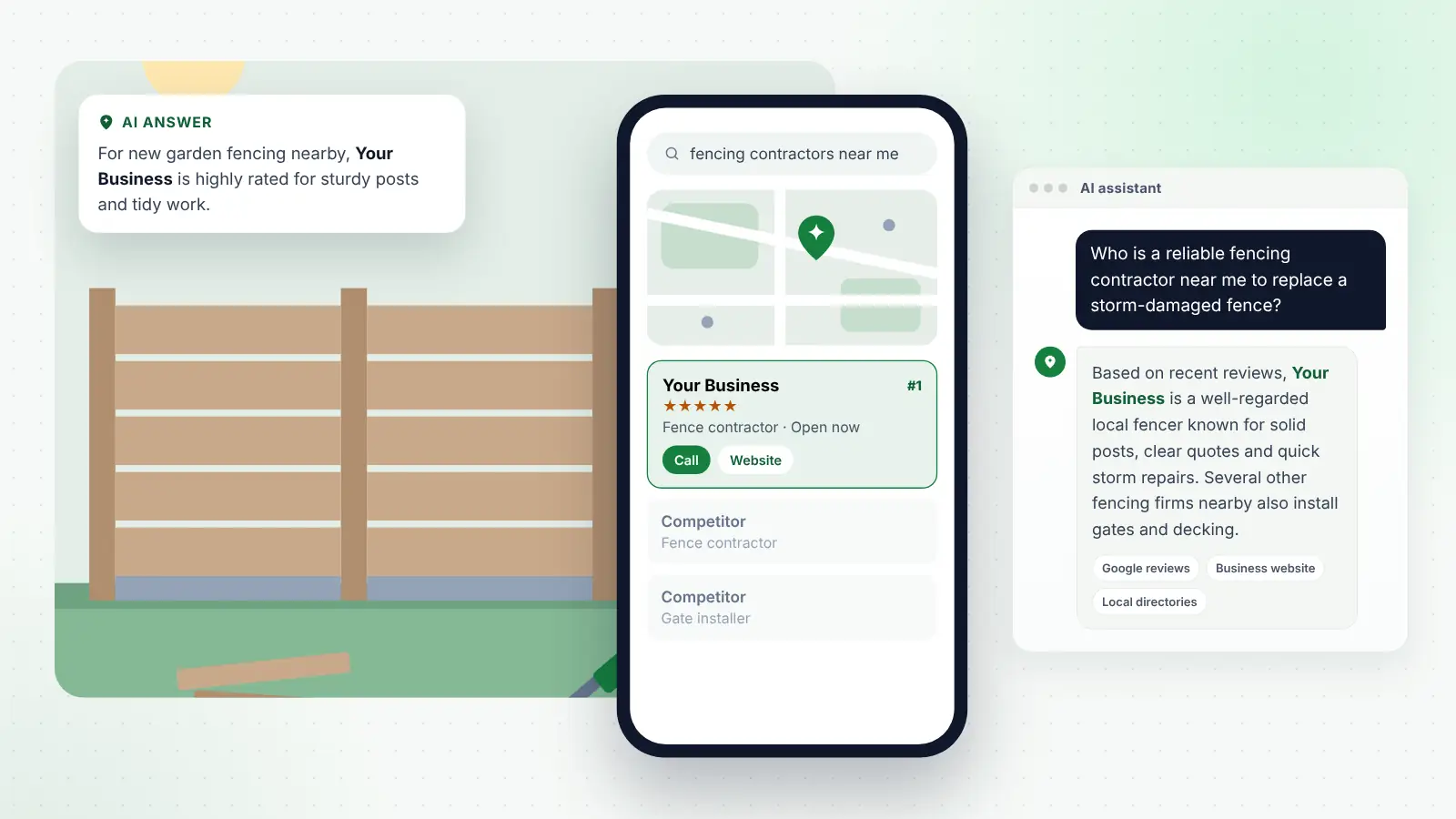
More people now ask AI assistants for help before they call anyone. They might ask ChatGPT, Gemini, Perplexity or Microsoft Copilot, or read a Google AI Overview, with questions such as:
- “Who is a reliable fencing contractor near me to replace a storm-damaged fence?”
- “How high can my garden fence be without planning permission?”
- “Concrete or timber fence posts — which last longer?”
- “Which fence is mine, left or right?”
- “Who installs electric gates near me safely?”
These tools do not hold a fixed list of the best fencers. Instead, they build each answer from details about local fencing firms that they can find and verify on several websites. Answer engine optimisation (AEO) means making sure that information exists, is accurate and is easy to understand. The signals they tend to rely on include:
- Consistent business information across your website, Google profile and directories, so the tool can be confident you are a genuine local business.
- Reviews that describe specific jobs and qualities, such as solid posts, tidy sites and quick storm repairs.
- Clear service descriptions that say which fence types you install, whether you do gates and automation, and which areas you cover.
- Helpful answers to common questions on your website, such as fence heights, boundaries, post types and timber treatment.
- Mentions on reputable sites, such as supplier installer directories, trade associations, local news and community organisations.
For a fencing business, the overlap between information questions and recommendation questions is unusually strong. Someone asking how high their fence can be is often about to ask who can put it up. If your website answers those questions clearly and your reviews and listings back you up, you are more likely to be mentioned. There are no guarantees, but the work overlaps heavily with good local SEO.
Frequently asked questions
Do I need a licence to start a fencing business?
There is no general licence to install fences. You do need to register as a waste carrier if you transport waste, comply with health and safety law and have employers’ liability insurance once you take on staff. Commercial clients may also expect FISS/CSCS cards and specific accreditations.
Does my customer need planning permission for a 2 metre fence?
In England, a fence of up to 2 metres in a back garden usually does not need planning permission, but anything over 1 metre next to a road used by vehicles usually does. Listed buildings and properties where permitted development rights have been removed are exceptions. Rules in Wales, Scotland and Northern Ireland are set separately, so check locally.
Who owns the fence between two gardens?
There is no general rule. Customers should check their title deeds and any T marks, and agree the position with the neighbour if they are unsure. HM Land Registry title plans usually show general boundaries only, so they rarely settle the question on their own.
Does the Party Wall Act apply to fences?
No. It does not cover timber fences. It can apply to masonry garden walls on or astride a boundary in England and Wales, and the property owner may need to serve notice before a new boundary wall is built.
Should I offer decking as well as fencing?
Many fencers do, because the tools, timber suppliers and customers overlap. Use timber treated to the right use class, follow manufacturer guidance for composite boards, and check whether a raised deck might need planning permission before you quote.
Final thoughts
A fencing business is judged on what happens in the first big storm and whether the gate still closes a year later. Choose your market, set posts properly with correctly treated timber, give accurate guidance on heights and boundaries without taking sides, treat automated gates as specialist work and get your insurance and waste registration in place before the first job.
Then make that care visible. Photograph your groundwork, ask for reviews, keep your Google Business Profile active and answer the questions customers really ask. When the wind picks up and searches rise, those habits are what put your name in front of them.