An automated gate looks like a simple product: a gate, a motor, a pair of photocells and a remote. In practice it is a machine that moves a heavy leaf of steel or timber across a space where people, children, pets and cars pass every day. Done well, it is one of the most satisfying jobs in the building trades. Done badly, it can injure or kill, and the UK has seen exactly that happen.
That is why gate automation rewards specialists. Customers increasingly want someone who understands force limits, safety edges and risk assessment, not just someone who can fit a kit bought online. Managing agents, schools, businesses and car park operators want engineers who can keep gates and barriers working safely for years, under a maintenance plan. The work combines groundwork, fabrication, electrics and controls, and each installation can lead to years of servicing income.
This guide covers what matters when you start: choosing your market, training, the safety lessons behind today’s standards, when an installer becomes the legal manufacturer of a gate, electrics and planning, maintenance contracts, costs and pricing, and how to get found on Google and in AI assistants.
Key points
- Decide early whether you will focus on domestic driveway gates, commercial gates and barriers, access control and intercoms, or repairs and maintenance.
- HSE issued safety alerts after children were killed by powered gates, and expects installers to measure forces with proper test equipment and fit suitable safety devices.
- When you automate a gate or build one from components, you are often treated as the manufacturer under the Supply of Machinery (Safety) Regulations 2008, with a technical file, declaration of conformity and conformity marking to provide.
- BS EN 12453:2017 and the DHF code of practice TS 013 set out current good practice for safe installation, testing and maintenance.
- Mains electrics, planning limits on gate height and the position of the gate next to a road all need checking before you quote.
- Maintenance contracts are the backbone of a stable gate business, and local search and AI recommendations are how many new customers will find you.
In this guide
- Decide what kind of gate business you will run
- Skills, training and competence
- Why powered gate safety matters so much
- When the installer becomes the manufacturer
- Electrics, planning and the position of the gate
- Maintenance contracts and owners’ duties
- Setting up the business
- Pricing and quoting
- Local SEO for electric gate installers
- AEO and AI search: how customers research gates now
- Winning work through partnerships
- Frequently asked questions
- Next steps
Decide what kind of gate business you will run
Gate automation covers several markets that overlap but need different skills, stock and sales approaches.
- Domestic driveway gates. Automating new or existing swing and sliding gates for homeowners, often with an intercom or keypad. Good job values and plenty of opportunities for photos and reviews.
- Commercial gates. Heavier sliding and swing gates for industrial units, schools, depots and housing developments. More paperwork, more demanding risk assessments and often a tender process.
- Car park and traffic barriers. Rising arm barriers for car parks, private roads and business premises, often linked to number plate recognition, ticketing or fob access.
- Intercoms and access control. Video and GSM intercoms, keypads, proximity fobs and app control, either with your own gates or as a standalone service for existing systems.
- Repairs and maintenance. Breakdown call-outs, safety checks and planned maintenance for gates and barriers installed by others. Steady work, and the route to long-term contracts.
Many companies start with domestic automation and repairs, then add barriers and commercial maintenance as their experience, test equipment and references grow. If you are coming from fencing, fabrication or electrical work, you will already have part of the skill set. The gap is usually the safety side: risk assessment, force testing and the paperwork that goes with a new machine.
Skills, training and competence
There is no single licence to install electric gates in the UK, but that does not mean anyone can do it. The law expects the people who design, install and maintain powered gates to be competent, and clients increasingly ask for evidence.
The Door and Hardware Federation (DHF) is the main trade association for powered gates and doors. It runs automated gate and traffic barrier training, publishes codes of practice and has a dedicated group for automated gate companies. Its code of practice TS 013 replaced the earlier gate guidance, TS 011, and is split into an on-site guide, guidance on legislation and guidance for owners and managers.
Most motor manufacturers also offer product training. Take it for every brand you fit or service, because control boards, force settings and safety inputs differ between systems. Alongside this you will need:
- Groundwork skills for foundations, ducting and sliding gate tracks or rails.
- Basic fabrication knowledge, so you can judge whether a gate is strong, square and suitable for automation.
- Electrical competence for the supply to the motor, or a working arrangement with a registered electrician.
- Calibrated force testing equipment and the training to use it.
Tip
Do not quote to automate a gate you have not inspected. Many existing gates are too heavy, too flimsy, badly hung or have gaps that create trapping points. Saying no, or quoting to put them right first, protects you and the customer.
Why powered gate safety matters so much
In 2010, two young children died in separate incidents after being trapped between the closing edge of an automated gate and the gatepost. HSE had published a safety notice on powered gates in February 2010, and in September 2010 it issued an updated safety alert aimed at gate manufacturers, installers, commissioning engineers, site managers, letting agents and maintenance companies. In both cases the child was not detected and the closing force was not limited to the values set in the relevant standard.
HSE’s safety alert on electrically powered gates is still the clearest starting point. It expects installers to measure opening and closing forces with suitable test equipment, to fit devices that detect a person and stop or reverse the gate, to protect crushing and trapping points along the gate’s travel, to provide an emergency release, and to base the safety measures on a risk assessment of how and where the gate will be used. It also makes clear that if you cannot verify that a gate meets the required standards, you should not install it.
Force testing and BS EN 12453
The main standard for safety in use of powered doors, gates and barriers is BS EN 12453. The 2017 version replaced the older BS EN 12453 and BS EN 12445, bringing the requirements and the force test methods into one document, and it has since been amended. HSE has noted that it represents the current state of the art, but that meeting it does not on its own guarantee legal compliance. Your risk assessment still has to deal with the actual site.
In practice, force testing means measuring the forces a moving leaf exerts at set points along its closing and opening edges with a calibrated force tester, adjusting the system until the results are within the limits, and recording them. Where force limitation is a main protective measure, forces should be kept as low as practicable. You should repeat the tests at every service visit, because hinges wear, gates drop and settings drift.
Safety edges, photocells and other protection
HSE’s guidance warns that photocells on their own do not guarantee detection, particularly of a small child, and that force limitation on its own may not be enough for some hazards. Pressure-sensitive safety edges on the closing edge, used together with force limitation, are more effective. Depending on the risk assessment, you may also need:
- Additional photocells at different heights and on both sides of the gate.
- Safety edges on opening edges and at the gatepost or wall where trapping can occur.
- Guarding or mesh infill to prevent hands and arms reaching through the gate where it passes fixed structures.
- Safe distances, shaped leaves or hold-to-run control in place of automatic operation.
- Extra measures where the public, including children, can reach the gate.
Write the risk assessment down, keep it in your job file and give the customer a copy. It is the document that shows why you chose the measures you did.
When the installer becomes the manufacturer
This is the point many new gate businesses miss. A powered gate is machinery, and HSE’s guidance on legal responsibilities for powered gates explains that those who design and make them must comply with the Supply of Machinery (Safety) Regulations 2008, whether or not the gate is used at work. When an installer assembles a gate from separate components, or converts an existing manual gate to automatic operation, the installer often becomes the manufacturer, or “responsible person”, in law.
That means, for each new installation, you are typically expected to:
- Carry out a risk assessment and design out or protect against the hazards.
- Build and test the gate to meet the essential health and safety requirements.
- Compile a technical file showing how the gate complies, including risk assessment, drawings, component details and force test results.
- Issue a written declaration of conformity.
- Apply the conformity marking and identification plate.
- Hand over user and maintenance instructions in English, including how to use the emergency release.
Motors and controllers are usually supplied as partly completed machinery with a declaration of incorporation. They do not make the finished gate compliant on their own. On marking, the government has extended recognition of CE marking for many products placed on the Great Britain market alongside UKCA marking, so check current gov.uk guidance on which marking to use and any Northern Ireland differences.
Where gates fall within its scope, the product standard BS EN 13241 may also apply, with its own declaration of performance and marking. It may not apply to bespoke or in-situ gates, which is another reason to understand the rules or take advice before taking on larger projects.
Significant changes to an existing gate, such as adding automation to a manual gate or changing its drive system, can trigger the same duties. Routine servicing and like-for-like replacement of parts generally do not, but you should still leave the gate safe and keep records.
Electrics, planning and the position of the gate
Mains supply and Part P
Many gate motors run at low voltage, but the supply to the control panel is usually a mains connection, often a new circuit run out from the house or building. In England, electrical work in homes and their gardens falls under Part P of the Building Regulations, and some jobs, such as adding a new circuit, are notifiable. For that notifiable work, either join a competent person scheme so you can self-certify the gate supply, or tell building control before you start. Wales, Scotland and Northern Ireland have their own arrangements. Many gate installers either qualify and register or work with a trusted electrician who installs and certifies the supply.
Planning and gate height
Planning is the customer’s responsibility, but they will ask you. In England, a new gate, fence or wall usually needs planning permission if it is over 1 metre high next to a road used by vehicles, or over 2 metres elsewhere. Listed buildings, conservation areas and properties where permitted development rights have been removed can have stricter rules, and Wales, Scotland and Northern Ireland set their own limits. Tall driveway gates beside a road are a common reason for an application, so advise customers to check with their council before you order materials.
Position on the driveway
Think about where cars will wait. A gate set right at the edge of the pavement can leave vehicles blocking the footway or road while it opens. Gates should not swing outwards over a pavement or road: in England and Wales, section 153 of the Highways Act 1980 says gates onto a street must not open outwards, and the council or highway authority can require them to be altered. The highway authority may also have views on new or altered access points. Setting gates back, choosing a sliding gate, or using a faster opening time can solve the problem.
Maintenance contracts and owners’ duties
Gates and barriers need regular servicing, and that is good news for your business. HSE guidance expects owners and controllers of workplace gates to maintain them under the Workplace (Health, Safety and Welfare) Regulations 1992 and to protect other people, including the public, under general health and safety law. Landlords and managing agents are expected to keep similar standards for gates serving residents. Domestic homeowners are not covered by health and safety law in the same way, but regular checks are still strongly recommended.
A sound maintenance visit usually includes:
- Re-measuring and recording opening and closing forces.
- Testing every safety device: edges, photocells, loop detectors and stop buttons.
- Checking hinges, rollers, tracks, gear racks and end stops for wear.
- Checking the emergency release and that users know how to operate it.
- Reviewing the risk assessment if the site or its use has changed.
- Recording settings and results, and securing settings against interference.
Agree a written schedule with commercial clients and keep service records for every visit. If you find a gate that is unsafe, explain why in writing, recommend what is needed and, where appropriate, advise that it is taken out of automatic use until it is put right.
Tip
Offer the maintenance plan with the installation quote, not as an afterthought. Customers who understand from the start that a gate needs servicing are more likely to sign up, and a steady base of contracts smooths out the gaps between installs.
Setting up the business
Company set-up, cover and gate installation records
Most gate engineers start as sole traders or small limited companies. Register with HMRC, keep records from day one and use written quotes and terms that cover deposits, what is included and who is responsible for planning and civil works.
Public liability insurance is essential, and employers’ liability insurance is a legal requirement once you employ staff. Because you may be the legal manufacturer of the gates you install, ask your broker specifically about product liability cover and professional indemnity for design work. Keep job files, including risk assessments, technical files and test results, for as long as your insurer and the law require.
Startup costs
Costs vary widely by area and by whether you buy new or used equipment. The table below is a rough guide only.
| Item | Typical cost | Notes |
|---|---|---|
| Van and racking | £10,000–£30,000 | Used is fine to start; needs space for motors and tracks |
| Force tester | £2,000–£5,000 | Calibrated regularly; essential, not optional |
| Groundwork and power tools | £1,500–£4,000 | Breaker, core drill, saws, welder if fabricating |
| Electrical test equipment | £500–£1,500 | If you carry out your own mains work |
| Training | £1,000–£3,000 | Safety, manufacturer and electrical courses |
| Insurance | Varies widely | Include product liability and design cover |
| Stock of common parts | £1,000–£3,000 | Photocells, edges, remotes and control boards |
Pricing and quoting
Customers often compare a professional installation with kit prices online. Your quote needs to show what they are paying for: a survey, a suitable motor for the gate’s weight and use, foundations and ducting, safety devices chosen from a risk assessment, force testing, a declaration of conformity and a proper handover.
Break the quote down clearly. Typical items include the gate itself if supplied, automation kit, groundworks, cabling and power supply, safety devices, access control and intercom, and commissioning and testing. State what is excluded, such as planning applications or making good of driveways.
Repair pricing works best with a clear call-out charge and hourly rate, with parts quoted before fitting. For maintenance, publish simple annual plans with one or two visits a year, and priority call-out for contract customers.
Local SEO for electric gate installers
When a gate fails or someone moves into a home with an old manual gate, they usually search on Google for a local company. Searches such as “electric gate repair near me”, “sliding gate automation”, “gate intercom installation” and “car park barrier installers” show a map with a handful of local businesses, and those businesses take most of the calls.
Getting into that map starts with your Google Business Profile:
- Choose the most accurate primary category, such as gate installer, and add relevant secondary categories.
- List each service separately: swing gate automation, sliding gates, intercoms, access control, barriers, repairs and maintenance.
- Set your service area to the towns you genuinely cover, and keep your opening hours and call-out cover accurate.
- Upload real photos of finished gates, motors, intercom posts, safety edges and barriers, not stock images.
- Post updates showing recent installations and servicing work.
Reviews matter a great deal because customers are trusting you with a safety-critical machine. Ask every customer after handover and every maintenance client after a call-out. Reviews that mention the type of gate, the town and how the engineer explained the safety features help both customers and search engines understand what you do.
Keep your business name, address and phone number identical on your website, Google profile, directories, trade association listings and manufacturer installer lists. Inconsistent details make it harder for Google and AI tools to trust that the information is correct.
Your website should have a separate page for each main service and pages for the main towns you cover, with real projects in each. Explain your safety approach in plain English: that you assess every gate, fit safety edges and photocells where needed, test forces with calibrated equipment and hand over full documentation. Few competitors explain this well.
Local links and mentions from builders, fencing contractors, architects, property managers and local business groups help too. If you would rather have specialists handle this, our guide to local SEO for electric gate installers and access control companies explains how Grow With SEO approaches it.
AEO and AI search: how customers research gates now
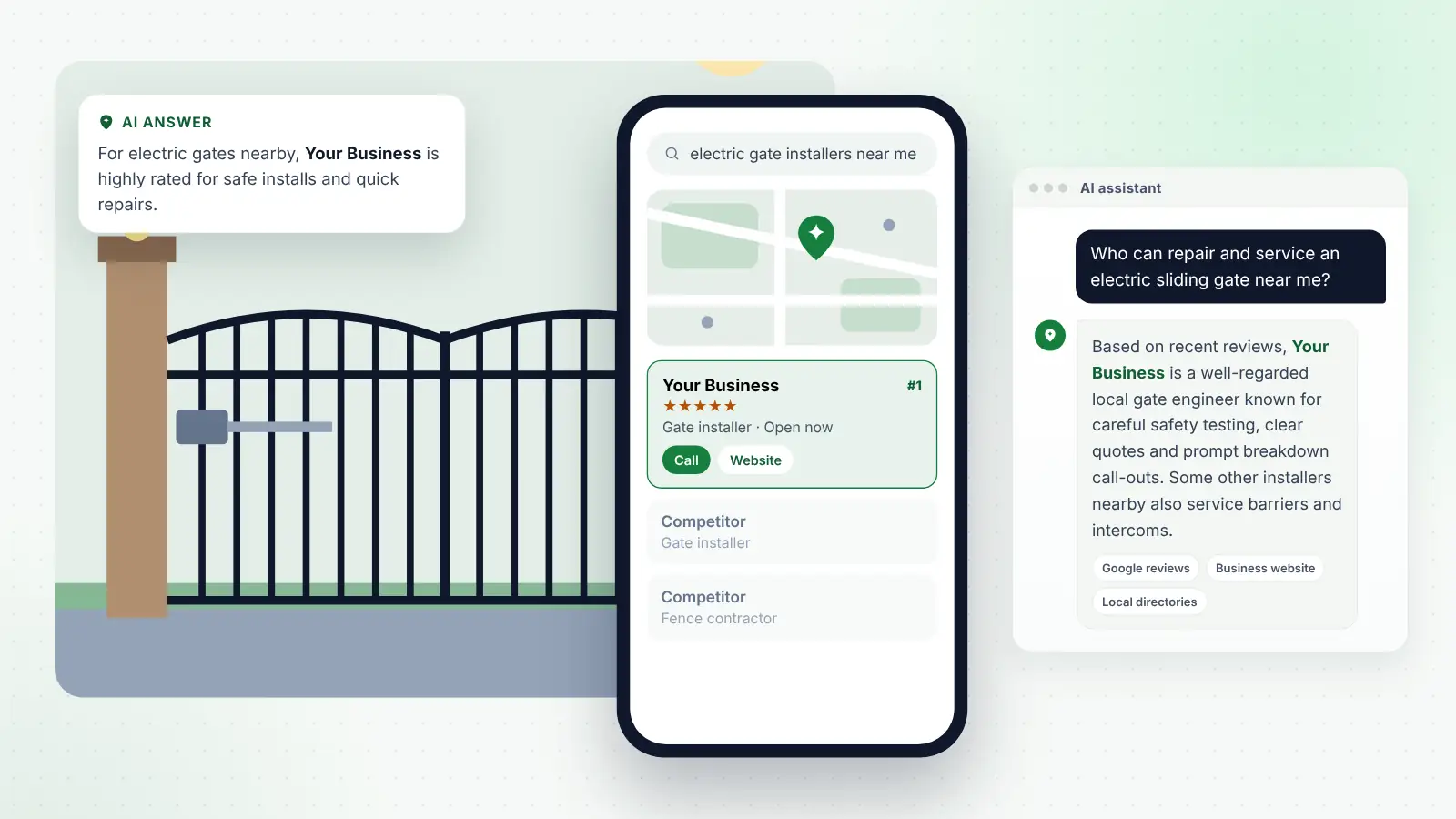
Many people now ask AI assistants such as ChatGPT, Gemini, Perplexity and Copilot, or read Google’s AI Overviews, before they contact anyone. Typical questions include “Should I get a swing or sliding electric gate?”, “How much does it cost to automate my driveway gates?”, “Are electric gates safe for children?”, “Who services electric gates near me?” and “What is the best intercom for an electric gate?”.
Asked who automates driveway gates locally, an AI assistant assembles its reply from reliable information it can find about gate firms. To be the company they mention:
- Publish clear service descriptions that say what you install, which motor brands you fit and service, and where you work.
- Answer common questions on your website in plain English: swing versus sliding, what affects the price, how often gates need servicing, what happens if the power fails, and how you test safety.
- Keep your business details consistent on every listing, so assistants can match your website, Google profile and directory entries.
- Collect detailed reviews on Google and other recognised review platforms.
- Earn mentions on reputable local and industry websites, such as trade association member listings, manufacturer installer pages and local business directories.
AI assistants tend to favour businesses that are described consistently and in detail. A company with thin pages, few reviews and conflicting phone numbers is much less likely to be recommended than one whose services, safety standards and coverage are clear everywhere.
Winning work through partnerships
Many of your best leads will come from other trades. Fencing contractors, landscapers and builders are regularly asked about automation but often do not offer it. Bespoke gate fabricators need a reliable installer to automate their gates. Electricians may want to pass on gate work they would rather not take on.
On the commercial side, managing agents, facilities management companies, housing associations and schools often look after several sites. A reliable, well-documented maintenance service at one site can lead to others. Taking over servicing of gates whose original installer has disappeared is another steady source of work, though always carry out a full safety assessment before taking responsibility for an existing system.
Tip
Keep a simple record of every gate you install or service, including the motor, control board, settings and test results. It makes repairs faster, supports maintenance renewals and shows commercial clients that you take safety seriously.
Frequently asked questions
Do I need a licence to install electric gates?
There is no specific licence, but you must be competent and comply with health and safety law and, for new installations, the Supply of Machinery (Safety) Regulations 2008. Recognised safety training, manufacturer training and electrical competence for mains work are what customers and insurers look for.
Am I the manufacturer if I only fit a motor to an existing gate?
Often, yes. HSE guidance says that converting a manual gate to automatic operation, or assembling a powered gate from components, usually makes the installer the manufacturer in law. That means a risk assessment, technical file, declaration of conformity, marking and instructions.
Are photocells enough to make a gate safe?
Usually not on their own. HSE has warned that photocells do not guarantee detection, and recommends safety edges used with force limitation as a more effective measure. The right combination depends on a risk assessment of the gate and where it is used.
How often should an electric gate be serviced?
It depends on the gate, how often it is used and the manufacturer’s instructions. Many domestic gates are serviced once a year and busy commercial gates more often. Each visit should include force testing and checks on every safety device.
Do customers need planning permission for electric gates?
Sometimes. In England, gates over 1 metre high next to a road used by vehicles, or over 2 metres elsewhere, usually need planning permission, and stricter rules can apply to listed buildings and conservation areas. Customers should check with their local council before work starts.
Next steps
Start by choosing your core market, getting proper safety and manufacturer training, and buying a calibrated force tester before your first job. Build a job file template that covers the risk assessment, technical file, test results and handover documents, so every installation is done the same way.
Then make sure customers can find you. A complete Google profile, consistent listings, detailed reviews and a website that explains your safety approach will help homeowners, managing agents and AI assistants choose you, and every installation you do well can become a maintenance customer for years to come.